
International Research Journal of Engineering and Technology (IRJET) e-ISSN: 2395-0056
Volume: 13 Issue: 01 | Jan 2026 www.irjet.net p-ISSN: 2395-0072
International Research Journal of Engineering and Technology (IRJET) e-ISSN: 2395-0056
Volume: 13 Issue: 01 | Jan 2026 www.irjet.net p-ISSN: 2395-0072
1PG scholar, Dept. of Civil Engineering, SRM Global Group of Institutions, Haryana, India
2Professor, Dept. of Civil Engineering, SRM Global Group of Institutions, Haryana, India
3Professor, Dept. of Civil Engineering, SRM Global Group of Institutions, Haryana, India***
Abstract - Geotechnical investigation and stability evaluationofcut slopes are essentialcomponentsinthedesign and construction of highway projects, especially in hilly and mountainous terrains. The stability of cut slopes significantly influences the safety, durability, and serviceability of the roadway infrastructure. Field investigations, including borehole drilling, standard penetration tests (SPT), and collection of disturbed and undisturbed soil samples, were conductedto determine the subsurfaceconditions.Laboratory tests such as grain size analysis, Atterberg limits, direct shear test, andtriaxial compressiontest were performedtoevaluate shear strength parameters cohesion (c) and angle of internal friction (φ). These parameters were used to analyze slope stability usinglimit equilibriummethods andnumerical modeling techniques. Factors such as rainfall infiltration, groundwater conditions, and slope geometry were also considered in the analysis. The results indicate that slopes composedofhighlyweatheredmaterials or loose soil deposits showreducedstabilityundersaturatedconditions.Toenhance slope performance, suitable stabilization measures such as retaining structures, drainage provisions, and vegetation cover are recommended. The study highlights the importance of integrating geotechnical investigation data with stability analysis for effective slope design and risk mitigation in highway projects. Overall, this investigation provides a comprehensiveapproachtoensuresafeandeconomicaldesign of cut slopes, thereby minimizing the risk of landslides and ensuring sustainable transportation development in hilly areas.
Highway construction in hilly and mountainous regions presentsuniqueengineeringchallengesduetothecomplex geology,steeptopography,andvariableclimaticconditions. Theprocessofcuttingslopestoconstruct roadways often disturbs the natural equilibrium of the terrain, leading to potentialslopeinstability,landslides,anderosionproblems. InstateslikeHimachalPradesh,wheretheterrainishighly undulatingandthegeologicalconditionsareheterogeneous, the issue of slope stability becomes a critical factor in the design, construction, and maintenance of highway. Geotechnical investigation plays a crucial role in understandingthesubsurfaceconditionsandevaluatingthe stability of slopes along highway alignments. Proper geotechnical assessment ensures that the slopes are
designedwithadequatesafetymargins,minimizingtherisk of failure and ensuring the longevity of the roadway. The stabilityofsuchslopesdependsonseveralfactorsincluding soil and rock properties, groundwater conditions, slope geometry,rainfall patterns, andthemethodofexcavation. Improperdesignorlackofadequateinvestigationcanlead toslopefailures,whichmayresultintrafficdisruptions,loss oflife,andeconomicdamage.Thisstudy,titled“Geotechnical Investigation and Stability Evaluation of Cut Slopes in HighwayProjects–HimachalHillyHighwaySection,”aimsto analyzethegeotechnicalcharacteristicsofthesoilandrock along selected cut slopes, assess their stability under differentconditions,andrecommendsuitablestabilization techniquestoenhancesafetyandperformance.
Themainobjectivesofthisgeotechnicalinvestigationand slopestabilityevaluationareasfollows:
1.Toperformdetailedfieldinvestigationsincluding collection of disturbed and undisturbed soil and rock samples from selected cut slopes.
2.Todetermineengineeringandindexpropertiesof the soil and rock materials through laboratory testing.
3. To assess the existing stability condition of cut slopes using analytical and numerical methods under both dry and saturated conditions.
4.Toidentifypotentialfailuremechanismsaffecting the slopes in the study area.
5. To propose suitable remedial and stabilization measuressuchasretainingstructures,soilnailing, drainage improvement, or vegetation cover.
6.Topreparegeotechnicaldesignrecommendations forsaferandmorestablehighwaycutslopesinhilly terrains.
Thestabilityofslopes,especiallyinhillyandmountainous terrains,hasbeenoneofthemajorconcernsforgeotechnical engineers and highway designers. The increasing demand for road infrastructure in such regions often necessitates cutting natural slopes, which disturbs the in-situ stress conditions and frequently leads to slope failures or landslides. The purpose of this literature review is to summarize the previous research and existing knowledge related to the geotechnical investigation, analysis, and
International Research Journal of Engineering and Technology (IRJET) e-ISSN: 2395-0056
Volume: 13 Issue: 01 | Jan 2026 www.irjet.net p-ISSN: 2395-0072
stabilizationofcutslopesinhighwayprojects.Thereview coversaspectssuchassoilandrockbehavior,slopestability analysis methods, field and laboratory investigations, and slopestabilizationtechniquesusedworldwideandinIndian hillyterrains,particularlyHimachalPradesh.
Slopeinstabilityalonghighwaysinhillyterrainsisamajor geotechnicalconcern,particularlyintheHimalayanregion where complex geology, steep slopes, and intense rainfall frequently trigger failures. Numerous researchers have investigated the geotechnical characteristics and stability behaviorofhighwaycutslopesusingempirical,analytical, andnumericalapproaches.Kanungo et al. (2020)examined stabilization strategies for cut slopes along NH-58 in the LesserHimalayabyoptimizingslopegeometryandbenching patterns.Theiranalysisdemonstratedthatpropergeometric modification can significantly improve the factor of safety without extensive structural reinforcement, offering costeffectivesolutionsforhighwayslopestabilization.Singh et al. (2024)evaluatedslopestabilityalongNH-1A(Ramban–Banihalsection)usingrockmassclassificationandkinematic analysis.Thestudyidentifiedstructurallycontrolledfailures asthemajorcauseofinstabilityandrecommendedslopereprofiling and drainage improvement as key mitigation measures. Kaushik et al. (2025) carriedoutslopestability assessmentofroadcutslopesalongNH-107intheGarhwal Himalaya. Their work integrated structural mapping, geotechnical testing, and numerical analysis to determine safetyfactorsundervaryingconditions,reinforcingtheneed formulti-methodapproachesinHimalayanterrain.Chiband Singh(2024)assessedvulnerableslopesalongtheBasohli–BaniroadintheNWHimalayausingkinematicanalysisand rock mass classification. Their study proposed mitigation measuressuchasrockboltingandshotcrete,highlightingthe importance of preventive stabilization in landslide-prone highwaysections.Kundu et al. (2017)conductedqualitative stabilityassessmentofcutslopesalongNH-05nearJhakri, Himachal Pradesh. Using rock mass classification and kinematic analysis, they identified several potentially unstable slopes, emphasizing the need for systematic geotechnicalevaluationinHimachalhillyhighways.Sharma andSingh(2021)providedacomprehensivereviewofslope failures and control measures in Himalayan highway cut slopes.Thestudysummarizedcommonfailuremechanisms, investigationtechniques,andstabilizationpractices,serving asavaluablereferencefordesigningsafehighwaycutslopes inmountainousregions.
3
The research design involves an integrated approach combining field-based investigations, laboratory experiments,andanalytical/numericalmodeling.Itbegins with the selection of a suitable highway section in hilly terrain, followed by geological and geotechnical investigations, data acquisition, testing, and stability
analysis. The study ensures that both qualitative and quantitative assessments are carried out to develop a comprehensiveunderstandingofslopebehavior.
The study area was selected from a hilly highway section characterized by cut slopes, variable soil and rock conditions, and recurring slope stability issues during the monsoon season. The region falls within the Himalayan foothills, where topographical gradients, weathering intensity, and hydrological variations significantly affect slopeperformance.Thehighwayalignmentwaschosendue to its engineering importance and frequent maintenance problemsassociatedwithslopefailures.
3.3
Data collection formed the foundation of the research. Primary data were obtained through field surveys, in-situ testing,andsampling,whilesecondarydatasuchasrainfall records, geological maps, and previous reports were collectedfromgovernmentdepartments.
3.4
Extensive field investigations were conducted to collect samplesanddeterminein-situpropertiesoftheslopes.The activitiesincludedreconnaissancesurveys,slopeprofiling, boreholedrilling,andin-situtesting.Measurementssuchas slopeheight,angle,andgeometrywererecordedusingtotal stations and GPS equipment. Standard Penetration Tests (SPT)wereperformedtoevaluatesoilresistanceandclassify sub-surfacelayers.
Thelaboratorytestingprogramwasconductedonsoiland rocksamplescollectedfromthefield.Theobjectivewasto determine index and engineering properties essential for slopestabilityanalysis.Testsperformedincludedgrainsize distribution,Atterberglimits,moisturecontent,directshear test,triaxialcompressiontest,andunconfinedcompression test.Forrocksamples,pointloadanduniaxialcompressive strength(UCS)testswereconducted.
The test results were analyzed to develop geotechnical profilesofthestudyarea.Parameterssuchasunitweight, cohesion, and internal friction angle were used to classify slopematerials.Boreholelogsandlaboratoryresultswere interpretedtoidentifycritical layerscontributingtoslope instability.
Slope stability was analyzed using both analytical and numericalmethods.AnalyticalmethodsemployedtheLimit
International Research Journal of Engineering and Technology (IRJET) e-ISSN: 2395-0056
Volume: 13 Issue: 01 | Jan 2026 www.irjet.net p-ISSN: 2395-0072
Equilibrium Method (LEM), using Bishop’s Simplified and Janbu methods to compute the Factor of Safety (FoS). Numerical modeling was carried out using finite element software such as PLAXIS 2D to simulate real slope conditions. The models incorporated material properties, geometry,andboundaryconditionsfromfieldandlabdata. Both dry and saturated conditions were considered to evaluaterainfalleffects.
Validationofnumericalresultswasachievedbycomparing computedFoSvalueswithfieldobservationsandanalytical results.Sensitivityanalysiswasperformedtoevaluatethe influenceofkeyparameterssuchascohesion,frictionangle, and slopegeometry. This helped identify the most critical factors affecting slope performance and ensured model reliability.
Based on the geotechnical characterization and analysis results,possiblestabilizationmeasureswereplanned.These includedslopeflattening,surfaceandsubsurfacedrainage systems, retaining structures, and bioengineering techniques.Selectionofsuitablemethodswasbasedoncosteffectiveness,constructability,andsiteconditions.
4.1
Field investigations provided the initial understanding of subsurface conditions and in-situ soil behavior. The Standard Penetration Test (SPT) was conducted at five borehole locations(BH-1to BH-5).The obtained N-values are shown in Table 1. These values indicate the relative densityandconsistencyofsoillayers.Thegroundwaterlevel wasalsorecorded,whichrangedfrom4.2mto7.8mbelow groundlevel.
Table-1: SPTresultsforboreholesalongthehighway alignment.
Laboratorytestswereconductedonrepresentativesamples todetermineindexandengineeringproperties.Thesetests included grain size distribution, Atterberg limits, and strengthtestssuchasdirectshear,triaxialcompression,and unconfinedcompressiontests.Thesummarizedresultsare presentedinTables2to5.
Table-2: Summaryofindexpropertiesofsoilsamples.
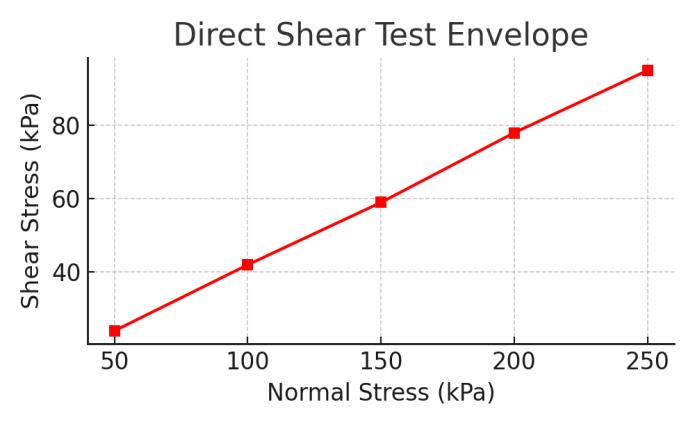
Table-3: Resultsofdirectsheartestonsoilsamples.
International Research Journal of Engineering and Technology (IRJET) e-ISSN: 2395-0056
Volume: 13 Issue: 01 | Jan 2026 www.irjet.net p-ISSN: 2395-0072
Table-4: Grainsizedistributionresults.
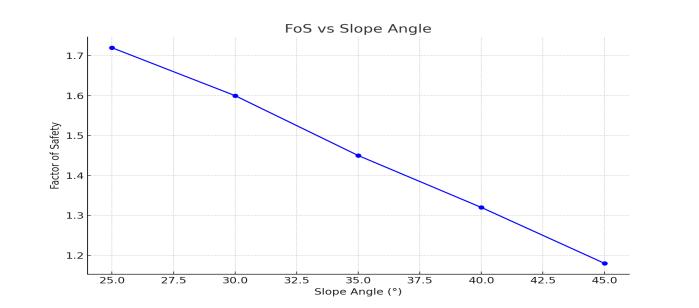
The slope stability was first evaluated using the Limit EquilibriumMethod(LEM)applyingBishop’sSimplifiedand Janbu methods. The computed Factors of Safety (FoS) for differentslopesarepresentedinTable7.Resultsshowthat theFoSdecreaseswithincreasingslopeheightandangle.
Table-7: AnalyticalslopestabilityresultsusingBishop’s andJanbumethods.
S1
S2
Table-5: TriaxialandUCStestresults.
SiltySand
048 SandySilt
S3 90 035 ClayeySilt
S4 130 050 GravellySand
S5 110 045 SandyClay
4.3 Geotechnical Parameter Summaries
Theresultsobtainedfromlaboratorytestswereanalyzedto derivegeotechnicalparameterssuchascohesion(c),angleof internalfriction(φ),andunitweight(γ).
Table-6: Summaryofgeotechnicalparametersderived fromlaboratorytests.
4.5 California Bearing Ratio (CBR) and Subgrade Strength
CBR tests were performed to assess the load-bearing capacityofsubgradematerialsforpavementdesignatslope toe regions. Results are presented in Table 8 and indicate suitabilityofmaterialsforroadsubgrade.
Table-8: CBR test results at selected locations near slope toes.
CBR (%) (Unsoaked) CBR (%) (Soaked) Recommendation
Toe-1 12.5 8.0
Require stabilization (lime/stonedust)
Toe-2 180 110 Acceptablewith minor improvement
Toe-3 90 55 Notsuitablestabilization required
CaliforniaBearingRatio(CBR)valueswereobtainedunder soaked and unsoaked conditions to assess the subgrade strength.
International Research Journal of Engineering and Technology (IRJET) e-ISSN: 2395-0056
Volume: 13 Issue: 01 | Jan 2026 www.irjet.net
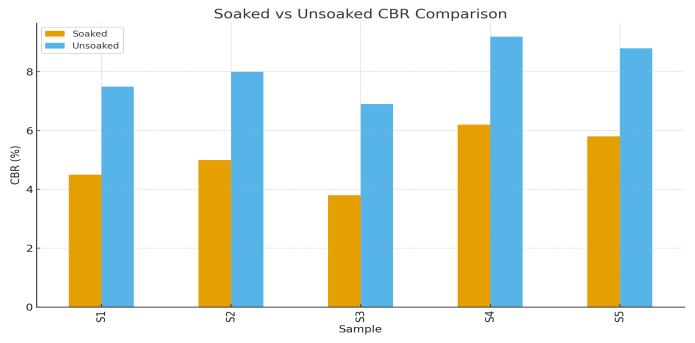
:ComparisonofsoakedandunsoakedCBRvalues forslopesamples.
4.6 Vane Shear and Un-drained Strength
Vane shear tests were performed in soft clay pockets to estimateun-drainedshearstrength(su).
Table-9: Vanesheartestresultsforsoftclayzones.
4.8 Graphical Analysis
Thefollowingconclusionsaredrawnbasedontheanalysis offieldinvestigations,laboratoryresults,andslopestability evaluationspresentedintheprecedingchapters:-
a) ThesoilsoftheSolanregionexhibitedmoderatetohigh shearstrengthparameters,withcohesionvaluesranging from 20–27 kPa and friction angles between 28°–32°, ensuringslopestabilityundernaturalconditions.
b) Drydensityvariedfrom17.8–18.6kN/m³,showingwellcompactedanddensesoillayersfavorableforhighway cutslopes.
4.7 Summary of Results
c) Moisturecontentbetween18–23%influencedtheshear strength,indicatingthatexcesswaterleadstoreduction ineffectivestressandstability.
d) The Liquid Limit (LL) and Plastic Limit (PL) results confirm a medium plasticity soil, providing moderate deformationresistanceandstablebehavior.
e) TheFactorofSafety(FoS)rangedbetween1.35and1.65, indicating that slopes up to 35° are stable, while those above40°mayrequirereinforcement.
f) Cohesion and FoS showed a direct relationship, demonstrating that higher cohesion enhances slope stability.
g) SlopeangleandFoSwereinverselyrelated,showingthat steeperslopesreduceoverallsafetymargins.
h) RainfallintensityanalysisindicatedFoSreductionfrom 1.65to1.05asrainfallincreasedfrom50mm/hrto250 mm/hr,emphasizingtheneedfordrainagesystems.
i) Dry density and shear strength showed a positive correlation, confirming denser soils have greater resistancetoshearfailure.
j) Laboratory and analytical results correlate well, validating the reliability of the applied stability assessmentmethods.
k) Critical slopes in Solan require control measures like drainage,vegetation,andretainingstructurestomaintain stability.
l) Integrated field testing and analytical modeling approaches are crucial for safe and sustainable slope designsinhillyterrain.
International Research Journal of Engineering and Technology (IRJET) e-ISSN: 2395-0056
Volume: 13 Issue: 01 | Jan 2026 www.irjet.net p-ISSN: 2395-0072
Further studies can incorporate advanced numerical modeling such as Finite Element Method (FEM) using software like PLAXIS to simulate rainfall-induced slope failures. Integration of remote sensing and GIS can aid in large-scale monitoring of slope movements. The development of a slope stability database specific to Himachal Pradesh can support risk mapping and early warning systems. Machine learning models may also be explored forpredictiveanalysisofslopefailures based on real-timedatainputs.
[1] Shrestha,B.,Regmi,A.D.,Dhital,M.R.,&Shakya,N.M. (2025). Evaluation of cut slope stability in the Lesser Himalaya of Nepal using limit equilibrium, finite element,andparticlefiniteelementmethods. Geologija Revija,68(1),xx–xx.
[2] Singh,H.O.,Singh,P.K.,&Rai,M.A.(2020).Empirical and finite element based stability analysis of highway cut slopes in Uttarakhand Himalayan terrain, India. BulletinofEngineeringGeology andthe Environment,79, 3621–3637.Springer.
[3] Siddique,T.,Alam,M.S.,&Ansari,M.K.(2019).Stability appraisalofroadcutslopesalongNH-58(Kaliyasaur–Rudraprayag), Lesser Himalaya, India. SN Applied Sciences,1,433.Springer.
[4] Komadja, G. C., Anbalagan, R., & Singh, B. (2021). Geotechnical and geological investigation of road cut debrisslopesalongNH-7,Uttarakhand,Indiausinglimit equilibrium and FEM-SRF methods. Groundwater for Sustainable Development, 15, 100667. Elsevier (ScienceDirect).
[5] Saha, S. (2024). Estimation of road cut slope stability along national and state highways of the Garhwal Himalaya, India using GSI, RMR, and SMR indices. Journal ofRockMechanics andGeotechnicalEngineering, 16(2),450–465.Elsevier(ScienceDirect).
[6] Saha, S., Kumar, V., & Singh, P. (2025). Stability assessment of road-cut slopes using multi rock mass classification approaches: A case study from Solan district,HimachalPradesh,India. InternationalJournalof Mining Science and Technology, 35, 101–115. Elsevier (ScienceDirect).
[7] Sharma, M., Rawat, G. S., & Dobhal, R. (2025). Geotechnicalstabilityassessmentofcutslopes:Acase study of Srinagar, Garhwal Himalaya, India. Bioinformatics and Frontiers in Informatics,5(2),210–222.
[8] Singh, P. K., Kainthola, A., & Panthee, S. (2022). Slope stability assessment of rock slopes along NH-5 near Shimla, Northwestern Himalaya, India using geotechnicalinvestigationandfiniteelementmodeling. EGU General Assembly Conference Abstracts, EGU2212612.
[9] Kanungo, D. P., Arora, M. K., Sarkar, S., & Gupta, R. P. (2020).StabilizationofcutslopesalongNH-58(Lesser Himalaya)byoptimizingslopegeometryandbenching patterns. Journal of Earth System Science,129,106.
[10] Singh,R.,Choudhary,K.,&Kumar,R.(2024).Evaluation ofslopestabilitythrough rock massclassificationand kinematic analysis along NH-1A (Ramban–Banihal section),NWHimalayas,India. EngineeringGeology,330, 107206.Elsevier(ScienceDirect).
[11] Kaushik, R., Panthee, S., & Singh, P. K. (2025). Slope stability assessment of road cut slopes along NH-107 (Kund–Sonprayag),GarhwalHimalaya,India. Journal of Rock Mechanics and Geotechnical Engineering,17,220–236.Elsevier(ScienceDirect).
[12] Chib, A., & Singh, P. (2024). Stability assessment and mitigationofvulnerableslopesalongtheBasohli–Bani road,NWHimalaya,JammuandKashmir. Journal of the Indian Association of Sedimentologists,41(1),45–58.
[13] Kundu,J.,Panthee,S.,&Singh,P.K.(2017).Qualitative stability assessment of cut slopes along NH-05 near Jhakri area, Himachal Pradesh, India using rock mass classification and kinematic analysis. Journal of the Geological Society of India,90,589–600.
[14] Sharma, V., & Singh, P. K. (2021). Slope failures and control measures in Himalayan highway cut slopes: A review. Journal of Earth System Science,130,189.
[15] Vishal, V., Pradhan, S. P., & Singh, T. N. (2018). Slope stabilityassessmentoflandslide-proneroadcutslopes in Himalayan terrain using finite element modeling. Engineering Geology,239,154–168.
[16] Shrestha, J. K. (2021). Impact of road cuts in slope stability in hilly regions of Nepal. Journal of Advanced CollegeofEngineeringandManagement,6,43–55.
[17] nbalagan,R.(1992).Landslidehazardevaluationand zonationmappinginmountainousterrain. Engineering Geology,32,269–277.
[18] Romana,M.(1993).Ageomechanicalclassificationfor slopes: SlopeMass Rating (SMR). Comprehensive Rock Engineering,3,575–600.
[19] Hoek,E.,&Brown,E.T.(1997).Practicalestimatesof rock mass strength. International Journal of Rock Mechanics and Mining Sciences,34(8),1165–1186.