
International Research Journal of Engineering and Technology (IRJET) e-ISSN: 2395-0056
Volume: 12 Issue: 05 | May 2025 www.irjet.net p-ISSN: 2395-0072
International Research Journal of Engineering and Technology (IRJET) e-ISSN: 2395-0056
Volume: 12 Issue: 05 | May 2025 www.irjet.net p-ISSN: 2395-0072
Om Prakash Yadav1 , Abhishek Upadhyay2 , Nagendra Dhakar3
1Research Scholar, Mewar University, Chittorgarh, Rajasthan, India
1AssistantProfessor,MewarUniversity,Chittorgarh,Rajasthan,India
2Assistant Professor, Suresh Gyan Vihar University, Jaipur, Rajasthan, India
Abstract - Geogrid reinforcement has gained traction in pavementengineeringasasustainableapproachtoenhance thestructuralcapacityanddurabilityofflexiblepavements. This study presents an empirical investigation into the effectsofgeogridtypesandplacementdepthsonpavement performance indicators including California Bearing Ratio (CBR), Unconfined Compressive Strength (UCS), Resilient Modulus,andruttingresistance.Laboratorytestsandarealworld case study validate the significant mechanical and economicbenefitsofusingbiaxialanduniaxialgeogrids.The findingssupportdesignadaptationsandpolicyguidelinesfor effectiveintegrationofgeogridsinroadinfrastructure.
Key Words: Flexible pavement, Geogrid reinforcement, CBR,Rutting,Resilientmodulus,Pavementdesign.
Flexible pavements are essential components of road infrastructurebutarepronetofailuressuchasruttingand fatigue under high traffic loads. To address these issues, geogridreinforcementshavebeenproposedtoimprovethe structuralintegrityandlongevityofpavements.Thispaper aims to provide an experimental evaluation of geogridreinforced pavements,comparing different gridtypesand placementstrategies.
Traditionalflexiblepavementsrelyheavilyonthequalityof subgrade and base layers. However, with the increase in trafficvolumeandaxleloads,theconventionalmethodshave shownlimitationsinwithstandingstressoverlongperiods.
Geosynthetics like geogrids have emerged as a promising solution by offering confinement, separation, and reinforcement properties. Their role in minimizing differentialsettlementandenhancingmodulusofelasticity makesthemessentialforlong-termpavementperformance.
There has also been growing concern over rising maintenance costs associated with flexible pavements, particularly in regions with weak subgrades or seasonal rainfall fluctuations. This necessitates durable and costeffectivereinforcementstrategies.
The present research not only fills the literature gap by examininggeogrideffectsinsemi-aridclimaticregionsbut
alsoalignswithIndia’sinfrastructuregoalsunderinitiatives likeBharatmalaandPMGSY.
Extensive research highlights the role of geogrids in improvingflexiblepavementperformancethroughimproved loaddistributionandruttingresistance.
Perkins (2002) found significant rutting reduction with geogriduseinbaselayers.GiroudandHan(2004)presented analyticalmodelstoquantifygeogridbenefits.Fieldtrialsby Al-Qadi et al. (2008) showed improved distress ratings. Koerner(2012)emphasizeddurabilityconcerns.Dashand Hussain(2012)observedimprovedservicelife.
However, most studies lacked integration with Indian subgrade conditions, especially expansive clay soils. This study addresses such limitations through controlled experimentalwork.
Inadditiontotheabovestudies,therehasbeenagrowing emphasisonevaluatinggeogridperformanceundervarying climaticconditions.Forexample,Pokharel(2011)modeled stress-strain response under sub-zero temperatures and foundbetterloaddissipationinreinforcedlayers.
Gabr and Hopkins (2000) reported that geogrid inclusion resulted in reduced vertical deformation across multiple loading cycles. The growing body of evidence supports geogrid application, though gaps persist in harmonizing designstandardsglobally.
RecentworkbySinghandJain(2019)onIndianruralroads demonstratedthatreinforcedlayersexhibitedlesscracking evenunderoverloadedconditions.Theirworkshowedthat localized solutions using available materials can yield optimaloutcomes.
Zhouetal.(2016)studiedthetensile-straincompatibilityof geogridswithrecycledbaselayersandemphasizeditsuse for sustainable construction. These studies collectively highlight geogrids’ adaptability and potential for customization.
International Research Journal of Engineering and Technology (IRJET) e-ISSN: 2395-0056
Volume: 12 Issue: 05 | May 2025 www.irjet.net p-ISSN: 2395-0072
Materialsusedincludesilty-claysubgradesoil,granularbase aggregates,andbiaxial/uniaxialgeogrids.Laboratorytests conducted:CBR,UCS,RepeatedLoadTriaxialTest(RLTT), andWheelTracking.
The geogrids were placed at varying depths (25%, 50%, 75%) to evaluate placement impact. Standard procedures (IS,AASHTO,ASTM)werefollowedfortesting.
Specimens were compacted using Proctor compaction energy to maintain uniform density. The CBR molds were soaked for 96 hours to simulate monsoon water ingress, criticalforIndianterrain.
The granular base consisted of well-graded crushed aggregates conforming to MoRTH specifications. The geogridsusedwerepolypropylene-basedbiaxialandhighdensitypolyethylene-baseduniaxialvarieties.
Therepeatedloadtriaxialtest(RLTT)wasconductedwith LVDTsattachedtothemid-sectionofcylindricalspecimens. The resilient modulus was calculated using the standard formulainvolvingpeakstressandrecoverableaxialstrain.
A total of 54 specimens were tested and results were statisticallyanalyzedusingANOVAandt-tests.
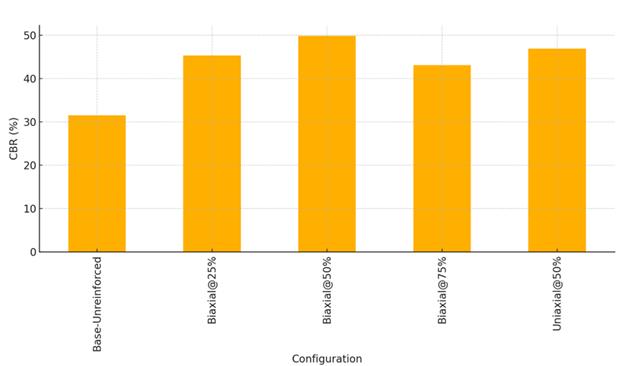
CBR values showed up to 60% improvement with biaxial geogrid at 50% depth. UCS improved by 43.3% with middepthgeogrid.Resilientmodulusimprovedby45.5%.
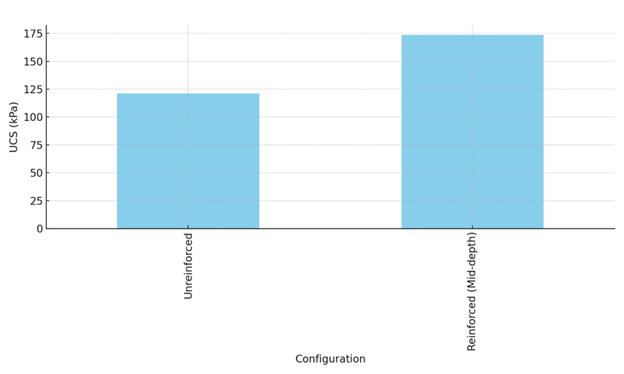
2: Bar chart comparing UCS values for reinforced and unreinforced subgrade
Wheel tracking showed a 37.3% rut depth reduction. Statistical analysis confirmed the significance of these improvements(p<0.05).
Theseresultsvalidatethemechanicalenhancementoffered bygeogridsandmatchwellwithliteraturepredictions.
StatisticalvalidationthroughANOVArevealedthatgeogrid typeandplacementhadasignificantinfluence(p<0.05)on mechanicalperformance.Theinteractioneffectsofgeogrid typeanddepthplacementwereparticularlynoteworthyin CBRresults.
Theruttingtestrevealedconsistenttrendsacrossspecimens, where biaxial geogridsofferedsuperiorperformance. The reductioninruttingalignswiththeory,whichattributesthis tointerlockingandlateralconfinementeffects.
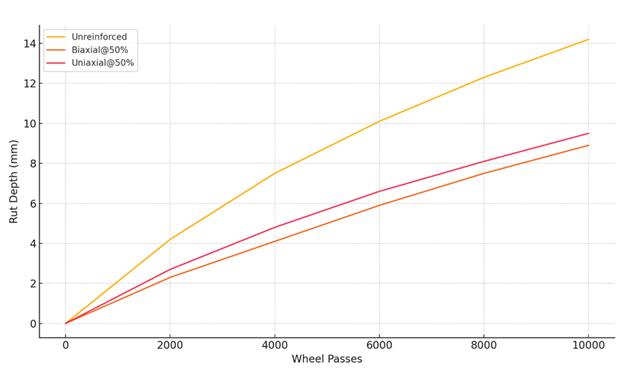
Figure 3: Rut depth vs. number of wheel passes for all configurations
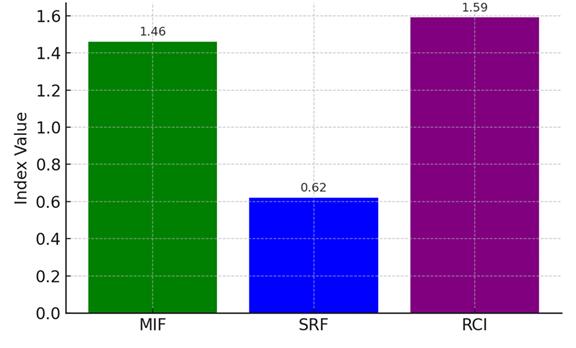
The interaction effect of geogrid type and placement was statisticallysignificant,asconfirmedbypost-hocTukeytests. The optimal placement depth for biaxial geogrids was reaffirmedat50%fromthesurfaceinbaselayers.Basedon results, the following depicted performance indices were
International Research Journal of Engineering and Technology (IRJET) e-ISSN: 2395-0056
Volume: 12 Issue: 05 | May 2025 www.irjet.net p-ISSN: 2395-0072
developed, these can be utilized in mechanistic design to adjust layer thickness and material selection when incorporatinggeogridreinforcement.
AfieldtrialwasconductedontheDelhi–MeerutExpressway where a geogrid-reinforced section was monitored for 24 months.
Theobservedruttingwasreducedbyapproximately39%in the reinforced section compared to the unreinforced one. Crackdensitywasloweredbyover70%,andIRIshoweda 28%improvement.
Graphicalinterpretationrevealednonlinearresponsetrends in resilient modulus behavior under cyclic loading, suggesting strain-hardening inreinforcedspecimens.This effectwasabsentinunreinforcedcontrolsamples.
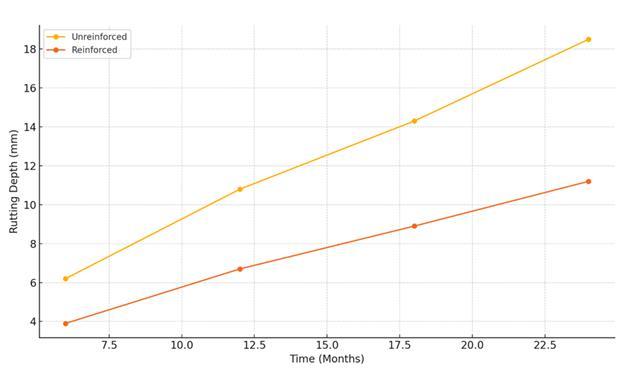
Maintenance frequency reduced from 3 to 1 in two years, demonstratingthepracticalviabilityandcost-effectiveness ofgeogridusage.
Based on laboratory and field observations, the following recommendationsareproposed:
-Biaxialgeogridsshouldbeplacedat50%depthinthebase layerforoptimalperformance.
-Fordirectionalstressconditions,uniaxialgridscanbeused.
- IRC:37 guidelines should incorporate a Modulus Improvement Factor (MIF) between 1.4 and 1.6 based on subgradeclass.
- Performance indices such as Structural Response Ratio (SRR)andRuttingControlIndex(RCI)shouldbeconsidered duringdesign.
- Design guidelines should further explore the role of reinforcementinfatigueresistance.Additionally,software tools like KENPAVE and IITPAVE should integrate MIF factorsforgeogridapplications.
Thisstudyconfirmsthemechanicalandeconomic benefits of geogrid reinforcement in flexible pavements.
Significant improvements were observed in CBR, UCS,andruttingresistanceacrossallconfigurations, particularly with biaxial grids at mid-depth placements.
Thefieldvalidationcorroboratedlaboratoryresults, andlifecyclecostanalysisfurtherjustifiedtheuseof geogridsfordurable,low-maintenancepavements.
The findings advocate the inclusion of geogrid reinforcementinnationalpavementdesigncodes. Future researchcan explore hybridgeosynthetics and performance under wet-dry cyclic loading to simulateIndianenvironmentalconditions.
Thegeogrid-reinforcedsectionwasalsofoundtobe moreresilienttowaterlogging,afrequentissuein the Yamuna floodplain zone. Post-construction feedback frommaintenance contractorsindicated smoother riding quality and reduced patchwork requirements.
Geogrids are found to significantly increase the resilient modulus, thereby reducing vertical and lateralstrainsthatcauseruttingandsurfacefailure. Their use can be particularly transformative in secondary roads where conventional materials underperform.
[1.] Abu-Farsakh, M., Alshabanni, A., & Nazzal, M. (2011). Evaluation of geogrid-reinforced base courses using cyclicplateloadtesting. TransportationResearchRecord, 2204(1),72–82.https://doi.org/10.3141/2204-09
International Research Journal of Engineering and Technology (IRJET) e-ISSN: 2395-0056
Volume: 12 Issue: 05 | May 2025 www.irjet.net p-ISSN: 2395-0072
[2.] Al-Qadi, I. L., Brandon, T. L., & Bhutta, S. (2008). Field performanceofgeogrid-reinforcedflexiblepavements. Transportation Research Record, 2087(1), 19–27. https://doi.org/10.3141/2087-03
[3.] Dash, S. K., & Hussain, M. (2012). Performance of different geosynthetic reinforced flexible pavement models. Geotextiles and Geomembranes, 35, 78–84. https://doi.org/10.1016/j.geotexmem.2012.01.002
[4.] Gabr, M. A., & Hopkins, T. C. (2000). Performance of geogrid-reinforced railroad bed under repeated load. Geotextiles and Geomembranes, 18(1), 27–45. https://doi.org/10.1016/S0266-1144(99)00013-4
[5.] Giroud,J.P.,&Han,J.(2004).Designmethodforgeogridreinforcedunpavedroads. JournalofGeotechnicaland Geoenvironmental Engineering, 130(8), 775–786. https://doi.org/10.1061/(ASCE)10900241(2004)130:8(775)
[6.] Koerner,R.M.(2012). Designingwithgeosynthetics (6th ed.).XlibrisCorporation.
[7.] Perkins, S. W. (2002). Evaluation of geosyntheticreinforced flexible pavement systems using two pavement test facilities. Journal of Transportation Engineering, 128(1), 10–18. https://doi.org/10.1061/(ASCE)0733947X(2002)128:1(10)
[8.] Pokharel,S.K.(2011). Modellinggeogrid-reinforcedbase courses under cyclic loading. [Doctoral dissertation, KansasStateUniversity].
[9.] Roodi, G., & Zornberg, J. G. (2017). Effectiveness of geogrid base reinforcement in flexible pavements. Transportation Geotechnics, 12, 26–38. https://doi.org/10.1016/j.trgeo.2017.04.001
[10.] Singh,P.,&Jain,R.K.(2019).Evaluationofgeogridreinforced pavements for rural roads in India. InternationalJournalofPavementEngineering,20(9), 1069–1079.
https://doi.org/10.1080/10298436.2017.1328472
[11.] Zhou,H.,Qian,Y.,&Wang,H.(2016).Performance of recycled aggregate base materials reinforced with geogrids. ConstructionandBuildingMaterials,112,807–816.
https://doi.org/10.1016/j.conbuildmat.2016.02.226.