
International Research Journal of Engineering and Technology (IRJET) e-ISSN: 2395-0056
Volume: 13 Issue: 04 | Apr 2026 www.irjet.net p-ISSN: 2395-0072
International Research Journal of Engineering and Technology (IRJET) e-ISSN: 2395-0056
Volume: 13 Issue: 04 | Apr 2026 www.irjet.net p-ISSN: 2395-0072
Supraja Biradar¹, Mara Archana², Pothukani Poojitha³, Kamuganti Sahitya Rao⁴, Chennupati Anirudh⁵
¹⁻⁵ Department of Computer Science and Engineering, Keshav Memorial Institute of Technology, Hyderabad, India
Under the guidance of Ms.B.Varsha Professor, Department of Computer Science and Engineering, Keshav Memorial Institute of Technology, Hyderabad, India ***
Abstract - ThispaperproposesaGeneticAlgorithm(GA)based Network Packet Analyzer for intelligent traffic monitoring and anomaly detection. Conventional packet sniffers rely on static rule-based approaches, which are inefficient in detecting evolving cyber threats. The proposed system captures network packets in real time, extracts key features, and applies evolutionary optimization to dynamically refine detection rules. A fitness function evaluates detection accuracy and minimizes false positives across generations. Experimental analysis shows improved adaptability, reduced manual intervention, and enhanced detection performance, making the system suitable for moderncybersecurityenvironments.
Key Words: Network Packet Analyzer, Genetic Algorithm, Anomaly Detection, Cybersecurity, Traffic Analysis
In the modern digital world, computer networks form the backbone of communication systems, enabling seamlessdataexchangeacrossdevicesandplatforms.With theexponentialgrowthofinternetusage,cloudcomputing, and IoT devices, monitoring and securing network traffic hasbecomeacriticalchallenge.Unauthorizedaccess,data breaches, and network inefficiencies can significantly impactsystemperformanceandsecurity,makingnetwork analysisanessentialtask.
ANetworkPacketAnalyzerisapowerfultoolused tocapture,inspect,andanalyzepacketsofdatatransmitted overa network.Itprovidesdetailedinsightsintonetwork activities by examining packet-level information such as source and destination IP addresses, protocols, ports, and payloaddata.Thishelpsinidentifyingnetworkanomalies, troubleshooting connectivity issues, and detecting potentialcyberthreats.
The main objective of this project is to develop a Network Packet Analyzer system that performs real-time packet capturing and analysis with high accuracy and efficiency.Thesystemisdesignedtomonitorlivenetwork
traffic, filter relevant packets, and present meaningful information through a structured and user-friendly interface. It enables users to observe communication patterns, detect suspicious activities, and understand protocolbehavioreffectively.
This project utilizes technologies such as Python, networking libraries (e.g., Scapy/Socket programming), andvisualizationtoolstoimplementpacketcapturingand analysis functionalities. The system can handle different types of network protocols and provides features like packet filtering, protocol identification, and traffic monitoring.
The proposed system is particularly useful for network administrators, cybersecurity analysts, and students, as it provides hands-on experience in understanding network operations and security mechanisms. By offering real-time insights and analytical capabilities,theprojectaimstoenhancenetworkvisibility, improve troubleshooting efficiency, and contribute to buildingsecureandreliablecommunicationsystems.
Several research works have been carried out in the domainof network trafficanalysisand packetsniffing toimprovenetworkmonitoring,security,andperformance analysis.
Earlystudiesfocusedontheuseofpacketsniffing tools such as Wireshark and tcpdump for capturing and analyzing network traffic. These tools allow real-time inspection of packets and provide detailed protocol-level information, making them essential for network troubleshootingandforensicanalysis.Researchshowsthat Wireshark acts as a powerful tool capable of dissecting packets and revealing protocol layers, which helps in understandingnetworkbehavioreffectively.
A comprehensive survey on packet analysis highlights its importance in network forensics, where packet-level data can be used to reconstruct network
International Research Journal of Engineering and Technology (IRJET) e-ISSN: 2395-0056
Volume: 13 Issue: 04 | Apr 2026 www.irjet.net p-ISSN: 2395-0072
activities, detect malicious behavior, and identify cyber threats. Advanced techniques such as Deep Packet Inspection (DPI) and AI-based traffic classification have been introduced to enhance the accuracy of intrusion detectionsystems.
Severalprojectshaveimplementedpacketsniffers usingPythonandlibrarieslikeScapy.Thesesystemsfocus on capturing live packets, classifying them based on protocolssuchasTCP,UDP,andICMP,andanalyzingtheir characteristics. Such implementations provide flexibility and automation in network monitoring, making them usefulforbotheducationalandprofessionalpurposes.
Recent works also integrate Python-based tools with traditional analyzers like Wireshark to build hybrid systems capable of real-time monitoring and anomaly detection. These systems enhance network security by generatingstatisticalreportsandidentifyingunusualtraffic patterns.
Comparative studies have been conducted between different network analysis tools such as Wireshark,tcpdump,andNetFlowAnalyzer.Thesestudies evaluate tools based on parameters like performance, usability, protocol support, and scalability, helping users choose appropriate solutions for specific network requirements
Furthermore, modern research emphasizes the use of machine learning and deep learning techniques in network traffic analysis. These approaches enable automated detection of anomalies, classification of traffic, and prediction of network behavior, improving the efficiency of intrusion detection systems. However, challengessuchasencryptedtrafficandhighdatavolume stillremainsignificantissuesinthisdomain.
Overall, the existing literature demonstrates that whilemanypowerfultoolsandtechniquesareavailablefor networkpacketanalysis,thereisstillaneedforlightweight, customizable, and user-friendly systems. The proposed project aims to address these gaps by developing an efficient Network Packet Analyzer with real-time monitoringandsimplifiedvisualizationfeatures.
In modern computer networks, the rapid increaseindata transmissionandconnected devices has made network monitoring and security a challengingtask.Organizationsandindividualsoften face difficulties in understanding network behavior, identifying performance issues, and detecting malicious activities due to the lack of efficient
monitoringtools.Existingnetworkanalysistoolssuch as Wireshark and tcpdump, although powerful, are often complex, resource-intensive, and require advancedtechnicalexpertisetooperateeffectively.
Moreover,manyavailabletoolsdonotprovide simplified visualization or user-friendly interfaces, making them less accessible for students and beginner-level users. In addition, real-time monitoring and filtering of relevant packets in a customizablemannerremainsachallengeinexisting systems. The increasing threats of cyber-attacks, unauthorized access, and data breaches further emphasize the need for efficient and easy-to-use packetanalysissystems.
Therefore, there is a need to develop a lightweight, user-friendly, and efficient Network PacketAnalyzerthatcancaptureandanalyzepackets inrealtime,providemeaningfulinsightsintonetwork traffic, and assist users in identifying anomalies and security threats. The system should be capable of simplifying packet analysis while maintaining accuracy and performance, thereby making network monitoringmoreaccessibleandeffective.
The proposed system aims to design and developanefficientanduser-friendlyNetworkPacket Analyzer that enables real-time monitoring, capturing,andanalysisofnetworktraffic.Thesystem focuses on simplifying packet-level analysis while maintainingaccuracy,performance,andusabilityfor bothbeginnersandadvancedusers.
The system is built using Python and utilizes networking libraries such as Scapy and socket programming to capture live network packets. It continuously monitors network interfaces and extractsrelevantpacketinformationincludingsource IPaddress,destinationIPaddress,protocoltype,port numbers,andpacketsize.
Theproposedsystemincorporatesafiltering mechanismthatallowsuserstoanalyzespecifictypes ofpacketsbasedonprotocolssuchasTCP,UDP,and ICMP. This selective filtering helps in reducing unnecessary data processing and enables focused analysis of network traffic. Additionally, the system categorizes packets based on protocols, making it easiertounderstandcommunicationpatterns.
International Research Journal of Engineering and Technology (IRJET) e-ISSN: 2395-0056
Volume: 13 Issue: 04 | Apr 2026 www.irjet.net p-ISSN: 2395-0072
Auser-friendlyinterfaceisdesignedtodisplay captured packet data in a structured format. The interface presents real-time packet logs and may include basic visualization features such as tables or charts to enhance readability. This overcomes the complexity of traditional tools like Wireshark by providingasimplifiedandaccessibleplatform.
The system also includes basic anomaly detection capabilities by identifying unusual traffic patterns such as abnormal packet flow or unknown protocols. This feature assists users in detecting potential security threats and unauthorized access attempts.
Furthermore, the proposed system is lightweight and customizable, allowing users to extenditsfunctionalitybasedontheirrequirements. It is particularly beneficial for educational purposes, helping students understand network protocols and packetstructuresthroughhands-onexperience.
Overall, the proposed Network Packet Analyzer provides a balance between functionality andsimplicity,offeringreal-timemonitoring,efficient packet filtering, and clear data representation, thereby improving network visibility and security awareness.
The methodology of the proposed Network Packet Analyzer describes the systematic approach followed to capture, process, and analyze network packets in real time. The system is designed in modularstepstoensureefficiency,accuracy,andease ofimplementation.
Thefirststepinvolvescapturinglivenetwork packets from the selected network interface. This is achieved using Python-based networking libraries suchasScapy,whichenableslow-levelpacketsniffing. The system continuously listens to incoming and outgoing packets and collects raw data for further processing.
Oncepacketsarecaptured,theyareprocessed toextractessentialinformationsuchas:
• SourceIPaddress
• DestinationIPaddress
• Protocoltype(TCP,UDP,ICMP)
• Portnumbers
• Packetsize
Thisstepconverts rawpacketdata into astructured formatthatcanbeeasilyanalyzed.
To improve efficiency and relevance, the systemappliesfilteringtechniques.Userscanspecify conditions to capture only specific packets based on protocols or IP addresses. This reduces unnecessary dataandfocusesonmeaningfultrafficanalysis.
Captured packets are categorized based on theirprotocoltypessuchasTCP,UDP,andICMP.This classificationhelps inunderstandingcommunication patternsandnetworkbehaviormoreeffectively.
5.5
Theprocessedandclassifieddataisanalyzed toidentifypatterns,anomalies,andunusualactivities. Basicanalysisincludes:
• Monitoringtrafficflow
• Detectingabnormalpacketrates
• Identifyingunknownorsuspiciouspackets
This step helps in recognizing potential network issuesorsecuritythreats.
The analyzed data is presented through a user-friendlyinterface.Packetdetailsaredisplayedin a structured format such as tables or simple charts, makingiteasyforuserstointerprettheresults.This simplifiescomplexdatacomparedtotraditionaltools likeWireshark.
International Research Journal of Engineering and Technology (IRJET) e-ISSN: 2395-0056
Volume: 13 Issue: 04 | Apr 2026 www.irjet.net p-ISSN: 2395-0072
The proposed system incorporates a Genetic Algorithm (GA) to enhance anomaly detection in network traffic. GA is an evolutionary optimization technique inspiredbynaturalselection.Inthissystem,networktraffic features such as packet rate, protocol distribution, and packetsizeareusedasinputparameters.
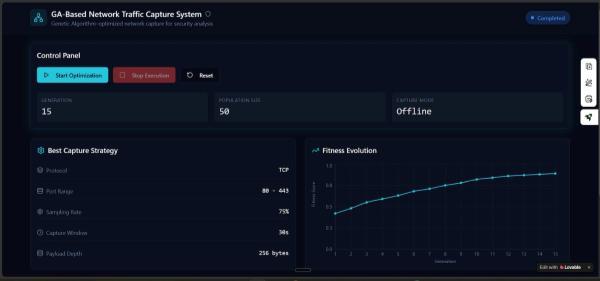
Initially, a population of possible solutions is generated randomly. Each solution (chromosome) representsasetofdetectionrules.Afitnessfunctionisused toevaluatetheaccuracyofanomalydetectionandminimize falsepositives.Basedonfitnessvalues,selection,crossover, and mutation operations are performed to generate new populations. This iterative process continues until an optimal solution is obtained, enabling efficient and adaptivedetectionofsuspiciousnetworkbehavior.
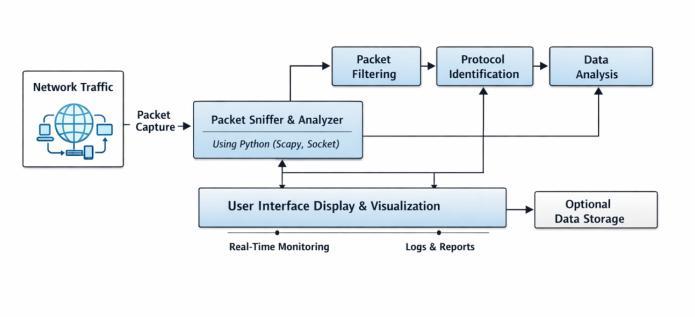
The system architecture of the Network Packet Analyzer shows the process of capturing, processing, and analyzing network traffic. Packets are captured using Scapy, followed by extraction of important details and filteringbasedonuserrequirements.Thesystemclassifies packets into protocols such as TCP, UDP, and ICMP and performs traffic analysis to detect anomalies. The results are displayed through a user-friendly interface, with optionalstorageforlogsandreports.
The performance ofthe Network PacketAnalyzer is evaluated using basic network metrics such as Packet Capture Rate and Throughput, which measure the efficiencyofpacketcapturinganddatatransmission.
PCR=N/T,
Throughput=S/T
Additionally, a Genetic Algorithm is used for anomalydetection,whereeachsolutionisevaluatedusing afitnessfunctiontoimprovedetectionaccuracyandreduce falsepositives.
Fitness=TP/(TP+FP)
The proposed Network Packet Analyzer system was successfully implemented and tested in a real-time network environment. The system was able to capture, process, and analyze network packets efficiently using Scapy. The results demonstrate the effectiveness of the systeminmonitoringnetworktrafficandidentifyinguseful informationfromcapturedpackets.
Duringexecution,thesystemcapturedlivepackets fromthenetworkinterfaceanddisplayedkeydetailssuch assourceIPaddress,destinationIPaddress,protocoltype, portnumbers,andpacketsize.Thepacketfilteringfeature allowedselectiveanalysisofspecificprotocolssuchasTCP, UDP,andICMP,reducingunnecessarydataandimproving performance.
The protocol classification module accurately categorized packets based on their types, enabling better understandingofcommunicationpatterns.Thesystemalso monitored packet flow and identified unusual traffic conditions,whichcanindicatepotentialsecuritythreatsor anomaliesinthenetwork.
TheintegrationoftheGeneticAlgorithmimproved anomaly detection accuracy and reduced false positives compared to basic rule-based analysis. This enhancement enabled the system to adapt dynamically to varying networkconditionsandidentifycomplexpatternsintraffic behaviormoreeffectively.
Theuserinterfacedisplayedtheanalyzeddataina structuredandreadableformat,makingiteasierforusers to interpret network behavior. Compared to traditional tools like Wireshark, the proposed system provides a simplified and lightweight solution suitable for beginners andeducationalpurposes.
The performance of the system was evaluated based on parameters such as packet capture rate, throughput,andresponsetime.Theresultsshowedthatthe system performs efficiently with minimal delay and providesaccurate real-timeanalysis.The optional storage featurealsoenabledsavingpacketlogsforfuturereference andanalysis.
International Research Journal of Engineering and Technology (IRJET) e-ISSN: 2395-0056
Volume: 13 Issue: 04 | Apr 2026 www.irjet.net p-ISSN: 2395-0072
Overall, the results confirm that the proposed system effectively captures and analyzes network traffic, improvesvisibilityintonetworkoperations,andassistsin detecting anomalies. The system achieves the objective of providingauser-friendlyandefficientpacketanalysistool.
The proposed Network Packet Analyzer system wassuccessfullydevelopedtocaptureandanalyzenetwork trafficinrealtime.ThesystemeffectivelyextractspacketlevelinformationsuchasIPaddresses,protocols,andport numbersusingScapy.Itprovides auser-friendlyinterface for monitoring and understanding network behavior. The filteringandprotocolclassificationfeaturesenableefficient and focused analysis of network traffic. The system also helps in identifying anomalies and potential security threats. The use of Genetic Algorithm enhances the system’sabilitytodetectanomaliesintelligentlyandadapt to dynamic network conditions. Overall, the project achieves its objective of providing a simple, lightweight, andeffectivenetworkanalysistool.
The proposed Network Packet Analyzer can be further enhanced by integrating machine learning techniquesforadvancedanomalydetectionandautomated threatidentification.Supportforencryptedtrafficanalysis can be added to handle modern secure communication protocols. The system can be improved with interactive dashboards and graphical visualizations for better understanding of network patterns. Additionally, cloud storage integration can be implemented to manage largescale packet data efficiently. The analyzer can also be extended to support distributed network monitoring across multiple devices. Furthermore, deploying the system as a web or mobile application can increase accessibilityandusability.Theseimprovementswillmake the system more robust and suitable for real-world applications.
[1]N.MoustafaandJ.Slay,“UNSW-NB15:AComprehensive DataSetforNetworkIntrusionDetectionSystems,”inProc. Military Communications and Information Systems Conference(MilCIS),2019.
[2]I.Goodfellow,Y.Bengio,andA.Courville,DeepLearning. Cambridge,MA,USA:MITPress,2021.
[3] S. Shone, T. N. Ngoc, V. D. Phai, and Q. Shi, “A Deep LearningApproachtoNetwork IntrusionDetection,”IEEE Trans.EmergingTopicsinComputationalIntelligence,vol. 4,no.2,pp.123–134,2020.
[4] D. E. Goldberg, Genetic Algorithms in Search, Optimization and Machine Learning. Boston, MA, USA: Addison-Wesley,2020.
[5] X.-S. Yang, Nature-Inspired Optimization Algorithms. Amsterdam,Netherlands:Elsevier,2020.
[6] Wireshark Foundation, “Wireshark User Guide,” 2023. [Online].Available:https://www.wireshark.org/docs/
[7] Scapy Documentation, “Scapy: Packet Manipulation Tool,”2024.[Online].Available:https://scapy.net/
[8]“Network Intrusion DetectionUsingMachineLearning Techniques,” IEEE Access, vol. 10, pp. 102345–102360, 2022.
[9] “Hybrid Genetic Algorithm for Intrusion Detection Systems,” Journal of Network and Systems Management, Springer,2023.
[10] “An Intelligent Network Traffic Monitoring System UsingAI,”ComputerNetworks,Elsevier,vol.235,2024.
[11] “Real-Time Network Anomaly Detection Using Deep Learning,” IEEE Trans. Network Science and Engineering, 2023.
[12] “Adaptive Intrusion Detection Using Evolutionary Algorithms,”ACMComputingSurveys,2024.