
International Research Journal of Engineering and Technology (IRJET) e-ISSN: 2395-0056
Volume: 13 Issue: 04 | Apr 2026 www.irjet.net p-ISSN: 2395-0072

International Research Journal of Engineering and Technology (IRJET) e-ISSN: 2395-0056
Volume: 13 Issue: 04 | Apr 2026 www.irjet.net p-ISSN: 2395-0072
Diksha Sagotra1 , Ravinder Kaur2
1Assistant Professor, Dept. of CSE, SBSSU Gurdaspur,Punjab,India
2Assistant Professor, Dept. of CSE, SBSSU Gurdaspur,Punjab,India
Abstract - Generative Artificial Intelligence (GenAI) has emerged as a transformative paradigm in medical diagnosis, offeringnovelapproachestodatasynthesis,diseasedetection, and clinical decision support. Unlike traditional machine learning methods, generative models such as Generative Adversarial Networks (GANs), Variational Autoencoders (VAEs), diffusion models, and large language models (LLMs) can learn complex data distributions and generate realistic medicaldata,includingimages,clinicalreports,andsynthetic patientrecords.Recentadvancementsbetween2020and2026 demonstrate that GenAI enhances diagnostic accuracy, improves data augmentation, and supports multimodal analysis integrating imaging, genomic, and clinical data. Studies indicate that generative AI contributes to improved diagnostic workflows, particularly in radiology, cardiology, and oncology, where data scarcity and imbalance are significant challenges. Furthermore, generative models facilitateearlydiseasedetectionandpredictivediagnosticsby modelingdiseaseprogressionpatterns.Despiteitsadvantages, challenges such as ethical concerns, data privacy, model interpretability, and clinical validation remain critical barriers to widespread adoption. Meta-analyses reveal that while generative AI demonstrates promising diagnostic capabilities, it has not yet consistently surpassed expert clinicians,emphasizingtheneedforhybridhuman-AIsystems. This paper provides a comprehensive overview of generative AI in medical diagnosis, covering its introduction, literature survey, problem definition, methodology, and future implications. The study highlights the potential of generative AI to revolutionize healthcare by enabling personalized medicine, reducing diagnostic errors, and improving healthcareaccessibility,whilealsoaddressingthelimitations that must be overcome for safe and effective deployment.
Key Words: Generative Artificial Intelligence, Medical Diagnosis, GANs, Deep Learning, Healthcare Analytics, Synthetic Data, Disease Detection
TheintegrationofArtificialIntelligence(AI)intohealthcare hassignificantlytransformeddiagnosticprocesses,enabling faster, more accurate, and data-driven decision-making. Among the various AI paradigms, Generative Artificial Intelligencehasgainedsubstantialattentionduetoitsability to generate new data samples that closely resemble realworld medical data.GenerativeAI encompassesadvanced models such as GANs, VAEs, diffusion models, and transformer-basedarchitecturesthatlearnunderlyingdata
distributions and produce realistic outputs. These capabilitiesareparticularlybeneficialinmedicaldiagnosis, wherehigh-qualitylabeleddataisoftenlimited,expensive, andsensitive.
RecentstudieshighlightthatgenerativeAIisrevolutionizing healthcarebyenhancingdiagnosis,treatmentplanning,and patientcarethroughadvanceddatamodelingandsynthesis techniques . The increasing adoption of multimodal AI systems,whichcombineimaging,textual,andgenomicdata, hasfurtherimproveddiagnosticperformancebyprovidinga comprehensive understanding of patient conditions . For instance, generative AI models can reconstruct missing medical images, simulate disease progression, and assist cliniciansininterpretingcomplexdiagnosticdata.
Moreover,generativeAIhasdemonstrateditseffectiveness inaddressingkeychallengesinmedicaldiagnosis,suchas data scarcity, class imbalance, and privacy concerns. By generatingsyntheticdatasets,these modelsenablerobust trainingofdiagnosticsystemswithoutcompromisingpatient confidentiality.Accordingtorecentfindings,generativeAIis widelyusedinradiology,cardiology,andotherdomainsfor disease detection, screening, and diagnostic support . Additionally, generative AI contributes to predictive healthcare by analyzing historical patient data to forecast diseaserisksandoutcomes.
However, despite these advancements, the integration of generativeAIintoclinicalpracticeisstillinitsearlystages. Issuessuchasmodelinterpretability,ethicalconsiderations, and regulatory compliance pose significant challenges. Studies emphasize that while generative AI can enhance diagnosticaccuracy,itshouldbeusedasasupportivetool ratherthanareplacementforhumanexpertise.Therefore, thereisaneedforcomprehensiveresearchtoexplorethe potential and limitations of generative AI in medical diagnosis.
The literature on generative AI in medical diagnosis has expanded rapidly between 2020 and 2026, reflecting the growinginterestinthisdomain.Earlystudiesfocusedonthe application of GANs for medical image generation and enhancement. These models demonstrated the ability to produce high-quality synthetic images, improving the performance of diagnostic systems trained on limited datasets. Recent research highlights that GAN-based
International Research Journal of Engineering and Technology (IRJET) e-ISSN: 2395-0056
Volume: 13 Issue: 04 | Apr 2026 www.irjet.net p-ISSN: 2395-0072
approachesdominatethefield,accountingforasignificant portionofgenerativeAIapplicationsinmedicalimaging. Subsequent advancements introduced VAEs and diffusion models, which improved image quality and stability comparedtoGANs.Thesemodelshavebeenwidelyusedfor anomaly detection, image reconstruction, and disease classification. For example, diffusion models have shown superiorperformanceingeneratinghigh-resolutionmedical images,enablingmoreaccuratediagnosisofconditionssuch ascancerandneurologicaldisorders. Recentsystematicreviewsemphasizetheroleofgenerative AI in improving diagnostic accuracy and clinical decisionmaking.Acomprehensiveanalysisof161studiesrevealed thatgenerativeAIisincreasinglyusedfordiseasedetection, diagnosis, and screening, particularly in radiology and cardiology.Furthermore,generativeAIhasbeenappliedin genomicanalysis,wheretransformer-basedmodelsassistin identifyinggeneticvariationsandpredictingdiseaserisks. A2025meta-analysisevaluatinggenerativeAImodels for diagnostictasksreportedanaveragediagnosticaccuracyof 52.1%, highlighting both the potential and limitations of these systems . The study also emphasized the need for comparativeanalysiswithhumanclinicianstoassessrealworld applicability. Similarly,recent reviewsindicate that whilegenerativeAIenhancesdiagnosticcapabilities,ithas notyetachievedexpert-levelreliability. Inadditiontodiagnosticapplications,generativeAIhasbeen usedforclinicaldocumentation,patientcommunication,and medicaleducation.Largelanguagemodelsenableautomated report generation and assist clinicians in decision-making processes.However,studiesalsohighlightconcernsrelated todataprivacy,bias,andethicalimplications,whichmustbe addressedtoensuresafedeployment.
Medical diagnosis faces several challenges that limit the effectiveness of traditional AI and machine learning approaches.Oneoftheprimaryissuesisthescarcityofhighqualitylabeledmedicaldata,whichisessentialfortraining accurate diagnostic models. Medical datasets are often limitedduetoprivacyconcerns,highannotationcosts,and the complexity of data collection processes. Additionally, classimbalanceinmedicaldatasets,wherecertaindiseases areunderrepresented,leadstobiasedmodelsandreduced diagnosticaccuracy.
Anothersignificantchallengeistheheterogeneityofmedical data,whichincludesimaging,clinicalrecords,genomicdata, and sensor data. Traditional models struggle to integrate these diverse data types, resulting in incomplete analysis andsuboptimaldiagnosticoutcomes.Furthermore,existing diagnostic systems often lack interpretability, making it difficultforclinicianstotrustandadoptAI-basedsolutions. Generative AI addresses some of these challenges by enabling synthetic data generation, multimodal data integration,andimprovedfeaturerepresentation.However, severalissuesremainunresolved.Theseincludetheriskof
generating inaccurate or misleading data, lack of standardized evaluation metrics, and limited clinical validation. Moreover, ethical concerns related to data privacy,bias,andaccountabilityposesignificantbarriersto theadoptionofgenerativeAIinhealthcare.
Therefore, the key problem addressed in this study is to explore how generative AI can be effectively utilized to enhancemedicaldiagnosiswhileaddressingthechallenges ofdatascarcity,heterogeneity,andreliability.Theobjective istodeveloparobustframeworkthatleveragesgenerative modelstoimprovediagnosticaccuracyandsupportclinical decision-making.
TheproposedmethodologyforimplementinggenerativeAI inmedicaldiagnosisconsistsofseveralstages,integrating dataprocessing,modeldevelopment,andevaluation.
The first stage involves data collection from multiple sources,includingmedicalimagingdatasetssuchasMRI,CT scans,andX-rays,aswell aselectronichealthrecordsand genomic data. These datasets are preprocessed through normalization,noisereduction,andanonymizationtoensure dataqualityandprivacy.
In the second stage, feature extraction techniques are applied to identify relevant patterns in the data. Deep learning models such as convolutional neural networks (CNNs) are used for image-based features, while transformer-based models are employed for textual and sequentialdata.
The third stage involves the selection and training of generativemodels.GANsareusedforimagesynthesisand augmentation, VAEs for anomaly detection, and diffusion models for high-quality image generation. These models learntheunderlyingdatadistributionandgeneratesynthetic samplesthatenhancethetrainingdataset.
The fourth stage focuses on model integration and multimodal analysis. Data from different sources are combined to create a unified representation, enabling comprehensive diagnostic analysis. This stage leverages multimodal AI techniques to improve the accuracy and robustnessofthediagnosticsystem.
Thefifthstageinvolvesmodelevaluationusingperformance metricssuchasaccuracy,sensitivity,specificity,precision, recall,andF1-score.Cross-validationtechniquesareusedto ensurethereliabilityofthemodel.
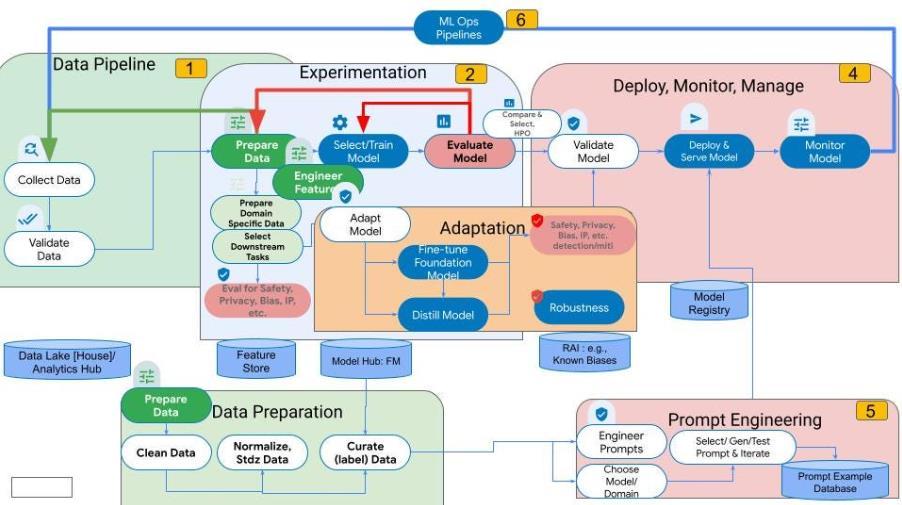
Finally, the system is deployed in a clinical environment, where it assists healthcare professionals in diagnosis and decision-making. Continuous monitoring and feedback mechanisms are implemented to improve model performanceovertime.Themethodologyisgiveninfigure1
International Research Journal of Engineering and Technology (IRJET) e-ISSN: 2395-0056
Volume: 13 Issue: 04 | Apr 2026 www.irjet.net p-ISSN: 2395-0072
5. CONCLUSION
Generative AI represents a significant advancement in medical diagnosis, offering innovative solutions to longstanding challenges in healthcare. By enabling data synthesis, improving diagnostic accuracy, and supporting multimodal analysis, generative AI has the potential to transformclinicalpractice.Recentstudiesdemonstrateits effectivenessindiseasedetection,predictiveanalytics,and personalized medicine, highlighting its role in improving patientoutcomes. However, the adoption of generative AI in healthcare requires careful consideration of ethical, technical, and regulatory challenges. Issues such as data privacy, model interpretability,andclinicalvalidationmustbeaddressedto ensure safe and effective implementation. Furthermore, collaboration between AI researchers, healthcare professionals, and policymakers is essential to develop robustandtrustworthyAIsystems. Inconclusion,whilegenerativeAIisnotyetareplacement for human expertise, it serves as a powerful tool that can augment clinical decision-making and enhance diagnostic processes.Futureresearchshouldfocusonimprovingmodel reliability, integrating explainable AI techniques, and establishing standardized evaluation frameworks to facilitate the widespread adoption of generative AI in medicaldiagnosis.
1. Bhuyan, S. S., et al. (2025). Generative Artificial IntelligenceUseinHealthcare.PMC.
2. Rouzrokh, P., et al. (2025). A Current Review of GenerativeAIinMedicine.PMC.
3. Wang, S., et al. (2025). Generative AI in Medical Imaging.PMC.
4. Takita,H.,etal.(2025).DiagnosticPerformanceof GenerativeAI:Meta-analysis.
5. Ratnam, K. K. Y., et al. (2025). Generative AI in PublicHealthResearch.
6. Rabbani, S. A., et al. (2025). Generative AI in HealthcareApplications.
7. Abbasi,N.,etal.(2024).GenerativeAIinHealthcare: RevolutionizingSystems.
8. Yim, D., et al. (2024). Preliminary Evidence of GenerativeAIinClinicalPractice.
9. Moulaei, K., et al. (2024). Generative AI in Healthcare:ApplicationsandChallenges.
10. Chen, Y., et al. (2024). Generative AI in Medical Practice.
11. Reddy,S.,etal.(2024).GenerativeAIinHealthcare Implementation.
12. Howell, M. D., et al. (2024). Generative AI and PatientSafety.
13. Alshanbari, A. H., et al. (2025). Generative AI for DiagnosticMedicalImaging.
14. Fahrner, L. J., et al. (2025). Generative Era of MedicalAI.
15. Karmakar,A.,etal.(2025).RoleofGenerativeAIin ImageSynthesis.