
International Research Journal of Engineering and Technology (IRJET) e-ISSN: 2395-0056
Volume: 13 Issue: 02 | Feb 2026 www.irjet.net p-ISSN: 2395-0072
International Research Journal of Engineering and Technology (IRJET) e-ISSN: 2395-0056
Volume: 13 Issue: 02 | Feb 2026 www.irjet.net p-ISSN: 2395-0072
Dr.S. Parthasarathy1, P. M.Thiravidan2, G. Jayasuriya3 , M.K.Vishwaraj4 , E.Sundara Vignesh5 , DR. A. ASKARUNISA6, R. Thangasankaran7
1 Professor, EEE Dept, Director - KLN.IRP, K.L.N. College of Engineering, Sivagangai, Tamil Nadu, India 2,3,4,5 UG Scholar, CSE Dept, K.L.N. College of Engineering, Sivagangai, Tamil Nadu, India
6 Professor & Head of Department, CSE Dept, K.L.N. College of Engineering, Sivagangai, Tamil Nadu, India 7 AP/EEE Dept, KLN.IRP Coordinator, K.L.N. College of Engineering, Sivagangai, Tamil Nadu, India
Abstract: G-FACE (Geo-Fencing and Face Authentication for Contactless Entry) is a App-based attendance management system designed to eliminate manual attendance issues such as proxy entries, inaccuracies, and administrative overhead in educational institutions. The system enables location-restricted attendance marking using geo-fencing and verifies user identity through face authentication to ensure secure and reliable tracking. Developedusing React.js with Supabase asthebackend, GFACE provides real-time attendance recording, secure data storage, and instant access for administrators. The system supports flexible schedules, multi-location tracking, and automated report generation, improving transparency, efficiency,andoverallreliabilityofattendancemanagement
Keywords : Geo-Fencing, Face Authentication, Contactless Attendance System, React.js, Supabas), Real-Time Attendance Tracking, Secure Data Storage, Automated Report Generation, Multi-Location Attendance
The rapid digital transformation of educational institutions has increased the need for automated and reliable attendance management systems. Traditional methods such as manual registers or basic digital checkins often suffer from issues like proxy attendance, data inaccuracies, and increased administrative workload. These limitations reduce the credibility of attendance recordsandhinderefficientacademicadministration.
To address these challenges, modern attendance systems integrate location-based verification and biometric authentication techniques. Geo-fencing restricts attendance marking to predefined physical locations such as classrooms or campuses, while face authentication verifies user identity before recording attendance. This dual-verificationapproachsignificantlyimprovesaccuracy, prevents fraudulent entries, and enhances overall system security. The proposed G-FACE (Geo-Fencing and Face Authentication for Contactless Entry) system leverages thesetechnologiestoprovideafullyautomated,app-based attendance solution. Developed using React.js with Supabase as the backend, the system enables real-time
attendance recording, secure cloud-based data storage, and instant access for administrators. Attendance is marked only when users are within the authorized geofenced area and successfully complete facial authentication.
Furthermore, G-FACE supports flexible schedules, multilocation attendance tracking, and automated report generation, making it suitable for modern academic environments. By minimizing manual intervention and ensuring transparent, real-time data management, the system improves operational efficiency, reliability, and trustinattendancemonitoring.
The objective of the proposed G-FACE (Geo-Fencing and Face Authentication for Contactless Entry) system is to provide a secure, automated, and reliable attendance management solution for educational institutions. The methodology follows a structured, role-based workflow that ensures accuracy, transparency, and accountability in attendance tracking. The system is developed as an appbased solution using React.js for the frontend and Supabase for backend services, including authentication, databasemanagement,andreal-timedatahandling..
The system defines distinct user roles such as Students, Faculty,andAdministrators,eachhavingrole-basedaccess privileges. Students can log into the application and initiateattendance marking only when they are physically present within a predefined geo-fenced location. The system continuously validates the user’s geographic coordinates against authorized boundaries before enabling the attendance option. This location-based verification ensures that attendance cannot be marked fromunauthorizedorremotelocations.
Once inside the geo-fenced area, the user undergoes face authentication to verify identity. Only after successful facial verification is the user allowed to mark attendance using IN and OUT actions, which accurately record entry and exit times. If face authentication fails or the user moves outside the geo-fenced area, the system restricts attendance marking. All attendance records are stored
International Research Journal of Engineering and Technology (IRJET)
-ISSN: 2395-0056
Volume: 13 Issue: 02 | Feb 2026 www.irjet.net p-ISSN: 2395-0072
securely in the cloud-based Supabase database and updatedinrealtime.Administratorsandfacultymembers can access attendance data through a dashboard that supports real-time monitoring, multi-location management, and automated report generation. The system also allows manual enablement of attendance for specialschedulesorirregularsessions.Byintegratinggeofencing, facial authentication, and role-based access control, the G-FACE methodology minimizes manual intervention, prevents proxy attendance, and ensures efficientandtransparentattendancemanagement.
The process flow of the G-FACE (Geo-Fencing and Face Authentication for Contactless Entry) system ensures secure and automated attendance tracking in educational institutions. The workflow begins when a student opens theG-FACEReactapplication.Thestudentmustthenlogin or register through Supabase, which handles authenticationandrole-basedaccesscontrol.
After logging in, the system checks the user’s current locationusinggeo-fencingvalidationtoverifywhetherthe student is within the authorized attendance zone. If the student is outside the designated zone, attendance marking is restricted. If the student is inside the geofenced area, the system initiates face authentication using the device camera, and the result is verified through Supabase
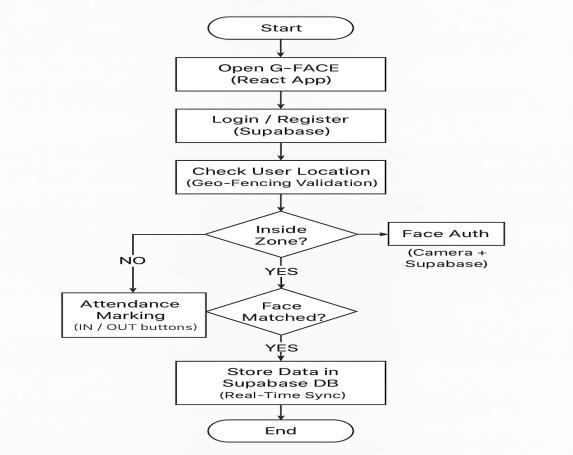
Upon successful facial verification, the student is allowed to mark attendance using the IN/OUT buttons, accurately recording entry and exit times. The attendance data is immediately stored in the Supabase database with realtime synchronization, ensuring secure and up-to-date records. The system also logs failed authentication attemptsorunauthorizedaccesstomaintaintransparency andaccountability.
This process flow integrates geo-fencing, face authentication, and cloud-based storage to provide a contactless,reliable,andefficientattendancemanagement system, eliminating manual errors and preventing proxy attendance
The Geo-Fencing and Face Authentication Algorithm (GFAA) forms the core decision-making logic of the proposed G-FACE (Geo-Fencing and Face Authentication for Contactless Entry) system. This algorithm governs the secure flow of attendance marking by validating user locationandidentitybeforerecordingattendance.Whena user logs into the application, the algorithm initiates a sequence of verification steps to ensure accurate and authorizedattendancetracking.
If facial verification is successful, the algorithm enables the IN/OUT attendance marking option and records the timestampedentryinthecloud-baseddatabase.Incaseof authentication failure or location mismatch, the system blocks attendance recording and logs the attempt for monitoring purposes. This algorithm ensures accurate, secure, and contactless attendance management by preventingproxyentriesandunauthorizedaccess.
Volume: 13 Issue: 02 | Feb 2026 www.irjet.net
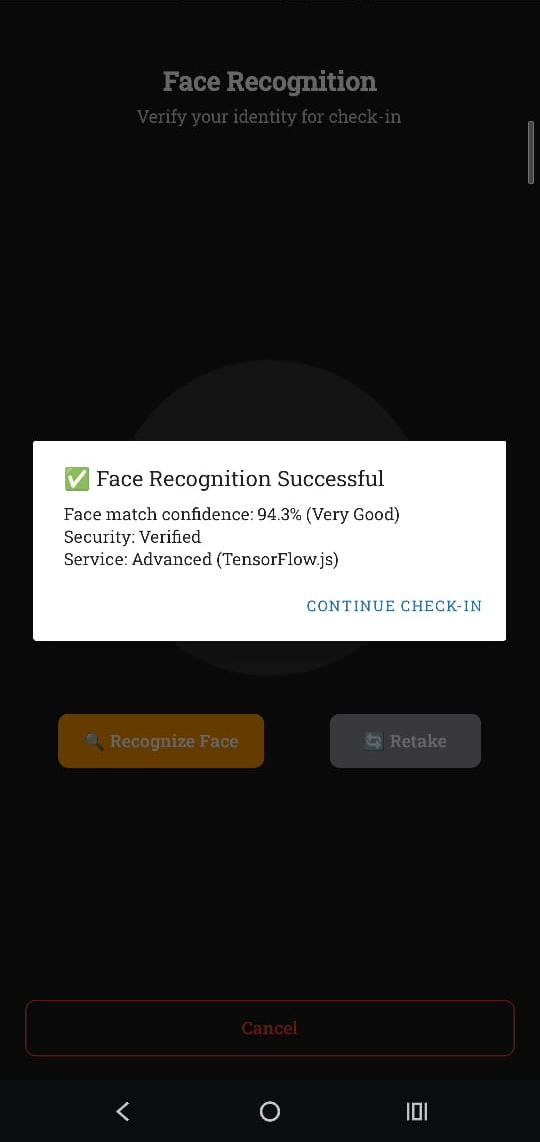
The face recognition verification interface used in the GFACE system during attendance marking. Once the user enters the authorized geo-fenced area, the system activates the device camera to perform facial authentication. Upon successful recognition, the interface displaysaconfirmationmessagealongwiththe facematch confidence score, indicating the accuracy of verification. The system confirms secure identity validation using an advanced recognition service before allowing the user to proceed with check-in. This step ensures that attendance is recorded only for authenticated users, thereby preventing proxy entries and enhancing the overall security and reliability of the attendance management process
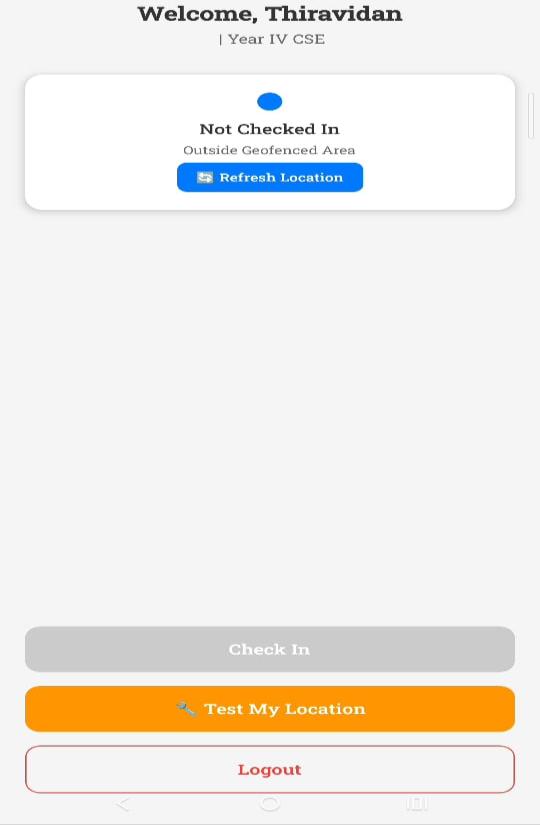
The G-FACE student dashboard interface when the user is outside the authorized geo-fenced area. The system displays the current attendance status as “Not Checked In” and clearly indicates that the user is outside the permitted location, thereby disabling the check-in option. A Refresh Location / Test My Location button is provided to allow users to revalidate their position once theyentertheauthorizedzone.Theinterfacealsoincludes basic user details, along with secure options such as logout. This screen ensures transparency by preventing unauthorized attendance marking and guiding users to complywithlocation-basedverificationbeforeproceeding
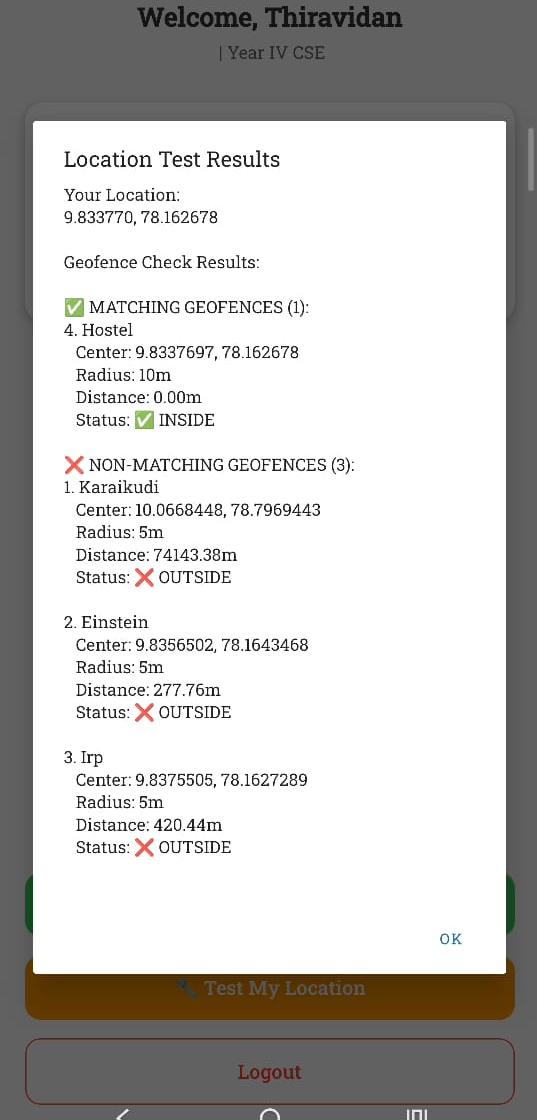
The geo-fencing location validation results in the G-FACE system. It shows the user’s current geographic coordinates and compares them against multiple predefined geo-fenced locations configured in the system. The interface clearly identifies matching geo-fences, indicatingthattheuseris inside anauthorizedzone,along withdetailssuchascentrelocation,radius,anddistance.It also lists non-matching geo-fences, where the user is outside the permitted boundary, marked with distance measurements and status indicators. This validation process ensures that attendance marking is enabled only when the user is physically present within an approved location, thereby preventing unauthorized or remote check-ins and improving the accuracy and reliability of attendancetracking
Volume: 13 Issue: 02 | Feb 2026 www.irjet.net p-ISSN: 2395-0072
The system architectureof G-FACE (Geo-Fencing and Face Authentication for Contactless Entry) follows a modular client–server design to provide secure and efficient attendancemanagement.ThesystemconsistsofaReact.jsbased user application, Supabase backend services, and a cloud database. Role-Based Access Control (RBAC) is implemented to manage access for students, faculty, and administrators. Students can mark attendance only after entering an authorized geo-fenced location and completing face authentication, while faculty and administrators can monitor records and generate reports throughdedicateddashboards
The Supabase backend handles user authentication, realtime data synchronization, and secure storage of attendance records. Geo-fencing validation and facial verification are performed before attendance data is recorded in the centralized database. Real-time updates ensure instant visibility across all dashboards, improving transparency and reliability. This architecture ensures scalability, fault tolerance, and reduced manual intervention, making the system suitable for modern educationalenvironments.
The proposed G-FACE (Geo-Fencing and Face Authentication for Contactless Entry) system demonstratessignificant performance improvements over traditional manual and basic digital attendance methods. One of the key enhancements is the automation of attendance verification, which eliminates time-consuming manual roll calls and reduces proxy attendance. By integrating geo-fencing and face authentication, attendance is recorded only when users are physically present within an authorized location and successfully verified,ensuringhigheraccuracyandreliability
Another major improvement is real-time data processing and centralized record management Attendance records are instantly stored and synchronized usinga cloud-based backend,allowingadministratorsand faculty to access up-to-date information without delays. Automated timestamps, user logs, and role-based access improve accountability and transparency. The userfriendly interface and real-time status updates further enhance system responsiveness and usability, resulting in reduced administrative workload and improved operationalefficiency.
The implementation of the G-FACE (Geo-Fencing and Face Authentication for Contactless Entry) system demonstrated effective and reliable attendance management in an educational environment. The system
successfully restricted attendance marking to predefined geo-fencedlocations,ensuringthatuserscouldnotrecord attendance from unauthorized areas. Face authentication further validated user identity, resulting in a significant reduction in proxy attendanceand false entriescompared totraditionalmethods.
Real-time attendance recording and cloud-based storage enabled instant synchronization of data across user dashboards. Faculty and administrators were able to monitor attendance status, access historical records, and generate reports without delay. The system accurately recorded entry and exit times using IN and OUT actions, improvingtheprecisionofattendancelogsandsupporting flexibleschedulesandmulti-locationusecases.
From a performance perspective, the system showed improved efficiency by minimizing manual intervention and administrative effort. Location verification and facial authentication were completed within acceptable response times, providing a smooth user experience. Any failed location checks or authentication attempts were clearly communicated to users, enhancing transparency andsystemtrustworthiness
Figure 5 :Result
Overall,theresultsindicatethatG-FACEprovidesasecure, scalable,anduser-friendlysolutionformodernattendance management. The integration of geo-fencing, face authentication, and real-time cloud services ensures high
Volume: 13 Issue: 02 | Feb 2026 www.irjet.net
accuracy, improved accountability, and operational efficiency, making the system suitable for adoption in educational institutions and similar organizational environments.
The G-FACE system successfully addresses the limitations oftraditionalattendancemethodsbyintroducingasecure, contactless, and automated attendance management solution. By integrating geo-fencing and face authentication, the system ensures that attendance is recordedonlywhenusersarephysicallypresentwithinan authorizedlocationandproperlyauthenticated.Thisduallayer verification significantly reduces proxy attendance, manual errors, and administrative overhead. The system provides real-time attendance tracking, accurate IN and OUT logging, and centralized cloud-based data storage, enablingeasymonitoringandreportgenerationforfaculty andadministrators.Itsuser-friendlyinterfaceandreliable performance make it suitable for practical deployment in educational institutions. Overall, G-FACE enhances transparency, accuracy, and efficiency in attendance management and serves as a scalable foundation The GFACE system effectively combines geo-fencing and face authentication to provide a secure, contactless, and automated attendance solution that eliminates proxy attendance, improves accuracy, and enhances transparencywhilereducingmanual effortininstitutional attendancemanagement
In the future, the G-FACE system can be enhanced by integrating advanced AI-based face recognition models with liveness detection to further improve authentication accuracyand prevent spoofing attacks. Support for offline attendance capture with automatic data synchronization can be added to ensure uninterrupted operation in lownetwork environments. The systemcan alsobe integrated with institutional ERP or Learning Management Systems (LMS) for seamless data sharing and academic management. Additionally, implementing push notifications, advanced analytics dashboards, and support for large-scale multi-campus deployment will further improveusability,scalability,andadoptionofthesystem.
Another potential enhancement for the G-FACE system is the incorporation of behavioral analytics and anomaly detectiontoidentify unusual attendance patterns,such as repeated late check-ins or abnormal location behavior This feature can help administrators proactively detect misuse or policy violations. Additionally, introducing QRcode or NFC-based fallback authentication for exceptional cases, along with multilingual support and accessibility features, would make the system more inclusive and adaptabletodiverseinstitutionalrequirements
[1] Babatunde, A. N., A. A. Ok, R. S. Babatunde, O. Ibitoye, andE.R.Jimoh."MobileBasedStudentAttendanceSystem Using Geo-Fencing With Timing and Face Recognition." J. Adv.Math.Computer-Science(2022).
[2]Chauhan, Vipul, Hardik Singh, Kinshuk Dewari, and Indrajeet Kumar. "Efficient Employee Tracking with Smart Attendance System Using Advanced Face Recognition and Geofencing." In 2024 2nd International Conference on Sustainable Computing and Smart Systems (ICSCSS), pp. 750-755.IEEE,2024.
[3] Prakash, Ayush, Archi Pathak, and Amit Shukla. "Face Recognition Based Attendance System." In 2023 5th International Conference on Advances in Computing, Communication Control and Networking (ICAC3N), pp. 335-337.IEEE,2023
[4]Nallusamy,C.,R.S.Gowri,andS.HariPriya."GPSusing attendancetrackingsystem."InChallengesinInformation, Communication and Computing Technology, pp. 106-111. CRCPress,2025.
[5] Chotaliya, Siddhesh, Ishika Vaish, and Saurabh Suman Prince Kanojia. "Self-X: Geo Fencing and Face Recognition based Smart Attendance Management Application." (2023).
[6]F.C.Babu,K.Sankar,andS.Kannan,"HostelAttendance Management System – A Survey," Middle-East Journal of Scientific Research, vol. 19, no. 9, pp. 1197–1198, 2014. DOI:10.5829/idosi.mejsr.2014.19.9.11203.
[7] K. G. Oladele, E. J. Iseh, J. O. Oladele, and P. R. Bhaladhare, "AI-Based Face Recognition Attendance System," International Journal of Innovative Research in Management, Engineering and Technology, vol. 12, no. 2, 2024.DOI:10.37082/IJIRMPS.v12.i2.230598
[8] S. Geerthik, R. Karthikeyan, and G. Keerthana, "Face Recognition Based Automated Smart Attendance Using Hybrid Machine Learning Algorithms and Computer Vision," in Proc. 2024 3rd Int. Conf. on Applied Artificial Intelligence and Computing (ICAAIC), 2024, pp. 606–611. DOI:10.1109/ICAAIC60222.2024.10574896.
[9] P. R. Kumar and D. Y. Reddy, "Enhancing Security: A Haar Cascade-Based Face Recognition System for PGs and Hostels,"inProc.2024IEEE9thInt.Conf.forConvergence in Technology (I2CT), 2024, pp. 1–4. DOI: 10.1109/I2CT61223.2024.1054359:
[11] J. Srikanth, R. K. Reddy, P. J. Reddy, K. Rahul, and C. Bharath, "Artificial Intelligence Based Multi-Face Recognition and Attendance Marking System," in Proc.
International Research Journal of Engineering and Technology (IRJET) e-ISSN: 2395-0056
Volume: 13 Issue: 02 | Feb 2026 www.irjet.net p-ISSN: 2395-0072
2024 5th Int. Conf. on Image Processing and Capsule Networks(ICIPCN),2024,pp.47–51.
[12] V. N. Kumar and S. Kumar, "Real-Time Attendance System Using Facial Recognition," in Multidisciplinary Approaches for Sustainable Development, CRC Press, 2024,pp.317–320.
[13] M. A. Thalor and O. S. Gaikwad, "Facial Recognition Attendance Monitoring System Using Deep Learning Techniques," International Journal of Integrated Science and Technology, vol. 1, no. 6, pp. 841–848, 2024. DOI: 10.59890/ijist.v1i6.685.
[14] N. Narkhede, A. Menon, I. Mathane, S. Nikam, and S. Dange, "Facial Recognition and Machine Learning-Based StudentAttendanceMonitoringSystem,"inProc.20233rd Int.Conf.onIntelligentTechnologies(CONIT),2023,pp.1–7.DOI:10.1109/CONIT59222.2023.10205631.
[15]D.MaliandN.Dharwadkar,"DevelopmentofaSimple andLow-CostUnifiedSmartVideoSurveillanceSystemfor Monitoring Hostel Student Attendance," International Journal of Engineering Research & Technology, vol. 8, 2019.
2026, IRJET | Impact Factor value: 8.315 |