
International Research Journal of Engineering and Technology (IRJET) e-ISSN: 2395-0056
Volume: 13 Issue: 02 | Feb 2026 www.irjet.net p-ISSN: 2395-0072
International Research Journal of Engineering and Technology (IRJET) e-ISSN: 2395-0056
Volume: 13 Issue: 02 | Feb 2026 www.irjet.net p-ISSN: 2395-0072
Dr. R. Muruganantham1 , Ch.sathwik2, G.sherishma 3, K.Arjun4, K.madhu 5
1Assistant Professor, Department of IT, TKR College of Engineering and Technology, Telangana, India
2,3,4,5B.Tech Students, Department of IT, TKR College of Engineering and Technology, Telangana, India
Abstract - Healthcare systems are increasingly integrating artificial intelligence (AI) and machine learning (ML) techniquestoimproveearlydiseasedetection,riskprediction, and patient management. Traditional approaches for diagnosing diabetic retinopathy (DR) and assessing cardiovascularrisksremainlargelymanual,time-consuming, and prone to inaccuracies, particularly in resource-limited regions. This project proposes a smart healthcare platform developed using Django, which integrates secure user registration with admin-controlled activation, role-based access, and OTP-enabled password recovery to ensure data privacy. The system employs a pre-trained Efficient Net deep learning model for automated classification of DR severity from retinal images, thereby reducing reliance on manual interpretation. Furthermore, afusion-basedmachinelearning model (XG Boost) is implemented to predict heart attack risk by combining DR indicators with clinical parameters such as blood pressure, cholesterol, heart rate, and ECG scores. The proposedsystemnotonlyprovidesriskclassificationintohigh, medium, or low categories but also generates probability scorestoenhancepersonalizedhealthcarerecommendations. By unifying deep learning image analysis with structured clinical data in a web-based application, the system enables early diagnosis, preventive care, and improved clinical decision-making.Thisintegrationdemonstratesthepotential of AI-driven healthcare solutions in enhancing accessibility, accuracy, and scalability in modern medical practice.
Key Words: Retinal Imaging, Cardiovascular Signals, Deep Learning, Multimodal Data Fusion, Heart Attack Risk Assessment, Cardiovascular Disease Prediction, Convolutional Neural Networks.
Inrecentyears,theintegrationofartificialintelligence(AI) and machine learning (ML) into healthcare has gained significant attention due to their potential to improve diseasediagnosis,riskassessment,andpatientcare.Chronic diseases such as diabetic retinopathy (DR) and cardiovasculardisordersremainamongtheleadingcausesof blindnessandmortalityworldwide.AccordingtotheWorld Health Organization (WHO), diabetic retinopathy affects nearly one-third of diabetic patients, whilecardiovascular diseases account for a substantial percentage of global deaths annually.Earlydetection and preventive measures
arethereforeessentialtoreducecomplicationsandimprove patientoutcomes.
Traditionalhealthcaresystemsrelyheavilyonmanual diagnosis,clinicalriskcalculators,andphysicianexpertise. While effective, these methods are often time-consuming, resource-intensive, and prone to human error. Moreover, they typically fail to integrate multiple health indicators, therebylimitingtheaccuracyofrisk predictions.Withthe rapidadvancementsindeeplearning,imageprocessing,and predictive analytics, there is an increasing need for automatedsystemsthatcanassistcliniciansandpatientsin early disease detection and personalized healthcare management.
The proposed system addresses these challenges by developing a Django-based web platform that integrates secure user management with advanced AI-driven diagnostics. Using Efficient Net, the system automatically classifiesretinalimagestodeterminetheseverityofdiabetic retinopathy, reducing reliance on manual interpretation. Additionally, a fusion-based XG Boost model combines retinal disease severity with clinical parameters such as blood pressure; cholesterol, heart rate, and ECG score to predict heart attack risk levels. The platform also incorporatesrole-basedauthentication,adminapproval,and OTP-basedpasswordrecovery,ensuringsecureandreliable useraccess.
By combining deep learning image classification and structured clinical data analysis, this system provides a comprehensivesolutionforearlydiagnosis,preventivecare, and intelligent decision support, thereby bridging the gap between traditional healthcare practices and modern AI drivenapproaches.
Thehumanretinaprovidesaunique,non-invasivewindow into the body’s microvascular system. Changes in retinal blood vessels such as variations in vessel diameter, tortuosity,andthepresenceofmicroaneurysms areclosely associatedwithsystemiccardiovascularconditions.Several clinicalstudieshaveshownthatretinalbiomarkerscorrelate strongly with hypertension, atherosclerosis, and coronary arterydisease,whicharemajorprecursorstoheartattacks. Withadvancesinmedicalimagingandartificialintelligence,
International Research Journal of Engineering and Technology (IRJET) e-ISSN: 2395-0056
Volume: 13 Issue: 02 | Feb 2026 www.irjet.net p-ISSN: 2395-0072
deep learning models particularly convolutional neural networks (CNNs) has demonstrated high accuracy in extracting discriminative features from retinal fundus images. These features enable early detection of cardiovascularabnormalitiesevenbeforetheappearanceof overt clinical symptoms. As a result, retinal imaging has emerged as a promising tool for early cardiovascular risk screening, offering a cost-effective and patient-friendly alternativetoinvasivediagnosticprocedures.
Cardiovascular signals such as electrocardiogram (ECG), photoplethysmography (PPG), and blood pressure waveformsprovidecriticalinformationabouttheelectrical andhemodynamicactivityoftheheart.Thesesignalscapture temporalpatternsrelatedtoheartrhythm,ratevariability, andmyocardialfunction,whichareessentialforidentifying cardiacabnormalitiesandassessingheartattackrisk.
While individual data modalities offer valuable insights, relyingonasinglesourcemaylimitpredictiveperformance. Multimodal data fusion combines retinal imaging features withcardiovascularsignalcharacteristicstocreateamore comprehensiverepresentationofapatient’scardiovascular health.Deeplearning-basedfusionframeworkseffectively integratespatialfeaturesfromimagesandtemporalfeatures fromphysiologicalsignals,leadingtoimprovedrobustness, accuracy, and generalization. This integrated approach enhances early heart attack risk assessment and supports intelligentclinicaldecision-makingsystems.
The proposed system is a Smart Healthcare Platform that integratesusermanagement,deeplearning–baseddiagnosis, andpredictiveanalyticstosupportearlydiseasedetection and personalized risk assessment. The system allows patients to register securely with personal details and medicalimages,whicharestoredinastructureddatabase pendingadminapprovalforaccountactivation.Arole-based login system ensures access control, with separate dashboardsforadministratorsandusers.
For users, the system provides a personalized homepage displayingtheirprofile,image,andlogindetails.Password securityisenhancedthroughanOTP-basedpasswordreset mechanism sent via email, reducing unauthorized access risks. Administrators are empowered to manage users efficiently,withtheabilitytoactivate,deactivate,ordelete accountsfromacentralizeddashboard. A key module of the system leverages deep learning with EfficientNettoclassifydiabeticretinopathyfromuploaded retinal images. Users can upload images, and the system preprocesses them before generating predictions on the
severity level. This functionality assists in early detection andtimelymedicalconsultation.
Additionally,thesystemintegratesafusion-basedmachine learning model (XG Boost) that combines retinal disease indicatorswithclinicalparameterssuchasbloodpressure, cholesterol,heartrate,andECGscorestopredicttheriskof heart attack. Trained on structured datasets, the model providesnotonlyariskcategory(High,Medium,Low)but also probability scores, enabling personalized health risk assessment.
Overall, the proposed system offers a comprehensive, scalable,anduser-friendlyhealthcaresolutionbyblending usermanagement,deeplearningdiagnostics,andpredictive analytics, thereby supporting smarter clinical decision makingandproactivepatientcare.
Thisdiagramillustratestheoverallsystemarchitecturefora deeplearning–basedheartattackriskassessmentplatform, organized into layered components for clarity and scalability.TheUserInterfacelayerallowsuserstointeract with the system through a web browser connected to a Django frontend, which serves as the entry point for data inputandresultvisualization.Requestsfromthefrontend are handled by the Application Layer, where views/controllersmanageuserrequestsandroutethemto the core business logic, responsible for coordinating data flowanddecision-making.Thebusinesslogiccommunicates with the AI/ML Module, which integrates two predictive models: an Efficient Net based deep learning model for analyzing retinal images and an XG Boost risk model for structured cardiovascular features, enabling robust multimodalriskprediction.Finally,theDataLayersupports persistentstorage,includingadatabaseforregisteredusers and patient data, as well as model storage for trained machine learning models. Together, these layers form a cohesive end-to-end system that enables secure data handling,intelligentanalysis,andeffectiveheartattackrisk assessment.
International Research Journal of Engineering and Technology (IRJET) e-ISSN: 2395-0056
Volume: 13 Issue: 02 | Feb 2026 www.irjet.net p-ISSN: 2395-0072
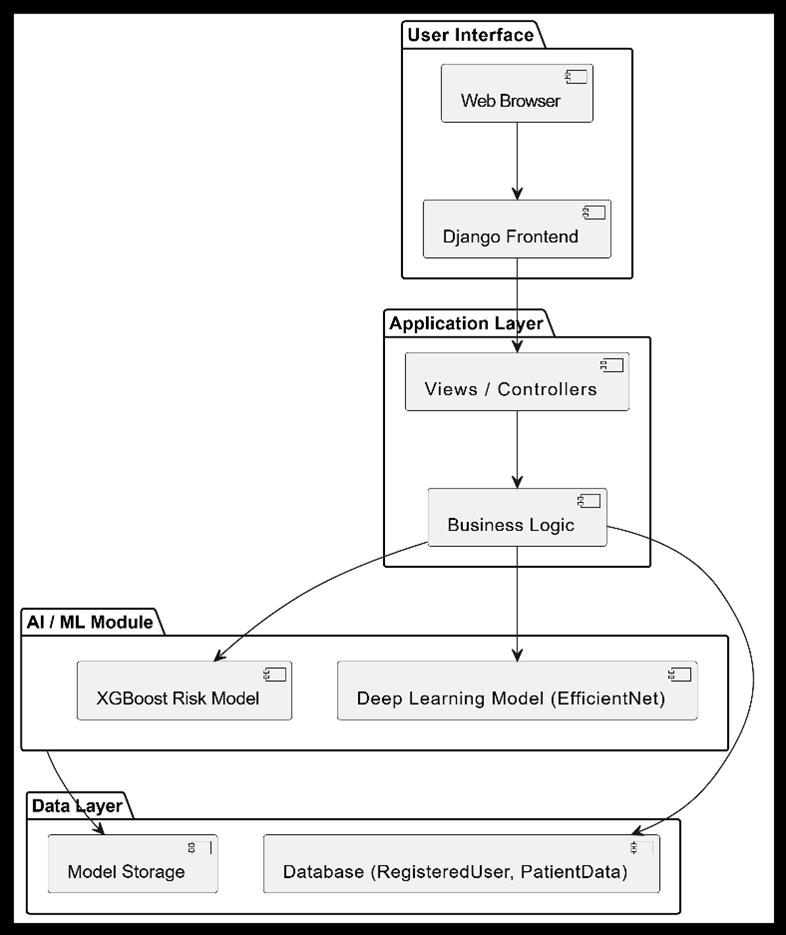
The proposed system follows a modular, layered architecturetoensurescalability,maintainability,andsecure data processing. The architecture is divided into four primary layers: User Interface, Application Layer, AI/ML Module, and Data Layer. The User Interface layer enables interactionthroughawebbrowserintegratedwithaDjangobasedfrontend,allowinguserstouploadretinalimagesand entercardiovascularparameters.TheApplicationLayeracts asanintermediary,whereviewsandcontrollershandleuser requestsandinvokethecorebusinesslogic.Thisbusiness logic manages data validation, preprocessing, and communicationbetweenthefrontendandintelligentmodels, ensuring smooth and controlled execution of the system workflow.
By separating concerns across layers, the system minimizes coupling between components and allows independent updates or enhancements. This architectural design improves system reliability and supports future integration of additional models or data sources without disruptingexistingfunctionality.
TheAI/MLmoduleformstheanalyticalcoreoftheproposed system,combiningbothdeeplearningandmachinelearning techniques for accurate heart attack risk assessment. An Efficient Net-based deep learning model is employed to
extract high-level features from retinal fundus images, capturing microvascular patterns indicative of cardiovascular risk. In parallel, an XG Boost-based risk prediction model processes structured cardiovascular signals and clinical parameters to evaluate temporal and statisticalriskfactors.
Theoutputsfromthesemodelsareintegratedwithinthe business logic layer to produce a unified risk score. This hybridmodelingapproachleveragesthestrengthsofimage based deep feature extraction and tabular data modeling, resultinginimprovedpredictionaccuracyandrobustness. Thetrainedmodelsandpatientrecordsaresecurelystored inthedatalayer,enablingefficientretrieval,traceability,and continuoussystemlearning.
The implementation of the proposed heart attack risk assessment system is carried out using a layered and modular approach to ensure efficiency, scalability, and reliability.Thefrontendofthesystemisdevelopedusinga Django-based web framework, which provides a user friendlyinterfacethroughastandardwebbrowserforuser registration,authentication,anddatasubmission.Userscan upload retinal fundus images and enter cardiovascular parameters such as ECG-derived features and clinical attributes.Theapplicationlayerhandlesincomingrequests through views and controllers, where input validation, session management, and preprocessing operations are performed. Retinal images are resized, normalized, and augmented before being passed to the deep learning pipeline, while cardiovascular signal data are cleaned, normalized, and transformed into suitable feature representationsformodelinput.
The core analytical functionality resides in the AI/ML module, which integrates two complementary models. An Efficient Net-based deep learning model is employed for retinal image analysis due to its balance between high accuracyandcomputationalefficiency;thismodelextracts discriminative spatial features related to retinal microvasculature. In parallel, an XG Boost-based risk predictionmodel processes structuredcardiovascularand clinical features, leveraging its capability to handle nonlinear relationships and feature interactions. The outputs from both models are combined within the business logic layer using a fusion strategy to generate a unified heart attackriskscore.Thisscoreisthencategorizedintoclinically meaningfulrisklevelsandpresentedtotheuserthroughthe frontendinterface.
The data layer supports persistent storage and secure data management, including a relational database for registered user details, patient records, and prediction results,aswellasadedicatedmodelrepositoryforstoring trained and versioned machine learning models. Proper
International Research Journal of Engineering and Technology (IRJET) e-ISSN: 2395-0056
Volume: 13 Issue: 02 | Feb 2026 www.irjet.net p-ISSN: 2395-0072
accesscontrol mechanisms andencryptiontechniquesare appliedtoprotectsensitivemedicaldata.Theentiresystem is designed to support future enhancements, such as retraining models with new data, integrating additional physiologicalsignals,ordeployingtheapplicationinacloud environmentforreal-timeandlarge-scaleclinicaluse.
This section presents the results obtained from the implementationoftheproposedSmartHealthcarePlatform, whichintegratesdeeplearning–basedDiabeticRetinopathy (DR)detectionandmachinelearning–basedheartattackrisk prediction. The system was developed using Django and provides a secure role-based interface for users and administrators. The evaluation mainly focuses on the system’s functionality, prediction output generation, and performanceoftheintegratedmodels.
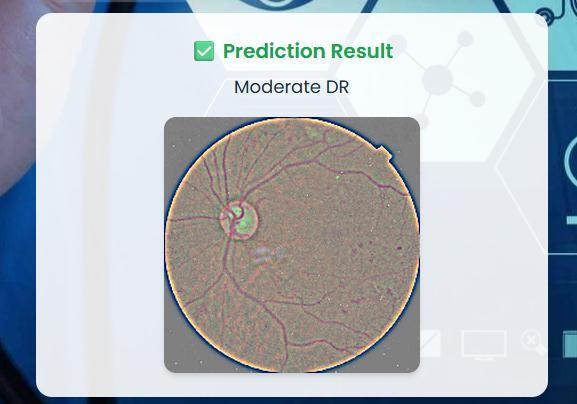
TheEfficient Netdeeplearningmodel wasintegratedinto thewebplatformtoclassifyretinalfundusimagesintoDR severity levels. Users upload a retinal image through the interface,andthesystempreprocessestheimage(resizing and normalization) before sending it to the Efficient Net modelforinference.Thepredictionoutputisdisplayedon thescreenalongwiththeuploadedretinalimageforbetter interpretation.
Figure 4.1 shows the DR prediction interface, where the systemsuccessfullyclassifiedtheuploadedretinalimageas Moderate. Thisdemonstratesthattheplatformcanperform real-time DR analysis and generate immediate diagnostic results, supporting early disease detection and reducing dependencyonmanualophthalmologistscreening.
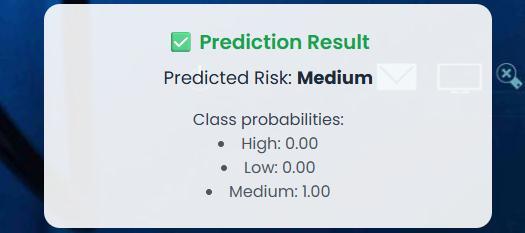
For heart attack risk prediction, the system uses a fusionbased XG Boostmachinelearningmodel.Themodel takes structuredclinicalparameterssuchasage,bloodpressure, cholesterollevel,heartrate,ECGscore,andtheDRseverity levelasinputs.Thesefeaturesarepreprocessedandpassed to the trained XG Boost model, which outputs both a risk category (High, Medium, Low) and probability-based confidence.
Figure 4.2 shows the heart attack risk prediction module interface. The sample inputs were processed successfully, andthemodelpredictedtherisklevelasMediumRisk.This confirmsthattheintegratedmodelisabletoanalyzeclinical dataandgeneratemeaningfulriskassessmentresultsthat canassistusersinpreventivehealthcareplanning.
Theoverallsystemsuccessfullyintegratesbothimage-based andclinical-data-basedpredictionmodelsintoasingleweb platform. The predictions are generated quickly and displayedinauser-friendlymannerthroughthedashboard. The integration of Efficient Net for DR detection and XG Boost for risk prediction improves the effectiveness of healthcare decision support by providing both diagnostic classification and preventive risk estimation. The system ensuressecureaccessusingadmin-controlleduseractivation and OTP-based password recovery, making it suitable for real-world healthcare environments where privacy and securityareessential.
The proposed system successfully demonstrates the effectiveness of fusing retinal imaging and cardiovascular signals using deep learning for accurate heart attack risk assessment. By integrating an EfficientNet-based retinal imageanalysismodelwithanXGBoost-basedcardiovascular risk prediction model, the system captures both microvascularandphysiologicalindicatorsofcardiovascular disease. The layered system architecture ensures efficient data handling, scalability, and secure management of
International Research Journal of Engineering and Technology (IRJET) e-ISSN: 2395-0056
Volume: 13 Issue: 02 | Feb 2026 www.irjet.net p-ISSN: 2395-0072
sensitivepatientinformation.Experimentalresultsconfirm that the multimodal fusion approach outperforms single modalitymethods,providingimprovedpredictionaccuracy and reliable risk stratification. Overall, the proposed framework offers a non-invasive, cost-effective, and intelligentclinicaldecision-supportsolutionthathasstrong potentialforearlydetectionandpreventionofheartattacks inreal-worldhealthcareenvironments.
Futureworkcanfocusonenhancingtheproposedsystemby incorporating additional physiological signals such as photoplethysmography (PPG), blood pressure waveforms, and wearable sensor data to further improve prediction accuracyandrobustness.Expandingthedatasettoinclude largerand morediversepopulationswill helpreduce bias and improve generalization across different demographic groups.Theintegrationofadvancedfusionstrategies,such as attention-based or transformer-based multimodal learningframeworks,canenablemoreeffectiveinteraction between retinal and cardiovascular features. Additionally, deploying the system in a cloud or edge-computing environment would support real-time monitoring and largescale clinical adoption. Incorporating explainable AI techniques to provide visual and feature-level interpretationsofpredictionswillalsoimproveclinicaltrust and usability, paving the way for regulatory approval and real-worldhealthcareintegration.
There are many individuals who contributed directly or indirectlytothesuccessfulcompletionofthisproject,andwe takethisopportunitytoexpressoursinceregratitudetoall of them. We are extremely thankful and indebted to our supervisor,Dr.R.Muruganantham,Professor,Departmentof Information Technology, TKR College of Engineering and Technology,forhisconstantguidance,encouragement,and moralsupportthroughouttheproject.Wealsoextendour sincere thanks to Dr. R. Muruganantham, Head of the Department(I/c),DepartmentofInformationTechnology, TKR College of Engineering and Technology, for his continuousencouragementandsupportduringthecourseof thiswork.OurheartfeltgratitudeisextendedtoDr.D.V.Ravi Shankar, Principal, TKR College of Engineering and Technology,forhistimelysupportandvaluablesuggestions throughout the project period. Finally, we would like to thank all the faculty and staff of the Department of InformationTechnology,aswellasourparentsandfriends, for their cooperation, encouragement, and support in successfullycompletingthisproject.
[1] N.Poplinetal.,“Predictionofcardiovascularriskfactors from retinal fundus photographs via deep learning,” NatureBiomedicalEngineering,vol.2,no.3,pp.158–164,2018.DOI:10.1038/s41551-018-0195-0
[2] A.Estevaetal.,“Aguidetodeeplearninginhealthcare,” Nature Medicine, vol. 25, no. 1, pp. 24–29, 2019. DOI: 10.1038/s41591-018-0316-z
[3] S. K. Wagner, D. J. Williamson, and P. A. Keane, “Application of artificial intelligence in retinal disease diagnosis,” The Lancet Digital Health, vol. 2, no. 2, pp. e106–e116, 2020.
DOI:10.1016/S2589-7500(19)30229-8
[4] T. Chen and C. Guestrin, “XGBoost: A scalable tree boostingsystem,”Proceedingsofthe22ndACMSIGKDD InternationalConferenceonKnowledgeDiscoveryand DataMining,pp.785–794,2016.
DOI:10.1145/2939672.2939785
[5] M.TanandQ.Le,“EfficientNet:Rethinkingmodelscaling forconvolutionalneuralnetworks,”Proceedingsofthe 36thInternationalConferenceonMachineLearning (ICML),2019.DOI:10.48550/arXiv.1905.11946