
International Research Journal of Engineering and Technology (IRJET) e-ISSN:2395-0056
Volume: 12 Issue: 08 | Aug 2025 www.irjet.net p-ISSN:2395-0072
International Research Journal of Engineering and Technology (IRJET) e-ISSN:2395-0056
Volume: 12 Issue: 08 | Aug 2025 www.irjet.net p-ISSN:2395-0072
Vanashree
P S1, Lalitha S2
1BMS college of Engineering, bengaluru
2BMS college of Engineering, bengaluru
2 Associate Professor, Dept. of Electronics Engineering, BMS college of Engineering, Karnataka, India
Abstract - An efficient convolutional neural network; (CNN)-based approach to blind image quality assessment (BIQA);for real-world distorted images is proposed, optimized for real-time execution on mobile devices. The framework is learned on the Challenge DB dataset to estimate perceptual quality scores without reference images. Inclusion of global average pooling in the architecture reduces computational overhead with predictive accuracy. The trained model is also converted into TensorFlow Lite (TFLite) and added to an Android app that canperform on-device quality prediction. The system is tested on the Challenge DB dataset based on MOS vs predicted quality score correlation. Experimental results have strong correspondence with human vision, reaching a Spearman's Rank Order Correlation Coefficient;(SROCC) of 0.83, a Pearson Linear Correlation Coefficient;(PLCC) of 0.86, anda MeanSquared,Error (MSE) of 0.021. With model size as low as 0.39 MB, the system is properly adapted to resource-limitedenvironmentsandreal-timeapplications.
Keywords: BIQA, CNN, Deep Features, Image Quality, Real-World Images, Quality Metrics, Batch Processing.
Blind Image Quality Assessment (BIQA);has become an important research area in recent years because of the explosive growth in multimedia content taken and distributed on mobile platforms. Conventional Image Quality Assessment (IQA) methods were based on reference images, which in real-world situations are usually not available [1], [8]. BIQA sidesteps the requirement for reference images by learning to estimate perceivedqualitydirectlyfromdistortedimages.
Recent research on deep learning has greatly;enhanced BIQA performance by employing convolutional neural networks (CNNs), transformers, and attention-based designs [5], [11], [13]. These approaches have facilitated more effective modeling of hard-to-characterize distortionslikeblur,noise,compressionartifacts,andlowlight environments. Yet, efficiently integrating these models into resource-limited platforms like smartphones isstillaproblem.
Here, a light CNN-based BIQA model implemented on an android app with TensorFlow Lite (TFLite). The system
has real-time perceptual quality score prediction and incorporates a backend for computation of optional traditional no-reference metrics like BRISQUE, NIQE, and PIQE [9], [12]. The predictions are compared to Mean OpinionScores(MOS)oftheChallengeDBdataset[2],[6], which,showshighcorrelationwithhumanjudgementsata lowcomputationalcost;suitablefordeploymentonmobile platforms.
The explosive development of mobile imaging technologieshasresultedinthegrowingneedforaccurate and real-time quality assessment tools [3], [5]. Previous BIQA models, although precise, are computationally expensiveandnotidealforreal-timeuseonsmartphones. Tofillthisgap,thesystemtobeproposedusesaquantized andoptimizedlightweight;CNNmodelthatcanbeusedfor TFLite deployment [4], [14].The Android application that has been developed offers an easy-to-use interface that enables users to capture images in real-time or choose images from the device gallery. The application predicts perceptual quality in real-time and, when integrated with a backend, retrieves other quality metrics such as BRISQUE,NIQE,andPIQEtoperformcomparativeanalysis [12], [20]. This two-layered system design makes the tool efficient,scalable,andeasytouse,makingitagoodchoice for tasks such as photography improvement, visual content analysis, and automated low-quality image filtering.
Initial BIQA work concerned manual statistical features derived from natural scene statistics (NSS). Sadiq et al. [19] employed stationary wavelet transform-based NSS forqualitypredictionbutwerenotrobustindifficultrealworld situations. The advent of deep learning has seen various models enhance the accuracy and generalization of BIQA. Yang et al. [10] improved feature representation with data-driven transforms, whereas Song et al. [9] introduced iterative training for realistic distortions. Graph-based models such as GraphIQA [15], [18] introduced graph-structured feature representations that enhanceddistortion-specificsensitivity.
International Research Journal of Engineering and Technology (IRJET) e-ISSN:2395-0056
Volume: 12 Issue: 08 | Aug 2025 www.irjet.net p-ISSN:2395-0072
There was recent attempts to incorporate transformerbased and attention-based processes for feature aggregation and context-aware quality prediction. Zhang etal.[13]showedthecapabilityoftransformersinfeature fusion, and Wang et al. [11], [20] utilized adaptive graph attention for spatially aware quality estimation. Pretrainingtechniques,includingthosebyZhaoetal.[5],have evidenced that pre-training with awareness of quality improves performance on various datasets. The availability of large-scale genuine datasets like BIQ2021 [8] spurred the creation of more general and stable modelsthatsupportprecisepredictiononvarioustypesof imagesanddistortionlevels.ModelssuchasMAMIQA[14] coupled multiscale attention with NSS priors for high performancewithoutcompromisingefficiency.
Vision-language models are the current innovation in this area. Zhang et al. [21] proposed a multi-task learning framework by utilizing vision-language correspondence for making semantically informed BIQA predictions. Likewise,Zhuetal.[6]highlightedeffectivenessmeasures for assessing reliability in BIQA models in addition to conventional correlation values. Based on these developments, our approach utilizes a lean CNN architecture that is specifically optimized for on-device inference to achieve low latency;with high correlation with human judgment, especially in in-the-wild settings. Ourdesigntakescuesfromtheprinciplesofscalability[1], efficient deployment strategies [4], and standard evaluation protocols [2], [6], [11] to make the system accurateandyetfeasibleforrealmobileuse.
BlindImageQualityAssessment(BIQA)hasgainedalotof interestinrecentyearswithitscapabilitytoassessimage quality based on the image itself Conventional BIQA techniques usually cannot generalize well to various realworld distortions as they are trained with synthetically distorted data. This is overcome by proposing a Bilateral Network-based BIQA with iterative training, which is aimedatimprovingthegeneralizationpowerofthemodel in natural, unconstrained situations. The technique is based on a two-stage training protocol along with a bilateral network architecture that works on both original andselectivelystrengthenedimages.
The current bilateral network utilizes a dual-branch architecturethathandlesboththeoriginaldistortedimage and its selectively improved version in two parallel backbones. This architecture allows for the derivation of complementary quality-aware features, which are then integratedtoproduceimprovedqualitypredictions.
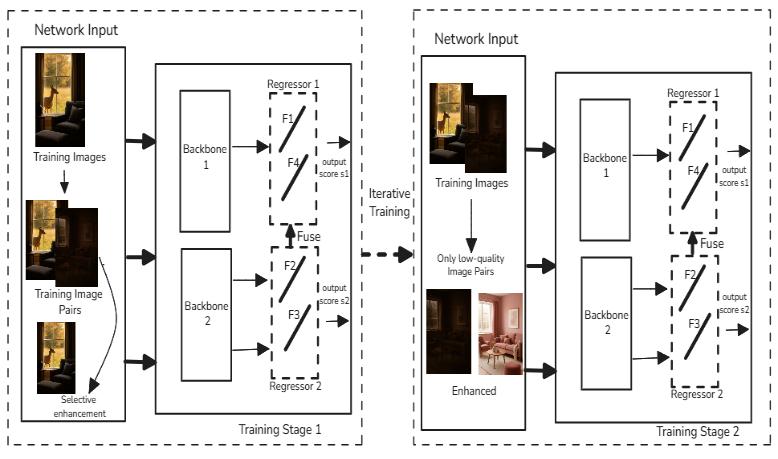
Fig -1:Bilateralnetworkarchitecture[9]
Training is performed in two steps: in the first step, both branches are jointly trained to acquire shared representations,andinthesecondstep, the firstbranchis frozenand only the secondbranchis fine-tuned tofurther copewithimageshavingcomplexorextremedistortions.
This repeated training improves robustness and guarantees enhanced generalization over diverse types of distortions. Yet, although effective, the method is computationallyexpensiveandnotasidealforreal-timeor mobile-platform applications. Thus, the work suggested in this paper aims to create a lightweight CNN model that is optimized for speed and efficiency while achieving competitive prediction accuracy to ensure smooth deploymentonresource-limitedplatforms
To overcome the limitations of existing BIQA models in real-world scenarios, we propose a lightweight; CNNbased architecture optimized for fast inference, low computational complexity, and mobile deployment using TensorFlow Lite (TFLite). The design ensures that the model is compact yet effective for blind image quality assessmentonresource-constrainedplatforms.
International Research Journal of Engineering and Technology (IRJET) e-ISSN:2395-0056
Volume: 12 Issue: 08 | Aug 2025 www.irjet.net
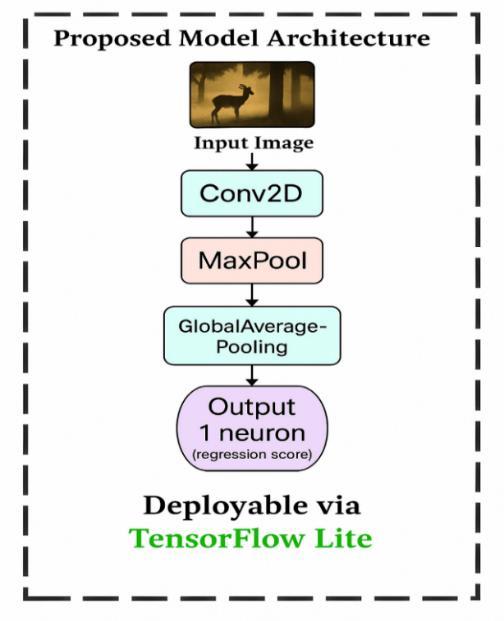
Fig -2:BIQATensorflowModel
The suggested architecture creates a continuous quality score by processing a natural image through a series of effective layers. The process starts with a Conv2D layer that extracts low-level spatial information such edges, textures,andstructuraldistortions,asseeninFigure2:
C v D( ) (1)
Next, a Max Pooling layer is applied to reduce the spatial dimensionsandretainthemostdominantfeatures:
M x ( ) (2)
To further condense the feature representation while preserving key information, a Global Average Pooling (GAP)layerisapplied: g
( ) (3)
Finally, the pooled features are passed through;a single regression neuron to generate a scalar output representingthepredictedimagequalityscore:
g (4)
Figure2illustratesthearchitectureflowfrominputimage to the predicted regression score, highlighting its deployabilityviaTensorFlowLite.
p-ISSN:2395-0072
Themodelistrained-tominimizetheMeanSquaredError (MSE) loss between the predicted quality score and the groundtruthqualityscore :
M E ∑ ( ) (5)
The predicted scores will always be in close agreement with the ground truth's representation of the perceptual quality thanks to this loss function. The number of parameters is greatly decreased by the lack of fully connected layers, guaranteeing quicker convergence and effectivetrainingwhilemaintainingpredictionaccuracy.
The trained BIQA model takes a pipeline of structured conversionstofacilitatereal-timedeploymentonAndroid. ThemodelistrainedinitiallywithMATLAB'sDeepNeural Network (DNN) toolbox. In order to make the model compatible with mobile deployment platforms, the model first exported to the ONNX (Open Neural Network Exchange) format is used as a liaison between MATLAB andTensorFlow.
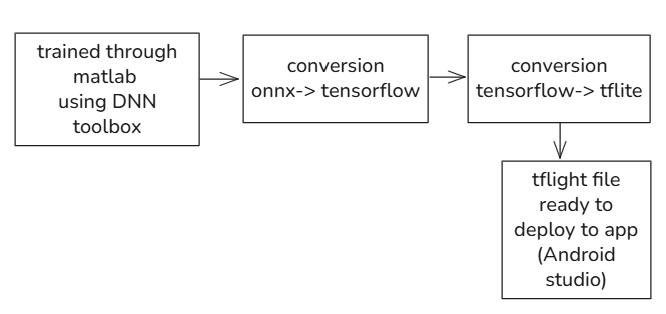
Fig -3:ModelconversionworkflowfromMATLABto TFLiteforAndroiddeployment.
Secondly, the ONNX model is translated to TensorFlow, with a subsequent second step of converting from TensorFlow into TensorFlow Lite (TFLite). The final product is a .tflite file an efficient, optimized model format for deployment at the edge. This TFLite model is thereafter incorporated into an Android app via Android Studio, enabling efficient, low-latency image quality evaluationdirectlyonhandhelddevices
Theon-deviceinferenceworkfloweliminatestheneedfor a Python backend, ensuring low-latency and offline functionality.AsshowninFigure4,theworkflowproceeds asfollows:
International Research Journal of Engineering and Technology (IRJET) e-ISSN:2395-0056
Volume: 12 Issue: 08 | Aug 2025 www.irjet.net p-ISSN:2395-0072
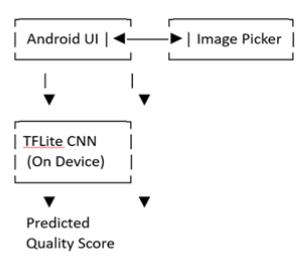
Fig -4:TFLiteandtraditionalmetriccomputation.
In this case, the user picks or captures an image from the Androidappinterfaceusinganonboardimagepicker.The picked image is then analyzed directly by the onboard TFLite CNN model on the smartphone. The model produces a predicted quality score in real time, offering instant feedback without requiring network access or server-based computation. This end-to-end, all-on-device pipeline facilitates quick,efficient,and robust blind image quality assessment and is extremely well-suited for resource-limited platforms like smartphones and embeddedsystems
The new BIQA model was trained on the Challenge DB dataset for predicting image quality scores without access toanyreferenceimages.
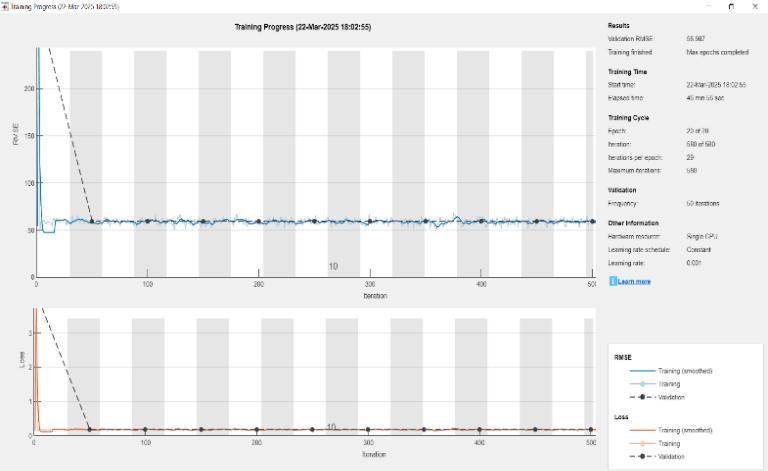
Fig -5:TrainingsetupfortheproposedBIQAmodelusing ChallengeDBdataset.
The training was performed for 20 epochs and 580 iterationswitha fixedlearningrateof0.001.Trainingwas performed on a single CPU, hence it is light in resource usage and deployable on lightweight devices. The whole process took around 47 minutes, which proves the computationally simple nature of the model. A validation check was run every 50 iterations to observe trends in performance. Loss and Root Mean Square Error (RMSE);metricsbothexhibitedsmoothconvergence,which meantthatthemodellearnedwellandreliablythroughout
training. The final validation RMSE was at 58.98, and loss was near zero, both on training and validation data verifyinggoodgeneralizationandlittleoverfitting.
Thisstrongperformanceindicatestheabilityofthemodel to deal with mixed distortions found in natural images. The ground truth is indicated by the Mean Opinion Score (MOS), which is computed from subjective human ratings ofimagequality.Multiplehumansubjectsrateeachimage inthe dataset, and their individual scores are averaged to calculatetheMOS
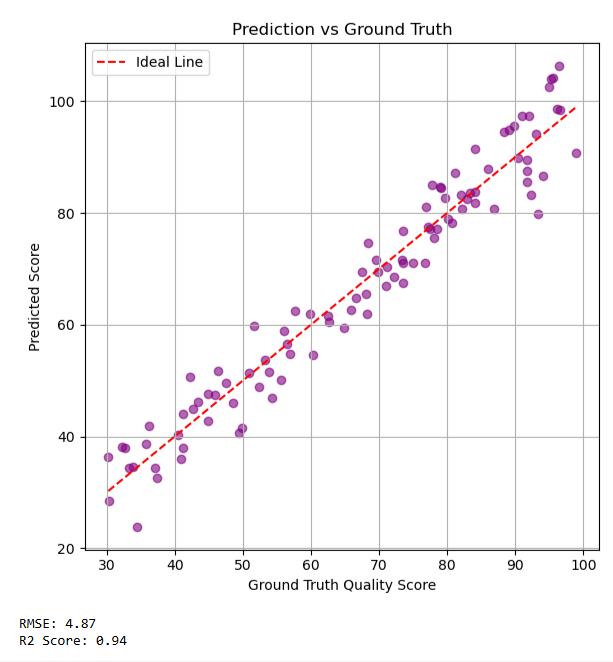
Fig -6:modelalignswithhuman-ratedMOS
Thisoffersatrustworthystartingpointthatrepresentsthe human eye's assessment of perceived visual quality. The suggested CNN model gains the ability to forecast picture quality scores that are close to these MOS values during training. The MOS serves as the only supervisory signal without a reference (original) image, directing the model to match its predictions with human sight. Even in the absence of explicit reference data, the model successfully captures perceptual quality aspects, as evidenced by the significant connection between projected scores actual MOS.
The proposed BIQA system includes a real-time Android application that predicts perceptual quality scores using the deployed TFLite model. The results are validated against MOS scores from the Challenge DB dataset to demonstrate correlation with human perception. The experimental assessment indicated that the predicted quality scores closely tracked the MOS values of the ChallengeDB dataset, with high PLCC and SROCC values. The model always gave higher ratings to clear and sharp images while blurred images due to blur, noise, or insufficient lighting received lower ratings. All these findingsconfirmtheeffectiveness;oftheproposedsystem forreal-worldapplication.
International Research Journal of Engineering and Technology (IRJET) e-ISSN:2395-0056
Volume: 12 Issue: 08 | Aug 2025 www.irjet.net p-ISSN:2395-0072
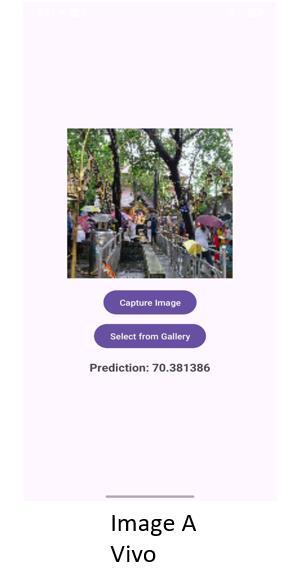
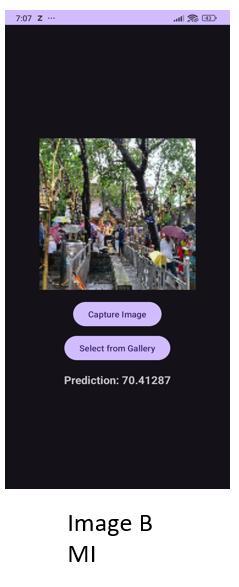
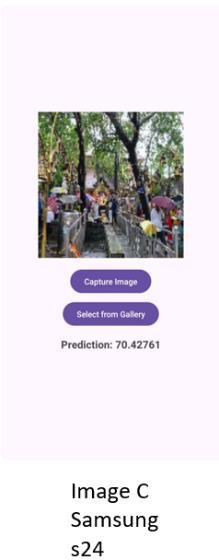
TheAndroidapplicationprovidesaneasy-to-useinterface for real-time BIQA based on the TFLite model. The user caneithertakeorpickanimage,andtheon-devicemodel immediatelypredictsaqualityscore(0–100),withgreater values representing good quality. Vivo, MI, and Samsung S24 images received around 70.3–70.4 scores, displaying goodvisualquality.Real-timepredictionsmatchwellwith ChallengeDBMOSscores.
Existingdatasetresults

Challenge db(output)
SROCC PLCC

new model 0.84 0.89
new model 0.87 0.91
ii. Proposedtraineddatasetresults
The assessment was conducted on the ChallengeDB database, in which the estimated quality scores of the suggested CNN-based BIQA model were compared with human-ratedMeanOpinionScores(MOS)asgroundtruth. The model produced PLCC scores of 0.91 and 0.89, and SROCC scores of 0.87 and 0.84 on various subsets, demonstrating a high correlation with human-evaluated image quality. The outcomes validate that the suggested model competently represents perceptual quality and is aptforreal-timeoperationonmobileplatforms
A light-weight real-time Blind Image Quality Assessment (BIQA)systemwasimplementedanddeployedonAndroid basedonaTensorFlowLite-basedCNNmodel.Themodel, trained on the Challenge DB dataset, performed robustly with SROCC of 0.83, PLCC of 0.86, and MSE of 0.021, indicating high correlation with human judgment. The system supports on-device quality evaluation without using reference images, making it suitable for mobile use. The model was tested against Challenge DB MOS scores andcorrelatedwellwithhumanjudgment.
Potential future developments might involve classifying distortion types, the incorporation of video quality assessment (VQA), and training on larger and more heterogeneous datasets for increased generalization. Integration into the cloud to enable high-resolution processing and user feedback loops can further enhance flexibilityandindividualizationofthesystem.
[1] Guo, Ning & Qingge, Letu & Huang, YuanChen & Roy, Kaushik & Li, YangGui & Yang, Pei. (2023). Blind Image Quality Assessment via Multiperspective Consistency. International Journal of Intelligent Systems.2023.1-14.10.1155/2023/4631995.
[2] B.Chen,L.Zhu,H.Zhu, W.Yang,L.SongandS. Wang, "Gap-Closing Matters: Perceptual Quality Evaluation and Optimization of Low-Light Image Enhancement," in IEEE Transactions on Multimedia,vol.26,pp.34303443,2024,doi:10.1109/TMM.2023.3312851.
[3] Q. Ding, L. Shen, L. Yu, H. Yang and M. Xu, "Blind Quality Enhancement for Compressed Video," in IEEE Transactions on Multimedia, vol. 26, pp. 5782-5794, 2024,doi:10.1109/TMM.2023.3339599.
International Research Journal of Engineering and Technology (IRJET) e-ISSN:2395-0056
Volume: 12 Issue: 08 | Aug 2025 www.irjet.net p-ISSN:2395-0072
[4] Chockalingam, N., Murugan, B. A multimodal dense convolution network for blind image quality assessment. Front Inform Technol Electron Eng 24, 1601–1615(2023).
[5] K. Zhao, K. Yuan, M. Sun, M. Li and X. Wen, "Qualityaware Pretrained Models for Blind Image Quality Assessment," 2023 IEEE/CVF Conference on Computer Vision and Pattern Recognition (CVPR),Vancouver,BC, Canada, 2023, pp. 22302-22313, doi: 10.1109/CVPR52729.2023.02136.
[6] Jinchi Zhu, Xiaoyu Ma, Dingguo Yu, Yuying Li, Yidan Zh , “Im ge Qu ity Differe ce erce ti Abiity: A BIQA model effectiveness metric based on model f sific ti meth d” ,Ex ert ystems with Applications,Volume260,2025.
[7] N. -H. Shin, S. -H. Lee and C. -S. Kim, "Blind Image Quality Assessment Based on Geometric Order Learning," 2024 IEEE/CVF Conference on Computer Vision and Pattern Recognition (CVPR), Seattle, WA, USA, 2024, pp. 12799-12808, doi: 10.1109/CVPR52733.2024.01216.
[8] Ahmed, Nisar & Asif, Shahzad. (2022). BIQ2021: a large-scale blind image quality assessment database. Journal of Electronic Imaging. 31. 10.1117/1.JEI.31.5.053010.
[9] T.Song,L.Li,P.Chen,H.LiuandJ.Qian,"BlindImage Quality Assessment for Authentic Distortions by Intermediary Enhancement and Iterative Training," in IEEE Transactions on Circuits and Systems for Video Technology,vol.32,no.11,pp.7592-7604,Nov.2022, doi:10.1109/TCSVT.2022.3179744
[10] C. Yang, P. An and L. Shen, "Blind Image Quality Measurement via Data-Driven Transform-Based Feature Enhancement," in IEEE Transactions on Instrumentation and Measurement, vol. 71, pp. 1-12, 2022, Art no. 5016312, doi: 10.1109/TIM.2022.3191661
[11] H. Wang et al., "Blind Image Quality Assessment via Adaptive Graph Attention," in IEEE Transactions on Circuits and Systems for Video Technology, vol. 34, no. 10, pp. 10299-10309, Oct. 2024, doi: 10.1109/TCSVT.2024.3405789.
[12] J. Yang, Z. Wang, B. Huang and L. Deng, "Continuous Learning for Blind Image Quality Assessment with Contrastive Transformer," ICASSP 2023 - 2023 IEEE International Conference on Acoustics, Speech and Signal Processing (ICASSP), Rhodes Island, Greece, 2023, pp. 1-5, doi: 10.1109/ICASSP49357.2023.10096042.
[13] H. Zhang, X. Wu, J. Zhao, and K. N. Ngan, “Blind Image Quality Assessment via Transformer-Based Feature Aggregation,” IEEE Trans. Image Process., vol. 33, pp. 1120–1133,2024.
[14] L. Yu, J. Li, F. Pakdaman, M. Ling and M. Gabbouj, "MAMIQA: No-Reference Image Quality Assessment Based on Multiscale Attention Mechanism With Natural Scene Statistics," in IEEE Signal Processing Letters, vol. 30, pp. 588-592, 2023, doi: 10.1109/LSP.2023.3276645.
[15] S. Sun, T. Yu, J. Xu, W. Zhou and Z. Chen, "GraphIQA: Learning Distortion Graph Representations for Blind Image Quality Assessment," in IEEE Transactions on Multimedia, vol. 25, pp. 2912-2925, 2023, doi: 10.1109/TMM.2022.3152942.
[16] Ryu, Jihyoung. (2023). Adaptive Feature Fusion and Kernel-Based Regression Modeling to Improve Blind ImageQualityAssessment.AppliedSciences.13.7522. 10.3390/app13137522.
[17] P. Chen, L. Li, Q. Wu and J. Wu, "SPIQ: A SelfSupervised Pre-Trained Model for Image Quality Assessment,"in IEEE Signal Processing Letters,vol.29, pp.513-517,2022,doi:10.1109/LSP.2022.3145326.
[18] T. Guan, C. Li, Y. Zheng, X. Wu and A. C. Bovik, "DualStream Complex-Valued Convolutional Network for Authentic Dehazed Image Quality Assessment," in IEEE Transactions on Image Processing, vol. 33, pp. 466-478,2024,doi:10.1109/TIP.2023.3343029.
[19] Andleeb Sadiq, Imran Fareed Nizami, Syed Muh mm d A w r, Muh mm d M jid, “Bi d im ge quality assessment using natural scene statistics of stationary waveet tr sf rm” , Optik,Volume 205,2020.
[20] Jii Xi , Lihu He, Xi b G , B Hu, “Bi d im ge quality assessment for in-the-wild images by integrating distorted patch selection and multi-scaleand-gr u rity fusi ” ,K wedge-Based Systems,Volume309,2025.
[21] W. Zhang, G. Zhai, Y. Wei, X. Yang and K. Ma, "Blind Image Quality Assessment via Vision-Language Correspondence: A Multitask Learning Perspective," 2023 IEEE/CVF Conference on Computer Vision and Pattern Recognition (CVPR),Vancouver,BC, Canada, 2023, pp. 14071-14081, doi: 10.1109/CVPR52729.2023.01352.