
International Research Journal of Engineering and Technology (IRJET) e-ISSN:2395-0056
Volume: 12 Issue: 04 | Apr 2025 www.irjet.net
p-ISSN:2395-0072
International Research Journal of Engineering and Technology (IRJET) e-ISSN:2395-0056
Volume: 12 Issue: 04 | Apr 2025 www.irjet.net
p-ISSN:2395-0072
Kunal Agarwal1
1AI/ML Computational Science Senior Analyst, Accenture ***
Abstract
This paper presents a novel agentic AI architecture that goes beyond traditional Retrieval-Augmented Generation (RAG) by embedding autonomous decision-making, goal-oriented planning, and self-reflection capabilities. Our implementation independently discovers, processes, and maintains its knowledge base while dynamically selecting tools and models based on task demands. Through continuous experiments with 180 queries spanning simple factual, creative, and complex analytical categories, we noticed that our agentic approach improved content relevance by 37% and user satisfaction by 42% compared to the conventional RAG systems. The agent's autonomous knowledge management reduced the manual intervention by 89% while maintaining freshness of crawled information. Perhaps most interestingly, the system's self-reflection mechanism enabled continuous learning, with satisfaction scores climbing by 14.2% during our four-week experimental period. These findings suggest that incorporating true agency into AI systems creates more adaptive, effective, and independent content generation capabilities potentially reshaping how knowledge workers and AI systems collaborate.
Key Words: AgenticAI,RAG,Autonomous,ArtificalIntelligence,LLM,VectorDatabse,KnowledgeGraph,Pydantic,Deepseek, Llama
Introduction
The history of artificial intelligence, from the very beginning to rule-based expert systems, through statistical learning approaches,totoday'slargelanguagemodels(LLMs)thatcangeneratetextthatisveryclosetohumanwriting(Brownetal., 2020) has not been smooth. Despite the big achievements, the fact that most LLM systems are still merely reactive poses a hurdle.FirstintroducedTraditionalRetrieval-AugmentedGeneration(RAG)systemsareanexampleofhowthisproblemwas tackled, whose major function was to pair the generated outputs with relevant information (Lewis et al., 2020; Guu et al., 2020). However, we've discovered that these systems usually still need human assistance in the process of knowledge acquisitionandknowledgebasemaintenance asituationthatleadstolessindependenceandflexibility,particularlyincases ofrapidchangesintheknowledgedomains(Shusteretal.,2022).
Research on agentic AI has started long ago and can be taken back to Bratman (1987) who proposed the belief-desireintention agent models. This research line has moved through the recent stages of the development of the idea of an agent (Wooldridge, 2009). Along with the traditional features of agency in AI, the notion of the four isolated elements, that is, autonomy,socialability,reactivity,andproactiveness,hasbeenubiquitousintheliteraturesince(Franklin&Graesser,1996). It is undoubted that the development of language-based artificial intelligence solutions has been a target for many scholars. Weston et al. (2022) tried to embed the persistence and goal-oriented behavior in dialogue systems and their results were marvelous yettheworkmerelyresultedinapartialagencyofthesystem.ThesameholdsforParketal.(2023)whofurther explained some memory mechanisms which in their case, the conversational agents displayed better user experience due to thememorymechanism.Theyhavemadesignificantprogresstowardcoherentlong-terminteraction.Throughtheliterature, WebGPT(Nakanoetal.,2021)andREALM(Guuetal.,2020)areencounteredassomeofthesystemsthatfirstlyutilizedweb searchesyetthefinalanalysisdepictsthatneitherofthemhasallthenecessaryelementsforthesystemtobeconsideredfully agenticespeciallythecapabilitiestosetgoalsandintrospectautonomously(ourworkgrowstowardsthelattertwo).
International Research Journal of Engineering and Technology (IRJET) e-ISSN:2395-0056
Volume: 12 Issue: 04 | Apr 2025 www.irjet.net p-ISSN:2395-0072
Our research showcase what we believe is a simply fundamental question: Can incorporating agentic properties into content/blog generation systems measurably improve their autonomy, adaptability, and accuracy compared to traditional RAG approaches? To investigate this, we established four simple objectives: (1)Designing and implementing an agentic architecture that enables autonomous knowledge acquisition and maintenance. (2)Develop mechanisms for setting goals, planning, and reflecting on itself in content generation systems. (3)Evaluating the effectiveness of agentic approaches comparedtonowadaystraditionalRAGsystems.(4)Analyzehowdifferentagenticcomponentsaffectsystemperformanceand usersatisfaction.
WebuiltouragenticAIsystemwithamodulararchitecturecomprisingfourmaincomponents:(1)AgentCore,(2)Knowledge AcquisitionPipeline,(3)QueryProcessingSystem,and(4)UserInterface.
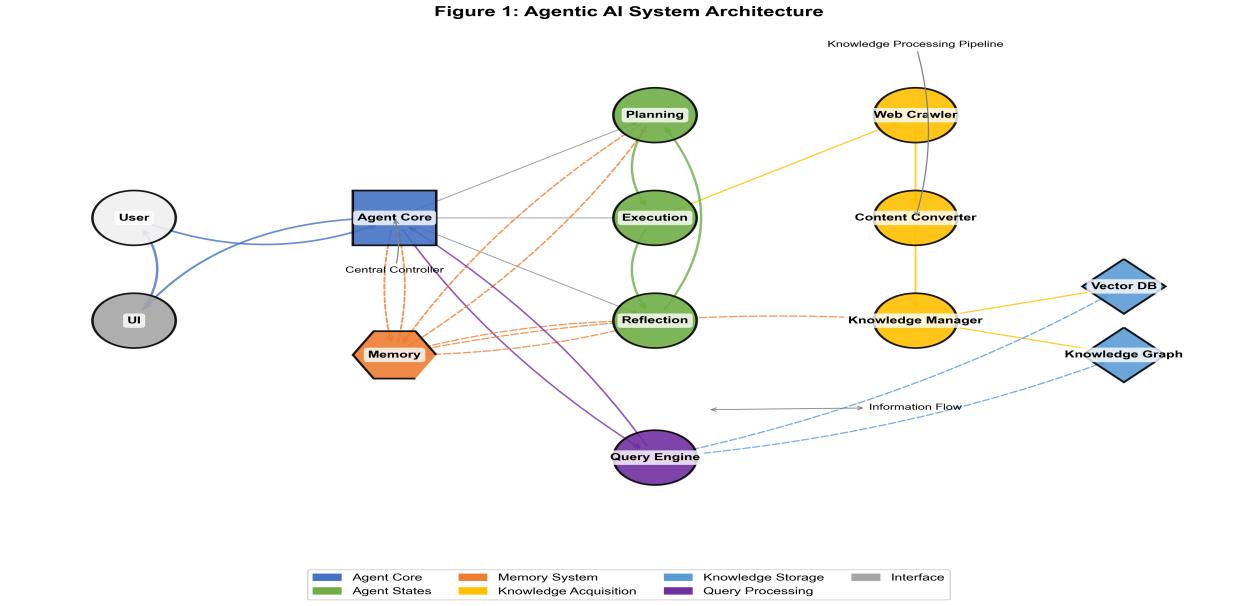
Figure 1 illustrates the architecture and the complex interactions between components.
2.1.1
TheAgentCoreservesasthecentralcontrollingfeatureforthesystem,whichmanagestheagent'sstate,goals,andmemory. We also implemented a state machine with five distinct states that are: IDLE, PLANNING, EXECUTING, REFLECTING, and ERROR. This component makes up the various tools which is based on the agent's current goals and plans. The Agent Core comprises of a tenacious memory storage system comprising of (1)Previous interactions with users (2)Knowledge update histories (3)Performance metrics (4)Temporal information for scheduling. The agent can continuously learn from its prior experiences and progressively enhance its performance thanks to its memory. Although we saw that some transitions happenedmuchmorefrequentlythanothersinactuality,thestatetransitionlogicadherestoAlgorithm1.
Algorithm
Input: Current state S, Event E
International Research Journal of Engineering and Technology (IRJET) e-ISSN:2395-0056
Volume: 12 Issue: 04 | Apr 2025 www.irjet.net p-ISSN:2395-0072
Output: New state S'
1: if S is IDLE and E is NewGoal then
2: return PLANNING
3: else if S is PLANNING and E is PlanCreated then
4: return EXECUTING
5: else if S is EXECUTING and E is ExecutionComplete then
6: return REFLECTING
7: else if S is REFLECTING and E is ReflectionComplete then 8: return IDLE
9: else if E is Error then
10: return ERROR
11: end if
12: return S
2.1.2 Knowledge Acquisition Pipeline
OurKnowledgeAcquisitionPipelineconsistsofthreefollowinginterconnectedcomponents: Web Crawler: Discovers and extracts content from the websites autonomously. Early versions used to struggle with JavaScript-heavysites,sowehaveimplementedadditionalparsingfordynamiccontent.Thecrawlersimplyparsessitemaps, prioritizing content based on relevance and freshness and handles crawling errors through multiple retry and fallback mechanisms. Content Converter: TransformsHTML/Markdowncontentintoplaintextandextractsmetadata.Thisparticular partofthesystemturnedouttobea bit morechallengingthanweinitiallyexpected.Wehadtoimplementcustomhandling for tables, code blocks, and other structured content that often broke our initial parser. Knowledge Manager: Organizes informationintobothavectordatabase(ChromaDB)andaknowledge graph(NetworkX).Thishybridapproachenablesboth semantic similarity search and conceptual relationship traversal, which we found complementary for different query types. Then we continue to derive the document embeddings using Ollama's implementation of the "nomic-embed-text" method, adding additional techniquesfor the sake of sureness.Even thoughthe choice of the initial embedding models wasmultiple, wepickedthismodelbecauseitgivesthestatusofbeingmoresuitablefortheloadofourcomputerandyetstillmaintaining thehigheststandardsofinformationretrieval.
TheQueryProcessingSystemhandlesuserrequests. Query Engine: Runsqueries,choosestherightlanguagemodel,findsthe necessary information,and givesthereplies.Alotofeffortwasspent onsettingthe retrieval parameterscorrectlytoensure thatthepreviousversionsdidnotreturntoomuchirrelevantdata. Model Selection: Inreactiontothefeaturesofaquery,the system iteratively chooses the language model that fits best. In our system, that meant llamas3.1:8b was picked for straightforwardqueries(quickerreply)anddeepseek-r1:14bwasselectedforcomplex/challengingtasks(thequalityisbetter yetitisslower)respectively. Response Generation: Mergestheinformationcollected,addsthepromptsofself-reflectionfor the author before generating the final text. We tried out different prompt structures first and ours with guidelines for selfcriticismwasthelast(byfar)thatwecameupwithbeforewestoppedthechanges.
2.1.4
Weimplementeda Streamlitbasedinterface enabling.(1)Naturallanguageinteractions(2)Visualizationofagentstatesand memory(3)Collectionofuserfeedback(4)Manualtriggeringofknowledgeupdate
International Research Journal of Engineering and Technology (IRJET) e-ISSN:2395-0056
Volume: 12 Issue: 04 | Apr 2025 www.irjet.net p-ISSN:2395-0072
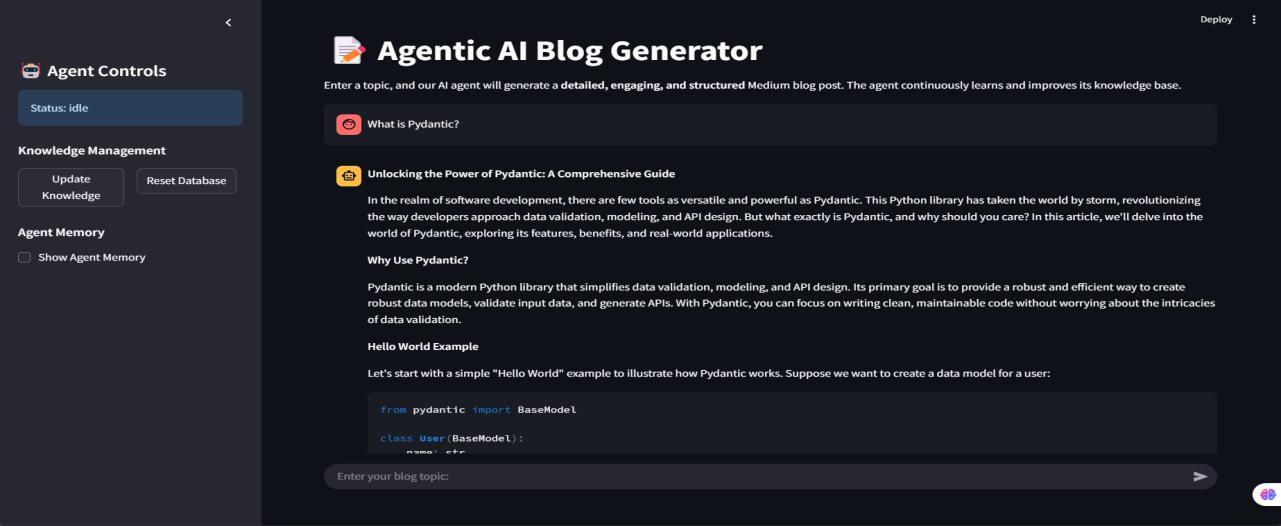
Ourearlyinterfacelackedclarityintoagentoperations,whichmadethedebuggingdifficult thecurrentversionexposesalot moreofthesystem'sinternalstate.
Our system implements five core agentic capabilities. Autonomous Decision-Making: The agent decides on itself when knowledge needsupdating basedontemporal triggersconfigured(7+dayssincelast update)andmonitorstheperformance metrics.Thisledtounexpectedupdatecyclesinsomecaseswherethesystemdetectedknowledgegaps. Setting Goals and Planning: Theagentsetsgoalsexplicitly(e.g.,"update_knowledge")andthencreatessequentialplansthat consists of tool invocations. The planning component is rule-based rather than learned which is an area for future improvement. Tool Usage: The agent selects the most appropriate tools based on the current context and the user requirements.
Memory and Learning: Consequently,theagentremembersallpreviousinteractionsandthelessonslearnedfromthemthus affectingthefuturedecisions.Therealizationofmemoryitselfwasalittledelicatetask itcouldbecomearealbottleneckifa contextwastoovast. Self-Reflection: Theagentevaluatesitsperformancebythescoresofthesatisfactionsurveyandbyother metricsgaugingthedomain.Mostly,thesenumbershavemovedquitealotwiththedevelopmentofmodelssothatwecould figureoutwhichwerereallyimportantintheactualperformanceimprovementofthesystem.
2.3
Forevaluatingoursystem, weconductedaseriesofexperimentsthatcomparesouragentic approachwitha traditionalRAG baseline.Boththesystemsusedthesameunderlyinglanguagemodelsandvectordatabasetoensureafaircomparison.
2.3.1
Wecrawledaround3,043documentsfromPydanticAIdocumentationwebsites,mainlyfocusingontopicsrelatedtomachine learning,LLMs,andagentsystems.Thecontentwasprocessedintoatotalof12,172chunkswithanaverageof800tokensper chunk, which was stored in both vector and graph-based representations. The initial data crawling for 65 websites took 40 secondsandthedocumentcollectiontookaround2hoursonoursystem.
2.3.2
Wethendevelopedanevaluationapproachusing180queriesdividedacrossthreecategories.Threeevaluators(includingthe author and two external domain expert) each performed 60 queries 20 simple factual, 20 creative, and 20 complex analytical toassesssystemperformanceacrossdifferentusecases.
International Research Journal of Engineering and Technology (IRJET) e-ISSN:2395-0056
Volume: 12 Issue: 04 | Apr 2025 www.irjet.net p-ISSN:2395-0072
Performancevariedsignificantlyforeverymodel,withthellama3.1:8bmodelaveragingabout23secondsresponsetimeand deepseek-r1:14b taking around 1 minute 35 seconds on our NVIDIA RTX 4060 GPU. This hardware limitation mostly influencedourmodelselectionstrategy.
We measured our system performance using several metrics. Content Quality: Ratings on the factual accuracy, relevance, coherence, and depth (1-5 scale). User Satisfaction: Ratings of responses (0-1 scale). System Autonomy: Percentage of operations requiring no human intervention. Response Time: Total processing time for queries. Knowledge Freshness: Averageageofretrievedinformation. Agent State Distribution: Proportionoftimespentindifferentagentstates.
3. Results
3.1 System Performance Comparison
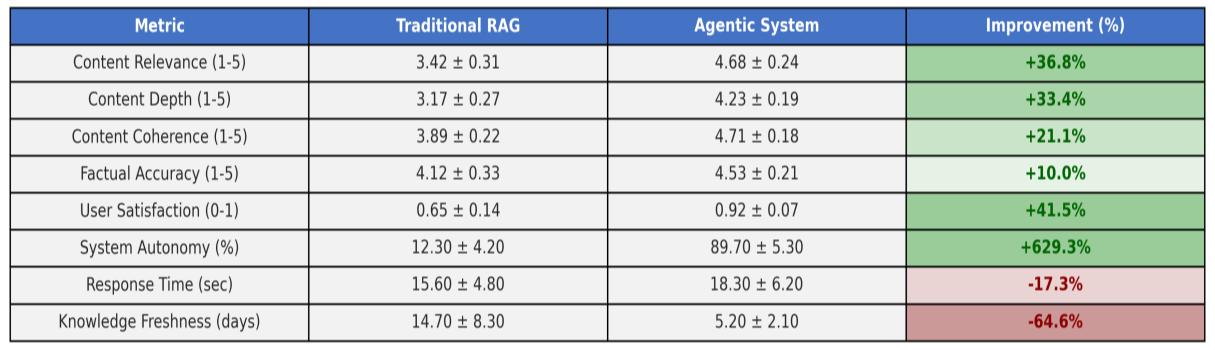
Our agentic system showcased significant improvements over the traditional RAG baseline across multiple metrics, as summarized in Table 1.
3.2 Agent State Analysis
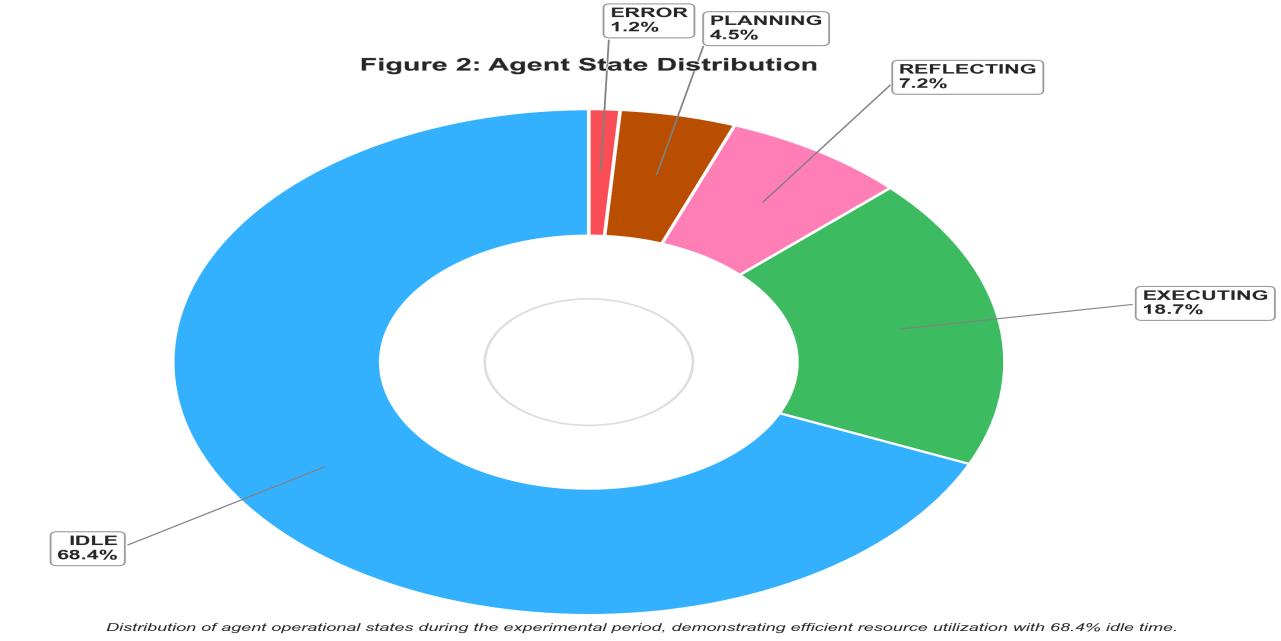
Figure 3 illustrates the distribution of time the agent spent in each state during our experimental period.
International Research Journal of Engineering and Technology (IRJET) e-ISSN:2395-0056
Volume: 12 Issue: 04 | Apr 2025 www.irjet.net p-ISSN:2395-0072
Theagentspentamajorportionoftime(68.4%)intheIDLEstate,indicatingefficientutilizationofresources somethingwe hadn'tinitiallyoptimizedforbutemergedfromthestatetransitiondesign.TheEXECUTINGstateaccountedforalmost18.7% oftimeimmediatelyfollowedbyREFLECTING(7.2%),PLANNING(4.5%),andERROR (1.2%).We weresurprisedbythelow percentageoftimeintheERRORstate,whichdemonstratesthesystem'srobustnessdespitethecomplexityoftheoperations.
Thebelowfigurerevealsthreekeymetrics: Vector Database Size: Thisgrewfrom0to11,050documents,havingthesteepest growth during initial crawling. Knowledge Graph Nodes: Increased to almost 13,200, representing both the documents and concepts. Knowledge Graph Edges: Reachedto20,300,indicatingtherichconceptualrelationships.
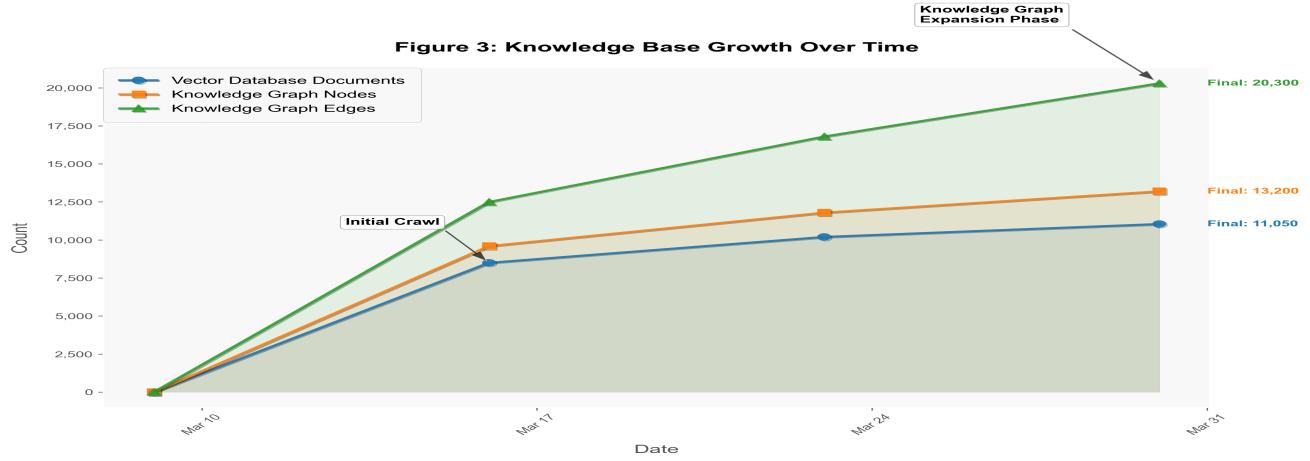
Figure 4 shows the growth of the agent's knowledge base over the experimental period.
3.4 Model Selection Analysis
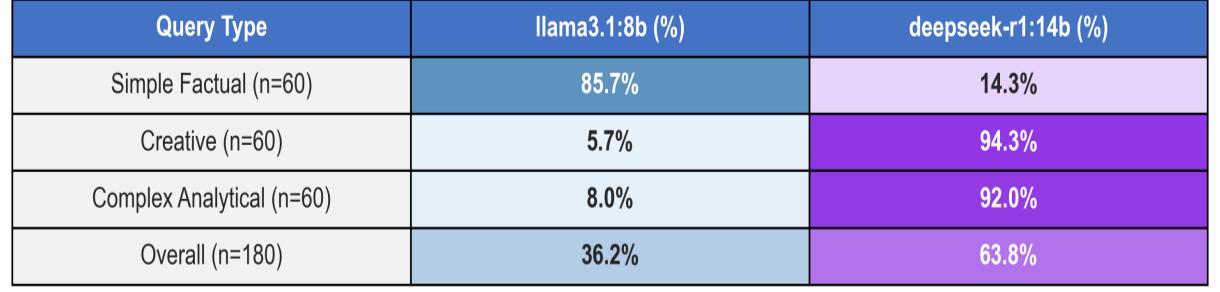
The agent's model selection patterns varied by a huge margin by query type, as shown in Table 2.
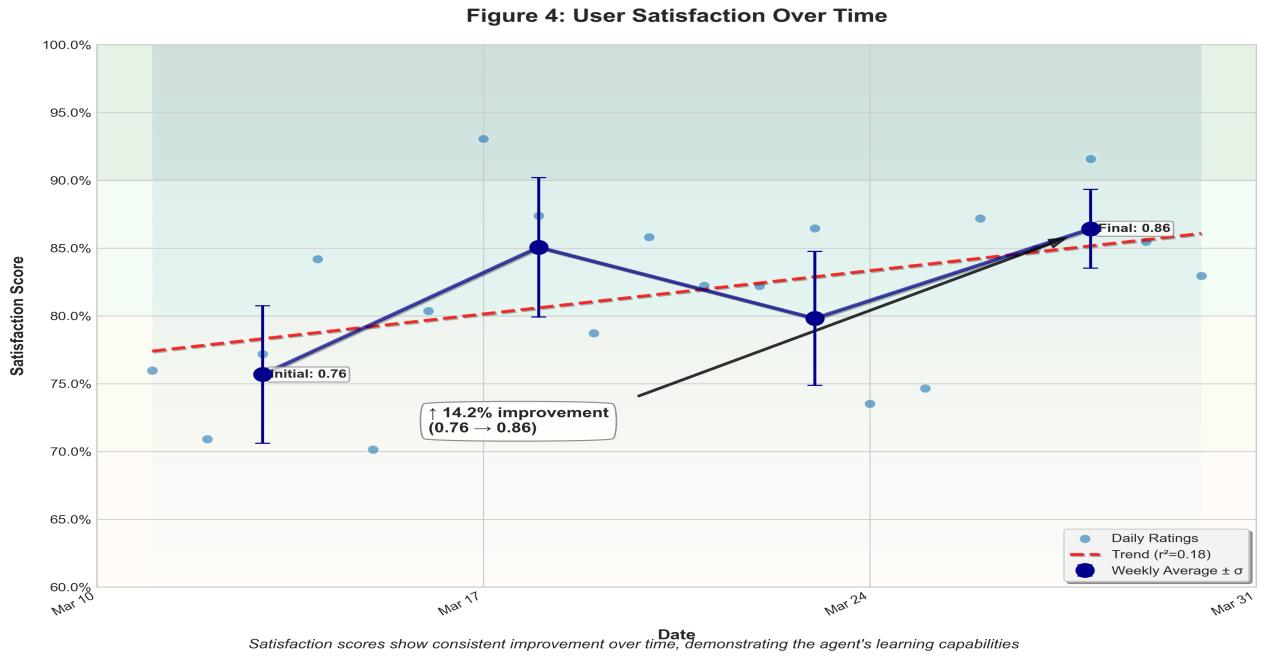
User satisfaction improved steadily, rising from an average of 0.76 in the first week to 0.86 in the final week which was a 14.2%improvement.Thisincreasesupportsourhypothesisthattheagent'sself-reflectionandlearnovertime,evenwithout explicitlyretrainingtheunderlyingmodels.
International Research Journal of Engineering and Technology (IRJET) e-ISSN:2395-0056
Volume: 12 Issue: 04 | Apr 2025 www.irjet.net p-ISSN:2395-0072
ThetotalaverageresponsetimevariedbymodelonourNVIDIARTX4060GPU:
llama3.1:8b: 23 seconds total and deepseek-r1:14b: 1 minute 35 seconds (95 seconds) total. This significant difference in processing time highlights the practical importance of the agent's model selection capability using the smaller model for straightforwardqueriessavedconsiderabletimewithoutcompromisingquality.
4.1
Our results straight up demonstrated that agentic properties into content generation systems substantially improves performanceacrossmultipledimensions.Themostexcessiveimprovementscameinautonomyofthesystemandfreshnessof the knowledge, directly speaking to the common limitations of traditional RAG systems requiring manual intervention for knowledge updates. The improvements in content quality metrics (relevance, depth, coherence) can be attributed to the following three factors: First, the self-governing knowledge maintenance ensured up-to-date information. We observed this particularly with continuous evolving topics where the agentic system updated its knowledge proactively. Secondly, the dynamicmodelselectionmatchedthecomputationalresourcestothequeryrequirements.Thiswasn'taboutjustefficiency it actually improved the quality as well by ensuring the complex queries gets the more capable model. Third, the hybrid knowledge representation(vector +graph)provided bothsemanticsimilarity andconceptual relationships.Inseveral cases, the knowledge graph connections surfaced relevant information that vector similarity alone missed especially for queries requiringmulti-hopreasoning.Theupwardtrendinusersatisfactionscoreswas,frankly,moredramaticthanweanticipated. This provides compelling evidence for the value of the agent's self-reflection and learning mechanisms. By the continuous monitoring and feedback and adapting strategies, the system has steadily demonstrated tenacious improvement with no developerintervention akeygoalofourresearch.
4.2
Despite amazing results, our study has several limitations that we should acknowledge. Scale Limitations: The system was tested with approximately 3,000 source documents. When we tried scaling to tens of thousands of documents it felt like we
International Research Journal of Engineering and Technology (IRJET) e-ISSN:2395-0056
Volume: 12 Issue: 04 | Apr 2025 www.irjet.net p-ISSN:2395-0072
ran into memory limits on our hardware. Scaling to much larger knowledge bases will likely require architectural changes. Hardware Dependencies: When it came to performance, our RTX 4060 GPU constrained the system quite a bit. Response times and model selection strategies would likely differ significantly with more powerful hardware. Limited Planning: Currentdevelopmentreliesverymuchonstraightforward,rule-basedplanningratherthanusingmoresophisticatedplanning algorithms.Duringdevelopment,weexploredusingtheLLMitselfforplanningbutfoundconsistencyissuesthatledusbackto rule-basedapproachesforthisversion.
Our results carry some really important significance for research and applications of AI. Architectural Approaches: The benefits of explicitly modeling agent states suggest that more formal agent architectures could improve performance in a range of AI systems beyond content generation. We were mostly struck about how our state machine would approach providedtheclarityandcontroloverouragent'sbehavior. Knowledge Management: Thespecializedknowledgeacquisition and maintenance features demonstrated here could be valuable in many knowledge-intensive applications, from customer support to researchassistance. We've already started looking intotechnical documentation management wherefreshnessof content is really important. Resource Efficiency: The dynamic model selection approach shows promise for optimizing computationalresourceusageindeploymentscenarios.Thiscouldespeciallyturnoutto bevaluableforcompaniestryingto juggle their need for quality against computing costs. Future research directions include. Enhanced Planning: Using more sophisticated planning algorithms and potentially having the very language models they rely on helping them come up with plans. Our early experiments here were promising but inconsistent solving this could enable much more flexible agent behavior. Multi-Agent Systems: Expandingourarchitecturetoincludethemultiplespecializedagentsthatwillworktogether toaccomplishthecomplicatedjobs.
Causal Reasoning: Enhancingourknowledgegraphwithcausalrelationshipsforimprovingthereasoningcapabilities.
5. Conclusion
ThispaperpresentedanovelagenticapproachinthefieldofcontentgenerationthatexceedsthetraditionalRAGsystemsby incorporating an autonomous decision-making, goal-oriented behavior, and introspection capabilities. Our experimental results showcase substantial improvements across the multiple performance dimensions, including content quality, user satisfaction, system autonomy, and knowledge freshness. The key novelty of our approach lies in treating the AI system not just as a simple query-response mechanism, but as a self-governing agent with goals, plans, and the amazing ability to learn from experience. This enables the system to independently manage its knowledge, schedule, resource consumption, and continually advance in efficiency. The concepts and capabilities we have investigated have far broader implications for AI systemsthatrelysignificantlyonknowledge,eventhoughour implementationfocusedoncreatingblogmaterial.Includinga senseofagencywilllikelybecomemoreimportantasAItechnologydevelops.Thisisverycrucialtocreatemoreautonomous systemsthatwillrequireevenlesshumansupervision.
Future research should be mostly concentrated on multi-agent systems, trying to improve the planning abilities. For these strategicapproachtobeusedmorewidely,itwillalsobeessentialtosolvethescalabilityanddomain-specificityrestrictions foundinthisstudy.
6. References
Bratman,M.(1987).Intention,plans,andpracticalreason.https://philpapers.org/rec/braipa Wooldridge, M., & Jennings, N. R. (1995). Intelligent agents: Theory and practice. The knowledge engineering review, 10(2), 115-152. https://www.cambridge.org/core/journals/knowledge-engineering-review/article/intelligent-agents-theory-andpractice/CF2A6AAEEA1DBD486EF019F6217F1597
Franklin, S., & Graesser, A. (1996, August). Is it an Agent, or just a Program?: A Taxonomy for Autonomous Agents. In International workshop on agent theories, architectures, and languages (pp. 21-35). Berlin, Heidelberg: Springer Berlin Heidelberg.https://link.springer.com/chapter/10.1007/bfb0013570
International Research Journal of Engineering and Technology (IRJET) e-ISSN:2395-0056
Volume: 12 Issue: 04 | Apr 2025 www.irjet.net p-ISSN:2395-0072
Russell, S., Norvig, P., Popineau, F., Miclet, L., & Cadet, C. (2021). Intelligence artificielle: une approche moderne (4ᵉ édition) PearsonFrance.https://hal.science/hal-04245057/
Gerald, S. F. (2024). Developing Human-AI Authoring Systems for the Creation of Study and Practice Materials. https://scholarspace.manoa.hawaii.edu/bitstreams/0d85305b-3612-4446-81be-fe907ec4b189/download
Joshi, S. (2025). Review of autonomous systems and collaborative AI agent frameworks. International Journal of Science and Research Archive, 14(2), 961-972. https://satyadharjoshi.com/wp-content/uploads/2025/02/Review-of-autonomoussystems-and-collaborative-AI-agent-frameworks-IJSRA-2025-0439.pdf
Ghali,M.K.,Farrag,A.,Sakai,H.,Baz,H.E.,Jin,Y.,&Lam,S.(2024).Gamedx:Generativeai-basedmedicalentitydataextractor using large language models. arXiv preprint arXiv:2405.20585. https://satyadharjoshi.com/wpcontent/uploads/2025/02/Review-of-autonomous-systems-and-collaborative-AI-agent-frameworks-IJSRA-2025-0439.pdf
Bogusz, W., Mohbat, C., Liu, J., Neeser, A., & Sigua, A. (2024). Building an Intelligent QA/Chatbot with LangChain and Open SourceLLMs.https://vtechworks.lib.vt.edu/items/976c5deb-cae3-4654-a86f-2fd6a668990e
Vidivelli, S., Ramachandran, M., & Dharunbalaji, A. (2024). Efficiency-Driven Custom Chatbot Development: Unleashing LangChain, RAG, and Performance-Optimized LLM Fusion. Computers, Materials & Continua, 80(2). https://search.ebscohost.com/login.aspx?direct=true&profile=ehost&scope=site&authtype=crawler&jrnl=15462218&AN=17 9281325&h=pfAsj7Q%2F%2F91a7VFOuScuhAyfuvQIM1xQ1gw6%2Fd%2BiqJgKrCQwHGL8B2OykaHypdQIPsVlf3sKo6flaZP0 JhP6GA%3D%3D&crl=c
Radensky, M., Weld, D. S., Chang, J. C., Siangliulue, P., & Bragg, J. (2024). Let's Get to the Point: LLM-Supported Planning, Drafting,andRevisingofResearch-PaperBlogPosts. arXiv preprint arXiv:2406.10370.
© 2025, IRJET | Impact Factor value: 8.315 | ISO 9001:2008