
International Research Journal of Engineering and Technology (IRJET) e-ISSN: 2395-0056
Volume: 13 Issue: 04 | Apr 2026 www.irjet.net p-ISSN: 2395-0072
International Research Journal of Engineering and Technology (IRJET) e-ISSN: 2395-0056
Volume: 13 Issue: 04 | Apr 2026 www.irjet.net p-ISSN: 2395-0072
Keerthi Krishna M1, Karan Singhal2, Neon Nixan3, Madan NS4, Mohammed Zayan5
¹² Student, School of Computer Science and Information Technology, Jain (Deemed-to-be University), Jayanagar, Bangalore, Karnataka – 560041, India
³⁴⁵ Student, School of Commerce, Jain (Deemed-to-be University), Jayanagar, Bangalore, Karnataka –560041, India
Abstract -Corporate Social Responsibility has evolved from a philanthropic activity into a strategic mechanism that enables non-governmental organizations and shelter homestoachievemeasurablesocialimpact.Itfacilitatesthe alignment of corporate resources, including funding, employeevolunteering,andinfrastructuresupport,withthe operational needs of non-governmental organizations working for marginalized communities. Key areas of intervention include education, skill development, healthcare, infrastructure support, and community outreachprograms.Thisstudyexaminestheeffectivenessof corporate social responsibility initiatives in strengthening non-governmental organization capabilities and enhancing social outcomes. A conceptual Corporate Social Responsibility–Non-Governmental Organization–Social Impactframeworkisproposedtoillustratetherelationship between corporate support, organizational capacity building, and measurable societal benefits. The research is based on secondary data sources, including corporate sustainability reports, non-governmental organization case studies, government policy guidelines, and relevant academic literature. The findings indicate that education and skill development initiatives generate the highest level of social impact, followed by healthcare programs, while infrastructure development and community outreach contribute to long-term sustainability. The study also identifies key challenges such as funding limitations, insufficient volunteer expertise, and misalignment between corporate objectives and non-governmental organization needs. The results highlight the importance of strategic planning, outcome-based evaluation, and effective partnerships between corporations and non-governmental organizations to enhance the efficiency, scalability, and sustainabilityofcorporatesocialresponsibilityinitiatives.
Key Words: Corporate Social Responsibility, NonGovernmental Organizations, Shelter Homes, Social Impact, Strategic Partnerships, Community Development, CapacityBuilding,SustainableDevelopment.
Corporate Social Responsibility has evolved from a philanthropic practice into a strategic approach that enables organizations to address social, economic, and
environmentalchallengesalongsidebusinessobjectives.It emphasizes long-term value creation and sustainable developmentratherthanshort-termcharitableoutcomes. Such initiatives play a crucial role in strengthening the operational capacity of non-governmental organizations and shelter homes, which often function under resource constraints. Through financial assistance, employee engagement, infrastructure support, and technical expertise, organizations contribute to areas such as education, healthcare, skill development, and community welfare.
In India, Corporate Social Responsibility has been institutionalized through the Companies Act, 2013, mandating eligible corporations to allocate resources toward social development. While this has increased participation, challenges remain in ensuring effective implementation, strategic alignment, and measurable impact.
This study aims to address these challenges by analyzing existing initiativesand proposinga structured framework that links corporate resources with organizational capabilitiesandsocialoutcomes.
CorporateSocialResponsibilityhasbecomeakeydriverof sustainable development, enabling organizations to create shared value for both society and business. It supports non-governmental organizations and shelter homes in overcoming resource limitations and expanding their services.
Despite regulatory support, limited research examines CorporateSocialResponsibilityasastructuredmechanism fororganizationalcapacitybuilding,particularlyinshelter homes. A systematic framework is required to enhance effectivenessandimpact.
International Research Journal of Engineering and Technology (IRJET) e-ISSN: 2395-0056
Volume: 13 Issue: 04 | Apr 2026 www.irjet.net p-ISSN: 2395-0072
• ToexaminetheroleofCorporateSocial Responsibilityinorganizationalcapacitybuilding
• Toanalyzealignmentbetweencorporateinitiatives andsocialneeds
• Todevelopaframeworklinkingresources, capabilities,andoutcomes
The study focuses on Corporate Social Responsibility initiatives in India, particularly those supporting nongovernmental organizations and shelter homes, with emphasisonstrategiceffectivenessandsocialimpact.
This section reviews Corporate Social Responsibility frameworks, corporate–non-governmental organization partnerships, their impact on shelter homes, and existing researchgaps.
Corporate Social Responsibility has been explained through models that define corporate obligations toward society. Carroll’s pyramid classifies responsibilities into economic, legal, ethical, and philanthropic levels. Strategic approaches emphasize aligning social initiatives with corporate capabilities to create shared value. Recent studies focus on outcome-driven programs with measurableimpactandlong-termsustainability.
2.2 Corporate-Non-Governmental Organization Alignment
Effective Corporate Social Responsibility requires alignment between organizational objectives and nongovernmental organization capacities. Such partnerships enhance resource utilization, operational efficiency, and sustainability through financial support, volunteer engagement,andtechnicalexpertise.
2.3 Impact on Shelter Homes and NonGovernmental Organizations
Initiatives targeting shelter homes primarily focus on education, healthcare, skill development, and infrastructure. These contribute to improved service delivery, expanded outreach, and better efficiency. However, challenges include limited monitoring, gaps in volunteerexpertise,and misalignment withorganizational needs.
Despite extensive research, limited studies examine CorporateSocialResponsibilityasastructuredmechanism for capacity building in non-governmental organizations. Few frameworks clearly link corporate contributions to sustainable social outcomes, indicating the need for a systematicapproach.
This study adopts a mixed-method approach to examine the role of Corporate Social Responsibility in enhancing non-governmental organization capacity and generating measurable social outcomes. By integrating quantitative and qualitative methods, the research provides a comprehensiveevaluationofinitiativeeffectiveness.
A descriptive and analytical design is employed. Quantitativedataarederivedfromcorporatesustainability reports and non-governmental organization case studies, while qualitative data are obtained through analysis of government guidelines, academic literature, and international frameworks. This combined approach ensuresreliableandwell-validatedfindings.
Data are collected from multiple sources to capture both operationalandprogram-levelinsights:
• Corporate reports covering budget allocation, programtypes,andbeneficiaryreach
• Non-governmental organization case studies highlightingpractices,outcomes,andchallenges
• Government and policy guidelines outlining regulatoryrequirementsandreportingstandards
• Academic literature providing theoretical frameworksandimpactassessmentmodels
Quantitative data are analysed using descriptive methods to assess program reach, resource utilization, and impact. Qualitative analysis is conducted through content analysis to identify key themes related to capacity building, challenges, and partnership effectiveness. The integration ofbothmethodssupportsabalancedevaluation.
A conceptual Corporate Social Responsibility–NonGovernmental Organization–Social Impact framework is developedtoillustrate the relationshipbetweencorporate inputs, organizational capacity, and social outcomes. It
International Research Journal of Engineering and Technology (IRJET) e-ISSN: 2395-0056
Volume: 13 Issue: 04 | Apr 2026 www.irjet.net p-ISSN: 2395-0072
highlights the flow from resource allocation to improved service delivery and community impact, supported by continuousevaluationmechanisms.
The study focuses on Corporate Social Responsibility initiatives in India, particularly those involving nongovernmental organizations and shelter homes. Limitations include reliance on secondary data and variationsinreportingpractices.Despitetheseconstraints, the methodology provides meaningful insights into effectivenessandcapacitydevelopment.
This section presents the findings on the impact of Corporate Social Responsibility initiatives on nongovernmental organization capacity and social outcomes basedonbothquantitativeandqualitativeanalysis.
4.1 CSR Program Distribution
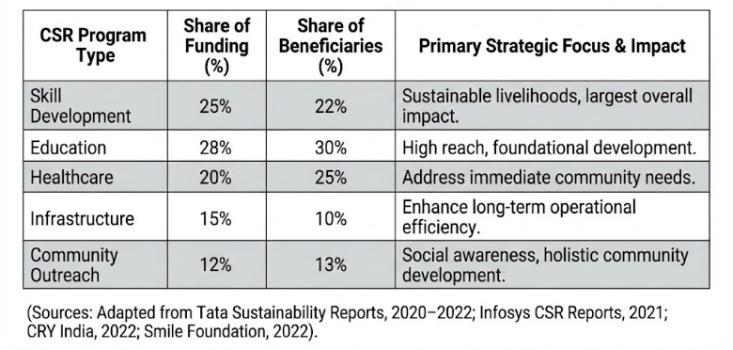
Analysis shows that Corporate Social Responsibility initiatives are concentrated in education, skill development, healthcare, infrastructure, and community outreach. Education and skill development receive the highestfocusintermsoffundingandbeneficiaries.
The distribution of CSR programs across key sectors is presentedinTable1.
Table 1: DistributionofCSRProgramsandBeneficiaries
Discussion:
Education and skill development programs demonstrate the highest impact due to their focus on long-term sustainability and employment generation. Healthcare programs address immediate needs, while infrastructure and outreach contribute to overall community development.
ThecomparativeimpactofdifferentCSRprogramtypes isillustratedinFigure1.
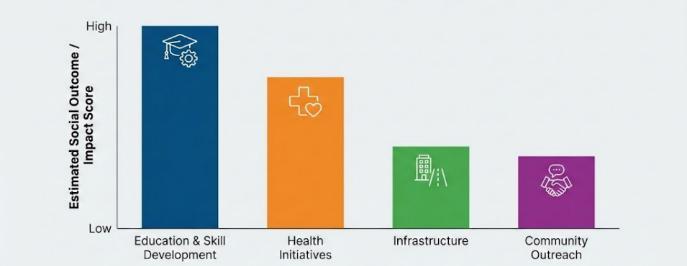
Fig-1: ComparativeimpactofCSRprogramtypeson beneficiaries
Discussion:
Educationandskilldevelopmentprogramsgeneratethe highest outcomes, followed by healthcare initiatives. Infrastructure and outreach programs, although lower in scale,supportorganizationalefficiencyandengagement.
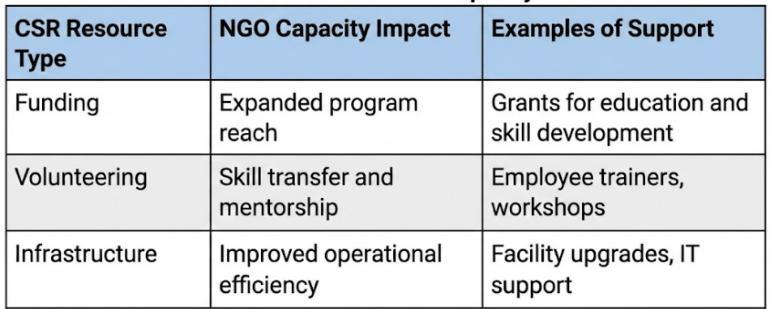
Corporate resources such as funding, employee volunteering,andinfrastructuresupportplayakeyrolein strengtheningorganizationalcapacity.
The contribution of corporate resources to capacity enhancementisshowninTable2.
Table 2: CorporateresourcecontributionandNGO capacityenhancement
Discussion:
Combined financial and technical support improves operational efficiency and enables organizations to scale theiractivities,resultinginlong-termimpact.
International Research Journal of Engineering and Technology (IRJET) e-ISSN: 2395-0056
Volume: 13 Issue: 04 | Apr 2026 www.irjet.net p-ISSN: 2395-0072
The proposed Corporate Social Responsibility–NonGovernmental Organization–Social Impact framework is illustratedinFigure2.
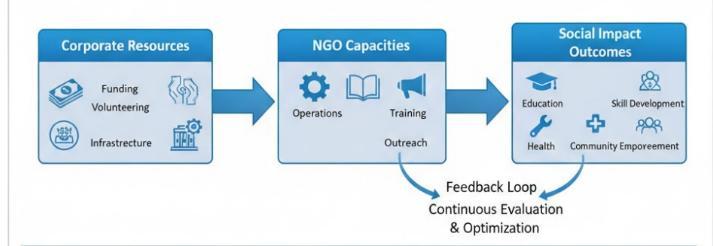
Fig-2: CorporateSocialResponsibility–Non-Governmental Organization–SocialImpactframework
Discussion:
The framework shows that corporate inputs strengthen organizational capacity, which leads to measurable social outcomes such as education, skill development, and communityempowerment.Continuous evaluation ensures sustainedeffectiveness.
4.5 Program Effectiveness Analysis
The effectiveness of different CSR program types is illustratedinFigure3.
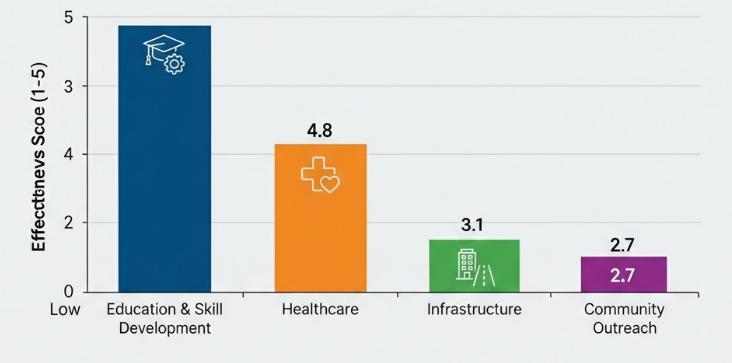
Fig- 3: ProgrameffectivenessbyCSRtype
Discussion:
Education and skill development programs are the most effective, followed by healthcare. Infrastructure and outreach provide supporting impact by improving efficiencyandengagement.
4.6Challenges and Limitations
Despitepositiveoutcomes,severalchallengesexist:
• Unevenfundingallocationacrossprograms
• Limitedvolunteerexpertise
• Misalignment between corporate priorities and organizationalneeds
These challenges highlight the need for better planning, monitoring,andalignmenttoimproveeffectiveness.
This study establishes that strategically designed Corporate Social Responsibility initiatives play a significant role in enhancing the capacity of nongovernmental organizations and shelter homes, converting corporate resources into measurable social outcomes. The findings validate the proposed Corporate Social Responsibility–Non-Governmental Organization–Social Impact framework, demonstrating that education and skill development programs generate the highest impact, while healthcare, infrastructure, and community outreachcontributetolong-termsustainability.
• Corporate–Organizational Alignment: Alignment between corporate priorities and organizational capacitiesimprovesefficiencyandsocialreach.
• Program Effectiveness: Education and skill development initiatives produce the highest outcomes, while other programs address essential communityneeds.
• Resource Integration: Combining financial, technical, and volunteer support strengthens operationsandimproveslong-termimpact.
• Balanced Approach: Financial support ensures measurable results; while volunteering and infrastructureenhancequalitativeoutcomessuchas engagementandefficiency.
• Adoption of outcome-based measurement to assess bothquantitativeandqualitativeimpact
• Strategic focus on high-impact sectors such as educationandskilldevelopment
• Emphasis on capacity building through training and technicalsupport
• Implementation of continuous monitoring and feedbackmechanismstoimproveeffectiveness
• Integration of digital tools for real-time monitoring anddata-drivendecision-making
• Expansion of frameworks to additional sectors such asenvironmentalandruraldevelopment
• Comparative studies across regions to understand variationsinimpactandimplementation
International Research Journal of Engineering and Technology (IRJET) e-ISSN: 2395-0056
Volume: 13 Issue: 04 | Apr 2026 www.irjet.net p-ISSN: 2395-0072
• Long-term studies to evaluate sustainability and scalabilityofinitiatives
In conclusion, Corporate Social Responsibility should be viewed as a strategic tool for sustainable social developmentratherthanapurelyphilanthropicactivity.A structured and integrated approach can significantly enhance both organizational capacity and societal outcomes.
[1] A. B. Carroll, “The pyramid of corporate social responsibility: Toward the moral management of organizational stakeholders,” Business Horizons, vol. 34,no.4,pp.39–48,1991.
[2] A.B.CarrollandK.M.Shabana,“Thebusinesscasefor corporate social responsibility: A review of concepts, research and practice,” International Journal of ManagementReviews,vol.12,no.1,pp.85–105,2010.
[3] M. Porter and M. Kramer, “Strategy and society: The link between competitive advantage and corporate social responsibility,” Harvard Business Review, vol. 84,no.12,pp.78–92,2006.
[4] D. Chandler, Strategic Corporate Social Responsibility: SustainableValueCreation,SagePublications,2015.
[5] A. Crane, D. Matten, and L. Spence, Corporate Social Responsibility: Readings and Cases in a Global Context, Routledge,2019.
[6] Organisation for Economic Co-operation and Development (OECD), “OECD Guidelines for MultinationalEnterprises,”2018.
[7] Ministry of Corporate Affairs, Government of India, “CompaniesAct,2013andCSRPolicyRules,”2018.
[8] Ministry of Corporate Affairs, Government of India, “National Guidelines on Responsible Business Conduct,”2019.
[9] TataGroup,“TataSustainabilityReports,”2020–2022.
[10] Infosys,“InfosysCSRReports,”2020–2022.
[11] SmileFoundation,“AnnualReport,”2022.
[12] ChildRightsandYou(CRY),“AnnualReport,”2022.
[13] World Bank, “Social Sustainability and Inclusion Reports,”2021.
[14] United Nations, “Sustainable Development Goals Report,”2022.
[15] United Nations Development Programme (UNDP), “Corporate Social Responsibility and Sustainable Development,”2020.
[16] KPMG, “India Corporate Social Responsibility ReportingSurvey,”2022.
[17] Deloitte, “Corporate Social Responsibility and SustainabilityReport,”2021.
[18] J. Elkington, Cannibals with Forks: The Triple Bottom Line of 21st Century Business, Capstone Publishing, 1997.