
International Research Journal of Engineering and Technology (IRJET) e-ISSN: 2395-0056
Volume: 11 Issue: 12 | Dec 2024 www.irjet.net p-ISSN: 2395-0072

International Research Journal of Engineering and Technology (IRJET) e-ISSN: 2395-0056
Volume: 11 Issue: 12 | Dec 2024 www.irjet.net p-ISSN: 2395-0072
Hitesh Raiyani 1 , H. S. Patil 2 , C. K. Desai 3
1Ph.D. Research Scholar, Gujrat Technological University. Assistant Professor, Mechanical Engineering Department L J Institute of Engineering and Technology, L J University, Ahmedabad, India
2 Professor and Head, Mechanical Engineering Department, GIDC Degree Engineering College, Abrama, Navsari, India
3Associate Professor and Head, Mechanical Engineering Department, C.K. Pithawala College of Engineering and Technology, Surat, India
Abstract - Fiber metal laminates (FMLs) are innovative hybrid composite materials formed by laminating metal alloy sheets with composite layers, aimed at improving mechanical properties and fracture resistance. This study focuses on the development of FMLs, specifically exploring the influence of thickness variations on their mechanical properties and fracture behavior. The research examines the impact of size effects on the nominal strength and fracture characteristics of Natural Bamboo Fiber Metal Laminates (NB-FMLs). FMLs were initially fabricated with a thickness of 1.8 mm to assess their mechanical properties, and then a reduced thickness of 1.5 mm was used to analyze the effect on strength. 2D scaled specimens were prepared with size ratios of 1:1, 1:2, and 1:4, with rectangular samples of 25 mm, 13 mm, and 6 mm in width, and corresponding lengths of 178 mm, 127 mm, and 101 mm, respectively, for the different scale ratios. A double notch was introduced at the center of each specimen to study the fracture characteristics in relation to size effects. The nominal tensile strength of the Natural Bamboo reinforced Fiber Metal Laminates, created by alternating layers of Al2024-T3 and bamboo-epoxy composite, was evaluated for each scaled model. The size effect parameter was determined by comparing the nominal strength across specimens. The tensile strength of the NB-FMLs was obtained using a Universal Testing Machine, followingASTM D 3039 standards. This paper provides an analysis of the tensile test results to determine the nominal strength ofFMLs andevaluates the size effect parameters, including the length of the fracture process zone (FPZ) and fracture energy, to predict the material's fracture behavior.
Key Words: FiberMetalLaminates,MechanicalProperties, NominalTensileStrength,EffectofchangingThicknessSize EffectLaw,FractureCharacteristics
1.INTRODUCTION
Fiber metal laminates (FMLs) have been recently developed using diverse materials and fibers to enhance mechanical properties, such as high strength, superior fatigueresistance,andimprovedfracturecharacteristics,to meet the demands of the automation and aerospace industries, which require lightweight structures with enhancedmechanicalandfractureproperties[1].Toaddress
these needs, hybrid FML structures have been created by alternating metal andcompositelayers [1,2, 3]. Materials like aluminum alloys (e.g., Al-2024-T3, [3,4,5] Al-7475-T6 [6,7,8]), titanium [2,9,10,11], magnesium [12,13], and reinforced fibers (such as glass, aramid, and carbon) are commonlyusedtofabricateFMLs.Recently,therehasbeena shift towards the development of eco-friendly FMLs by substituting natural fibers for traditional glass or carbon fibers.Epoxyresins,typicallymixedwithhardenersata10:1 ratio, are employed to form composite layers and as adhesives to bond metal and composite layers together [13,14].
ThehybridstructureofFMLsisformedthroughadhesive bondingofmetalalloysheetsandcompositelayers[3,15,16], makingthesurfacetreatmentofaluminumsheetscrucialto improving FML strength. Surface preparation techniques, suchasmechanicalabrasion,alkalinetreatment,anodizing, and etching, are commonly employed to enhance the bondingpropertiesbetweenlayers[3,13,16].Inaddition, alternative manufacturing methods, such as autoclave processingandresintransfermolding,havebeenadopted overtraditionalhand-layuptechniquesforFMLproduction. ThemechanicalpropertiesofFMLsdependonfactorssuch asthethicknessofthealuminumsheets,compositelayers, resin-to-fiber ratio, and overall laminate thickness. The overall mechanical properties of FMLs can be predicted usingtwomethods:MetalVolumeFraction(MVF)[9,11,17] and Classical Laminate Theory (CLT) [8,18]. While CLT providesmoredetailedpredictions,MVFisasimplermethod forestimatingpropertiesliketensilestrengthandmodulus ofelasticity.
StandardFMLstypicallyconsistofthinmetalalloysheets (0.2to0.5mm)andthincompositelayers(0.2to0.3mm) with various fiber orientations. However, a significant challenge in FML development is the lengthy resin curing process. Additionally, during the cutting of FMLs, the possibilityofdelaminationbetweenlayerscanoccur.Cutting methods such as water jet cutting, wire cutting, and laser machining are commonly used. Water jet cutting is particularly effective for FMLs containing non-conducting materials,aslaserandwirecuttingmethodsmaystruggle with such materials. However, water jet cutting can cause
International Research Journal of Engineering and Technology (IRJET) e-ISSN: 2395-0056
Volume: 11 Issue: 12 | Dec 2024 www.irjet.net p-ISSN: 2395-0072
more delamination than the other methods, requiring optimization of parameters like water jet flow and nozzle distancetominimizethiseffect.
Thesizeeffectisanotherimportantconsiderationinthe design of FMLs, referring to how changes in specimen dimensionsinfluencetheir nominal strength. Asignificant sizeeffectisobservedincompositematerials,asthefracture energyreleaseisinfluencedbythepresenceofthefracture processzonenearthecracktip.In1984and1993,Bazant proposedthatforquasi-brittlecompositematerials,thesize effect transitions from plasticity in the absence of a size effecttolinearelasticfracturemechanicsasthesizeeffect becomesmoreprominent.Thenominalstrengthisdefined bythefailurestressofcrack-freeornotch-freespecimens. Therelationshipbetweensizeeffectandnominalstrength for geometrically similar specimens is described by the equation:
Where β is relative structure size, D0 is the constant depending on both fracture process zone and specimen geometry, D is characteristic dimensions, B is constant accordingtoplasticlimittheory,fu isreferencestrengthof material to make B dimensionless This size effect law appliestoboth2Dand3Dgeometricalsimilarities.In1Dand 3D scaling, tensile strength decreases as scaling size increases due to more delamination, while in 2D scaling, tensile strength increases as the size grows, as the delamination effect is more significant at smaller scales. Furthermore,mechanicalpropertiesgenerallyimprovewith anincreaseinspecimenwidth.Sizeeffectparametershave been measured to calculate the effective length of the fractureprocesszoneandthefractureenergyofmaterials [19].
The development of FMLs for aerospace applications is advanced for better strength and fracture toughness comparedtomonolithicmaterials.FML’sdevelopmentwith monolithic aluminum Al-2024-T3 has better fracture toughnessandfracturecharacteristicsthanpuremonolithic aluminum Al-2024-T3. The crack growth of monolithic aluminum Al-2024-T3 rapidly increases, while GLARE and ARALLFML’scrackgrowthareslowerandalmostconstant slowcrackgrowth[1].MechanicalpropertiesofZn-Al-based FMLweretestedusingaCMT5205electronicUTMmachine, considering the extensometer’s span length of 25mm to measuredeformation.Zn-Al-basedFML’sstrengthis103% comparedwiththeoriginalmagnesiumalloy[12].Theeffect of using alternative metal material, magnesium instead of aluminum,isstudied,anditobservedthatmagnesiumis1.55 timeslessheavythanaluminum withminordifferences in tensilestrength,bendingstrengthandimpacttoughness.So, magnesiumisbetterthanaluminiumforFML'sdevelopment
in the application where less weight is required by compromisingslightstrength[4].
Tensile-strength prediction of titanium-based FMLs with different fiber orientations between 0° to 90° with a 15degreedifferenceinfiberorientationiscarriedoutbytensile testing. It is predicted that as the fiber orientation angle increases, tensile strength decreases. FMLs with 0-degree fiber orientation give higher tensile strength, while FMLs with 90° fibber orientation give lower tensile strength of FMLs[18].
FMLswithcontinuousfilmstackinghavebetterproperties than monolithic steel plates with 0.8 mm thickness. FMLs with 2 mm thickness archive 29% weight reduction comparedwiththesteelplateof0.8mm[20].Itisbetterto use FMLs for lightweight structures. However, the scaling alsoaffectsthestrengthofFMLs.ThesizeofFMLsvariesin 1D, 2D and 3D and compared the normalized stress of all specimens. The normalized stress increases in 2D with increasesinthesizefactor,whilein1Dand3D,normalized stressdecreaseswithincreasesinthesizefactor[21].
The test specimens of FMLs were prepared following the ASTMD-3039standard[31]usingthemanufacturedFMLs sheets.ThespecimenswereextractedfromtheFMLssheets throughawaterjetmachiningprocess.AspertheASTMD3039 standard, rectangular specimens with dimensions of 250 mm(L) x 15mm (W)x1.8 mm(t) were cut fromthe FMLs sheet for the 0° fiber orientation, while specimens measuring175mm(L)x25mm(W)x1.8mm(t)werecut forthe90°fiberorientation,bothusingwaterjetmachining [16,22].
Quasi-static tensile tests were performed at a constant crossheaddisplacementrateof1mm/min[6,23,30,31]to evaluatethespecimens,whichhadgaugelengthsof138mm (forthe0°specimen)and125mm(forthe90°specimen). Thesetestswereconductedinaccordancewiththeguidelines and recommendations outlined in ASTM D3039 [16,22] to assessthemechanicalproperties.
Table -1: Tensilestrength(0°specimen)
International Research Journal of Engineering and Technology (IRJET)
Volume: 11 Issue: 12 | Dec 2024 www.irjet.net
Specimen Type
(Specimen 1)
(Specimen 2)
(Avg.)
Twospecimenswerepreparedandtestedtoensuregreater accuracy.Theload-deflectionandstress-straincurveswere recordedforallspecimensuntilfailureoccurred.Mechanical properties, including tensile strength and modulus of elasticity, were determined from the results of the tensile tests.
From the tensile test results, The Nominal strength of268 MPa, YieldStress of 189 MPa,and Modulus ofElasticityof 14708 MPa were recorded for the 0° fiber orientation specimenasshown in table 1 and the nominal strengthof 168 MPa, Yield Stress 148 MPa, and Modulus of Elasticity 6635MPawererecordedfor90°fiberorientationasshown intable2.Thesetestswereconductedinaccordancewiththe guidelinesandrecommendationsoutlinedinASTMD3039 [16,22]toassessthemechanicalpropertiesasmentionedin Table3.
ThetotalthicknessofFMLschangedto1.8mmto1.5mmby reducingthelayerthicknessofAl-2024-T3from0.4mmto 0.3mm.ThechangingthicknesseffectonFMLsiscarriedout bytestingofrectangularspecimenswithdimensionsof250 mm(L)x15mm(W)x1.5mm(t)werecutfromtheFMLs sheet for the 0° fiber orientation as shown in Fig-1, while specimensmeasuring175mm(L)x25mm(W)x1.5mm(t) were cut for the 90° fiber orientation as per the ASTM D3039standard,usingwaterjetmachining[16].
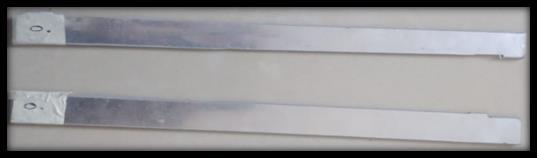
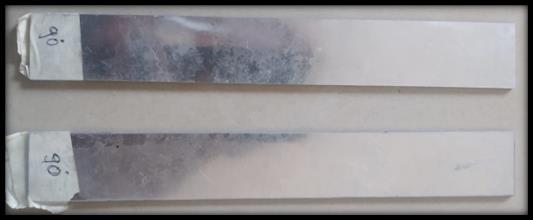
TheNominalstrength,YieldStress,andModulusofElasticity wererecordedforthe0°and90°fiberorientationspecimen asshownintable3andcomparisonofdifferentthicknessas shownintable4
Table -3: Tensilestrength(1.5mmThickness)
1)
2)
1)
(Specimen 2)
Table -4: TensilestrengthComparison(1.5mmand1.8 mmThickness)
ThethicknesseffectofFMLsevaluatedfromcomparisonof FMLsspecimenstest results asshownin Table4itshows that the better yield stress in 1.5 mm thickness in both 0°fiber direction and 90°fiber direction with 1.5 mm total FMLs thickness as compare with FMLs with total 1.8 mm thickness.
International Research Journal of Engineering and Technology (IRJET) e-ISSN: 2395-0056
Volume: 11 Issue: 12 | Dec 2024 www.irjet.net p-ISSN: 2395-0072
Fiber metal laminates (FMLs) are hybrid composite materialscomposedofalternatinglayersofthinmetalalloys and fiber-reinforced composites. In this investigation, the stacking sequence of the FMLs is arranged as follows: Al2024-T3 / Bamboo-epoxy Composite / Al-2024-T3 / Bamboo-epoxyComposite/Al-2024-T3.Threerectangular specimenswerefabricatedwiththefollowingdimensions: 25mm×178mm×1.8mm(SE-1),13mm×127mm×1.8 mm (SE-2), and 6 mm × 101 mm × 1.8 mm (SE-3), correspondingto1,½,and¼scalemodels,respectively.All the FML specimens were precision-cut using water jet machining.Adouble-notchwasintroducedatthecenterof eachspecimenusinga 1mmhandgrindertoexaminethe fracture behavior of the natural bamboo Fiber Metal Laminates. Figure 1 depicts the specimen with a central double-edge notch. The double-notch was fabricated according to the relationship a=B/16 [23], where a is the lengthofthenotchandBisthewidthofthespecimen.The nominaltensilestrengthofthescaledFML specimenswas evaluated as following ASTM D 3039 [23, 25,27-32] standards with crosshead speed kept at 1mm/min for all specimens[24,25,26]andgaugelengthofallspecimenskept the same as 38mm using an Instron Universal testing machine.
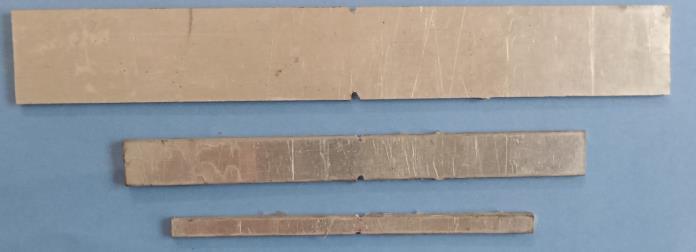
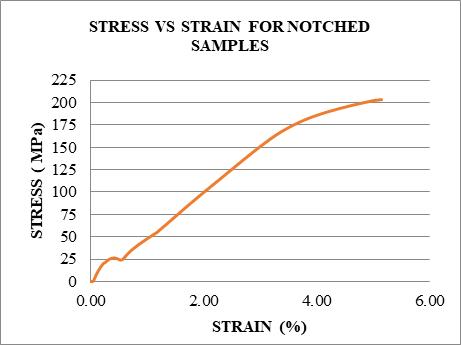
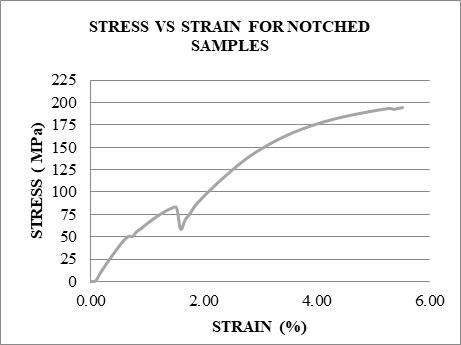
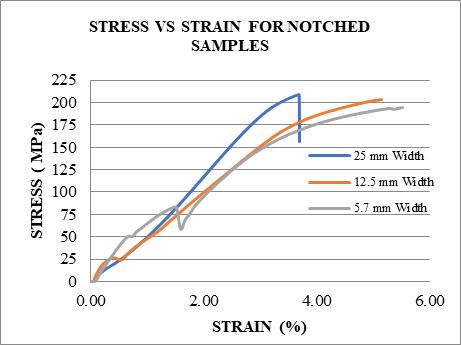
Combineallspecimens
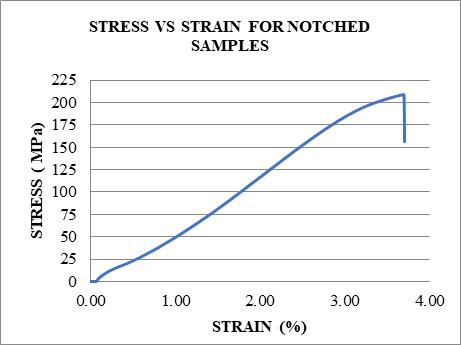
Chart -1:Stress(MPa)vsStrain(%)
Chart1showstheexperimentalresultsobtainedfromthe tensile test. The stress-strain diagram for large specimen dimensionsbehaveslikebrittlematerialwhilethesmall-size specimens behave like ductile materials. The size effect parameterforNaturalFiberMetalLaminateswascalculated basedonthenominaltensilestrengthobtainedfromtests
International Research Journal of Engineering and Technology (IRJET) e-ISSN: 2395-0056
Volume: 11 Issue: 12 | Dec 2024 www.irjet.net p-ISSN: 2395-0072
conducted on specimens of varying sizes. This parameter was determined through a regression analysis of the data derivedfromthetensiletesting.Incalculatingthesizeeffect parameter,thesizeeffectlaw,asrepresentedbyEquation1, wasapplied,withthefollowingconsiderationsincorporated intotheregressionanalysisprocess[23].
D=X
σN =Y(-0.5)
Y= σN -2 (GPa-2
Bfu=A-0.5
D0 = A/C= 1/(C(Bfu)2 )
Linearregressionequationobtainedforthesizeeffectlawin equation1basedontheaboveconsideration.
Y=A+CX
AregressionanalysisplottedYversusXinChart2byusing Minitabforgeometricallysimilarspecimens.
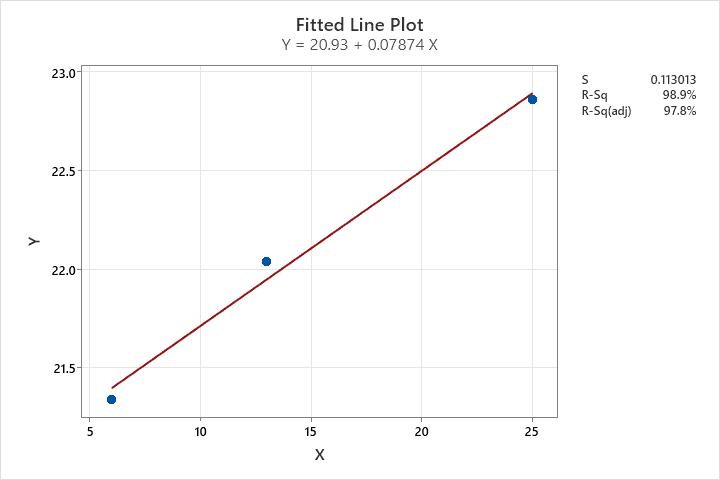
Chart -2:RegressionAnalysis
AregressionequationY=20.93+0.07874Xwasobtained byPlottingYversusXorfittingtheresultdatawiththesize effectlawbasedonnominalstrength. ThevalueofA=20.93 whichistheverticalinterceptandC=0.07874whichisthe slope, were obtained by comparing standard linear regressionequations.ThesizeeffectparameterD0 andBfu determinebyusingequation2.Theparameterofsizeeffect obtainedasfollows:D0 =265.81mmandBfu=218.58Mpa
5. FRACTURE CHARACTERISTICS BASED ON MEASURED SIZE EFFECT
The failure of Natural fiber metal laminates containing cracksornotchshowsasignificantsizeeffect.Thissizeeffect gradually converts from strength criteria to linear elastic fracturemechanicswithincreasesinsize.In1990,Bazant and Kazemi reported the size effect law in terms of the
nondimensionalized energy release-rateg(α)andobtains fracture energy of material (Gf) and effective length of fractureprocesszone(Cf)asfollows[2].

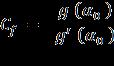


Where = , is initial crack length, value kept 1, and modulus of elasticity E = 15174.654 Mpa obtainedfromtensiletest.Fracturecharacteristicsinterms offractureenergyofmaterialandeffectivelengthoffracture processzonecanobtainby usingthemeasuredsize effect parameter. We obtain fracture characteristics as Gf = 0.99088 MJ/m2 and Cf = 31.52 mm for double notched naturalFiberMetalLaminates.
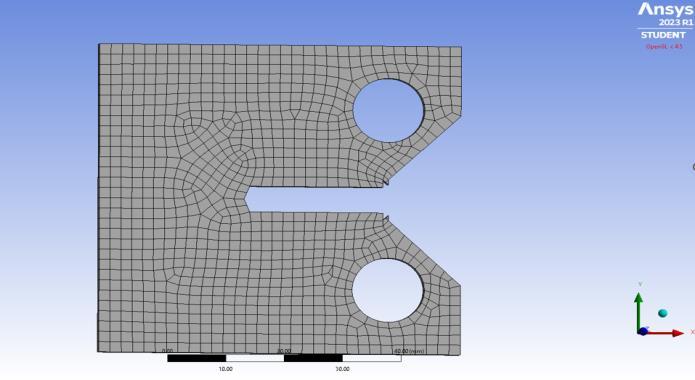
NumericalFractureTestingcarriedoutwithCTspecimenfor stressintensityfactorofFMLs.Fig-3Showstheboundary conditionandresultsobtainfromnumericalanalysis.
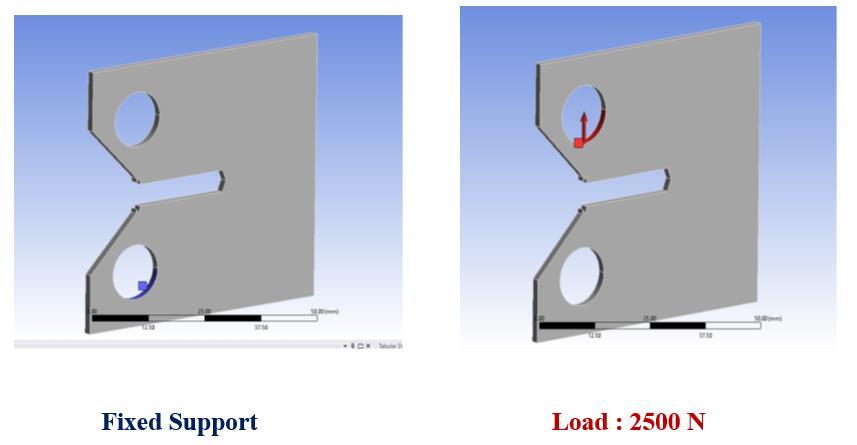
BoundaryConditions
International Research Journal of Engineering and Technology (IRJET) e-ISSN: 2395-0056
Volume: 11 Issue: 12 | Dec 2024 www.irjet.net p-ISSN: 2395-0072
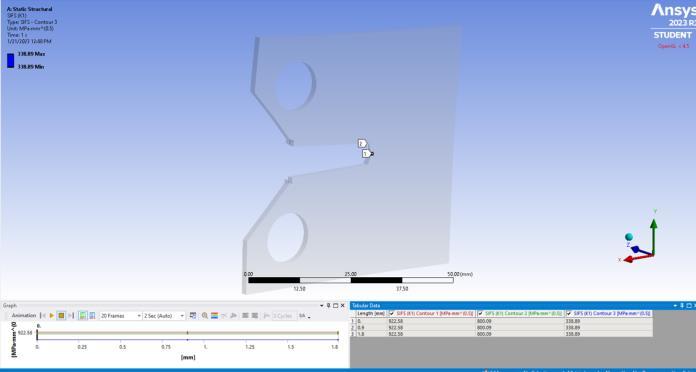
SIFS(K1):338.89Mpamm0.5
Fig -3:BoundaryconditionandSIFS(K1)
Stressintensityfactor 338.89Mpamm^(0.5) isobtain by numerical analysis and analytical critical stress intensity factorbyusingK1 formulaasshowninFig–4,iscalculated as519.729Mpamm^(0.5)
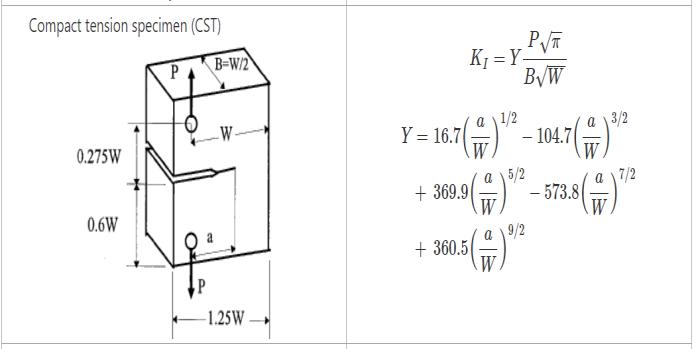
Fig -4:CTSpecimenDimensions
Crack propagation takes place when the stress intensity factor, K1, exceeds or equals the critical stress intensity factor,KIC.Inthecurrentanalysis,sinceK1 islowerthanKIC, crackgrowthdoesnotoccurinthefabricatedFMLs.
ThetensilestrengthofFiberMetalLaminates(FMLs)witha 0°fiberorientationwasfoundtobe59.52%higherthanthat ofFMLswitha90°fiberorientation,whiletheyieldstrength of FMLs with a 0° fiber orientation was 27.70% higher comparedtothosewitha90°orientation.Additionally,the modulusofelasticityforFMLswitha0°fiberorientationwas observedtobemorethantwicethatofFMLswitha90°fiber orientation.Thematerial'stensilestrengthinnaturalfiber metal laminates represents an optimal value compared to theindividualstrengthsofaluminum(Al-2024-T3)andthe compositematerial.Itwasnotedthatbothtensilestrength andmodulusofelasticitydecreaseasthefiberorientation angleincreases,makingthe0°fiberorientationpreferable forachievingsuperiorstrength.Moreover,fiberorientation paralleltotheappliedloaddirectionresultsinhighertensile strength than fiber orientation perpendicular to the load direction.Thelongitudinalelasticityofnaturalbamboofiber
metal laminates was found to be more than twice the transverseelasticity.
Furthermore, the yield stress observed in FMLs with a thicknessof1.5 mm, regardlessof fiber orientation(0° or 90°),washigherthaninFMLswithatotalthicknessof1.8 mm.Thisisattributedtothefactthatlargerthicknessestend toresultingreaterdelaminationwithintheFMLs.Thesize effect on the nominal strength of natural fiber metal laminates was examined by testing three geometrically similar specimens. The stress-strain behavior of large specimensmimicsthatofabrittlematerial,whereassmaller specimensdisplayductilecharacteristics.Notably,alarger notchinalargerspecimenreducesthematerial'sductility, causingittobehavemorelikeabrittlematerial.Theanalysis revealedthatasthespecimensizeincreases,thesizeeffect transitionsfromastrength-basedcriteriontolinearelastic fracturemechanics.
Thesizeeffectmethodforcalculatingfracturecharacteristics isadvantageousduetoitssimplicity,asonlythemaximum load needs to be considered. The size effect parameters derived from regression analysis can be utilized to determinefracturepropertiessuchasfractureenergyand the effective length of the fracture process zone. These parametersareessentialinassessingthefracturebehavior of FMLs, especially in structures with micro-cracks. Additionally, crack propagation occurs when the stress intensity factor, K1 , reaches or exceeds the critical stress intensityfactor,KIC .Inthisstudy,asK1 remainsbelowKIC, crackgrowthdoesnotoccurinthefabricatedFMLs.
[1] Vogelesang, L. B, and Ad Vlot. "Development of fiber metal laminates for advanced aerospace structures."Journalofmaterialsprocessingtechnology 103.1(2000):1-5.
[2] Nassir, Nassier A., et al. "Experimental and numerical characterization of titanium-based fibre metal laminates."CompositeStructures245(2020):112398
[3] Sinmazçelik, Tamer, et al. "A review: Fibre metal laminates,background,bondingtypes,andappliedtest methods."Materials&Design32.7(2011):3671-3685.
[4] Vasumathi, M., and Vela Murali. "Effect of alternate metals for use in natural fibre reinforced fibre metal laminates under bending, impact and axial loadings." ProcediaEngineering64(2013):562-570.
[5] Kawai, M., and Y. Arai. "Off-axis notched strength of fiber–metal laminates and a formula for predicting anisotropic size effect." Composites Part A: Applied ScienceandManufacturing40.12(2009):1900-1910.
International Research Journal of Engineering and Technology (IRJET) e-ISSN: 2395-0056
Volume: 11 Issue: 12 | Dec 2024 www.irjet.net p-ISSN: 2395-0072
[6] Bieniaś,Jarosław."Fibremetallaminates-someaspects of the manufacturing process, structure and selected properties."Composites11.1(2011):39-43.
[7] Botelho, Edson Cocchieri, et al. "A review on the development and properties of continuous fiber/epoxy/aluminum hybrid composites for aircraft structures."MaterialsResearch9.3(2006):247-256.
[8] Khan,S.U.,R.C.Alderliesten,andR.Benedictus."Poststretchinginducedstressredistributioninfibremetal laminatesforincreasedfatiguecrackgrowthresistance." CompositesScienceandTechnology69.3-4(2009):396405.
[9] Cortes,P.,andW.J.Cantwell."Thepredictionoftensile failure in titanium-based thermoplastic fibre–metal laminates."CompositesScienceandTechnology66.13 (2006):2306-2316.
[10] Sharma,AnkushP.,andR.Velmurugan."Uni-axialtensile responseandfailureofglassfiberreinforcedtitanium laminates."Thin-WalledStructures154(2020):106859.
[11] Sun,Jing,etal."Tensilefailureoffiber-metal-laminates made of titanium and carbon-fibre/epoxy laminates." Materials&Design183(2019):108139.
[12] Hao, Xinwei, et al. "Mechanical properties of a novel fibermetallaminatebasedonacarbonfiberreinforced Zn-Al alloy composite." Materials Science and Engineering:A740(2019):218-225.
[13] Zareei, Nabiollah, Abdolreza Geranmayeh, and Reza Eslami-Farsani."Interlaminarshearstrengthandtensile properties of environmentally-friendly fiber metal laminatesreinforcedbyhybridbasaltandjutefibers." PolymerTesting75(2019):205-212.
[14] Zareei, Nabiollah, Abdolreza Geranmayeh, and Reza Eslami-Farsani."Interlaminarshearstrengthandtensile properties of environmentally-friendly fiber metal laminatesreinforcedbyhybridbasaltandjutefibres." PolymerTesting75(2019):205-212
[15] Ríos,JuanC.,etal."Determinationoffracturetoughness J on fiber-metal laminate type CARALL with sheets of aluminum6061."ProcediaMaterialsScience9(2015): 530-537.
[16] ASTM D 3039 standard test method for tensile properties of polymer matrix composite materials." ASTMinternational15.03(2002):1-13.
[17] Nestler, Daisy, et al. "Continuous film stacking and thermoforming process for hybrid CFRP/aluminum laminates."ProcediaCirp66(2017):107-112.
[18] Cortes,P.,andW.J.Cantwell."Thepredictionoftensile failure in titanium-based thermoplastic fibre–metal laminates."CompositesScienceandTechnology66.13 (2006):2306-2316
[19] Bazant,ZdenekP.,IsaacM.Daniel,andZhengzhiLi."Size effect and fracture characteristics of composite laminates."(1996):317-324.
[20] Nestler, Daisy, et al. "Continuous film stacking and thermoforming process for hybrid CFRP/aluminum laminates."ProcediaCirp66(2017):107-112.
[21] Carrillo,J.G,and W. J.Cantwell."Scaling effectsin the tensilebehaviouroffiber-metallaminates."Composites ScienceandTechnology67.7-8(2007):1684-1693.
[22] Cantwell,W.J."Themechanicalpropertiesoffiber-metal laminates based on glass fiber reinforced polypropylene." Composites Science and Technology 60.7(2000):1085-1094
[23] Bazant,ZdenekP.,IsaacM.Daniel,andZhengzhiLi."Size effect and fracture characteristics of composite laminates."(1996):317-324.
[24] Sinmazçelik, Tamer, et al. "A review: Fibre metal laminates,background,bondingtypes,andappliedtest methods."Materials&Design32.7(2011):3671-3685
[25] Carrillo,J.G.,andW.J.Cantwell."Mechanicalproperties of a novel fiber–metal laminate based on a polypropylenecomposite."MechanicsofMaterials41.7 (2009):828-838
[26] Reyes, G., and H. Kang. "Mechanical behaviour of lightweight thermoplastic fiber–metal laminates." Journal of materials processing technology 186.1-3 (2007):284-290.
[27] Khalili, S. M. R., R. K. Mittal, and S. Gharibi Kalibar. "A study of the mechanical properties of steel/aluminum/GRPlaminates."MaterialsScienceand Engineering:A412.1-2(2005):137-140
[28] B.S. Sugun, RMVGK Rao, D.V. Venkatasubramanyan. "Cost-effective approach for the manufacture of fibre metal laminates" Proceedings of international conferenceonaerospacescienceandtechnology(2008).
[29] Gonzalez-Canche, N. G., E. A. Flores-Johnson, and J. G. Carrillo. "Mechanical characterization of fiber metal laminate based on aramid fiber reinforced polypropylene."Compositestructures172(2017):259266.
[30] Moussavi-Torshizi,S.Ebrahim,etal."Astudyontensile propertiesofanovelfiber/metallaminates."Materials
International Research Journal of Engineering and Technology (IRJET) e-ISSN: 2395-0056
Volume: 11 Issue: 12 | Dec 2024 www.irjet.net p-ISSN: 2395-0072
Science and Engineering: A 527.18-19 (2010): 49204925.
[31] Wu,Guocai,YiTan,andJenn-MingYang."Evaluationof residual strength of notched fiber metal laminates." Materials Science and Engineering: A 457.1-2 (2007): 338-349.
[32] Lawcock,G.D.,etal."Effectsoffibre/matrixadhesionon carbon-fiber-reinforced metal laminates I.: residual strength." Composites Science and Technology 57.12 (1998):1609-1619.
© 2024, IRJET | Impact Factor value: 8.226 | ISO 9001:2008 Certified