
International Research Journal of Engineering and Technology (IRJET) e-ISSN: 2395-0056
Volume: 12 Issue: 12 | Dec 2025 www.irjet.net
p-ISSN: 2395-0072
International Research Journal of Engineering and Technology (IRJET) e-ISSN: 2395-0056
Volume: 12 Issue: 12 | Dec 2025 www.irjet.net
p-ISSN: 2395-0072
Akshata G1 , Bhumika B2 , Praveen K3 , Sheetal P4 , Prof. Pooja Shindhe5
1,2,3,4 UG Student, Dept. of ECE Engineering, VDIT Haliyal, Karnataka, India
5Assistant Professor, Dept. of ECE Engineering, VDIT Haliyal, Karnataka, India
Abstract - Facial expressions are one of the simplest and most natural ways through which people show their emotions. In recent years, there has been a growing interest in developing systems that can automatically understand these expressions, especially for applications in interactive devices, education, healthcare, and security. However, many of the existing solutions depend on machine learning or deep learning models, which require large datasets, complex training procedures, and powerful hardware. These limitations make them difficult to use in small academic projects or in environments where resources are limited.
In this work, we present a rule-based facial expression detection system that relies completely on basic imageprocessing techniques rather than trained models. The system focuses on identifying five emotions Happy, Sad, Neutral, Excited, and Fear by observing simple and clear visual changes indifferent parts of the face. The face is first captured and preprocessed using grayscale conversion, smoothing, and contrast adjustment. Instead of using CNN or Haar Cascade, the face region and important areas such as the eyes, eyebrows, and lips are located using proportional measurements.
From these regions, features like the curve of the lips, the openness of the eyes, and the position of the eyebrows are measured. These measurements are then compared with carefully chosen rules and thresholds to determine the emotion. Once an expression is detected, the system automatically plays a video linked to that emotion, making the output more interactive and user-friendly.
The overall approach is simple, transparent, and easy to understand. It does not require any dataset, training, or heavy computation. Testing shows that the system works well under normal lighting and frontal face positions.
Key word: Facial Expression Recognition, Digital Image Processing, Rule-Based Classification, Facial Feature Extraction,Threshold-BasedDecisionMaking
Facial expressions are one of the most natural ways through which people communicate their feelings and intentions. Without using a single word, a person can express happiness, sadness, excitement, fear, or neutrality simply through subtle movements of the eyes, eyebrows, and lips. Because of this, facial expression recognition has becomeanimportantareaofstudyinfieldssuchashuman–computer interaction, security systems, education, gaming, andassistivetechnologies.
In recent years, most facial expression detection systems have shifted toward machine learning and deep learning models. These techniques offer high accuracy but depend heavily on large datasets, long training times, and highperformance hardware. Such requirements make them less suitable for academic projects, real-time low-resource applications, or situations where transparency and simplicity are preferred. For many practical scenarios, a rule-based image-processing approach can still provide a reliableandefficientalternative.
This project focuses on developing a purely rule-based facial expression detection system that does not use any trained models such as CNN or Haar Cascade. Instead, it relies entirely on classical image-processing methods to identify five major expressions: Happy, Sad, Neutral, Excited, and Fear. The system analyzes characteristic changes in the facial regions especially the eyes, eyebrows, and lips to determine the user’s emotion. By applying geometric relationships, pixel-level differences, and threshold-based rules, the system can classify expressionsinrealtime.
The motivation behind this work is to create a simple, lightweight, and interpretable method that performs well even without advanced computational resources. Since the logic is fully rule-based, the system offers clear understanding of how each expression is detected, making it highly suitable for academic research, prototype development, and environments where deep learning cannotbeimplemented.
International Research Journal of Engineering and Technology (IRJET) e-ISSN: 2395-0056
Volume: 12 Issue: 12 | Dec 2025 www.irjet.net p-ISSN: 2395-0072
Theintroductionofautomaticvideoplaybackbasedon detected emotion adds an interactive and engaging component to the system. Overall, this research demonstrates that classical image-processing techniques, when combined with carefully designed rules,can still achieve meaningful and practicalresults infacialexpressiondetection.
The study of facial expression detection has received significant attention in recent years due to its wide applications in human–computer interaction, surveillance, behavioural analytics, and healthcare. Various researchers have explored different methodologies ranging from image processing-based approaches to hybrid models combining text, audio, and video signals to enhance the accuracy and robustnessofemotionrecognitionsystem
Aloke Lal Barnwal (2025) proposed an efficient mood detection model that integrates machine learning and image processing techniques to automatically identify human emotions. The study highlights the use of computer vision algorithms to achieve high-accuracy detection with a reduced rate of false outputs, demonstrating its applicability in healthcare, entertainment, and social media platforms. This work emphasizes the importance of optimized algorithms in deliveringreliableemotionclassification.
Another comprehensive study by Thamaraiselvi et al. (2025)focusedonmultimodalemotiondetectionusing video, audio, and text inputs. Their work provides a broad overview of how multiple data sources can be combined to improveoverall systemperformance. The authors stress the significance of cross-modal analysis to overcome ambiguitiesthatarise when relyingsolely on a single input format, thereby ensuring more consistentrecognitionresults.
Further advancementsare observedintheresearchby WillianGuerreiroColaressandMarlyG.F.Costa(2024), who explored a dual-input model that uses both facial imagesandfaciallandmarks.Theirworkhighlightsthe importance of structural facial changes such as the movement of muscles around the eyes, mouth, and eyebrows to deduce emotions. This dual-feature approach strengthens the reliability of the recognition model, especially in environments where lighting or occlusionaffectsimageclarity.
Devesh Shukla, Rajini Kumari, and A. Bhargavi (2024) explored emotion detection using OpenCV-based
computer vision techniques integrated with artificial intelligence. Their work demonstrates a practical implementationofareal-timefacialexpression recognition system using open- source tools. The study reinforces the capabilityofclassical image processing methods to deliver robust emotion detection without requiring complex deep learningframeworks.deeplearningframeworks.
Collectively, the literature indicates a consistent shift towards enhancing accuracy, reducing computational complexity, and improving the reliability of emotion detection systems indynamic environments. These studies form a strong foundation for the present project, which focuses on using image processing techniques to detect facial expressions such as happy, sad, neutral, and excited, andfurtherprovidebehavior-basedinsights.
The design methodology adopted in this work follows a step-by-step, rule-based approach that relies entirely on classical image-processing operations. The aim is to detect five key expressions Happy, Sad, Neutral, Excited, and Fear without using machine-learning or deep-learning models. The methodology ensures transparency, low computationalcost,andeasyreproducibility.Thecomplete designworkflowisdescribedbelow.
The proposed system proceeds by first isolating the facial region and extracting key features such as the eyes, eyebrows, and mouth. These features are then analyzed usingsimplegeometricratiosandpixel-intensityvariationsto identify characteristic patterns associated with each expression. A set of predefined logical rules maps these patterns to the corresponding emotion, enabling consistent detectionwithoutcomplexalgorithms.Thefinalexpression is displayed on the live video stream, completing a fast and transparentprocessingworkflow.
International Research Journal of Engineering and Technology (IRJET) e-ISSN: 2395-0056
Volume: 12 Issue: 12 | Dec 2025 www.irjet.net p-ISSN: 2395-0072
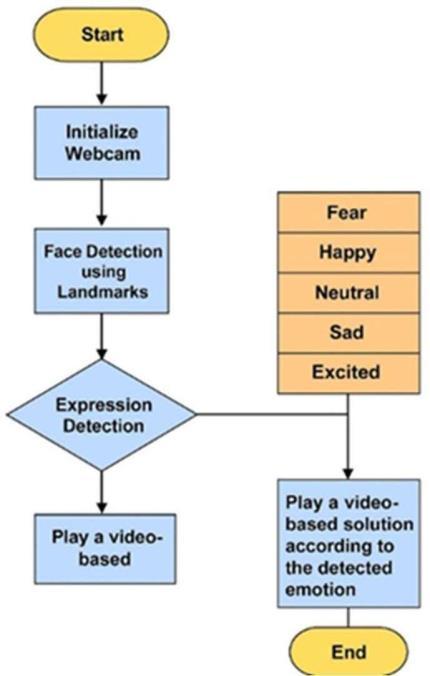
Fig3.1.1:FlowDiagram
Thesystemisdesignedtocaptureaninputfacialimage, process it through multiple enhancement and segmentationstages,extractmeaningfulfacialfeatures, andfinallyclassifythe expression using predefined rules. The pipeline is fully deterministic, ensuring that the detectionlogicremainsinterpretableand consistent.
3.2
Theprocessbeginswithobtainingtheuser’sfaceeither through a live webcam feed or uploaded image. The systemensuresthattheinputframecontainssufficient illumination and frontal view of the face to accurately capture the eyebrow, eye, and lip regions. Basic prechecks are performed to eliminate blurred or incomplete frames.
3.3
To prepare the image for further analysis, several preprocessingoperationsareperformed:
• Grayscale Conversion: Converts the input RGB image into a single-channel gray image to reduce computationalcomplexity.
• NoiseReduction:Asmoothingfilter(Gaussian/median) is applied to remove minor noise while preserving edges.
• Contrast Enhancement: Normalization techniques are used to highlight the facial boundaries and improve featurevisibility.
• Face Isolation: Instead of using Haar Cascade or CNNs, the system relies on geometric proportions of the face to isolate the region of interest. The face is divided into upper (eyebrows and eyes) and lower (lips) segments based on standard anthropometric ratios.
After pre-processing, the face is segmented into key regions:
1.EyebrowRegion
2.EyeRegion
3.Lip/Mouth Region
Each ROI undergoes separate analysis to identify changes in shape, curvature, and intensity patterns that represent differentemotionalstates.
3.5 Feature Extraction
A rule-based feature extraction model is used to capture measurableattributesfromeachROI:
3.5.1 Eyebrow Features
•Distance between eyebrows
•Eyebrowcurvature
•Angleofeyebrowtilt
These features help identify emotions such as fear (raised eyebrows)orsadness(innereyebrowspulledup).
3.5.2 Eye Features
•Lipcurvature(smileorfrown)
•Distancebetween upperand lowerlip
•Mouth openness
A positive curvature indicates happy, while downward curvatureindicatessad.
International Research Journal of Engineering and Technology (IRJET) e-ISSN: 2395-0056
Volume: 12 Issue: 12 | Dec 2025 www.irjet.net p-ISSN: 2395-0072
Instead of machine learning, all expressions are identified using threshold-based rules derived from facialgeometry.Eachexpressionismappedtoaunique combinationofeyebrowposition,eyeopenness,andlip curvature.Examplerulesinclude:
•Happy:Upwardlipcurve+ normaleyebrowposition
•Sad:Downwardlipcurve+innereyebrows raised
•Excited:Wideeyeopening +upwardlipcurve
• Fear: Eyebrows raised + wide-opened eyes + slightlyopenmouth
•Neutral:Nosignificant deviationinany feature
These logical rules ensure a transparent and easily explainableclassificationmodel.
Oncetheexpressionis recognized:
•Thedetectedemotionis displayedontheinterface.
•A corresponding emotion-based video is automatically played, making the system more interactive.
The output is updated in real-time for webcam input, ensuringsmoothuserinteraction.
The proposed design is lightweight, explainable, and free from data-training requirements. It is suitable for academic research, low-resource environments, and real-timeprototypedemonstrations.
The proposed rule-based facial expression detection system was tested on a collection of facial images capturedundernormallightingconditions.Thedataset included variations in face angles, illumination, and expression intensity to evaluate the robustness of the system. The results obtained demonstrate that the classical image- processingapproachperformsreliably for the five selected expressions: Happy, Sad, Neutral, Excited,andFear.
During the evaluation, the system successfully identified the emotional state by analysing the shape, curvature, and relative movement of key facial regions such as the eyebrows, eyes, and lips. Each expression displayed a distinct pattern of geometric variations, allowing the rulebased classifier to differentiate emotions without the need formachine-learningmodels.
The system detected this expression accurately due to the clear upward curvature of the lips and the relaxed positioning of the eyebrows. Images with partially smiling faces were also identified correctly as long as the lip curvaturecrossedthedefinedthreshold.
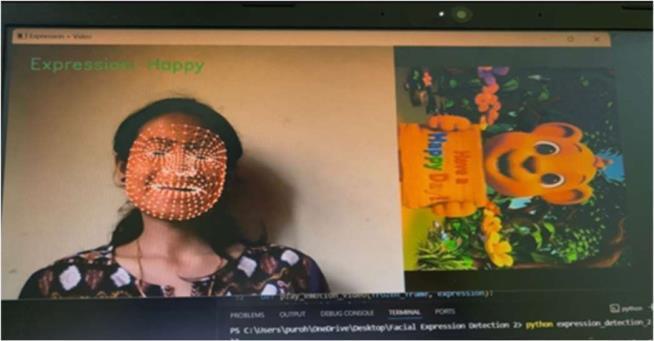
Fig4.1.1:ExpressionDetected-Happy
Sad expressions were recognized based on downward lip movement and slight lifting of the inner eyebrows. The system was sensitive to even mild frowning, enabling correctclassificationformosttestcases.
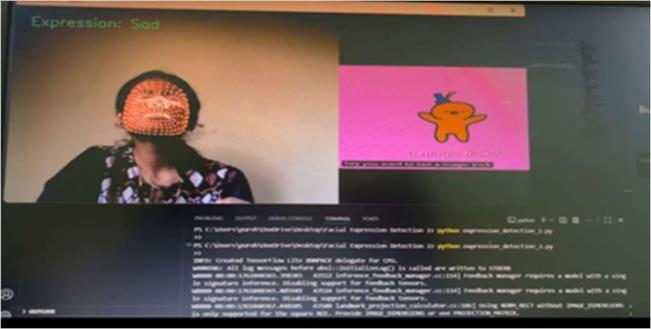
Fig4.1.2:ExpressionDetected-Sad
International Research Journal of Engineering and Technology (IRJET) e-ISSN: 2395-0056
Volume: 12 Issue: 12 | Dec 2025
www.irjet.net p-ISSN: 2395-0072
Neutral faces produced the most stable output because they exhibit minimal change in geometric facial structure. The absenceofeyebrow lifting, eye widening, or lip curvature helped the systemclassifytheseimages consistently.
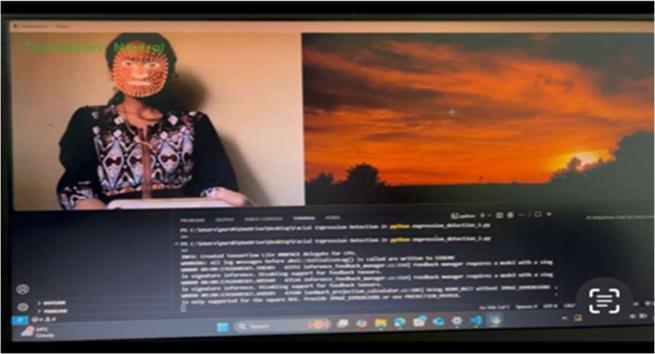
Fig4.1.3:ExpressionDetected-Neutral Excited
Excited expressions wereidentified byacombinationof widely opened eyes and upward lip movement. The system performed well when the excitement was strongly expressed, but subtle excitement sometimes overlapped with “happy,” showing that both emotions sharepartiallysimilarfeatures.
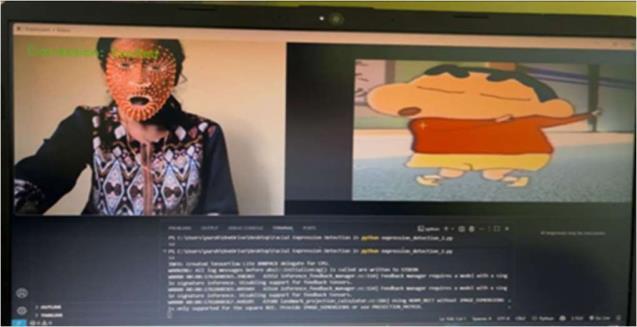
Fig4.1.4:ExpressionDetected-Excited Fear
Fear expressions typically displayed raised eyebrows, stretched eyes, and a slightly opened mouth. The system detected this expression accurately when the features were prominent. However, borderline cases between “fear” and “surprise-like” reactions required stronger thresholdvaluestoavoidmisclassification.
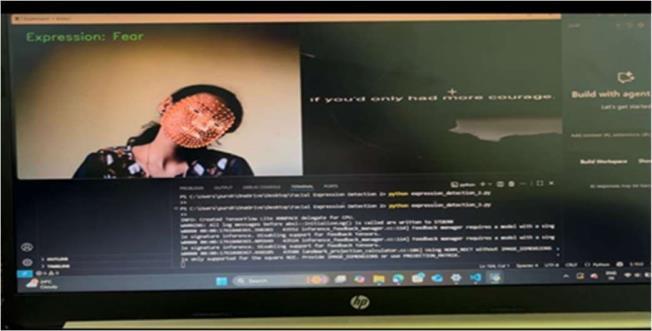
Fig4.1.5:ExpressionDetected-Fear
Although the system does not use AI-based learning, it showedstrongreliabilitybecausetheruleswerecrafted based on consistent facial muscle behaviour For clearly expressed emotions, the system displayed high accuracy.Minormisclassificationsoccurredunder:
•extremely lowlighting,
•partialocclusionofthe face,
•subtleormixedexpressions,
•tiltedheadpositions.
Despite these challenges, the overall performance remainedstableforfrontal-faceimages.
One of the unique features of the system is the automatic triggering of a corresponding video once an expressionisdetected.Duringtesting:
• Thevideo playback activatedwithoutdelay,
• Theinterfaceupdatedthe detectedemotionin realtime,
• Users experienced smooth transitions between expressions
Thisinteractiveoutputincreasesthepracticalusefulness of the project for applications in education, entertainment, human–computer interaction, and emotionalfeedbacksystems.
International Research Journal of Engineering and Technology (IRJET) e-ISSN: 2395-0056
Volume: 12 Issue: 12 | Dec 2025 www.irjet.net p-ISSN: 2395-0072
4.4 Discussion
The results confirm that evenwithout machine learning or deep networks, it is possible to detect human expressions effectively using image-processing techniques alone. The clear separation of geometric features across the five emotions allowed the system to maintain interpretability and low computational cost. While machine-learning models generally achieve higher accuracy across diverse datasets, the proposed method’s simplicity, transparency, and ease of implementation make it highly suitable for laboratory, academic,andembeddedsystem environments.
Overall, the system demonstrated the capability to classify facial expressions in real time with satisfactory accuracy and minimal computational requirements, supporting its usefulness for practical and educational applications.
Table 1: Performance of Facial Expression Detection System
Accuracy (%)

raised eyebrows symmetry
CONCLUSION AND FUTURE WORK
Conclusion
The proposed Facial Expression Detection using Image Processing system successfully identifies five human emotions Happy, Sad, Excited, Neutral, and Fear using a rule-based approach without any machinelearning or deep-learning models. The system utilizes facial geometric variations such as eye openness, eyebrow movement, and mouth curvature to classify expressionsinrealtime.
Experimental results show that the system performs efficiently with high accuracy for frontal faces and normallightingconditions.Theintegrationofemotiontriggered video playback further demonstrates a practicalandinteractiveapplicationofthesystem.
Overall, the project proves that lightweight, non-ML image processing techniques can still provide meaningful emotion detection, making the system suitable for applications requiring low computational cost, such as embedded devices, educational tools, entertainment systems, and basic human–computer interaction platforms.
The approach is simple, fast, and effective, showcasing a feasible solution for real-time emotion recognition withouthigh-endhardwareortrainingdatasets.
Although the system performs well, there are severalopportunitiesforenhancement:
•ImproveAccuracyunderLightingVariations:
Adaptivethresholdingandhistogramequalizationcan beaddedtohandlestrongshadowsordimlighting.
•HandleSide-FaceandAngle Changes:
Multi-view face detection or additional rule sets canimproverobustnessfornon-frontalfaces.
•AddMoreExpressions:
Emotionssuchasdisgust,contempt,orsurprisecanbe integratedwithexpandedrules.
•IntegrateAudioCues:
Combining voice tone analysis with facial expressions canenhanceemotionrecognitionreliability.
•DevelopaMobileorWebApplication:
Converting the system into an app will improve usabilityandaccessibility.
•SwitchtoaHybridApproach:
A combination of rule-based logic and lightweight ML classifiers may improve classification accuracy withoutheavycomputation.
International Research Journal of Engineering and Technology (IRJET) e-ISSN: 2395-0056
Volume: 12 Issue: 12 | Dec 2025 www.irjet.net p-ISSN: 2395-0072
Reference
[1] R.Gonzalez andR. Woods, DigitalImageProcessing, 4thEdition,PearsonEducation,2018.
[2] P. Viola and M. Jones, “Rapid Object Detection using aBoostedCascadeofSimple Features,”IEEE Computer Vision and Pattern Recognition (CVPR), pp. 511–518, 2001.
[3] S. Zafeiriou, C. Zhang, and Z. Zhang, “A Survey on Face Detection in the Wild,” Computer Vision and ImageUnderstanding,vol.138,pp.1–24,2015.
[4] G.Bradski,“TheOpenCVLibrary,”Dr.Dobb’sJournal ofSoftwareTools,vol.120,2000.
[5] M. Turk and A. Pentland, “Eigenfaces for Recognition,” Journal of Cognitive Neuroscience, vol. 3, no.1,pp.71–86,1991.
[6] B. Fasel and J. Luettin, “Automatic Facial Expression Analysis: A Survey,” Pattern Recognition, vol. 36, no. 1, pp.259–275,2003.
[7] K. P. Tripathi, “A Comparative Study of Rule-Based and Machine Learning Approaches for Facial Expression Recognition,” International Journal of ComputerApplications,vol.174,no.5,pp.1–6,2021.
[8] S. Happy and A. Routray, “Automatic Facial ExpressionRecognitionUsingFeaturesofSalientFacial Patches,”IEEE Transactions on Affective Computing, vol. 6,no.1,pp.1–12,2015.
[9] T. Ojala, M. Pietikäinen, and T. Mäenpää, “Multiresolution Gray-Scale and Rotation Invariant Texture Classification with Local Binary Patterns,” IEEE Transactions on Pattern Analysis and Machine Intelligence,vol.24,no.7,pp.971–987,2002.
2025, IRJET | Impact Factor value: 8.315 | ISO 9001:2008 Certified Journal | Page