
1,2,3
International Research Journal of Engineering and Technology (IRJET) e-ISSN: 2395-0056
Volume: 13 Issue: 04 | Apr 2026 www.irjet.net p-ISSN: 2395-0072

1,2,3
International Research Journal of Engineering and Technology (IRJET) e-ISSN: 2395-0056
Volume: 13 Issue: 04 | Apr 2026 www.irjet.net p-ISSN: 2395-0072
Bhope Varun1,M Dharmeshwar2 , K Abhishek3 P Udaya Sree 4
B Tech final year students ,ECE department, JB Institute of Engineering and Technology,Hyderabad, Telangana 4 Assistant professor, ECE Department ,JB Institute of Engineering and Technology,Hyderabad, Telangana
Abstract - With an increasing demand for energy in our society today, it is becoming important to look for alternative/renewable forms of energy. One innovative idea to achieve this is called "footstep energy generation" using piezoelectric sensors converting mechanical energy created from walking into electrical energy. The footstep energy generation system consists of piezoelectric sensors placed under floors where you walk. Every time someone walks across these floors and exerts pressure on the floor, it will generate an electrical charge through the piezoelectric effect (due to force applied). An energy collection circuit will collect, rectify, and store any generated energy for use later. This stored power can be used for low power applications such as powering an LED light bulb, charging small electronic devices, or powering sensors in public areas. Footstep energy generation is particularly beneficial in high traffic/public places such as train stations, shopping malls, and pavements where large crowds of people continuously walk over the same location. The footstep energy generation system is cheap, environmentally friendly, and simple to set up.
Keywords: Piezoelectric Sensors, Footstep Power Generation, Energy Harvesting, Renewable Energy, Sustainable Technology, Mechanical to Electrical Energy Conversion
1. INTRODUCTION
We rely heavily on electricity every day and as theworld'spopulation continuestogrow,sotoowillthe need for electricity. Currently, most of the energy sources we use today are referred to as non-renewable energy sources., Non-renewable sources tend to harm the environment in some way or another. Therefore, there is a growing need for alternative sources of energy to
continuously create energy in practical, easy, and environmentally friendly ways. One way to accomplish this is to generate electricity from foot traffic (people walking) with the use of piezoelectric sensors, which produceelectricalenergyfrommechanicalpressure. When there are lots of people walking in an area like a shopping mall, train station, or college campus, a tremendous amount of energy is wasted through foot power. Each time you take a step, you create a small amount of electricity through the use of piezoelectric sensors, but when you have continuous foot traffic, you can create enough energy over time that can be used meaningfully.
As demand for electric power increases, most energysourcesareharmfultotheenvironmentanddonot qualify as renewable. Additionally, there is a waste of energygeneratedbyhumanfootstepseachdaybecausea significant amount of mechanical energy is wasted in crowdedareas.Existingsourcesofrenewableenergyrely upon environmental conditions that may not be available atalltimesmakingthemimpracticalforuseinthefuture. Aneedexistsforaneffectivewaytoharnessfootprintsto generateusefulelectricitythroughaneasytousesystem.
International Research Journal of Engineering and Technology (IRJET) e-ISSN: 2395-0056
Volume: 13 Issue: 04 | Apr 2026 www.irjet.net p-ISSN: 2395-0072
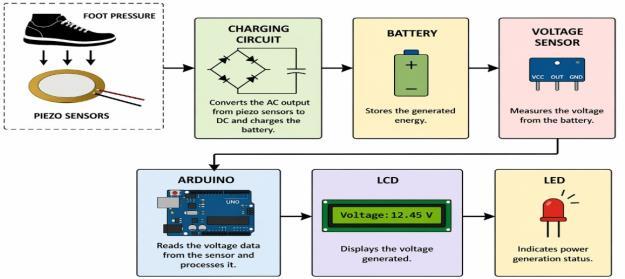
Figure 1: Illustrates the functionality of the power generationsystembymakinguseofpiezoelectricsensors. Electricalenergyisproducedbyapplyingpressuretothe surface. This energy is transformed and stored in the battery via a charging circuit. Voltage is sensed using a sensing technique, and itis processed using the Arduino board. The output is displayed on the LCD and shown usingLEDs.
3.Proposed system
The suggested design harnesses electricity from footsteps by making useof piezoelectric transducers. On application of force, the transducer creates an electric potential that is rectified and saved into the battery usingachargingcircuit.Theamountofvoltageproduced is measured using a voltage sensor, which relays the information to the microcontroller, which in turn displays the data on the LCD monitor. Power generation is indicated by the LED light. The system has been developed to ensure simplicity and ease of installation. This can be done by installing it in highly populated placesforincreasedpowerproduction.
4.System Architecture
Thesystemincludesthefollowingelements:
Piezoelectric Sensors: Convert mechanical pressurefromfootstepsintoelectricalenergy.
Charging Circuit: Converts and regulates the generatedvoltageintousableDCpower.
Battery: Stores the generated electrical energy for lateruse.
Voltage Sensor: Measures the amount of voltage generatedandstoredinthesystem.
Arduino: Acts as the main controller, processes sensordata,andmanagesoutput.
LCD Display: Shows the generated voltage and systemstatus.
LED Indicator: Indicates when power is being generated.
5.Methodology
5.1System Overview
The Footstep Power Generation System makes useofthePiezoeffectthatallowsconvertingmechanical energy from footsteps into electrical energy. These are installed in thebottompartofasurfacewherepressure
is exerted while walking. Pressure creates an electrical voltage because of the piezo effect. The voltage is sent to the charger to provide a constant DC power output and is stored in a battery for future use. A voltage sensor captures the produced electrical energy and relays the information to the Arduino, which then controls the display of the data on the LCD and turns theLEDON/OFF.
The function of piezoelectric sensors is to harness the mechanical energy from walking motions and transform it into electrical energy. As soon as the person walks on the floor, pressure is exerted on the piezoelectricsensors,whichresultsintheproductionof electricity.Thisismadepossiblethroughtheprocessof piezoelectricity, whereby specific materials create an electricchargewhenforceisexertedonthem.
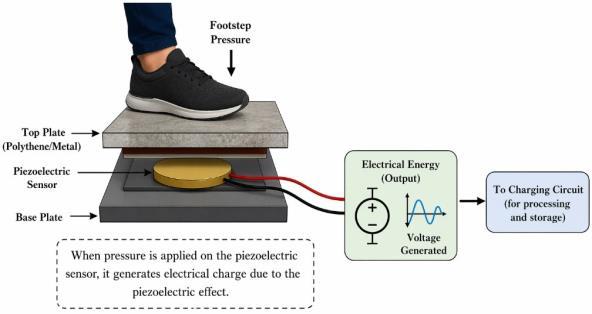
Figure 2: WorkingofEnergyGenerationUsing PiezoelectricSensors
Figure 2: The figure shows how piezoelectric sensors generate electrical energy when pressure is applied through footsteps. Theproducedvoltageisthensentto thechargingcircuitforprocessingandstorage.
Theelectricalenergygeneratedbythepiezosensors is stored in a rechargeable battery for later use. A charging circuit is used to convert and regulate the voltage before storing it. This ensures that the battery receives stable and usable power. A voltage sensor is connected to measure the amount of energy stored in the battery. The measured voltage is then sent to the Arduinoformonitoringanddisplay.
International Research Journal of Engineering and Technology (IRJET) e-ISSN: 2395-0056
Volume: 13 Issue: 04 | Apr 2026 www.irjet.net p-ISSN: 2395-0072
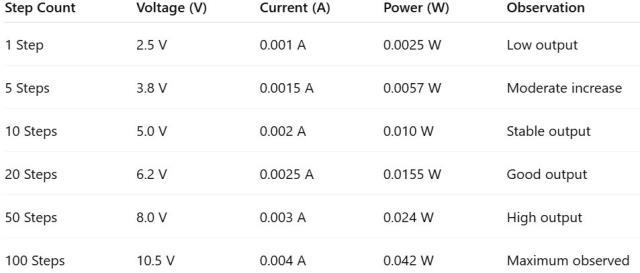
Table1:ExperimentalReadingsofFootstepPower GenerationSystem
5.4Output Display and Indication
This part represents the way the generated power is presented and used. LED acts as an indicator showing that power is being generated by pressing the button. Voltagedatareceivedfromthegeneratorisprocessedby theArduinoboardandpresentedontheLCDscreen.The USB charging module is attached to utilize the power generated by the system to charge other gadgets. Power supplied by the battery powers the charging circuitry to producesteadyoutput
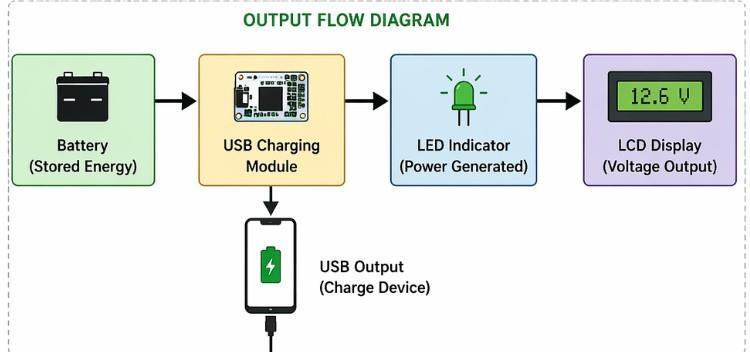
Figure 3: OutputDisplayandIndicationSystem
Figure 3: Thefigureshowshowthegeneratedenergy is displayedusing anLCDand indicated through anLED. It also illustrates the use of a USB charging module to chargedevicesusingthestoredenergy.
6. Implementation
Implementation of the system design entails the incorporation of piezo sensors, charging circuit, battery, voltagesensor,Arduino,LCD,andLED.Piezo sensorsare
installed below the surface where it can sense any pressure caused by walking. As soon as there is pressure, the energy in form of electricity is produced duetopiezoelectricphenomenon.
The produced energy voltage is fed to the charging circuit in order to produce stable DC voltage output. The produced energy is stored in a rechargeable battery. The voltage is measured using a voltage sensor, which sends information to Arduino. Arduino interprets the input data and produces an outputontheLCDdisplay.LEDindicatorsusedtoshow production of power. USB module can be attached to make use of stored energy for charging electronic gadgets.
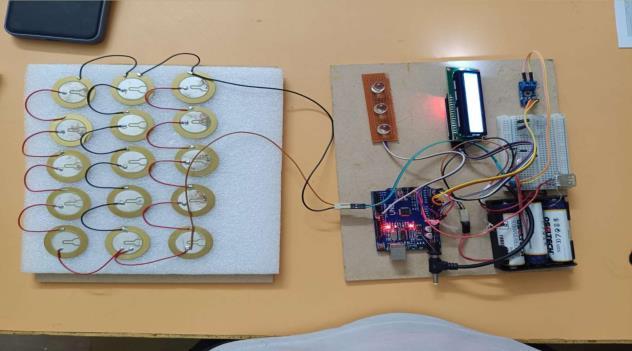
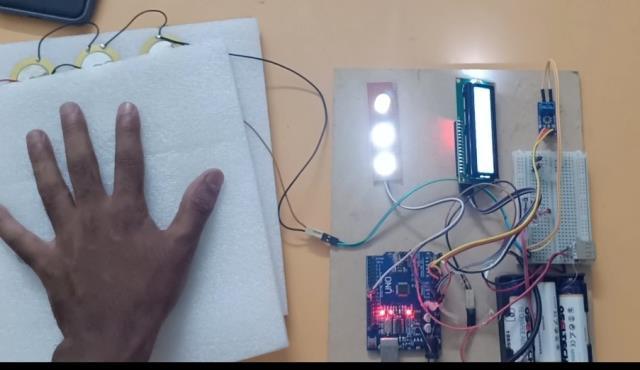
Figure 4:WorkingofFootstepPowerGenerationusing piezo
Figure 4: The system works by converting mechanicalenergyfromfootstepsintoelectricalenergy using piezoelectric sensors. When pressure is applied, the sensors generate voltage, which is then stored and usedforlow-powerapplications.
International Research Journal of Engineering and Technology (IRJET) e-ISSN: 2395-0056
Volume: 13 Issue: 04 | Apr 2026 www.irjet.net p-ISSN: 2395-0072
7. Result and discussions
The developed system was then tested for its effectiveness by using various types of footsteps. It can be observed that the piezo sensors produced voltage upon application of pressure. Energy harvested was stored in the battery and detected through a voltage detector. Voltage values were then shown on the LCD, and an LEDsignified powerproduction. Thesystem was successful in charging portable gadgets with the aid of theUSBmodule.
8.Advantage and Limitation Advantages
Thesystemgeneratesrenewableenergyfromhuman footsteps.
Itissimple,cost-effective,andeasytoimplement.
It Worksinbothindoorandoutdoorenvironments withoutdependingonweather.
Requireslowmaintenanceandissuitableforhigh footfallareas.
Limitations
Theenergygeneratedperstepisverysmall.
Efficiencydependsonthenumberofpeopleand appliedpressure.
Notsuitableforlarge-scalepowergeneration.
Outputmayvaryunderdifferentconditions.
9. Future Scope
The system can be improved by increasing the number of piezoelectric sensors to generate more energy.Advancedenergystoragetechniquescanbeused to enhanceefficiency. It can beimplementedincrowded places like malls, stations, and public walkways. Improved materials can increase durability and performance. This concept can be combined with other renewablesourcesforbetterenergygeneration.
10. Conclusion
The piezoelectric footstep generator serves as a basic example of converting mechanical energy to electrical energy through piezoelectric sensing. This design effectively harvests and stores energy generated by the mechanical force exerted during human foot movements. This technique is efficient, easy to adopt, andapplicabletosmall-scaleprojects.Despiteproducing smallamountsofenergy,itprovesusefulinplaceswitha highvolumeoffoottraffic.
1. S. Priya and D. J. Inman, Energy Harvesting Technologies,Springer,2009.
2. G. K. Ottman, H. F. Hofmann, and G. A. Lesieutre, “Optimized Piezoelectric Energy Harvesting Circuit,”IEEETransactions,2002.
3. N.S.ShenckandJ.A.Paradiso,“EnergyScavenging with Shoe-Mounted Piezoelectrics,” IEEE Micro, 2001.
4. S. Roundy, P. K. Wright, and J. Rabaey, Energy Scavenging for Wireless Sensor Networks, Springer,2004.
5. S. R.AntonandH. A.Sodano,“A ReviewofPower Harvesting Using Piezoelectric Materials,” Smart MaterialsJournal,2007.
6. R.S.DahiyaandM.Valle,RoboticTactileSensing, Springer,2013.
7. M. Safaei, H. A. Sodano, and S. R. Anton, “A Review of Energy Harvesting Using Piezoelectric Materials,”AppliedMechanicsReviews,2
8. Khaligh and P. Zeng, “Kinetic Energy Harvesting UsingPiezoelectricMaterials,”IEEETransactions, 2010.
9. J. Yang, An Introduction to the Theory of Piezoelectricity,Springer,2005.
10. Y.K.TanandS.K.Panda,“EnergyHarvestingfrom Vibrations Using Piezoelectric Devices,” IEEE Transactions,2011.
11. M. Elvin and A. Erturk, Advances in Energy HarvestingMethods,Springer,2013.
12. S. Priya, “Advances in Energy Harvesting Using LowProfilePiezoelectricTransducers,”Journalof Electroceramics,2007.
13. A. Erturk and D. J. Inman, Piezoelectric Energy Harvesting,Wiley,2011.
14. J. A. Paradiso and T. Starner, “Energy Scavenging for Mobile and Wireless Electronics,” IEEE PervasiveComputing,2005.
International Research Journal of Engineering and Technology (IRJET) e-ISSN: 2395-0056
Volume: 13 Issue: 04 | Apr 2026 www.irjet.net p-ISSN: 2395-0072
15. S. Kim, J. Priya, and H. A. Sodano, “Piezoelectric Energy Harvesting: Current Status and Future Challenges,”IEEE,2012.
16. Espressif Systems, “ESP32 Technical Reference Manual,”2023.
17. Arduino, “Arduino Uno Documentation,” Arduino OfficialWebsite.
18. M.Rahmanetal.,“FootstepPowerGenerationUsing PiezoelectricSensors,”IJERT,2020.
19. A. Kumar and R. Singh, “Energy Generation from Footsteps Using Piezo Sensors,” International JournalofEngineeringResearch,2021.
20. P. Sharma and S. Gupta, “Smart Energy Harvesting SystemUsingPiezoelectricSensors,”IJRASET,2022.