
International Research Journal of Engineering and Technology (IRJET) e-ISSN: 2395-0056
Volume: 13 Issue: 04 | Apr 2026 www.irjet.net p-ISSN: 2395-0072

International Research Journal of Engineering and Technology (IRJET) e-ISSN: 2395-0056
Volume: 13 Issue: 04 | Apr 2026 www.irjet.net p-ISSN: 2395-0072
Ajay Kannaujiya1 ,Abhishek Mishra2, Indraraj Singh3, Amit Patel4,Aman Mishra5
1234UG student of the Department of Information Technology , Goel Institute Of Technology and Management Lucknow, Uttar Pradesh, India
5Assistant Professor of the Department of Information Technology, Goel Institute Of Technology and Management Lucknow Uttar Pradesh, India ***
Abstract - Food waste is a major global issue that coexists with hunger and food insecurity. A significant portion of foodpreparedby restaurants,hotels, hostels, and dhabas remains unsold and is eventually discarded. This paper proposes Foodwise, a smart food waste management system that integrates predictive analytics and a redistribution platform to minimize food wastage. The system collects daily data on food preparation and sales from food service providers and employs a Random Forest regression model to predict the optimal preparation quantity for the next day. Surplus food is automatically listed on a web platform, enabling non-governmental organizations (NGOs) and individuals to collect and distribute it to needy populations. The model continuously retrains using new data, improving prediction accuracy over time. The proposed system aims to reduce food waste, optimize operational efficiency, and contribute to social welfare.
Keywords—Food Waste Management, Machine Learning, Random Forest, Predictive Analytics, Food Redistribution,SmartSystems,Django,Scikit-learn.
Food waste has emerged as a critical global challenge, impacting not only environmental sustainability but also economic efficiency and food security. A significant proportionoffoodpreparedinrestaurants,hostels,hotels, and community kitchens remains unsold due to demand uncertainty, poor planning, and lack of data-driven decision-making. At the same time, a large section of the populationcontinuestofacefoodinsecurity,highlightinga clear mismatch between surplus generation and redistributionmechanisms.
To address this gap, Foodwise proposes an integrated, intelligent platform that combines machine learning with real-time food redistribution. The system is designed to assistfoodprovidersinoptimizing dailyfoodpreparation while simultaneously enabling efficient redistribution of surplusfoodtoneedyindividualsandorganizations. The core of the system lies in its ability to learn from historical food preparation and consumption patterns. Each day, the system records key parameters such as prepared quantity, sold quantity, and generated waste
through structured data models. These records are then used to train predictive models that estimate future demand. The implemented approach leverages a Random Forest regression model, which considers temporal features (day of the week and month) along with recent consumption trends to generate accurate preparation recommendations.
Inadditiontopredictiveanalytics,thesystemincorporates a real-time redistribution module. Once the day is closed and surplus food is identified, available quantities are dynamically listed on a public interface. NGOs and individuals can browse available food, submit requests, and schedule pickups through a structured request management workflow. This ensures that surplus food is not only minimized at the source but also effectively utilized.
Furthermore, the system extends beyond regular food providers by including event-based donations, such as wedding surplus food, thereby expanding the redistribution ecosystem. The integration of user-friendly dashboards,datavisualization(preparedvs.soldvs.waste trends), and automated notifications enhances usability forstakeholders.
Overall, Foodwise represents a shift from reactive waste handling to proactive waste prevention, combining artificial intelligence, web-based interaction, and social impactintoaunifiedframework.
The scope of the Foodwise system encompasses both technological and societal dimensions, focusing on reducing food waste at its source and improving the efficiencyofsurplusfooddistribution.
From a technological perspective, the system is designed as afull-stackwebapplicationbuiltona scalablebackend framework. It supports multi-user interaction where each food provider maintains independent records and predictive models. The machine learning component operatesatanindividualitemlevel,meaningthatseparate predictivemodelsaretrainedforeachfooditemperuser, enabling personalized and context-aware recommendations.
Thepredictivemoduleconsidershistoricaldailyrecords including prepared, sold, and wasted quantities along withshort-termmovingaveragestocapturerecenttrends.
International Research Journal of Engineering and Technology (IRJET) e-ISSN: 2395-0056
Volume: 13 Issue: 04 | Apr 2026 www.irjet.net p-ISSN: 2395-0072
In cases where insufficient historical data is available, the system falls back to heuristic-based estimation, ensuring robustnessandcontinuityofoperation.
Ontheoperationalside,thescopeincludes:
• Food Preparation Optimization: Assisting restaurants, hostels, and similar establishments using AI-driven predictions.
• Waste Monitoring and Analytics: Providing visual insights into food waste trendsovertime.
• Surplus Food Redistribution: Enabling real-time listing of leftover food and facilitating structured requests from NGOsandindividuals.
• RequestManagementSystem:Supporting request creation, acceptance, rejection, andschedulingoffoodpickups.
• Event-Based Donations: Allowing largescale food donations from events such as weddings.
• User and Location Management: Maintaining restaurant profiles with locationdata.
Thesystemisintendedfordeploymentinurbanandsemiurban environments where food waste is significant and digital access is available. Future enhancements can incorporate real-time data sources and more advanced predictivetechniques.
The primary objective of the proposed system is to minimize food wasteatits source while ensuring efficient redistribution of surplus food to those in need, by integrating predictive analytics, real-time data tracking, andastructuredrequestmanagementworkflow.
A key objective is to enable data-driven decision-making for food providers. By analyzing historical records of prepared, sold, and wasted food, the system generates accurate preparation recommendations. Another important objective is to establish a seamless bridge between food surplus and food demand by automatically identifyingleftoverfoodandmakingitavailablethrougha publicinterface.
The system also aims to enhance transparency and operational efficiency through visualization and monitoring tools. The specific objectives are summarized asfollows:
Reduce food waste using predictive analytics andhistoricaldatamodeling.
Optimize daily food preparation for food serviceproviders.
Facilitatereal-timeredistributionofsurplus food.
Createanefficientandtransparentrequest andpickupmanagementsystem.
Supportcommunity-drivenfooddonation initiatives,includingevent-baseddonations.
Food waste management has been an active area of research, with various approaches proposed to tackle the problem from technological, logistical, and social perspectives.
One major area of research involves demand forecasting using statistical and machine learning techniques. Traditional methods such as time-series analysis and regressionmodelshavebeenwidelyusedtoestimatefood demand in hospitality environments [1]. However, these approaches often struggle to capture non-linear patterns and dynamic consumption behavior. Recent studies have explored ensemble techniques like Random Forests to improvepredictionaccuracy[2].
Another significant area is food redistribution systems, which aim to connect surplus food providers with consumersinneed.Severalplatformshavebeendeveloped to facilitate donation and redistribution, but many rely heavily on manual input and lack predictive capabilities [3][4]. As a result, they address the consequences of food wasteratherthanpreventingitatthesource.
Research has also highlighted the importance of real-time datacollectionanddigitalplatformsinreducingfoodwaste [5]. However, many existing solutions focus either on analytics or redistribution, rarely combining both into a cohesiveframework.
In recent years, hybrid approaches have gained attention wherepredictiveanalyticsiscombinedwithredistribution mechanisms.Challengesremainintermsofscalability,user adaptability,andintegrationofmultiplestakeholders[6].
TheproposedFoodwisesystembuildsupontheseexisting studies by integrating machine learning-based demand prediction with a real-time redistribution platform. Unlike traditional systems, it uses item-level historical data to train individualized predictive models, enabling more precise recommendations. Additionally, it incorporates a structured request and scheduling mechanism, ensuring thatsurplusfoodisefficientlyallocatedandcollected.
The Foodwise system follows a data-driven and modular methodology that integrates data collection, machine learning-based prediction, and real-time redistribution into a unified workflow. The methodology is designed to ensure continuous learning, adaptability, and efficient utilizationoffoodresources.
International Research Journal of Engineering and Technology (IRJET) e-ISSN: 2395-0056
Volume: 13 Issue: 04 | Apr 2026 www.irjet.net p-ISSN: 2395-0072
5.1 Data Acquisition
Food providers input daily records including item name, prepared quantity, and sold quantity. The system automatically computes waste as the difference between prepared and sold quantities, ensuring consistency and eliminating manual errors. These records are stored in a structureddatabaseanduniquelymaintainedperuserand perday,formingthefoundationforpredictivemodeling.
5.2 Data Preprocessing and Feature Engineering
Historical records are organized chronologically, and additional features are derived to improve prediction accuracy.Theseincludetemporalattributessuchasdayof the week and month, as well as short-term moving averages of prepared, sold, and waste quantities over recent days. This enables the model to capture both seasonalpatternsandrecentconsumptiontrends.
5.3 Model Training
The engineered features are used to train a Random Forestregressionalgorithmtopredictthequantityoffood to be prepared for the next day. The model is trained separately for each food item and each user, ensuring personalization and higher accuracy. In scenarios where insufficienthistoricaldataisavailable,thesystemadoptsa fallback heuristic approach based on recent averages and observedwaste.
5.4 Prediction and Recommendation Generation
Whenauserclosestheday,themodelpredictstheoptimal preparation quantity for the next day. These predictions are stored and displayed through an intuitive interface, enabling informed decision-making. The model is continuously retrained with new daily data to improve accuracyovertime.
5.5 Waste Identification and Redistribution
Once the day is closed, leftover food items with positive waste quantities are automatically identified as available for donation. The system dynamically calculates available quantities by subtracting previously requested amounts, ensuring accurate and fair allocation. External users such as NGOs can view available food, submit requests specifyingquantityandpreferredpickuptime,andreceive updatesonrequeststatus
The proposed methodology enhances traditional food waste management approaches by combining predictive analytics with real-time redistribution in a scalable webbasedsystem.Itisstructuredintointerconnectedmodules thatcollectivelyaddressbothpreventionandutilizationof foodwaste.
6.1 Intelligent Prediction Module
This module leverages machine learning to forecast food demand. Unlike conventional systems that rely on static rules, it dynamically adapts to historical patterns and recent trends. Ensemble learning techniques enable the system to handle variability in demand and improve predictionreliabilityovertime.
6.2 Dynamic Waste Tracking Module
This module continuously monitors food preparation and consumption. By automatically calculating waste and maintaining historical records, it provides accurate insights into inefficiencies and supports long-term optimizationstrategies.
6.3 Real-Time Redistribution Module
This module acts as a bridge between surplus food providers and potential beneficiaries. It ensures that leftover food is immediately visible and accessible, reducing delays and minimizing spoilage. The system accounts for previously allocated quantities, preventing overbookingandensuringfairdistribution.
6.4 Request Management and Scheduling Module
This module introduces structure and accountability into the redistribution process. By allowing users to specify pickuptimesandenablingproviderstoschedulerequests, it reduces coordination issues and improves operational efficiency. Requests move through states: pending, accepted,scheduled,andrejected.
6.5 Event-Based Donation Module
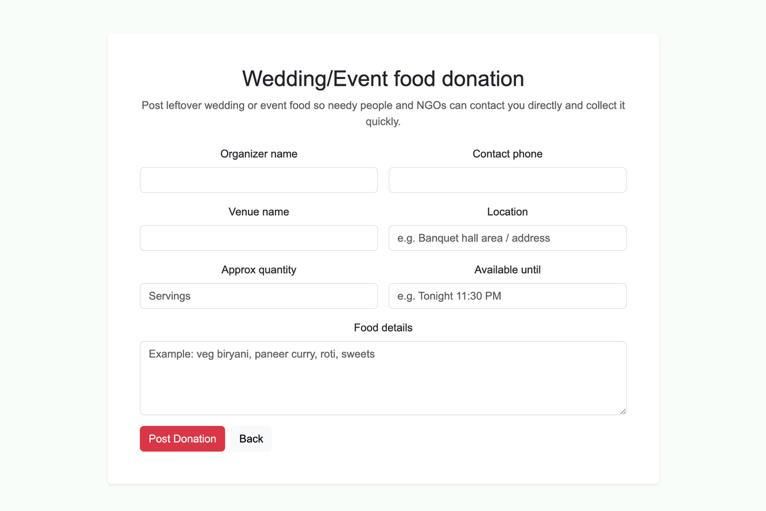
This module extends functionality to large-scale food surplus scenarios such as weddings and public events. Event organizers enter food donation details including location, quantity, and availability time. These donations are displayed alongside regular surplus food, increasing the volume of recoverable food and broadening the system'simpact
TheimplementationofFoodwisereliesonacombinationof modern web technologies and machine learning tools. TableIsummarizesthetechnologiesused.
Table -1: TechnologyStackoftheFoodwiseSystem
Component Technology
BackendFramework Django(Python)
Language Python3.x
MLLibrary Scikit-learn
ModelPersistence Joblib
Database
Frontend
AuthSystem
PostgreSQL
HTML5,CSS3,JS
DjangoAuth
International Research Journal of Engineering and Technology (IRJET) e-ISSN: 2395-0056
Volume: 13 Issue: 04 | Apr 2026 www.irjet.net p-ISSN: 2395-0072
The system design of Foodwise is represented through an Entity-Relationship(ER)Diagram,aUseCaseDiagram,and aDataFlowDiagram(DFD),whichcollectivelycapturethe datamodel,actorinteractions,andinformationflowwithin thesystem.
8.1. Entity-Relationship Diagram
The ER diagram (Fig. 1) illustrates the core entities of the system User, FoodItem, DailyRecord, SurplusListing, and Request along with their relationships. Each User maintains multiple DailyRecords keyed by date and item. Surplus listings are derived from closed daily records and linkedtoincomingRequestsfromNGOs.
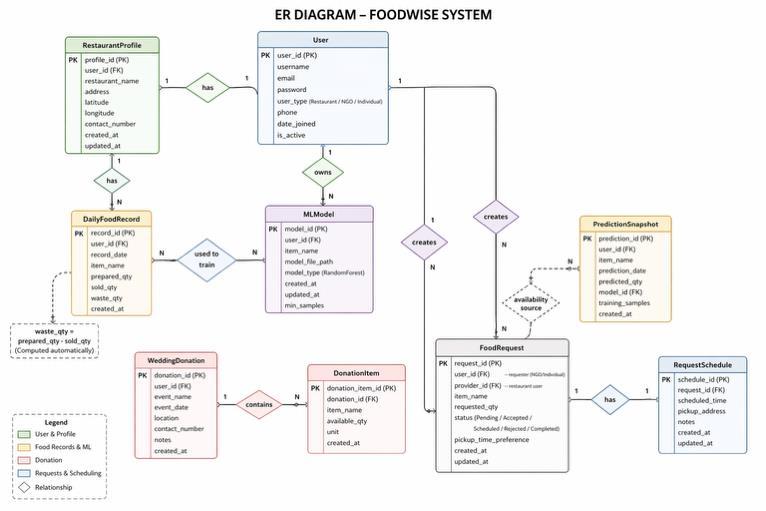
-1:E-RDiagram
8.2 Use Case Diagram
The Use Case diagram (Fig. 2) defines the interactions between the two primary actors Food Provider and NGO/Recipient and the system. Key use cases include daily data entry, day closure, prediction retrieval, surplus listing,foodrequestsubmission,andrequestscheduling.
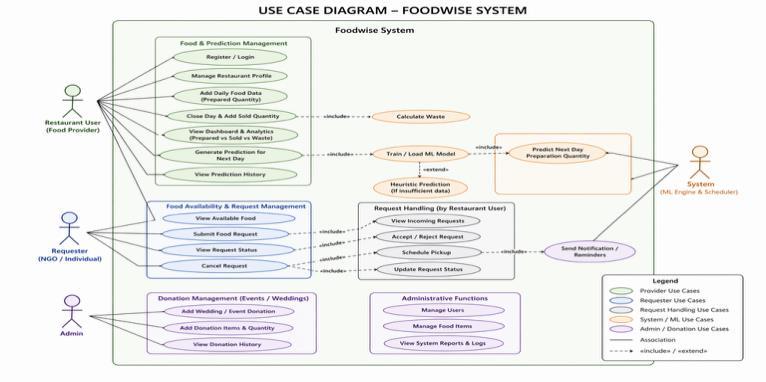
Fig -2:UseCaseDiagram
8.3 Data Flow Diagram
The Data Flow Diagram (Fig. 3) models the movement of data through the system. At Level 0, the DFD shows the system as a single process receiving food data from providers and returning predictions and surplus listings. Level 1 decomposes this into sub-processes: data entry, waste calculation, model training, prediction generation, andredistribution.
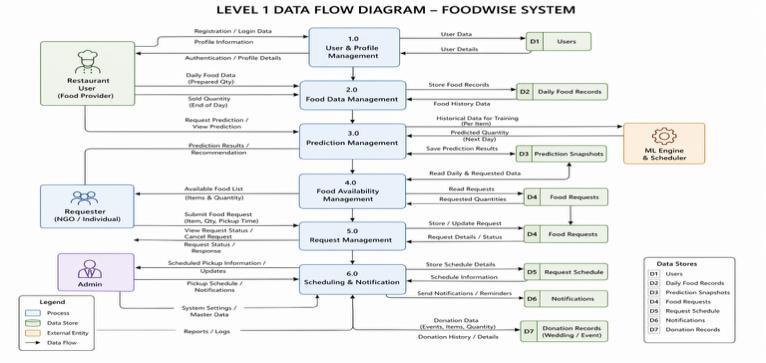
-3:DataFlowDiagram
9. IMPLEMENTATION
9.1 Home Screen
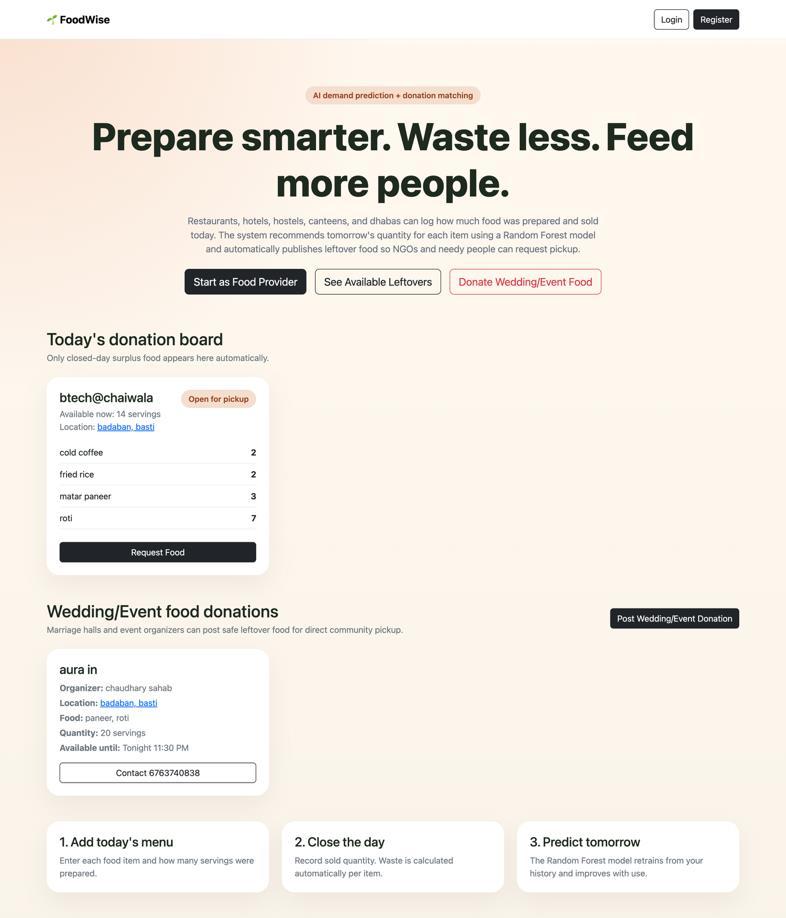
Fig -4:HomeScreen
International Research Journal of Engineering and Technology (IRJET) e-ISSN: 2395-0056
9.2 Restaurent Register Screen
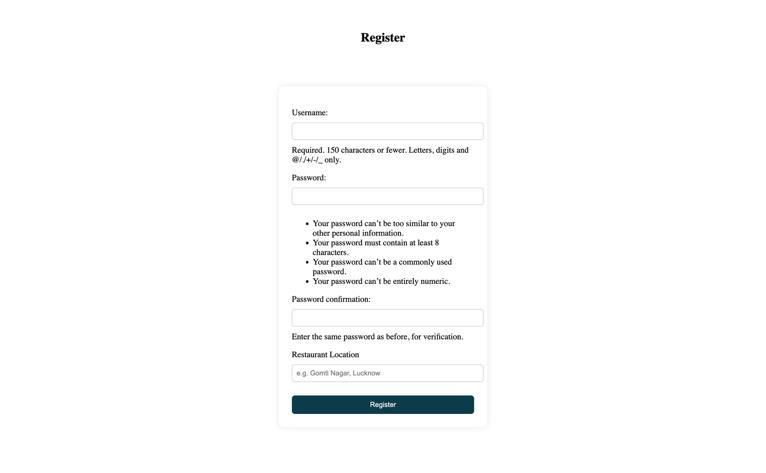
Fig -5:RestaurentRegistrationScreen
9.3 Restaurent Login Screen
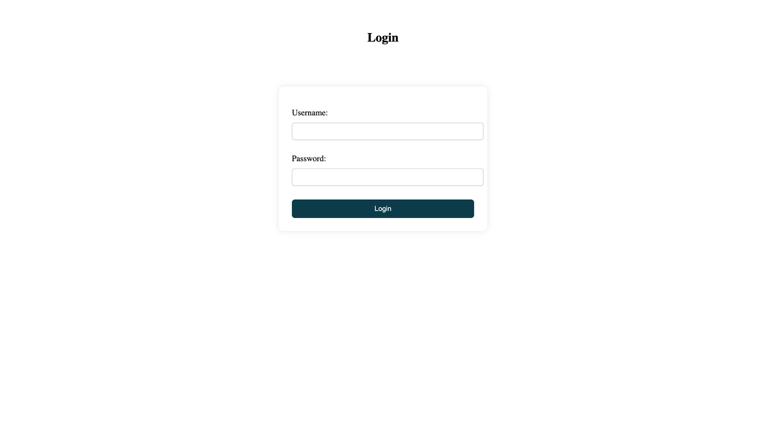
Fig -6:RestaurentLoginScreen
9.4 Restaurent Dashboard
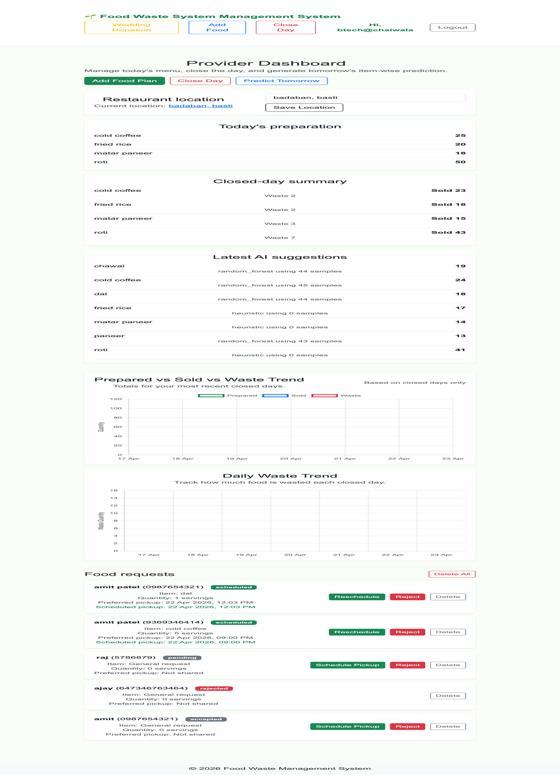
Fig -7:RestaurentDashboard
9.5 Add Food Plan
Volume: 13 Issue: 04 | Apr 2026 www.irjet.net p-ISSN: 2395-0072 © 2026, IRJET | Impact Factor value: 8.315 | ISO 9001:2008
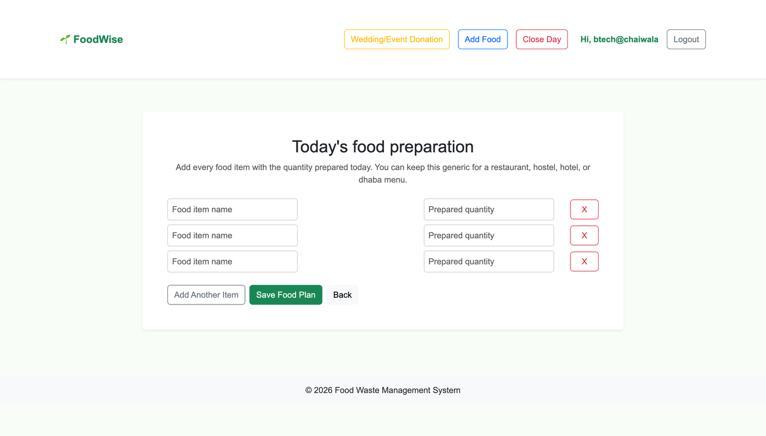
Fig -8:AddFoodPlan
9.6 Close Day
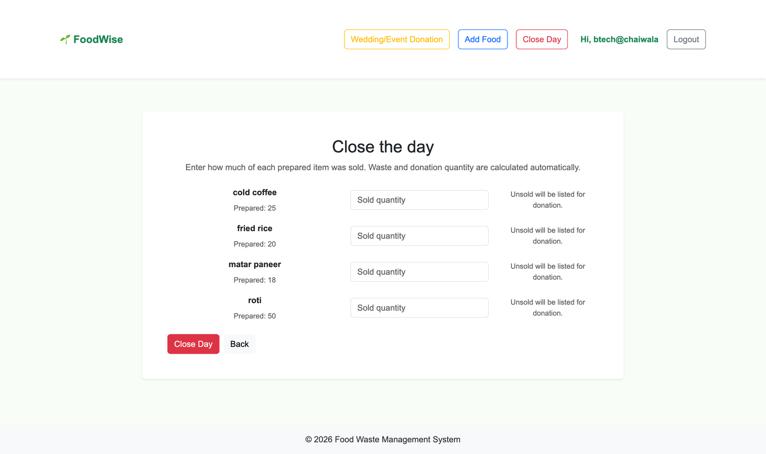
Fig -9:CloseDay
9.7 Predict Tomorrow
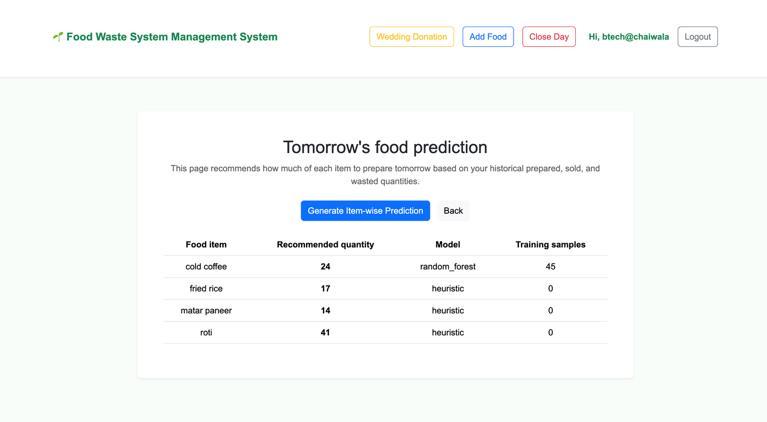
Fig -10:PredictTomorrowFood
Volume: 13 Issue: 04 | Apr 2026 www.irjet.net p-ISSN: 2395-0072
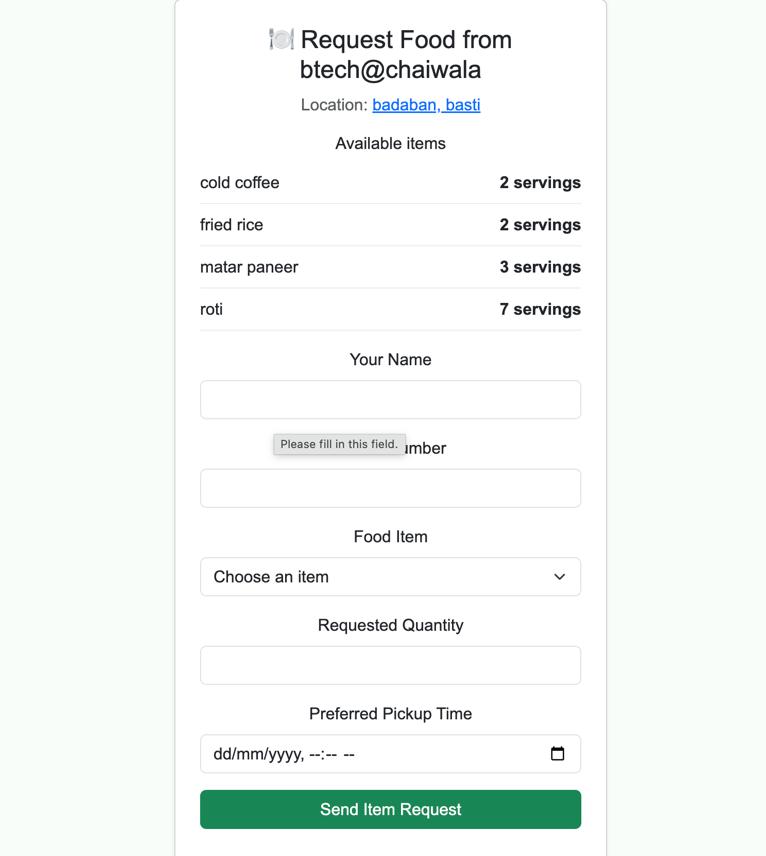
Food providers register on the platform and create profiles by providing essential details including location. Thisinformationisusedforaccessibilityandcoordination duringfoodredistribution.
10.2
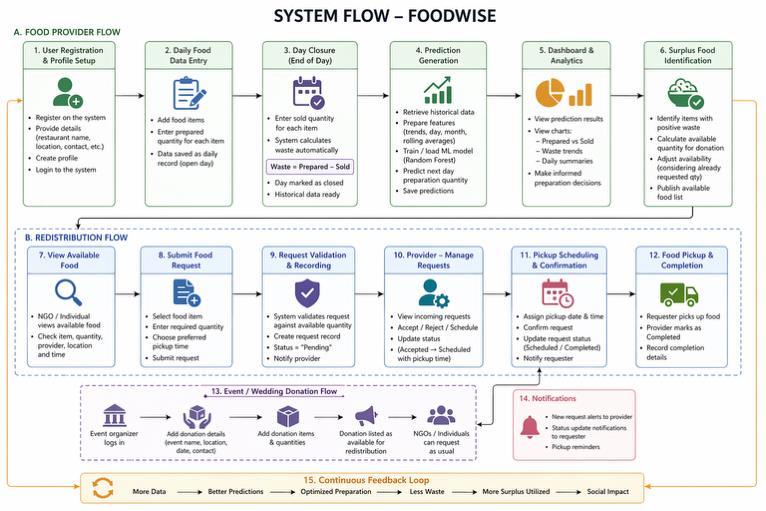
After login, the food provider enters daily food preparation details item name and prepared quantity for each menu item. The system ensures consistency by updatingexistingrecordsratherthanduplicatingthem.
At the end of the day, the provider inputs the sold quantity for each item. The system then: (1) computes Waste=Prepared−Sold;(2)markstherecordasfinalized (closed day); and (3) makes historical data available for modeltraining.
10.4
After day closure, the system retrieves historical records,constructsfeaturevectorsusingrecenttrendsand temporal attributes,andtrainsorreusesa RandomForest model to generate recommended preparation quantities forthenextday.Ifsufficientdataisunavailable,aheuristic fallbackisapplied.
10.5
10. SYSTEM FLOW
The Foodwise system follows a structured and sequential workflow that integrates food data collection, predictive analytics,andsurplusfoodredistributionintoacontinuous cycle,asillustratedinFig.13
The system provides a dashboard displaying prepared vs. sold vs. waste trends, daily waste patterns, and prediction results, enabling users to continuously refine theirplanningstrategy.
Once the day is closed, the system identifies leftover items with positive waste quantities, calculates available quantities (subtracting already requested amounts), and prepares a real-time list for redistribution. NGOs view available food, submit requests with quantity and pickup time,whicharevalidatedandassigneda"pending"status.
Food providers manage incoming requests through their dashboard, accepting, rejecting, or scheduling pickups.Oncescheduled,therequeststatusisupdatedand both parties can view the final schedule, ensuring smooth coordination.
10.8
Event organizers enter food donation details (location, quantity, availability time). These donations are displayed alongside regular surplus food, extending the system's capabilitytohandlelarge-scalefoodredistribution.
International Research Journal of Engineering and Technology (IRJET) e-ISSN: 2395-0056
Volume: 13 Issue: 04 | Apr 2026 www.irjet.net p-ISSN: 2395-0072
The system operates in a closed loop: daily data is collected, predictions are generated, waste is reduced, remaining surplus is redistributed, and new data continuouslyimprovesfuturepredictions.
TheimplementationoftheFoodwisesystemdemonstrates significantimprovementsinbothfoodwastereductionand efficient redistribution. The system was tested using realtimeinputsandsimulatedhistoricaldatasetstoevaluateits predictiveaccuracyandoperationaleffectiveness.
One of the primary outcomes observed is a measurable reductioninexcessfoodpreparation.Byutilizinghistorical data and machine learning-based predictions, the system provides recommended preparation quantities that are closely aligned with actual demand. Over time, as more data is accumulated, prediction accuracy improves due to thecontinuouslearningmechanism.
Visualizationdashboardsshowagradualdecreaseinwaste trends as users begin to rely on prediction outputs rather thanmanual estimation,indicatingtheeffectiveness ofthe Random Forest model in minimizing overproduction. The structured request handling mechanism ensures that: (1) requests are validated against available quantities; (2) over-allocation is prevented; and (3) pickup scheduling is streamlined.
The request management workflow shows high efficiency, with requests moving seamlessly through pending, accepted, scheduled, and rejected stages. The inclusion of event-based donation functionality increases the overall volume of food redistributed, particularly in large-scale scenarios such as weddings. From a system performance perspective, the application handles multiple users independently with personalized per-user, per-item
predictive models, and model persistence via Joblib ensuresefficientpredictiongeneration.
Overall, the results indicate that Foodwise effectively achieves its dual objective of reducing food waste at the source and maximizing the utilization of surplus food throughredistribution.
Foodwisepresentsapracticalandscalablesolutiontothe growing problem of food waste by integrating predictive analytics with a real-time redistribution platform. The systemmovesbeyondtraditionalreactiveapproachesand introduces a proactive mechanism that minimizes waste duringthefoodpreparationstageitself.
By leveraging Random Forest-based prediction models, the system enables food providers to make informed decisions regarding daily preparation quantities, significantly reducing the likelihood of overproduction. Any unavoidable surplus is efficiently redistributed to those in need through a structured and transparent requestmanagementsystem.
The modular design, combined with user-friendly interfaces and automated workflows, makes the system suitable for deployment in real-world environments such as restaurants, hostels, and event venues. Future improvementscaninclude: Integration of external factors such as weather, festivals, andseasonaltrends.
Adoption of advanced deep learning or LSTM time-series modelsforimprovedpredictionaccuracy.
Mobileapplicationsupportforwideraccessibility.
Integration with logistics and delivery services for faster redistribution.In conclusion, Foodwise demonstrates how technology and data-driven approaches can address both environmental and social challenges, providing a sustainable framework that reduces food waste and contributestofoodsecurityandcommunitywelfare.
[1] L. Breiman, “Random Forests,” Machine Learning, vol. 45,no.1,pp.5–32,2001.
[2] S. Kaza, L. Yao, P. Bhada-Tata, and F. Van Woerden, What a Waste 2.0: A Global Snapshot of Solid Waste Management to 2050. Washington, DC: World Bank Publications,2018.
[3] FAO, “The State of Food and Agriculture: Moving Forward on Food Loss and Waste Reduction,” Food and AgricultureOrganization,Rome,Italy,2019.
[4] J.C.BuzbyandJ.Hyman,“Totalandpercapitavalueof food loss in the United States,” Food Policy, vol. 37, no. 5, pp.561–570,2012.
International Research Journal of Engineering and Technology (IRJET) e-ISSN: 2395-0056
Volume: 13 Issue: 04 | Apr 2026 www.irjet.net p-ISSN: 2395-0072
[5] T.M.W.Mak,X.Xiong,D.C.W.Tsang,I.K.M.Yu,andC. S. Poon, “Sustainable food waste management towards circular bioeconomy: Policy review, limitations and opportunities,”BioresourceTechnology,vol.297,2020.
[6] F. Pedregosa et al., “Scikit-learn: Machine Learning in Python,”JournalofMachineLearningResearch,vol.12,pp. 2825–2830,2011.
[7] DjangoSoftwareFoundation,Django Web Framework Documentation.[Online].Available: https://docs.djangoproject.com/
[8] Joblib Developers, Efficient Serialization of Python Objects.[Online].Available:https://joblib.readthedocs.io/
[9] UNEP, “Food Waste Index Report,” United Nations EnvironmentProgramme,2021.
[10] E. Papargyropoulou, R. Lozano, J. K. Steinberger, N. Wright, and Z. Ujang, “The food waste hierarchy as a framework for the management of food surplus and food waste,” Journal of Cleaner Production, vol. 76, pp. 106–115,2014.