International Research Journal of Engineering and Technology (IRJET)
e-ISSN: 2395-0056
Volume: 13 Issue: 08 | Aug 2026
p-ISSN: 2395-0072
www.irjet.net
Flora-Sense: Deep Learning Based Rose Plant Disease Detection and Cure Recommendation System Rutuja Mohite1, Tanvi Mayekar2, Saba Tamboli3, Dr. Mrs. K. A. Adoni4 1234Electronics & Telecommunications PES Modern College of Engineering, Pune, India
----------------------------------------------------------------------------***-------------------------------------------------------------------------Abstract-Rose plants are highly affected by several technologies have created new opportunities for diseases that reduce plant quality and overall developing automated crop monitoring systems. Neuralproductivity. Conventional disease recognition in plants network-based models are capable of examining leaf can be challenging because it depends heavily on regular images and identifying disease symptoms using visual field inspections and specialized agricultural knowledge. characteristics such as texture, color variation, and leaf To address this issue, Flora-Sense was designed as a smart patterns. These capabilities make CNNs particularly monitoring platform for rose plants that can recognize well-suited for identifying plant diseases across varying various diseases and provide appropriate treatment environmental conditions. The feature-learning ability of recommendations. The proposed framework analyzes rose neural network models enables effective recognition of leaf photographs to recognize diseases such as Powdery disease symptoms under different environmental Mildew, Black Spot, Rose Rust, Downy Mildew, Rose Mosaic, conditions. Flora-Sense is an intelligent disease analysis and Gray Mold. Before model training, the collected leaf and recommendation system that examines images of images undergo preprocessing operations including rose leaves and determines the type of infection present, resizing and augmentation. The developed prediction while also suggesting suitable preventive and corrective model examines captured leaf images and determines the measures. corresponding disease category. Based on the generated prediction, the system provides appropriate cure and prevention recommendations through an integrated platform. The proposed solution minimizes manual effort, improves disease prediction reliability, and supports efficient monitoring of rose plant health. Keywords-Rose Plant Monitoring, Neural Network Model, AI-Based Agriculture, Intelligent Crop Analysis, Automated Plant Health System, Disease Prediction
I. INTRODUCTION Agriculture has remained an essential part of human development and continues to contribute significantly to economic growth and food production. Among ornamental flowering plants, roses are widely cultivated because of their decorative value and commercial demand. However, rose plants are frequently affected by diseases such as Powdery Mildew, Black Spot, Rose Rust, Downy Mildew, Rose Mosaic, and Gray Mold, which negatively influence plant growth and flower quality. Traditional plant disease identification mainly depends on physical examination carried out by farmers and field specialists. On larger agricultural operations, early disease symptoms often go unnoticed, leading to substantial crop damage and considerable economic losses. Modern image-analysis
© 2026, IRJET
|
Impact Factor value: 8.315
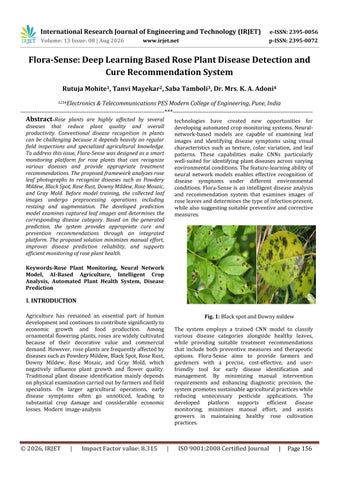
Fig. 1: Black spot and Downy mildew The system employs a trained CNN model to classify various disease categories alongside healthy leaves, while providing suitable treatment recommendations that include both preventive measures and therapeutic options. Flora-Sense aims to provide farmers and gardeners with a precise, cost-effective, and userfriendly tool for early disease identification and management. By minimizing manual intervention requirements and enhancing diagnostic precision, the system promotes sustainable agricultural practices while reducing unnecessary pesticide applications. The developed platform supports efficient disease monitoring, minimizes manual effort, and assists growers in maintaining healthy rose cultivation practices.
|
ISO 9001:2008 Certified Journal
|
Page 156
II.
International Research Journal of Engineering and Technology (IRJET)
e-ISSN: 2395-0056
Volume: 13 Issue: 08 | Aug 2026
p-ISSN: 2395-0072
www.irjet.net reliable prediction categories.
LITERATURE SURVEY
Earlier research explored different computational approaches for recognizing crop diseases through digital image analysis and intelligent prediction models.
plant
Sharma et al. [12] designed a hybrid learning framework integrating SVM and CNN methods for early rose disease prediction. Their model improved recognition accuracy on limited datasets.
Reddy et al. [3] utilized machine learning techniques to identify crop infections through image characteristics such as texture and color information. Their method improved the consistency of automated disease prediction.
Reddy et al. [13] investigated multiple predictive algorithms for analyzing health conditions in rose foliage. Their study evaluated multiple learning models and demonstrated the effectiveness of automated visual data evaluation for identifying plant infections in ornamental plants.
Arivazhagan et al. [4] applied segmentation and texture evaluation methods to detect unhealthy regions in plant leaves. Their approach enhanced the identification of infected areas in crop images.
Srivastava et al. [14] presented a computational approach for recognizing rose leaf infections through digital image evaluation and intelligent learning models. Their system integrated CNN, SVM, and KNN models to enhance classification performance and support early disease diagnosis in rose plants.
Ramesh et al. [5] enhanced neural-network performance for paddy disease recognition using evolutionary optimization strategies. Their approach improved classification efficiency and reduced prediction errors.
Duman et al. [15] designed a smartphone-assisted application for identifying infections and pest-related symptoms in rose crops using deep convolutional neural networks. The proposed solution enabled rapid disease identification through an Android application suitable for practical agricultural use.
Waghmare et al. [6] created a machine-learning-based crop prediction system along with pesticide recommendation functionality. Their platform supported agricultural decision-making and preventive crop management. Liakos et al. [7] examined different machine learning applications in agriculture, including crop supervision, disease recognition, and intelligent irrigation methods. Their review emphasized the importance of AI in modern farming systems.
Guduru Ramakrishna Reddy et al. [16] analyzed leaf photographs to determine infection categories and generated management suggestions platform using InceptionV3 and MobileNetV2 architectures. Their system identified crop health conditions using photographs of leaves and provided suitable recommendations for disease management.
A. S. Ahmad et al. [8] proposed an IoT-assisted greenhouse automation system for controlling environmental parameters and reducing disease spread. Their system improved greenhouse management through continuous monitoring.
Liu et al. [17] developed an efficient disease recognition strategy that utilized transferable feature learning for rose plant analysis. Their method improved disease recognition under field while reducing processing overhead and resource consumption requirements for real-time deployment.
Ferentinos et al. [9] implemented deep neural network models for crop disease classification under different environmental conditions. Their study demonstrated
Impact Factor value: 8.315
multiple
Kumar et al. [11] combined image segmentation methods with neural-network algorithms for recognizing rose leaf infections. Their framework improved disease differentiation and classification performance.
Rajendra et al. [2] developed a smart farming system using IoT sensors and cloud communication for monitoring agricultural conditions. Their work reduced manual supervision and improved environmental observation in farming applications.
|
across
Zhang et al. [10] presented a neural-network-oriented technique for identifying rose leaf diseases using images captured under natural lighting environments. Their work supported practical disease analysis for ornamental plants.
Ramcharan et al. [1] introduced a CNN-supported application for cassava leaf disease analysis using images collected from real agricultural environments. Their framework enabled faster disease recognition and supported field-level crop monitoring.
© 2026, IRJET
capability
|
ISO 9001:2008 Certified Journal
|
Page 157
International Research Journal of Engineering and Technology (IRJET)
e-ISSN: 2395-0056
Volume: 13 Issue: 08 | Aug 2026
p-ISSN: 2395-0072
www.irjet.net
IV. BLOCK DIAGRAM
Ozkan et al. [18] introduced a crop-health recognition model that examined real-world leaf images through computational analysis methods on real-world agricultural images. The research evaluated conventional prediction algorithms alongside modern neural-network approaches and demonstrated improved classification performance under practical field conditions. Based on this literature review, most current systems can only identify three to four plant diseases and do not provide comprehensive rose disease detection or treatment recommendation capabilities. While these systems deliver acceptable accuracy levels, the proposed CNN model successfully enhances prediction accuracy beyond existing methods. The proposed system addresses these shortcomings by detecting six distinct rose plant diseases and offering appropriate treatment recommendations for practical real-world use.
Fig. 2: Block diagram
V. PROPOSED SYSTEM Hardware Components 1. Microcontroller (RaspberryPiZero2W):
III. OBJECTIVE
Serves as the central control unit for the entire system. It analyzes leaf images through a deep learning model and coordinates communication across hardware components, software elements, cloud services, and the website interface.
The "Flora-Sense: Deep Learning Based Rose Plant Disease Detection and Cure Recommendation System" project aims to enhance rose farming efficiency and sustainability by automating disease identification and providing treatment guidance. Rose plants face significant threats from diseases like Powdery Mildew, Black Spot, Rose Rust, Downy Mildew, Rose Mosaic, and Gray Mold, all of which can severely impact plant health and crop yields. The suggested approach uses a Convolutional Neural Network (CNN) that leverages deep learning capabilities to analyze images of leaves and accurately identify diseases as they occur in real time. Built around a Raspberry Pi Zero 2W equipped with a camera module and control buttons, this system offers a portable, cost-effective, and easy-to-use approach. When the system identifies a disease, it delivers appropriate treatment and prevention recommendations via a web-based platform. FloraSense seeks to decrease reliance on manual plant monitoring, enable earlier disease identification, reduce agricultural losses, and encourage environmentally responsible farming methods through smart plant health monitoring.
© 2026, IRJET
|
Impact Factor value: 8.315
1.
2.
3.
|
Camera-Module(v2): Takes detailed, high-quality photographs of plant leaves to identify potential diseases and transmits these images to the Raspberry Pi for processing and evaluation. Website-Application: Displays detected diseases, plant health status, and treatment suggestions through a userfriendly interface. Cloud: Stores images and analysis data securely for remote access, backup, and future reference.
ISO 9001:2008 Certified Journal
|
Page 158
International Research Journal of Engineering and Technology (IRJET)
e-ISSN: 2395-0056
Volume: 13 Issue: 08 | Aug 2026
p-ISSN: 2395-0072
www.irjet.net
VI. FLOW OF THE SYSTEM
rose plant leaf images captured using Raspberry Pi Zero 2W and Camera Module V2 are uploaded to the system for disease analysis and prediction.
Fig.5.Original Image Fig 3: Flow Chart
3.
VII. RESULTS AND DISCUSSION
As shown in the figure 6 below, the captured images are preprocessed using resizing and normalization techniques to improve CNN model performance and prediction accuracy.
The system we developed includes a Raspberry Pi Zero 2W, Camera Module V2, a CNN-based deep learning model, cloud connectivity, and a Streamlit web application that detects rose plant diseases in real time and suggests treatments. Images of rose leaves and flowers are captured by the Camera Module V2, then processed through image preprocessing methods and examined by our trained CNN model. The web application we created displays both prediction results and treatment recommendations. The figures that follow demonstrate the outcomes from different phases of system development and testing Fig.6.Preprocessed Image 1. As shown in figure 4, the image capturing process is initiated through the command prompt using a push button interface, where system messages such as “capturing image” and “image uploaded” are displayed after successful image acquisition.
4. Healthy leaf and healthy flower prediction are successfully identified by the developed CNN based system, as shown in the figures below 7 and 8.
Fig.4. Image capture using Raspberry Pi camera 2.
As shown in the figure 5 below, the original
© 2026, IRJET
|
Impact Factor value: 8.315
Fig.7. Healthy Leaf Prediction Result
|
ISO 9001:2008 Certified Journal
|
Page 159
International Research Journal of Engineering and Technology (IRJET)
e-ISSN: 2395-0056
Volume: 13 Issue: 08 | Aug 2026
p-ISSN: 2395-0072
www.irjet.net
Fig.8. Healthy Flower Prediction Result Fig.11. Downy Mildew Prediction Result 5.
Similarly, the same process is carried out for diseased rose plant leaves and flowers which are successfully demonstrated.
Fig.12. Powdery Mildew Prediction Result
Fig.9. Gray Mold Prediction Result
Fig.13. Rose Mosaic Prediction Result
Fig.10 Black Spot Prediction Result
© 2026, IRJET
|
Impact Factor value: 8.315
|
ISO 9001:2008 Certified Journal
|
Page 160
International Research Journal of Engineering and Technology (IRJET)
e-ISSN: 2395-0056
Volume: 13 Issue: 08 | Aug 2026
p-ISSN: 2395-0072
www.irjet.net
existing systems. The system integrated Raspberry Pi, Camera Module V2, cloud connectivity, and a web application for real-time disease detection and monitoring. Multiple tests under different environmental conditions showed consistent accuracy and reliable performance. The presented system reduced human effort, enabled early disease identification, and improved plant health monitoring. The system we developed provides an effective, precise, and easy-to-use approach for identifying rose plant diseases in real time, tracking their progression, and managing crops in an environmentally sustainable way.
REFERENCES Fig.14. Rose Rust Prediction Result 1) A. Ramcharan, P. Baranowski, B. McCloskey, et al.,
“Deep learning for image-based cassava disease detection,” Frontiers in Plant Science, vol. 8, p. 1852, 2017.
6. Our CNN model reached acceptable accuracy and confidence levels when predicting both healthy and diseased rose plant images, as illustrated in the graph presented in figure 15.
2) R. P. Rajendra, et al., “IoT based smart agriculture
monitoring system,” International Engineering & Technology, 2018.
Journal
of
3) K. S. Reddy, et al., “Crop disease detection using
machine learning,” International Journal of Innovative Technology and Exploring Engineering, 2019.
4) S. Arivazhagan, R. Newlin Shebiah, S. Ananthi, and S.
Vishnu Varthini, “Detection of unhealthy region of plant leaves and classification of plant leaf diseases using texture features,” Agricultural Engineering International: CIGR Journal, 2013. 5) M. Ramesh, et al., “Optimization of deep neural
Fig.15. Model Prediction Accuracy Graph
networks using evolutionary algorithms for paddy leaf disease recognition,” Computers and Electronics in Agriculture, 2020.
Our completed system effectively detects rose plant diseases in real time by utilizing the Raspberry Pi Zero 2W, Camera Module V2, image preprocessing, and CNN-based deep learning methods. The system reliably recognizes healthy leaf and flower conditions while accurately predicting diseased leaves and flowers through our Streamlit web application, which incorporates cloud connectivity and treatment recommendation capabilities.
6) A. Waghmare, et al., “Crop disease prediction system
using machine learning and pesticide recommendation,” International Journal of Advanced Research in Computer Engineering & Technology, 2019. 7) T. G. Liakos, P. Busato, D. Moshou, et al., “Machine
learning in agriculture: A review,” Sensors, vol. 18, no. 8, p. 2674, 2018.
VIII.CONCLUSION 8) A. S. Ahmad, et al., “IoT-based greenhouse monitoring
and automation system,” International Journal of Advanced Computer Science and Applications, 2018.
The presented system addressed the problem of slow and inaccurate manual detection of rose plant diseases, which often led to yield loss and delayed treatment. A CNN based model was implemented to classify diseases from leaf images and provide suitable cure recommendations. The proposed CNN model also achieved improved prediction accuracy compared to
© 2026, IRJET
|
Impact Factor value: 8.315
9) K. P. Ferentinos, “Deep learning models for plant
disease detection and diagnosis,” Computers and Electronics in Agriculture, vol. 145, pp. 311–318, 2018.
|
ISO 9001:2008 Certified Journal
|
Page 161
International Research Journal of Engineering and Technology (IRJET)
e-ISSN: 2395-0056
Volume: 13 Issue: 08 | Aug 2026
p-ISSN: 2395-0072
www.irjet.net
10) Y. Zhang, et al., “Deep learning-based detection of
rose leaf diseases under natural environment,” Computers and Electronics in Agriculture, 2020. 11) H. Kumar, et al., “Image segmentation and deep
CNN for rose plant disease classification,” International Journal of Computer Applications, 2021. 12) M. Sharma, et al., “Hybrid SVM-CNN model for
early detection of rose plant diseases,” Procedia Computer Science, 2022. 13) E. R. Reddy, S. D. Satturi, M. Harshini, and S. Shaik,
"Machine Learning Approaches for Identifying Rose Plant Leaf Diseases," Asian Journal of Research in Computer Science, vol. 17, no. 11, pp. 65-72, 2024.
14) S. Srivastava, N. Fatma, P. K. Pandey, et al.,
"Intelligent Detection of Rose Leaf Ailments Through Enhanced Image Analysis and Machine Learning Techniques," Journal of Information Systems Engineering and Management vol. 10, 2025.
15) B. Duman, "Portable Device Detection Framework
for Rose Plant Diseases and Pests Through Deep Convolutional Neural Networks with Quantization Methods," Journal of Agricultural Sciences, vol. 31, no. 2, pp. 302-318, 2025.
16) G. R. Reddy and G. J. Moses, "Artificial Intelligence
Plant Disease Identification and Treatment Recommendations Through Deep Learning Models InceptionV3 and MobileNetV2," International Journal of Creative Research Thoughts, vol. 13, no. 6, 2025.
17) L. Liu, T. Yin, Y. Bai, B. Yang, and J. Yang,
"Investigation of Efficient Rose Disease Identification Using Transferable Feature Learning Approaches," Plants, vol. 15, no. 4, 2026.
18) M. Ozkan, "Plant Leaf Disease Classification
Through Image Processing and Machine Learning Applied to Real Environment Images," BEU Fen Bilimleri Dergisi, vol. 15, no. 1, pp. 328-340, 2026.
© 2026, IRJET
|
Impact Factor value: 8.315
|
ISO 9001:2008 Certified Journal
|
Page 162