
International Research Journal of Engineering and Technology (IRJET) e-ISSN: 2395-0056
Volume: 13 Issue: 01 | Jan 2026 www.irjet.net p-ISSN: 2395-0072
International Research Journal of Engineering and Technology (IRJET) e-ISSN: 2395-0056
Volume: 13 Issue: 01 | Jan 2026 www.irjet.net p-ISSN: 2395-0072
Babitha M Mulge1 , Dr. Kiran T2
1Student of Master in Technology, Department of Civil Engineering, University of Visvesvaraya College of Engineering, Bengaluru, Karnataka, India
2Associate Professor, Department of Civil Engineering, University of Visvesvaraya College of Engineering, Bengaluru, Karnataka, India.
Abstract - Reinforced concrete slabs are important components influencing serviceability performance through their flexural behaviour, stiffness, and deflection characteristics.Duetosomeconsiderationslikethehighelastic modulusandductilebehaviour,HighYieldStrengthDeformed (HYSD) steel bars are generally preferred for slab reinforcement. On the contrary, in recent times, Glass Fibre ReinforcedPolymer(GFRP)barshaveattractedinterestasan alternative to steel reinforcement by its high tensile strength, corrosion resistance, and durability leverage. However, the lesser modulus of elasticity of GFRP bars leads to different flexural response behaviour, especially under service load levels, when compared to conventionally used steel reinforcement, calling for experimental verification. The present study investigates the flexural behaviour of concrete slabs reinforced with HYSD bars and GFRP bars nominally in laboratory conditions by applying experimental-analytical intervention. Four reinforced concrete slab specimens, which had the same material properties and geometric configurations, were tested; two slabs were reinforced with HYSD bars and the other two with GFRP bars. The flexural loading was carried out in an incremental manner while measuringmid-spandeflectionduringloading.Experimentally determined deflections were compared with theoretical predictions made by elastic analysis formulations. The results presentedindicatethatundersimilarloadingconditions,slabs reinforced with HYSD bars were stiffer and had lower deflectionscomparedtothosereinforcedwithGFRPbars.Even though higher deflections were recorded for GFRP-reinforced slabs, their flexural behaviour was generally stable. For both reinforcementtypes,itwasfoundthatexperimentaldeflections exceeded theoretical predictions, with GFRP-reinforced slabs presenting the largest divergence. The study emphasizes the importanceofexperimentalverificationinestablishingrealistic assessment of serviceability for RC slabs reinforced by alternative reinforcement materials.
Key Words: Reinforced concrete slabs; Flexural behaviour;HYSDreinforcement;GlassFibreReinforced Polymer (GFRP); Load–deflection response; Serviceabilityperformance
Reinforced concrete (RC) slabs serve as one of the most important elements of any building structure. They act as primaryloaddistributioncomponentstransferringimposed loadstovariousbeams,columns,andsupportingwalls.The structuralperformanceoftheseslabsisdeterminedprimarily byflexuralbehaviour,whichgovernsserviceabilityaspects like deflection control, crack development, and stiffness characteristics.Excessivedeflectionsorcrackingmaypose challenges to function, durability and comfort even when sufficient strength is given, thus making serviceability performance an important design consideration for slab elements. Although reinforced concrete slabs have always been incorporated with high-yield steel deformed (HYSD) bars because of its high flexible behavior and elasticity, reliable performance most especially under service and ultimate loading conditions has been the traditional application of HYSD in reinforced concrete slabs. Steel reinforced slabs possess good stiffness and a predictable load-deflection behavior supported by design guidelines under codal provisions; however, steel reinforcement is susceptible to corrosion under very harsh environmental conditionslikecoastalareas,industrialzones,andareaswith exposuretochemicalsandmoisture.Corrosioncauseslossof cross-sectional area, deterioration of bond, and reduced service life. Thus, the development of alternative reinforcementmaterialsnotsovulnerabletotheincidenceof deterioration has been greatly motivated. GFRP bars are increasing as a popular alternative to normal steel reinforcement because of their better internal tensile strength,resistancetocorrosion,andlightweight.Themost important advantage offered by GFRP reinforcement is its durabilityanddegradationthroughenvironmentalexposure. However,GFRPbarshaveasignificantlylowermodulusof elasticity than steel bars, which brings differential flexural response behaviour. Notably, GFRP concrete slabs tend to exhibitgreaterdeflectionandlowerstiffnessunderservice loads compared to steel-reinforced slabs, thus making serviceabilitybehaviorcrucialinthedesigncriterion.Alotof work has been done on the study of flexural behavior of reinforcedconcretebeamsreinforcedwithsteel andGFRP bars,buttheexperimentalworkrelatingtoslabelementswas relativelylimited.Slabsdifferfrombeamsconcerningatwodimensionalload-transfermethod,boundarycondition,and
International Research Journal of Engineering and Technology (IRJET) e-ISSN: 2395-0056
Volume: 13 Issue: 01 | Jan 2026 www.irjet.net p-ISSN: 2395-0072
crackingpattern.Therefore,theslabsneedseparatestudy. Furthermore,thedeflectionatpresentisusuallypredicted withanalyticalmethodsonsomesimplifiedassumptionsthat may not include the actual behavior of the slabs after cracking.Thus,inthisarea,anexperimentalandanalytical study needs to be performed on RC slabs reinforced with HYSDsteelandGFRPunderambientconditions.Thepresent studyseekstocomparetheflexuralbehaviorofsuchRCslabs intermsofloaddeflection,aswellasthedifferencesbetween theoreticalpredictionsandexperimental observation,thus leading to furthering understanding on serviceability performanceofslabsreinforcedwithbothconventionaland alternativereinforcementmaterials.
Thisexperimentalprogramwasessentiallysetouttoprepare four reinforced concrete slab specimens of M30 grade concrete, which were to represent conventional structural slabelementswhenambientconditionsapply.Thematerials selected and the mix proportions were so according to corresponding Indian Standard specifications to maximize the degree of uniformity, repeatability and reliability of resultsfromthetests.OrdinaryPortlandCement,grade53 and according to IS 12269, was used as the main cementitious material in the experiments whose source shouldcomefromasinglesourceandstoredintotallydry condition to prevent moisture ingress to maintain quality consistency.Fineaggregatecomefrommanufacturedsand (M-sand) having specific gravity of 2.65. As far as the fine aggregateisconcerned,itwillfollowthegradingandquality requirements of IS 383 and will be completely free of the following:organicimpurities,silt,andclaycontent.Allcoarse aggregateswerecrushedangulargraniteaggregateandwere takentomaximumnominalsizeof20mm.Coarseaggregate was selected to achieve interlocking and strength of the concretematrixandalsoaccordingtoIS383specifications. Alltheaggregateswerekeptindryconditionbeforebatching to ensure accurate control of water–cement ratio during mixing. Concrete was mixed in such a way that a characteristic compressive strength of 30 MPa at 28 days wouldbeobtained,witha water-cementratioof0.45.The chemical admixture was mixed in this mix to improve workabilitycentraltouniformcompactionofconcreteinslab moulds as normal-range in accordance with IS:9103. The admixture dosage was finely controlled to improve workabilitywithoutendangeringtheaggregatebeginnerand bleedingormodifyingadverselythesettingtime.Theuseof admixture clearly enabled efficient placement by concrete around reinforcement leading to more weighty and homogeneousspecimens.Thereinforcementschemeforthe slabspecimenscomprisesreinforcementbarssituatednear wherethetensionfacewastoensureflexuralactionduring testing.Inthespecifiedslabs,GlassFiberReinforcedPolymer (GFRP)barsof6mmdiameterwereutilizedasreinforcement while the other slabs were reinforced with conventional HYSD steel bars for comparative evaluation. GFRP bars
conformedtospecificationsasperIS18255:2023andwere reinforced for high tensile strength and low modulus of elasticity compared to steel reinforcement. Thus this variationbetweenmaterialpropertieswaspresumedtohave aninfluenceonflexuralbehavior,particularlydeflectionsand stiffness responses. All such reinforcement received an adequate concrete cover toensure proper embeddingand bondwithinthedepthoftheslab.Eachslabwas500mm× 500mm×50mmthickandwasathinslabsimilartothose found in building applications. An appropriate spacer was used to maintain a nominal concrete cover of 15 mm. concretemixingwasdoneinamechanicalmixertoachieve uniformincorporationofallconstituents.Freshconcretewas placed inside steel molds in layers and compacted using mechanical vibration to eliminate entrapped air. After casting, specimens were set under laboratory conditions, demouldedafter24hours, andthencuredforappropriate periods until adequate strength had developed prior to carrying out tests. The mix proportions adopted for M30 concreteusedinthestudyaresummarizedinTable2.1.
Table-2.1
The experimental program aimed at studying the flexural behavior of reinforced concrete slabs reinforced with High YieldStrengthDeformed(HYSD)steel barsandGlassFiber ReinforcedPolymer(GFRP)barsintheambientlaboratory conditions.Fourreinforcedconcreteslabspecimenswerecast usingM30gradeconcretewiththesamematerialproperties, reinforcement layout, and curing conditions ensuring uniformity.Eachoftheslabsmeasured500mm×500mm× 50mm,withreinforcementsplacedclosetothetensionface andadequateconcretecoverprovidedforproperbondand embedment.Comparisonofflexuralresponsewasenabledby havingtwoofthespecimensreinforcedwithHYSDsteelbars andtheothertwowithGFRPbars.Allslabsweretestedafter curingforflexuralloadingunderroomtemperature.Theload was applied incrementally through a calibrated loading device,whilstmid-span deflectionsweremeasuredwiththe help of dial gauges throughout the loading process. The experimentalobservationsweremajorlyconcernedwithloaddeflection behavior, stiffness characteristics, and cracking response of the slabs. The experimentally obtained values werethencomparedwiththeoretical deflectionsthat were derived through elastic analysis formulations, therefore
International Research Journal of Engineering and Technology (IRJET) e-ISSN: 2395-0056
Volume: 13 Issue: 01 | Jan 2026 www.irjet.net p-ISSN: 2395-0072
getting a measure of the divergence between analytical predictionandactualbehavioroftheslab.
The experimental investigation was comprised of four slabspecimen’sreinforcedusingM30-gradeconcrete.Allthe slabshavethesamesizeof500mm×500mm×50mm,and they have a single layer of reinforcement placed at the tension face for flexural action under loading. Adequate concretecoverwasmaintainedtoensureproperbondingand embedment of reinforcement. Two slabs were reinforced withconventionalHighYieldStrengthDeformed(HYSD)steel bars,whiletheothertwoslabswerereinforcedwithGlass Fibre Reinforced Polymer (GFRP) bars for comparison of flexuralbehaviorunderenvironmentalconditions.Specimen identificationdetailsarepresentedinTable3.1.
Table-3.1: SpecimenIdentification
Foreachslabspecimen,testsunderflexuralloadingin roomtemperatureshouldbeundertakenemployingaloading framefittedwitha hydraulic jack.Therearetwoopposing edges supported by steel supports mounted on a loading chair,whileallowingfreeedgealongtheremainingsides.The supportingarrangementallowsforrotationattheedgesof the slabs as well as strictly vertical reaction forces, hence, creating one-way simply supported boundary conditions. Loadcellswereusedinapplyingconcentratedverticalloadto thecenteroftheslabthroughstiffloadingplate,toensure uniform application and produce flexural bending. All the slabspecimenswereflexuralloadedatambienttemperature usingaloadingframeintegratingahydraulicjack.Theslabs were,however,laidonsteelsupportsmountedonaloading chair so that the load could act on the edge along two oppositeedges,whereastheremainingedgesremainedfree. Thearrangementallowsrotationatslabedgesandhasonly vertical reaction forces, thus simulating one-way simply supportedboundaryconditions.Loadappliedverticallyatthe center of the slab through a rigid loading plate ensures uniformloadtransferandinducesflexuralbending.
Theflexuralloadingwasincrementallyraisedwiththehelp ofacalibratedhydraulicjack.Inloadingincrementsofsmall
magnitude, the exact observation of load-deflection behaviour was made possible during the whole course of testing. At each loading increment, the applied load was recorded, followed by the corresponding mid-span deflection values. The loading was continued until an excessivedeflectionwithvisiblecrackingwasobservedon theslab,indicatingflexuralfailure.
The mid-span deflections were recorded by the dial gauge having a least count of 0.01 mm, placed directly beneaththeslabcenter.Observationsduringthetestwere made on the initiation and propagation of cracks. Crack patterns were manually marked for understanding the flexural cracking behaviour of the slabs. The main parametersrecorded during testing includedappliedload andcorrespondingmid-spandeflection,alongwithcracking patternandoverallflexuralresponse.
Flexural Testing of Reinforced Concrete Slab Specimens: Results and Discussion of the Structural Response of SpecimensUnderLoadThissectionwilldealfurtherwiththe analysis of the load-deflection characteristics of the slabs, the stiffness variation, and the effect of different types of reinforcements.Theload-deflectioncharacteristics,stiffness variation, and reinforcement type influence the slabs' response. The other parts include the comparison of the experimental tests and the anticipated theoretical predictionsforanalyzingtheapplicabilityoftheanalytical modelsinthestudy.
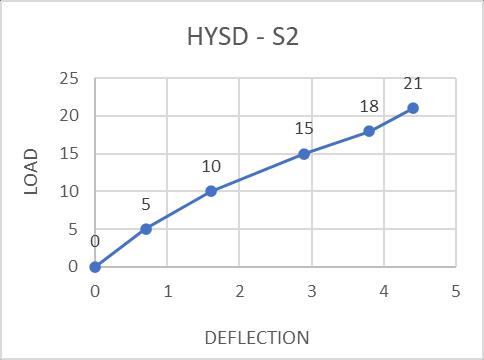
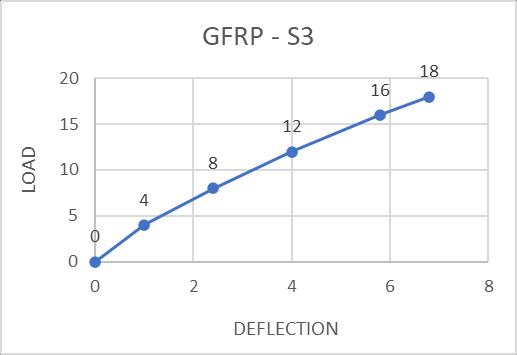
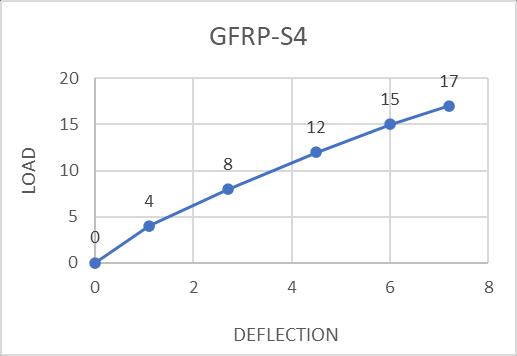
The experimental load-deflection response of the reinforcedconcreteslabspecimensfromflexuraltestingis outlinedinTable4.1.Theflexuralresponseoftheslabswas assessedintermsofstiffnesscharacteristics,ultimateloadcarrying capacity, and maximum mid-span deflection. All specimensstartedwithaslightlylinearresponse;thereafter, after the cracking process set in, the responses were nonlinear.
Table-4.1: HYSDReinforcedSlab-S1
International Research Journal of Engineering and Technology (IRJET) e-ISSN: 2395-0056
Volume: 13 Issue: 01 | Jan 2026 www.irjet.net p-ISSN: 2395-0072
Table-4.2: HYSDReinforcedSlab-S2
Deflection
Table-4.3: GFRPReinforcedSlab-S3
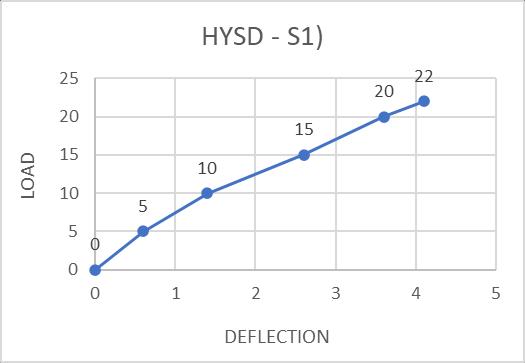
Table-4.4: GFRPReinforcedSlab-S4
Deflections were theoretically calculated based on elastic analysesusingidealisedmaterialbehaviourwithrespectto uncracked section properties. The comparisons between theoretical predictions and experimental measurements revealedthatthedeflectedvaluesobservedexperimentally were always higher for all slab specimens. This deviation alwaysincreasedwiththeprogressionofloadbutwasmore pronounced in GFRP-reinforced slabs. The discrepancies identified in these experiments are attributed to cracking effects, bond behaviour, or material nonlinearity, none of whichareaccuratelyrepresented bythesimplified elastic analysisapproach.
International Research Journal of Engineering and Technology (IRJET) e-ISSN: 2395-0056
Volume: 13 Issue: 01 | Jan 2026 www.irjet.net p-ISSN: 2395-0072
4.3 Comparison between HYSD And GFRP Reinforced Slabs
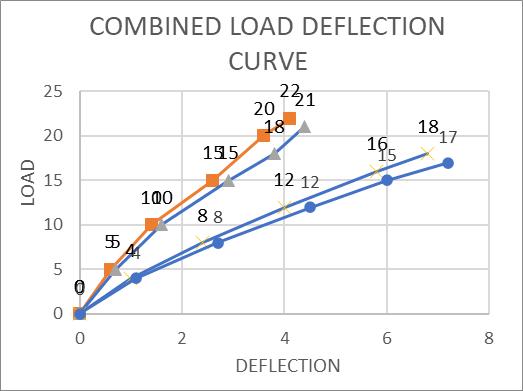
In the comparative evaluation of test results, slabs reinforcedwithHYSDsteelbarsshowedhigherstiffnessand lower deflections under the same loading conditions than GFRP-reinforcedslabs.Theprimaryreasonforthisbehavior is related to the higher modulus of elasticity of steel reinforcement that provides higher resistance to flexural deformation. On the contrary, GFRP bars reinforced slabs have comparatively greater deflections because of lower elasticmodulusofGFRPreinforcement.However,theload deflection response of GFRP-reinforced slabs remained stable and gradual, without sudden or brittle failure, indicating satisfactory flexural performance under surroundingconditions.
GFRP-reinforcedslabs,incontrast,astheirnamesuggests, has comparatively more deflections because of the lower elasticmodulusofGFRPreinforcement.However,theloaddeflection response of GFRP-reinforced slabs remained stableandprogressiveovertime,withoutsuddenfailureor completes brittle failure, which shows flexibility under ambientconditions.
Accordingtoexperimentalandanalyticalinvestigationsdone on ambient conditions reinforced concrete slabs, the followingwouldbederivedasconclusions:
1. Flexuralbehaviorofreinforcedconcreteslabshas been differentially affected by the type of reinforcementused,particularlyregardingstiffness anddeflectionresponse.
2. Intheirfightagainstasimilarload,slabsreinforced withHYSDsteelbarswerestifferandhadsmaller midspandeflections,mainlybecauseofthehigher modulus of elasticity of the steel reinforcement comparedtotheirGFRPcounterparts.
3. Dependingontheloadapplication,GFRP-reinforced slabsexhibitedhigherdeflections;however,gradual and stable shall load-deflection response was observed which didn't show any abrupt change typicalofsuddenfailureorbrittlefailure.
4. Theload-deflectionresponseofallslabspecimens during the initial stage was linear, whereas nonlinear behavior was observed after cracking commenced, which is characteristic of flexural behaviorofreinforcedconcretemembers.
5. Theload-carryingcapacityofslabsreinforcedwith HYSD was at best comparably equal to GFRPreinforcedslabsslightlyhigher,therebyreflecting thecontributionofsteelreinforcementtoflexural resistance.
6. Experimental deflections during the course of testing were reported higher than the deflections calculatedtheoreticallybyelasticanalysisforevery specimen.
7. Astheloadwasincreased,thedifferencebetween the theoretical and experimental deflections kept increasing, thus creating a greater differentiation forGFRP-reinforcedslabs.
8. Greater differences above those for GFRP-slab deflectionscanbeattributedtocrackingstatus,loss of stiffness, bond behavior, and the material nonlinearity not taken care of in some simplified analyticalmodels.
International Research Journal of Engineering and Technology (IRJET) e-ISSN: 2395-0056
Volume: 13 Issue: 01 | Jan 2026 www.irjet.net p-ISSN: 2395-0072
9. Theoretical analysis based on uncracked section properties drastically under-predicted the deflections, thus highlighting the importance of experimental verification in establishing the serviceabilitybehaviorofGFRPslabs.
10. Thisstudyconcludesthattheserviceabilitycriteria, especiallydeflectioncontrol,controlthedesignof GFRP-reinforced RC slabs under ambient conditions.
[1] GlassFibreReinforcedPolymer(GFRP)barsmaybe consideredasanalternativetoconventionalHYSD steel reinforcement in reinforced concrete slabs where durability, corrosion resistance, and longterm performance are critical, provided that serviceabilitylimitsarecarefullysatisfied.
[2] Since GFRP-reinforced slabs exhibit higher deflectionsduetothelowermodulusofelasticityof GFRPbars,deflectioncontrolshouldbetreatedasa governing design criterion in comparison with strength-baseddesign.
[3] Analyticaldeflectionmodelsbasedonelastictheory should be used with caution for slabs reinforced with GFRP bars, as they tend to underestimate actual deflections observed experimentally. Appropriatestiffnessreductionfactorsormodified analyticalapproachesarerecommended.
[4] Experimentalvalidationisstronglyrecommended when assessing the flexural and serviceability performanceofreinforcedconcreteslabsreinforced with alternative reinforcement materials such as GFRP.
[5] For practical applications, hybrid reinforcement strategies combining steel and GFRP bars may be explored to achieve a balance between stiffness, ductility,anddurability.
[6] Future experimental studies may be extended to investigatetheinfluenceofreinforcementratio,slab thickness, and support conditions on the flexural behaviourofGFRP-reinforcedslabs.
[7] Numericalandfiniteelementmodellingstudiesare recommended to complement experimental investigationsandtodevelopimprovedpredictive models for load–deflection behaviour of slabs reinforcedwithGFRPbars.
[1] IS456:2000,PlainandReinforcedConcrete–Code ofPractice,BureauofIndianStandards,NewDelhi, India.
[2] IS 18255: 2023, Glass Fibre Reinforced Polymer (GFRP) Bars for Concrete Reinforcement –Specification, Bureau of Indian Standards, New Delhi,India.
[3] Bank,L.C.,“CompositesforConstruction:Structural DesignwithFRPMaterials,”JohnWiley&Sons,New York,2006.
[4] Benmokrane,B.,El-Salakawy,E.,andEl-Ragaby,A., “Flexural Behaviour of Concrete Slabs Reinforced with FRP Bars,” Journal of Composites for Construction,ASCE,Vol.10, No.5,2006,pp.402–414.
[5] Toutanji, H. and Saafi, M., “Flexural Behaviour of Concrete Slabs Reinforced with Fibre Reinforced Polymer Reinforcement,” ACI Structural Journal, Vol.97,No.5,2000,pp.727–736.
[6] ACI 440.1R-15, Guide for the Design and Construction of Structural Concrete Reinforced with FRPBars,AmericanConcreteInstitute,Farmington Hills,USA.
[7] El-Salakawy,E.,Benmokrane,B.,andEl-Ragaby,A., “Flexural Behaviour of One-Way Concrete Slabs ReinforcedwithGFRPBars,” Journal of Composites for Construction,ASCE,Vol.9,No.2,2005,pp.147–157.
[8] ISIS Canada Design Manual No. 3, “Reinforcing Concrete Structures with Fiber Reinforced Polymers, ”ISIS Canada Corporation, Winnipeg,2007.
[9] Wang, H., Belarbi, A., and Wang, J., “Deflection Behavior of Concrete Members Reinforced with FRPBars,”ACI Structural Journal, Vol.106,No.3,2009,pp.333–341.
[10] Rafi, M. M., Nadjai, A., Ali, F., and Talamona, D., “AspectsofBehaviorofCFRPReinforcedConcrete Beamsin Bending, “Construction and Building Materials,Vol.22,No.3,2008,pp.277–285.
[11] Teng, J. G., Chen, J. F., Smith, S. T., and Lam, L., “FRP-Strength ened RC Structures, ”John Wiley & Sons,Chichester,UK,2002.