
International Research Journal of Engineering and Technology (IRJET) e-ISSN: 2395-0056
Volume: 13 Issue: 04 | Apr 2026 www.irjet.net p-ISSN: 2395-0072

International Research Journal of Engineering and Technology (IRJET) e-ISSN: 2395-0056
Volume: 13 Issue: 04 | Apr 2026 www.irjet.net p-ISSN: 2395-0072
Mrs.Hemalatha1 , Ms. ArokkiyaMerina A2 , Ms.Arunthathi T3 , Ms. Monisha S4
Department of Computer Science and Engineering N.S.N. College of Engineering and Technology , Karur , Tamil Nadu , India
Abstract : FleetVision: An Integrated Fleet Operations and Maintenance Management System is a web-based application designed to streamline and centralize fleet management activities within institutions and organizations. The system integrates vehicle operations, fuel monitoring, driver management, and AI-based predictive maintenance and fuel consumption analytics into a single unified platform to improve operational efficiency and support better decisionmaking.FleetVision enables institutions to register and manage multiplevehicles, monitor fuelconsumption,calculate mileage, and track service schedules through structured dashboards and graphical reports. The platform also supports role-based access control, allowing institutions, drivers, mechanics, and users to access relevant features securely. Drivers and mechanics can create profiles within the system, making them searchable and easily accessible for operational and service requirements.The application is developed using HTML, CSS, and React.js for the frontend, along with Java Spring Boot and MySQL for backend processing and data management. By replacing manual record-keeping with an integrated digital system, FleetVision enhances operational control, reduces maintenance delays, and supports better decision-makinginfleetoperationsmanagement.
Keywords Fleet Management; Fleet Operations; Fuel Consumption Analytics; Predictive Maintenance; Vehicle Monitoring; Web Application;
The rapid growth of transportation and logistics has increased the need for efficient fleet management systems. Organizations that operate multiple vehicles must manage various activities such as vehicle tracking, driver management, fuel monitoring, maintenance scheduling, and performance analysis. Managing these operations manually canbetimeconsuming,errorprone,andinefficient.
FleetVision: An Integrated Fleet Operation and Maintenance Management System is developed to simplify and automate the management of fleet operations. The system provides a centralized platform that allows administrators to manage vehicles, drivers, fuel records,
maintenance schedules, and operational reports in an organizedandefficientmanner.
The main objective of FleetVision is to improve operational efficiency by providing accurate data managementandautomatedprocesses.
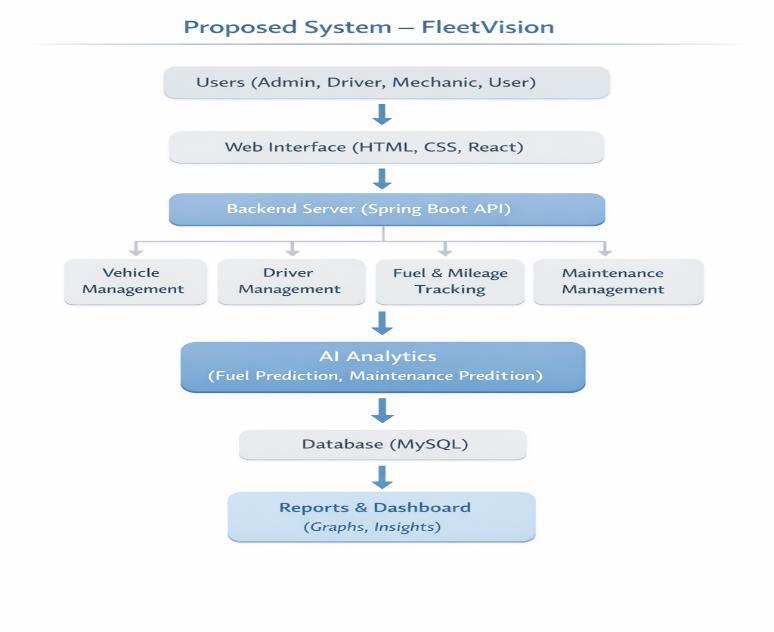
The literature survey provides a comprehensive review of existing research studies and systems related to fleet management,fuel monitoring,vehiclemaintenancetracking, and integrated management platforms. The purpose of this chapter is to analyse previous work in the domain, identify the strengths and limitations of existing systems, and establishtheneedforanintegratedsolutionlikeFleetVision.
According to Ian Sommerville [1] in his book "Software Engineering," software engineering is "a systematic approach to building software systems." He specifically mentions structured software development methodologies such as Waterfall and Agile methods, which are used for organizingsoftwaredevelopmentactivitiesintowell-defined software development phases, including requirement analysis, system design, implementation, and testing. These are critical software requirements for software applications
International Research Journal of Engineering and Technology (IRJET) e-ISSN: 2395-0056
Volume: 13 Issue: 04 | Apr 2026 www.irjet.net p-ISSN: 2395-0072
such as fleet management systems, as they ensure software reliability, scalability, and maintainability. Software engineering also helps in reducing software development costs and improving software quality by reducing errors in theinitialsoftwaredevelopmentphases.
Software development is incomplete without proper analysis, design, and testing of requirements. In his book "Software Engineering: A Practitioner’s Approach," Roger S. Pressman [2] emphasizes the significance of proper engineering practices to develop efficient software. It is mentioned in his book that validation and verification techniques play a vital role in developing efficient software. Datamanagementefficiencyisafundamentalrequirementin areal-timesystem.AsdiscussedbyAbrahamSilberschatzet al. in Database System Concepts, database systems provide data consistency, integrity, and efficiency in retrieving data. These characteristics are fundamental in storing and managing large volumes of vehicle and user data in fleet managementsystems[3].
System modeling and design are made easier through standardizedtools.GradyBooch,JamesRumbaugh, and Ivar Jacobson proposed the concept of UML in their book, The Unified Modeling Language User Guide [4], which includes diagrams such as use case and class diagrams. These tools facilitate the design of applications in a more efficient manner .Modern applications are dependent on database management systems for storing data. According to Oracle Corporation [5] in its documentation on MySQL, relational databasemanagementsystemsareusedforstoringdataina structured manner and for handling transactions, which are requiredforfleet-relateddata
For backend system development, programming environments must be dependable and platformindependent. According to Oracle Corporation’s Java Platformdocumentation[6],Javaisaprogramminglanguage that offers portability, security, and scalability. Therefore, it is appropriate for use in the development of enterprise applications such as fleet management systems.Web technologies make it possible to develop interactive and user-friendlyinterfaces.
The World Wide Web Consortium [7] has developed standardsthatensureconsistencyandcompatibilityinwebbased systems. HTML is commonly used to develop interactive interfaces for monitoring and controlling fleet managementsystems.Intelligentsystemshaveimprovedthe decision-makingcapabilitiesofmodernapplications.
Kevin P. Murphy [8] explains in his book "Machine Learning:AProbabilisticPerspective"howmachinelearning
can be used to predict system behavior and optimize performanceinvariousfieldssuchasfleetmanagement.
A web-based fleet management system was proposed by S. Malik and R. Singh, which emphasizes real-time tracking, central data storage, and user authentication. The study proves the efficiency of web technologies in enhancing fleet managementandtrackingsystems[9].Avehicletrackingand monitoring system was developed by A. Kumar and P. Sharma, using GPS and communication technologies for precise real-time tracking. This system enhances safety, accuracy,andefficiencyintransportationsystems[10]
M. Gupta discusses a fuel monitoring and management system [11]thatcantrackfuelconsumptioninreal-timeand can identify anomalies. It can help in reducing fuel wastage andincreaseefficiencyinfleetmanagementR.Jaindiscusses a cloud-based fleet management system [12] It can provide access, storage, and scalability to the system. Cloud integrationcanincreaseflexibilityinfleetmanagement
S.Verma and D. Patel discuss a preventive maintenance system [13] for vehicles. It can predict failures in vehicles basedontheirusage.Itcanincreasethelifespanofvehiclesin afleet.N.Kaurdiscussesaweb-basedtransportmanagement system [14] It can increase efficiency in transport management. It can provide easy access to transport managementthroughawebinterface.
P. Singh discusses monitoring systems [15] based on dashboards. It can provide insights into data through charts and reports. It can help administrators in taking decisions quickly. T. Brown discusses data management techniques [16] in transport management. It can provide efficient storage, processing, and retrieval of data. It can increase efficiency in transport management. [17] In his paper, J. Lee talksaboutsmartfleetmanagementusingIoTtechnology.
The IoT technology helps in tracking and data collection.R. Taylor talks about database [18] design and implementation strategy. He describes normalization and indexing as database design and implementation strategy.S. Wilson talks about software development life cycle [19] He describes Agile and Spiral as software development life cycles. These life cycles help in developing high-quality software.D.Greentalksaboutthecurrentfleet analyticsand reporting system [20] He describes data visualization and analyticstools.
The existing system for fleet management in many organizations is primarily based on manual processes or partially computerized methods that lack full integration. In
International Research Journal of Engineering and Technology (IRJET) e-ISSN: 2395-0056
Volume: 13 Issue: 04 | Apr 2026 www.irjet.net p-ISSN: 2395-0072
traditional systems, fleet operations such as vehicle management, driver details, fuel tracking, and maintenance schedulingarehandledusingpaperrecords,spreadsheets,or separate standalone applications. This fragmented approach makes it difficult to maintain consistency, accuracy, and efficiencyinmanagingfleet-relatedactivities.
In the currentsystem, vehicle details suchas registration number, model, and service history are often recorded manuallyinlogbooksorstoredinseparatefiles.Thismakesit challenging to retrieve information quickly when required. Similarly,driverinformationincludinglicensedetails,contact numbers,andassignedvehiclesismaintainedindependently, leadingtoduplicationofdataandincreasedchancesoferrors.
Fuel management is another critical area where the existing system faces significant limitations. Fuel entries are usually recorded manually, and calculations for mileage are done separately. This process is time-consuming and prone to human errors, which can lead to incorrect analysis of fuel consumption and inefficiencies in fleet operations. There is no automated mechanism to monitor fuel usage or detect abnormalconsumptionpatterns.
Maintenance management in the existing system is often reactive rather than preventive. Vehicles are serviced only afterabreakdownorbasedonmanualreminders,whichcan lead to increased repair costs and downtime. There is no propertrackingofmaintenanceschedules,servicehistory,or automated alerts for upcoming services. This lack of systematic maintenance management affects the overall performanceandlifespan.
The proposed system, FleetVision: An Integrated Fleet OperationandMaintenanceManagementSystem,isdesigned to overcome the limitations of the existing manual and semi‑automatedsystemsbyprovidingacentralized,efficient, and fully automated platform for managing fleet operations. The system integrates all major fleet management activities such as vehicle management, driver management, fuel monitoring, mileage calculation, maintenance tracking, and reportgenerationintoasingleweb‑basedapplication.
This centralized approach ensures that all data is stored inastructureddatabase,makingiteasytoaccess,update,and manage information efficiently. In the proposed system, vehicledetailsarestoreddigitally,allowingadministratorsto easily add, update, and retrieve information such as registration number, model, type, and service history. Similarly,driverinformationismaintained.
One of the key features of the proposed system is automatedfuelentryandmileagecalculation.Userscanenter fuel details and odometer readings, and the system
automaticallycalculatesvehiclemileage.Thisreducesmanual errorsandhelpsinmonitoringfuelefficiencyaccurately.
The system also allows tracking of fuel consumption patterns, enabling better analysis and cost control. The proposed system includes an advanced maintenance management module that supports both preventive and corrective maintenance. It records service details, tracks maintenance history, and provides alerts for upcoming services.
This ensures timely servicing of vehicles, reduces unexpected breakdowns, and increases the lifespan of fleet vehicles. Another important feature is the report generation module, which automatically generates reports related to vehicleperformance,fuelusage,andmaintenanceactivities.
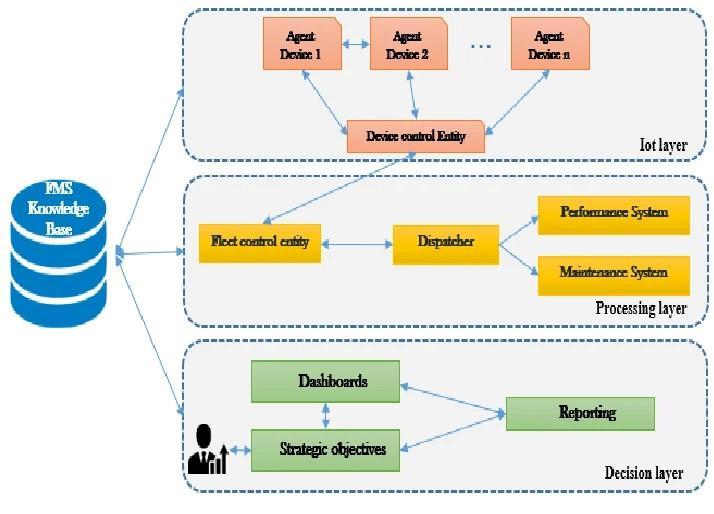
This chapter describes the methodology adopted for the development of FleetVision: An Integrated Fleet Operations and Maintenance Management System. The methodology outlinesthesystematicapproachfollowedtodesign,develop, implement,and test the system effectively. The development of FleetVision follows a structured Software Development Life Cycle (SDLC) approach to ensure proper planning, analysis, implementation, and validation. Each phase of the development process was carefully executed to achieve accuracy, reliability, and efficiency in the system. The methodology includes requirement analysis, system design using UML diagrams, database design, implementation using appropriate technologies, and thorough testing. This structuredapproachensuresthatthefinalsystemmeetsuser requirements, maintains data integrity, and provides secure
International Research Journal of Engineering and Technology (IRJET) e-ISSN: 2395-0056
Volume: 13 Issue: 04 | Apr 2026 www.irjet.net p-ISSN: 2395-0072
and efficient fleet management operations. By following a well-definedmethodology,developmentrisksanderrors
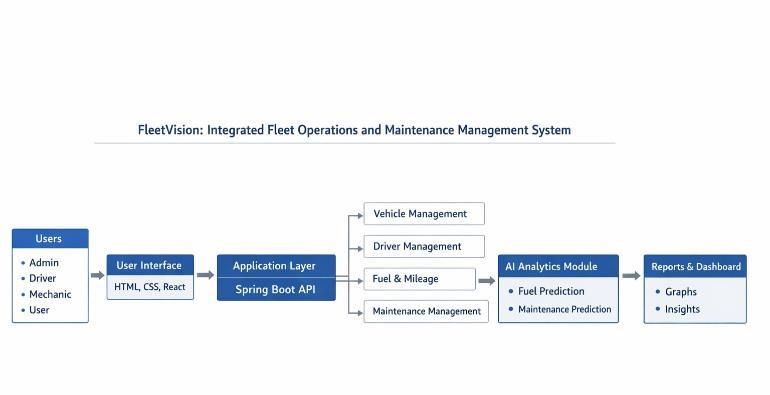
To guarantee effective design and implementation, the FleetVision system was created using a structured methodology. Requirement analysis first revealed problems with the current system, including ineffective maintenance tracking, poor data integration, and manual record-keeping. Key requirements such as vehicle, driver, fuel, maintenance management,andreportgenerationwereestablishedinlight ofthis.Thesystemwasdividedintodistinctmodulesforeach function during the design phase to create a modular architecture. System structure and workflow were representedusingUMLdiagrams,suchasusecase,class,and activity diagrams. This methodical approach guarantees the fleet management system's accuracy, dependability, and improvedperformance.
The outcomes and analysis of the FleetVision system assess its efficacy and performance following deployment. The system managed cars, drivers, fuel, maintenance, and reports effectively after being tested under a variety of conditions. To guarantee seamless operation, each module was tested both separately and in combination. System security was ensured by the login module's accurate validation of user credentials and restriction of access to authorized users only. The authentication procedure was error-free and dependable. All thingsconsidered, the system effectively addressed the shortcomings of conventional approaches by offering a centralized, automated, and effective fleet management solution. The vehicle management module efficiently handled adding, updating, and retrieving vehicle details, improving data organization through a structured database. The driver management module maintained driver information, including personal andlicensedetails,andallowedeasyassignmentofdriversto vehicles,enhancingcoordination.
The fuel entry and mileage calculation module produced accurate results by automatically calculating mileage using fuelinputandodometerreadings.Thisreducedmanualwork
and helped analyze fuel efficiency. Overall, these modules improved record management, operational efficiency, and supportedbetterdecision-makinginfleetoperations.
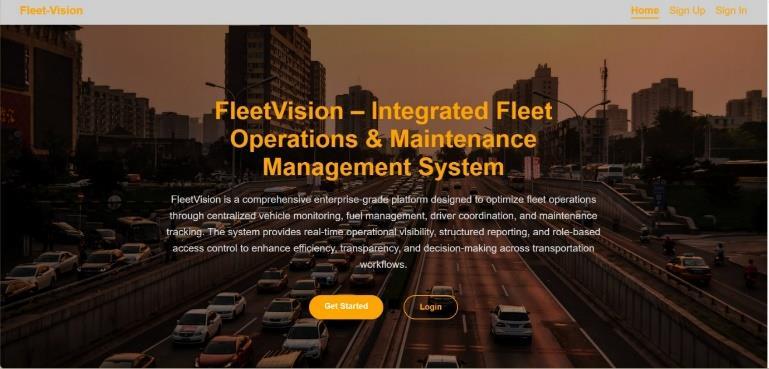
The maintenance management module improved vehicle reliability by recording service details and tracking maintenance history. It supported preventive maintenance and reduced unexpected breakdowns. The reportgeneration module produced accurate reports on fuel usage, vehicle performance,andmaintenance,helpingadministratorsmake informeddecisions.
Overall, the system showed reliable and efficient performance with quick response and smooth data processing. Integration between modules ensured consistent dataflow.Comparedtomanualmethods,thesystemreduced paperwork, minimized errors, and improved accuracy. The centralized database also ensured secure storage and easy accesstoinformation.
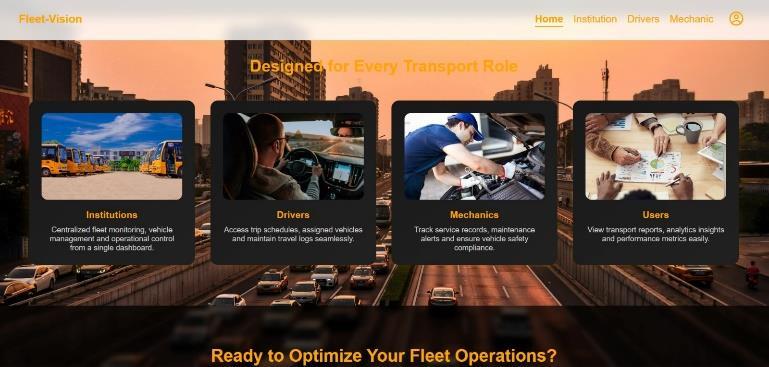
By offering real-time data and analytical reports, the systemenhancesdecision-makingbyassistingadministrators in efficiently monitoring operations, fuel consumption, and maintenance. This improves the efficiency and use of resources. Its reliance on manual data entry, which could resultinsmallmistakes,anditslackofsophisticatedfeatures like GPS tracking and mobile support are some of its drawbacks. In spite of this, the system achieves its goals by
International Research Journal of Engineering and Technology (IRJET) e-ISSN: 2395-0056
Volume: 13 Issue: 04 | Apr 2026 www.irjet.net p-ISSN: 2395-0072
providing a thorough and effective fleet management solution. All things considered, FleetVision is dependable, easy to use, and lessens the negative aspects of manual systems while offering a solid foundation for further advancements.

By managing several tasks at once without experiencing any performance problems, the system demonstrated strong consistency.Accuratedataflowanddataintegritythroughout the system were guaranteed by module integration. Users needed little training to operate it because of the user interface'ssimplicityandeaseofuse.Additionally,thesystem showed adaptability in handling various fleet data types, making it appropriate for a range of organizations. Reduced redundancyandspeedydataretrievalweremadepossibleby structured database storage. Features like automated alerts, mobileaccess,andreal-timetrackingcanfurtherimprovethe system. All things considered, it satisfies present needs and hasstrongpotentialforfutureadvancementsandscalability.
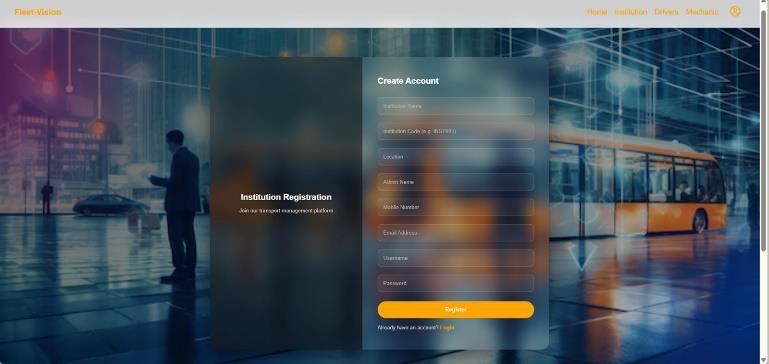
TheFleetVisionsystemwaseffectivelycreatedtoaddress issues with conventional fleet management. It offers a centralized and automated way to manage driver information, mileage calculations, fuel monitoring, vehicle records, maintenance tracking, and report generation. The system minimizes human error, cuts down on manual labor,
and enhances data organization and accuracy. Through appropriate integration, all modules operate effectively, guaranteeing seamless fleet operations and improved coordination. By providingprompt and accurate reports, the systemimprovesdecision-makingbyassistingadministrators in keeping an eye on performance and efficiently allocating resources. All things considered, it guarantees better vehicle maintenance, lowers expenses, and increases operational efficiency. FleetVision is a dependable and expandable solution that emphasizes the significance of automation and digitizationincontemporaryfleetmanagement.Inconclusion, the FleetVision system effectively improves fleet management by automating key operations and ensuring accurate data handling. It reduces manual effort, enhances efficiency, and supports better decision-making. Overall, it is a reliable and scalable solution with strong potential for futureenhancements.
In conclusion, the FleetVision system successfully addresses the limitations of traditional fleet management by providing a centralized, automated, and efficient solution. It streamlines key operations such as vehicle management, driver coordination, fuel monitoring, maintenance tracking, and report generation. The system reduces manual effort, minimizes human errors, and improves data accuracy and organization.Furthermore, it enhances decision-making through real-time data and detailed analytical reports, enabling better resource utilization and operational control. The smooth integration of modules ensures consistency and reliability across the system. Overall, FleetVision is a userfriendly, scalable, and dependable solution that not only meets current requirements but also offers strong potential forfutureenhancementsandexpansion.
[1] I. Sommerville, Software Engineering, 10th ed., Pearson, 2016.
[2] R. S. Pressman and B. R. Maxim, Software Engineering: A Practitioner’sApproach,McGraw‑Hill,2019.
[3] A. Silberschatz, H. F. Korth, and S. Sudarshan, Database SystemConcepts,7thed.,McGraw‑Hill,2019.
[4] G. Booch, J. Rumbaugh, and I. Jacobson, The Unified ModelingLanguageUserGuide,Addison‑Wesley,2005.
[5]OracleCorporation,“MySQLDocumentation,”2023.
[6]OracleCorporation,“JavaPlatformDocumentation,”2023.
[7] World Wide Web Consortium (W3C), “HTML & Web Standards,”2023.
International Research Journal of Engineering and Technology (IRJET) e-ISSN: 2395-0056
[8] K. P. Murphy, “Machine Learning in Fleet Systems,” MIT Press,2018.
[9] S. Malik and R. Singh, “Fleet Management System Using Web Technology,” International Journal of Computer Applications,2020.
[10] A. Kumar and P. Sharma, “Vehicle Tracking and MonitoringSystem,”IJERT,2019.
[11] M. Gupta, “Fuel Monitoring and Management System,” InternationalJournalofEngineeringResearch,2021.
[12] R. Jain, “Cloud-Based Fleet Management System,” IEEE ConferenceProceedings,2020.
[13] S. Verma and D. Patel, “Preventive Maintenance System Design,”InternationalJournalofScienceandResearch,2018.
[14] N. Kaur, “Web-Based Transport Management System,” IJCSIT,2019.
[15] P. Singh, “Dashboard-Based Monitoring Systems,” InternationalJournalofAdvancedResearch,2021.
[16] T. Brown, “Data Management in Transportation Systems,”Springer,2017.
[17] J. Lee, “Smart Fleet Management Using IoT,” IEEE Transactions,2022.
[18]R.Taylor,“DatabaseDesignandImplementation,”Wiley, 2016.
[19] S. Wilson, “Software Development Life Cycle Models,” Pearson,2018.
[20] D. Green, “Modern Fleet Analytics and Reporting Systems,”Elsevier,2021.
Volume: 13 Issue: 04 | Apr 2026 www.irjet.net p-ISSN: 2395-0072 © 2026, IRJET | Impact Factor value: 8.315 | ISO 9001:2008 Certified Journal | Page775