
International Research Journal of Engineering and Technology (IRJET) e-ISSN: 2395-0056
Volume: 13 Issue: 03 | Mar 2026 www.irjet.net p-ISSN: 2395-0072

International Research Journal of Engineering and Technology (IRJET) e-ISSN: 2395-0056
Volume: 13 Issue: 03 | Mar 2026 www.irjet.net p-ISSN: 2395-0072
Prof. Rajashree Salokhe 1, Harshal Patil2, Akshay Chaudhari3, Dipak Shinde4 Mayur Wayzade 5
1Prof. Department of Computer Engineering, MGM College Of Engineering and Technology, Navi Mumbai, Maharashtra, India.
1234Student, Department of Computer Engineering, MGM College Of Engineering and Technology, Navi Mumbai, Maharashtra, India. ***
Abstract - In today's world of software development, software developers face multiple challenges and errors or bugs in their projects. Debugging manually takes time and if developers help from today's Large Language Models (LLMs) models like Chatgpt then Gemini or Claude this takes time and less accuracy. Developers need one system that solves their errors and help them in their development and speed of developing the software must be fast.
To solve this problem, we introduced this paper which includes the AI powered CLI based Debugging Agent that solves the bugs and errors autonomously with help of Large Language Models (LLMs). Developers have tools like GitHub Copilot that suggest code snippets, or LLMs that suggest the codes, but they don't have the tool which solves the error autonomously without any interference of developers. This system has memory for agents to store the previously solved errors; this will reduce the API calling again and again for LLMs.
This system is based on reinforcement model like agents learns the processes overtime because they have their memory and due to that these agents get smarter overtime. This agent system has debate feature which allows agents to take multiple suggestions from different LLMs with the error is complex and debate among the agents for one good solution and then fix it autonomously.
Key Words: Multi-Agent Systems, Large Language Models, Self-Healing Software, Automated Program Repair, MERN Stack, Command-Line Interface
Softwarerelatedbugsleadtosystemfailures,badlyimpact theuserexperience,frustratethedevelopers,andthistask becomes more complicated and takes a lot of time [1]. Usually, software developers take the help of Google or coding models that suggest code solutions, but it requires manual searching and takes lots of developers' time that theycanuseinotherthings.Studiesshowthatdevelopers canspendupto35%–50%oftheirtotaldevelopmenttime ondebuggingandverificationtasks.
In earlier times, Automated Program Repair (APR) methods used rule-based techniques, predefined fix patterns, or constraint solving approaches [5][8]. Later,
machine learning methods were introduced to learn bugfixing patterns from existing code [6]. Recently, Large LanguageModels(LLMs)have become the most powerful tools for automated bug fixing because they understand codeandgeneratesourcecode[2][3][5].
Nowinrecenttimes,LLMsgivesuggestionsforerrorsand bugs but only when the prompt given by the user is correct and appropriate [14]. This is a limitation of LLMs thepromptneedstobegoodenoughandthedeveloper must also have knowledge about prompting, so this becomes more difficult when solving bugs [5]. Big organizations want projects to be completed on time, and bugs are becoming one of the main reasons for delays in projectdevelopment[1].
Now in our system, multiple agents are working together tosolvebugseffectively[10][12][16].Theyhaveaccessto multipleLLMsatatime,andtheytakebugsfromtheuser side, send an appropriate prompt to an LLM, take responses and suggestions, convert them into code, and automaticallyfixit[2][4].
If the code is not fixed, then a multi-agent system is activated. Multiple prompts are sent to multiple agents, they generate multiple suggestions and code solutions, thentheystartdebatingtofindthebestsolutionandapply ittothecode[10][16].Thisprocessincreasestheaccuracy of the code and helps developers achieve their goal of solvingbugsefficiently[4].
This system has a memory feature that stores previously solved code, which can be read by agents. This helps reduce the cost of calling multiple LLMs together because callingthemtakestimeandhashighcost,somemorygives anadvantagehere.Duetothismemoryfeature,agentscan learn over time how previous bugs were solved, and insteadofcallingLLMsagain,agentscancheckmemory similar to how humans learn from past experiences and applytheminthepresentandfuture[11][1].
Increasing Complexity and heavy load of Developer to Create a Software, which is required human effort, proper technical knowledge, debugging code, lot of test cases To
2395-0056
Volume: 13 Issue: 03 | Mar 2026 www.irjet.net p-ISSN: 2395-0072
Build Asoftware user friendly So that’s This isNot Proper SolutionEvenifStaticwork,butitiserrorProne.
ByObservingthislimitationCLIBasedAgentisEffective Solution in Software Development. CLI Allow Faster Execution which is not same for GUI Based application because GUI Based required Lot of time to Creating Effective Solution. CLI Agent give better Accuracy Because CLIBasedAgentWorkOndifferentplatformlikePyCharm, Vscode etc and smoothly Connected with different programming language like JavaScript, python ,CSS, HTML that’swhyCLIagentBetterforautonomousagent
CLI Bug Agent is a program That can observe the system, Generate Decision and fix error without human effort. multiple agent work inside Cli they read User code andperformtasklikefixbug,solveitandimproveaccuracy. CliagentreadUseroutputanddecidewhichagentusedto CompleteTask.
Recent growth of Artificial industry Multiple agent integration is easy and All Agent Work Together Like Shares information, Assign Task and solve it Fastly. This is useful for large software development also AI understand errormessageandlearnfrompreviouserrorwhichismake agent more accurate. Hence CLI-BASED AUTONOMOUS AGENTS provideFastersolution forsoftware development by comparing other AI Tools like ChatGPT Because Other toolisnoteasytohandleArerequiredtechnicalknowledge andpromptknowledgewrongpromptleadwrongoutput
This project is trying something to create and test a system that helps fix problems in MERN stack web applications. The main goal of this system is to save time and work for developers when they are fixing bugs. Normally developers have to find and fix errors by themselves. This system uses artificial intelligence to do the fixing for them. The system is controlled from a commandlineinterface.Itworksonitsowntofindandfix problems,inMERNstackwebapplications.
This work uses a way of doing research that tries things. The system we are talking about is tested with kinds of mistakesthatpeopleusuallymakewhentheyarebuilding web applications. These mistakes include ones that we know about already and ones that we find when we are actually working on a project. We use a design that is basedonthesystemtoputtogetherabunchofparts,such, astheAnalyzer,theFixerandtheVerifierintoonesimple workflow that you can use from the command line. The system is made up of the Analyzer, the Fixer and the Verifier,whichallworktogetherinthesystem.
Data Source:
TheinformationweusetotestthesystemisfromaMERN stack web project. These MERN stack web projects have mistaken that people make when they are programming like syntax errors and runtime errors and logical errors.
Wealsohavelifetestcasessothatthesystemworkslikeit is, in a real work place. This way we can see how the MERN stack web projects and the system really work whenweusethem.
The tools and technologies that were used include the following:
*Thetools
* The technologies: The tools and technologies that were used are the tools and technologies. The tools and technologiesweregoodtoolsandtechnologies.
Thesearethetoolsandtechnologiesthatareusedtomake thesystemwork:
* The system uses tools: the system also uses certain technologies to make the system work properly the system relies on these tools and technologies. Python is whatweusetowritethepartsofthesystem. Wealsouse Pythontomanagetheagents.Themainlogicofthesystem is written in Python. This helps us to manage the agents with Python. LangChain is used to handle communication between agents. It helps these agents talk to each other. LangChain makes it possible for different agents to share informationandworktogether.ThemainjobofLangChain istohandlecommunication,betweenagents.
TheOpenAIAPIisusedtolookaterrorsandcomeupwith fixes for the OpenAI API. We use the OpenAI API to find mistakes.ThentheOpenAIAPIhelpsus figureouthow to fixthem.
IuseNode.jsandMongoDBwhenIamtestingapplications thatarebuiltwiththestack.ThismeansIamworkingwith Node.jsandMongoDBtoseehowtheywork togetherina stack application. The MERN stack is what I am really testing and Node.js and MongoDB are the tools that help medothat.
People use Command Line Interface tools to do things on the computer. They show what happens when you give a command. These Command Line Interface tools are really good for running commands. Then showing you what the resultsare.YoucanthinkofCommandLineInterfacetools like helpers that make it easy to give commands to the computer and see what the computer does with those commands. Command Line Interface tools are very useful fordoinglotsofthings,onthecomputer.
Performance Evaluation:
Thesystemischeckedtoseehowlongittakestofindand fixerrors,howgoodthefixesareandhowtimeitsavesthe people who develop the system. We compare the results from this automated system with the results from debugging to see how well the automated system really works. The automated system is evaluated on the time
International Research Journal of Engineering and Technology (IRJET) e-ISSN: 2395-0056
Volume: 13 Issue: 03 | Mar 2026 www.irjet.net p-ISSN: 2395-0072
taken to debug errors the accuracy of the generated fixes and the reduction in developer effort. We look at the results from the automated system and the results, from manual debugging techniques to measure the effectivenessoftheautomatedsystem.
Table -1: SystemPerformanceMetrics
The debugging process is done by itself using a kind of pipeline that has many agents working together. First the AnalyzerAgentlooksatthecodeorerrormessagethatwe getandfiguresoutwhatkindoferrorsthere.TheAnalyzer Agentdoesthistounderstandtheproblem.
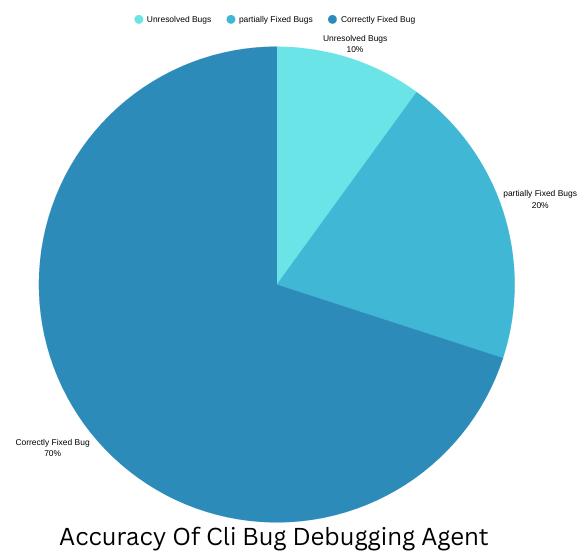
ThepiechartrepresentstheAccuracyOf CLIBUGAGENT. Approx70%bugarecorrectlyfixedincludingMERNStack Error.30 % Error are Partially Resolve and 10 % Error remains unsolved. This Demonstrate That System Almost ReducedManualEffortandimproveSystemPerformance.
Once the Analyzer Agent finds the error the Fixer Agent comesupwithasolutionorapatchforthecode.Thenthe Verifier Agent checks the fix that the Fixer Agent generated to see if it really works or not. The Verifier Agent makes sure the fix is correct, for the code or error message that the Analyzer Agent looked at. If the fix does notworktheFixerAgentgetsitbacktomakeitbetter.
TheFixerAgentandthesystemkeepdoingthis untilthey findafixthatworks.Whentheyfinallyfindafix,itissaved usinga Retrieval-AugmentedGenerationmechanism.This helps the system remember the fix so it can solve problems with the fix more easily next time. The system uses this stored knowledge to solve errors with the fix moreefficientlyinthefuture.
Volume: 13 Issue: 03 | Mar 2026 www.irjet.net p-ISSN: 2395-0072
The system gives us a way to automatically find and fix problems using a command line interface. This is really helpful for debugging. We can use the command line to makethingsworkproperly.Thesystemdoesallthework, for us so we do not have to do it. The command line interface is whatmakes this possible. Thisthinghelpscut downthetimeittakestofix mistakes.Itreallysavestime when you have to fix errors. The time required to fix errors is a lot less now. The manual debugging effort that developers have to put in is really small. This means that developersdonothavetospendalotoftimeandefforton debugging. The manual debugging effort by developers is minimized, which is a thing, for developers. The system gets better over time because it uses the solutions that it hasstored.Itkeepsgetting betterand betterastime goes on. The system uses these stored solutions to improve itself.ItcanbescaledforlargeMERNstackprojects
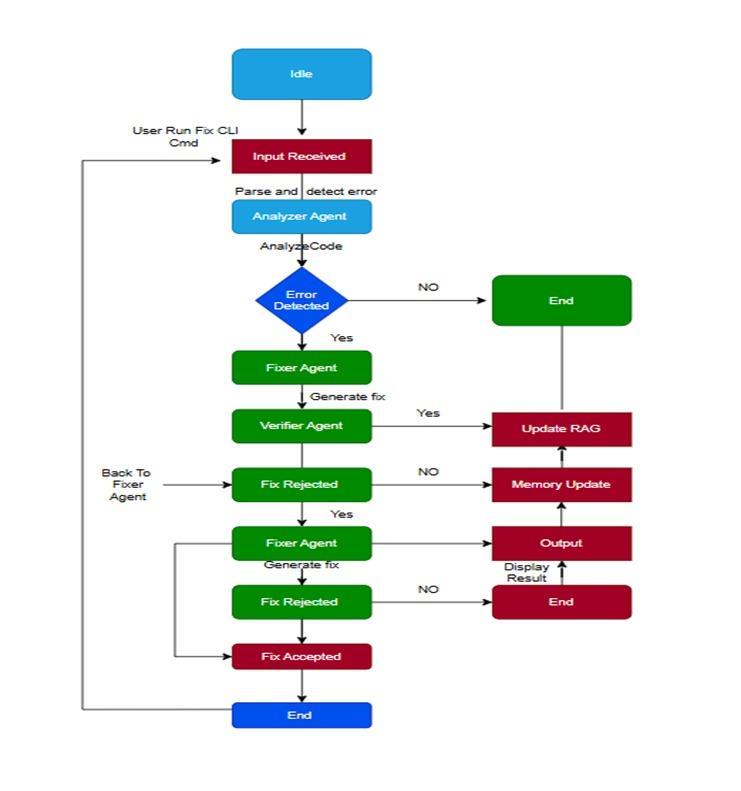
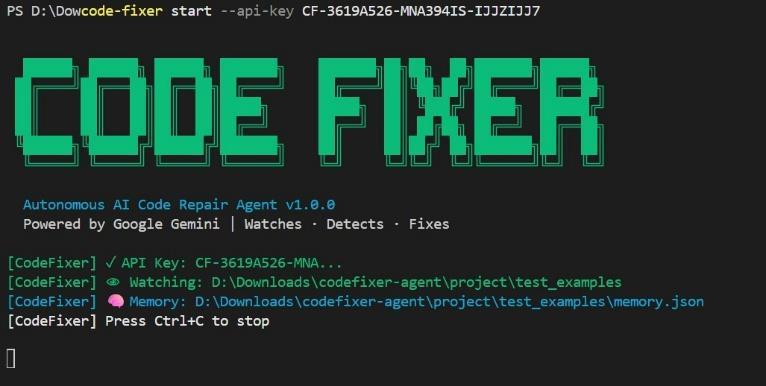
Thispictureshowstheprocessofhowthecommandlinebased system works on its own to fix problems. The command line-based system is what we are talking about here and this command line-based system is able to find andfixissuesbyitself.
The system just sits there until the user decides to run a debugging command using the command line interface. Whenthiscommandisgiventhesystemlooksatthecode or error details that the user has provided. The Analyzer Agent then goes through this information. Checks for things like syntax errors, problems with the logic or errors that happen when the code is running. The Analyzer Agent is really good at finding these kinds of errorsintheinputcodeorerrordetails.
If everything is okay the process stops. If the Fixer Agent findsanerror,itcomesupwithasolution.TheFixerAgent solutionisthenchecked by theVerifierAgent.IftheFixer Agent solution does not work right it goes back, to the Fixer Agent for work. The Fixer Agent and Verifier Agent keep doing this until the Fixer Agent solution is checked anditworks.Whenwecheckeverythingthefixthatworks is stored in the RAG memory. Then the correct output is showntotheuser,onthecommandline.TheRAGmemory and command-line interface help us with this. After that theprocessisfinished.
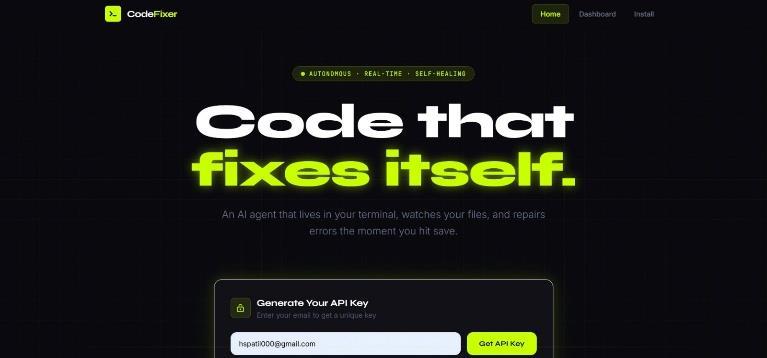
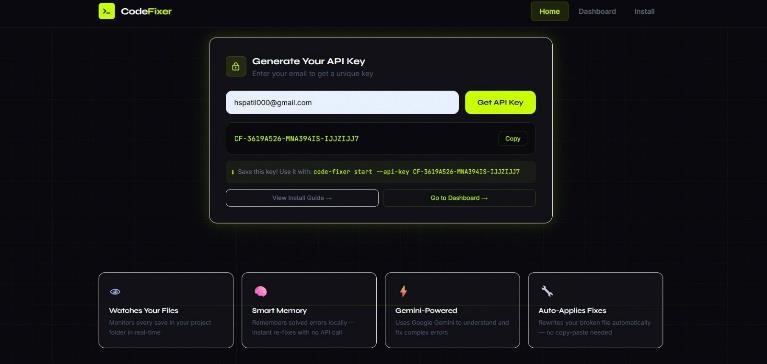
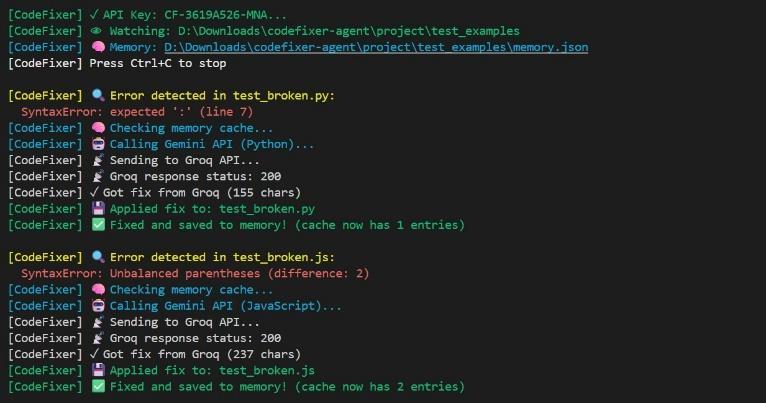
The system successfully detected and fixed syntax, runtime, and logic errors in multiple test scenarios. Debuggingtimewassignificantlyreducedcomparedtothe manual approach. Memory reuse improves correction accuracy with repeated use. Results are displayed using tables and graphs that show time savings, repair success rates,andsystemefficiency.
Volume: 13 Issue: 03 | Mar 2026 www.irjet.net p-ISSN: 2395-0072
During Development We Observed Following Point DiscussWithourProjectGuideandgroupmember
1) Understanding Bug: Our Agent Does not see only error it collects information on many agents. Error messages shown Why the program crashes. The part of the code wheretheerrorhappensSometimeWeSolvedbefore.We introduced Memory based system which is store similar error.TheSystemrememberseverythingandhowitfixed ThismethodhelptosavetimeandminimizerepeatedLLM call.
2) How The Multiagent Connectivity Help: Instead of one agent Give Ans, multiple agents suggest correct code then they check each other Fix code and Mistakes and Suggest better Code which is helping to remove incomplete error and improve accuracy specially where complicated error notreducedForOneQuicklyAns.
3)ProblemWithFixcode:Some-timeSystemSuggestsBig and Complicated changes which is not required This happens because sometime LLM Overthink, but we not required thistypeof Ans. wedecidedin the future wetry tosolvethis error.firstGive simpleChangesIf itdoes not work then Give advance Suggestion. overall, the system needstobetterunderstandandKnowledgeBetweenFiles.
4) Result can change sometime agent not Give Fix and if developer run the system again also agent use different methodssoresultmaybepartiallychanges.
5) High Cost: Multiagent system Improve accuracy but slightly costly because more agent required to more LLM callsandmoretimeneedtodecidethefinalfix.Evenonly authorizedusercanusethisagentduetoprivacyissue.in thefuture wetrying to makethesystemsmartlikeDirect Fixing For simpler bug and used multiagent only for hard tosolvebug.
6)NeedGoodTestCases
In real world Projects Some Test cases doesn't cover all bug so system think the bug is fix even if a problem still Exists
5. CONCLUSIONS
This Research Paper Demonstrate that, We successfully DevelopedbutCLIbugagentwhichisWorkonMultiagent System which is helping to reduce debugging time, minimizes human effort and Quickley identify error and auto fix it without required extra resources like ChatGPT andotherpowerfulaitools.
Our project Limitation include internet connectivity's must require When developer Used agent, and we will Focus on our agent work on offline which is beneficial becauseDevelopercanworkanytime.
[1] M. Baqar, R. Khanda, and S. Naqvi, “Self-Healing Software Systems: Lessons from Nature, Powered by AI,” 2025.
[2]I.Bouzenia,P.Devaux,andM.Pradel,“RepairAgent:An Autonomous, LLM-Based Agent for Program Repair,” 2024.
[3]D.Hidvégi,K.Etemadi,S.Bobadilla,andM.Monperrus, “CigaR: Cost-Efficient Program Repair with Large LanguageModels,”2024.
[4]X.Meng,Z.Ma,P.Gao,andC.Peng,“AnEmpiricalStudy onLLM-BasedAgentsforAutomatedBugFixing,”2024.
[5] S. MacNeil et al., “The Use of Large Language Models forProgramRepair,”2024.
[6] Multiple Authors, “A Deep Dive into Large Language ModelsforAutomatedBugRepair,”2024.
[7] M. Lewis et al., “LangChain Documentation: Building ApplicationswithLargeLanguageModels,”2023.
[8] M. Jin, S. Shahriar, M. Tufano, X. Shi, S. Lu, N. Sundaresan, and A. Svyatkovskiy, “InferFix: End-to-End ProgramRepairwithLargeLanguageModels,”2023.
[9] Y. Zhang, Z. Jin, Y. Xing, and G. Li, “STEAM: Simulating the Interactive Behaviour of Programmers for Automatic BugFixing,”2023.
[10] P. K. Rajput and G. Sikka, “Multi-Agent Architecture Approach for Self-Healing Systems: Run-Time Recovery withCase-BasedReasoning,”2022.
[11] M. Chen et al., “Retrieval-Augmented Generation for Knowledge-IntensiveNLPTasks,”2021.
[12] F. C. Sampaio et al., “A Multi-Agent-Based Integrated Self-HealingandAdaptiveProtectionSystem,”2020.
[13] S. Russell and P. Norvig, Artificial Intelligence: A ModernApproach,4thed.,Pearson,2020.
[14] T. Brown et al., “Language Models Are Few-Shot Learners,”2020.
[15] A. Sweigart, Automate the Boring Stuff with Python, 2nded.,2019.