

International Research Journal of Engineering and Technology (IRJET) e-ISSN: 2395-0056
Volume: 13 Issue: 04 | Apr 2026 www.irjet.net p-ISSN: 2395-0072
FINGERPRINT BASED DIABETES PREDICTION USING AI & ML
Sanika Sargar, Sanika Shinde, Sanika Sutar, Shravani Shinde, Prof. Monika Nagawakar Department of Artificial Intelligence and Data Science Dr.J.J.Magdum College Of Engineering Jaysingpur,Maharashtra, India.
Abstract - Diabetes mellitus is a health issue that is getting worse. We need to find out if someone has Diabetes mellitus on so they do not get really sick. The old methods of finding out if someone has Diabetes mellitus are not simple. They cost a lot of money. Usually involve getting a blood test.This paper is about a way to find out if someone has Diabetes mellitus that is easy to use. We can do this by looking at the patterns on a persons fingerprints and using computers to help us. The things we look at on a fingerprint include how dense it is, the lines and points on it and the texture. We use computer programs to look at the fingerprint. First we get a picture of the fingerprint. Then we make the picture better so the computer can understand it. After that we find the things, about the fingerprint. Finally we use the computer to look at the fingerprint and figure out if someone might have Diabetes mellitus. This new way is easy to use. Does not cost a lot of money. We can use it to help people, people who live in the country where it is hard to get to a doctor. When we tried this way we found out that it is possible to predict if someone might have Diabetes mellitus by looking at their fingerprints.
Key Words: Diabetes mellitus Prediction, Fingerprint Analysis, Artificial Intelligence, Machine Learning,CNN.
I. INTRODUCTION
Diabetes is a problem that is getting worse everywhere in the world and it is really bad in India. Thishappens whenour body cannot control the sugar in our blood either because it does not make insulin or because it does not use insulin properly. If we do not find out we have diabetes it can cause a lot of problems like heart issues, kidney damage, nerve problemsand blindness.Soitisveryimportanttofindout if we have diabetes early so we can take care of diabetes. The wayswecanfindoutifwehavediabetesnowlikegettingourbloodtestedwhenwehavenoteatenneedusto giveblood. Thesemethodsaregood.
Theyarenotnicewemightnotwanttodothemallthetime.Insomeplaceslikeinthecountryorwherepeopledonothave a lot of money people do not like to get testedbecauseithurts,costsmoneyortheydonothave a doctor. This means we need a way to find out if we have diabetes that does not hurt and is easy to do. Our fingerprints are special diabetes is a problemwewanttosolve.Nobodyelsehasthefingerprintslikeustheyhavepatternsonthemthatare madewhenweare growinginsideourmother.Somestudiessaythatthepatternsonourfingerprintsmightbedifferentifwehavediabetes. Thismeansthatmaybe we canuseourfingerprintsto seeifwe mighthavediabetesandthat would bea help infighting diabetes.
Computersaregettingbetteratlookingatpicturesandfindingpatterns,whichcanhelpuswithdiabetes.Wecanusethisto lookatourfingerprintsandfindthingslikehowclosetogetherthelinesrewhichwaytheygoandwhattheylooklike.Then wecanusethisinformationtoteachacomputertofindpatternsandmakepredictionsaboutdiabetes. Inthisstudywewanttoseeifwecanusefingerprintstopredictifsomeonehasdiabetes.Wewilluseacomputertolookat thefingerprintfindthethingsaboutitandthenusethattosayifsomeonehasdiabetesornot.Thiswayisbetterthanthe waysbecauseitdoesnothurtitischeapanditiseasytodo.Thismakesitagoodwaytouseforalotofpeopleitcanhelpus fightdiabetes.
Wewanttohelppeoplefindoutiftheyhavediabetesearlysotheycantakecareofthemselvesandmanagediabetes.This can be especially helpful in places where people do not have doctors more people can get the help they need and be healthier.Diabetesisa problemusingfingerprintstopredictdiabetescanbe a tool.Diabetescancausealotofproblems likeheartissuesandkidneydamage.If wecanfindoutaboutdiabetesearlywecan do somethingaboutitthatisthegoal ofourstudy,ondiabetes
II. LITERATURE REVIEW
Thefieldofdiabetespredictionhasseenalotofgrowthinthefewyears.ThisisbecauseArtificialIntelligenceandMachine Learning techniques have been used. Researchers have tried different approaches. They have looked at data and made modelsthatcanpredictthings.
OneofthestudieswasdonebyJhaetal.TheylookedattherelationshipbetweenfingerprintpatternsandTypeIIdiabetes. They found that certain features of fingerprints like the patterns of the ridges are different in people with diabetes and
International Research Journal of Engineering and Technology (IRJET) e-ISSN: 2395-0056
Volume: 13 Issue: 04 | Apr 2026 www.irjet.net p-ISSN: 2395-0072
peoplewithoutdiabetes.Thisstudyshowedaconnection.Itdidnothaveautomationandcouldnotmakepredictions. Someotherresearchers,likeMohamedandKhalafmadeasystemthatcanpredictglucoselevelsintime.Theirsystemwas goodatmakingpredictions.Couldadapttonewpatients.Howeveritneededadevicetoconstantlymonitorglucoselevels, which'snotveryconvenient.
Wuetal.UsedMachineLearningtechniqueslikeSupportVectorMachinesandArtificialNeuralNetworkstopredict blood glucoselevels.Theirmodelswereverygood.Theyneededclinicaldata,whichlimitstheiruse.
Dhoble et al. Showed that methods like Random Forest and Logistic Regression can be used to classify conditions. Their work was very accurate. Showed that Artificial Intelligence can be used in healthcare. However their approach neededprameterslikeglucoselevelsandbodymassindex,whichmakesithardtouseonalargescale.Recentlyresearchers havestartedlookingatusingdatalikefingerprintstopredictdiabetes.
Sureshetal.UsedConvolutionalNeuralNetworks toanalyzefingerprintimages.Theyfoundthatthesemodelscancapture features of fingerprints and can be used to classify diabetic conditions. This is a step towards making non-invasive diagnosticsystems.
Withallthisprogressmostofthecurrentapproacheshavesomeproblems.Theyneedinvasiveclinicaldataoronlyuseone method.Therearealsoissueswiththedatasets,scalabilityanddeployingthesystems,intheworld.These problemsshow that we need a practical solution. The proposed work is trying to make a system that can predict diabetes using fingerprints.ItwillcombineimageprocessingandMachineLearningtechniquestomakea-invasive,efficientandscalable healthcaresolution.Thissystemwilluse.
III. METHODOLOGY
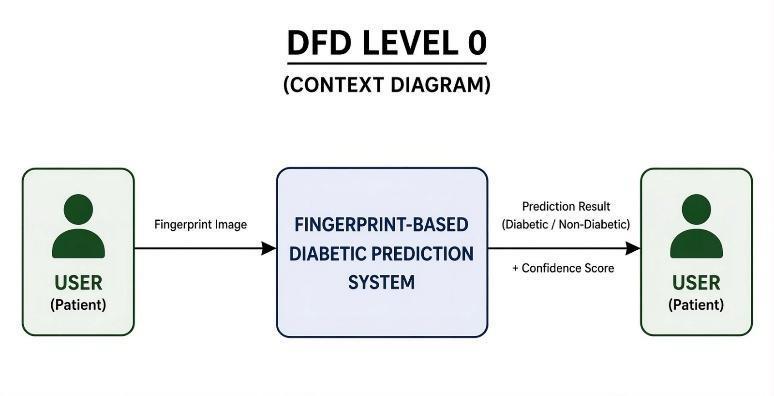
ThisFingerprint-BasedDiabeticPredictionSystememploystheclient–serverarchitecturaldesignwherebybiometricsare collected, processed into images,andanalyzedviamachinelearning algorithms for prediction of diabetes non-invasively. This model of interaction enables easy and efficient communication between the user interface and the backend unit in termsofanalysisandprediction.
A. Architecture Overview
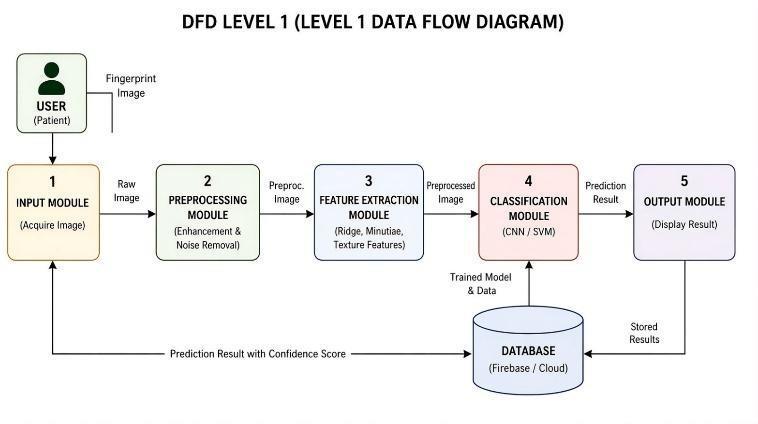
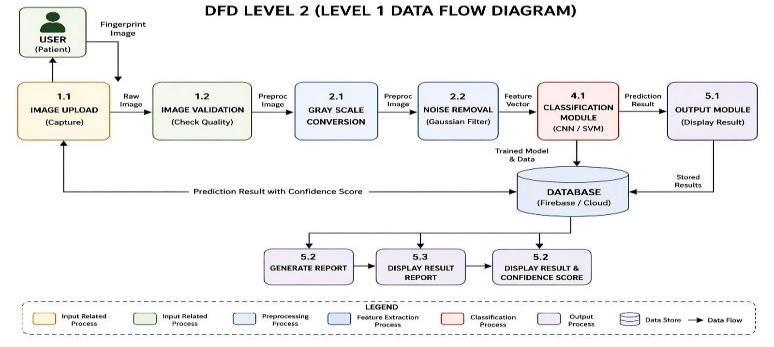
This system has the frontend for users’ interactions and the backend processing unit where all data will be preprocessed,extracted,andclassified.Thefrontendinterfacepermitsuserstouploadfingerprintimagesviaanonline interface.Thebackendprocessesthisinformationutilizingvariousimageprocessingandmachinelearningalgorithms. Cloud database is employed for the storage of user information and prediction history. Real-time prediction is facilitatedbytheapplication.
B. Important Components
1) Client Interface:
An website made with Streamlit technology that lets customers upload pictures of their fingerprints and get predictions.
2) Server for processing:
This includes preprocessing, feature extraction, and using machinelearningmodelslikeCNNontheimages that were uploaded.
3) Model for Machine Learning:
Usessupervisedlearningtechniquestosortthefingerprintsintotwogroups:thosethatbelongtopeoplewithdiabetes andthosethatdon't.
4) The Database Layer:
Acloudcomputingplatform(likeFirebase)thatkeepstrackofusers'fingerprints,theresultsofpredictions,andother importantinformation.
5) Layer for Deployment:
Thisstepisaboutputtingallthepartstogetherintoonesystem.
2026, IRJET | Impact Factor value: 8.315 | ISO 9001:2008 Certified Journal | Page1392
International Research Journal of Engineering and Technology (IRJET) e-ISSN: 2395-0056
Volume: 13 Issue: 04 | Apr 2026 www.irjet.net p-ISSN: 2395-0072
DATA FLOW DIAGRAM : DFD 0 :
V. SYSTEM ARCHITECTURE :
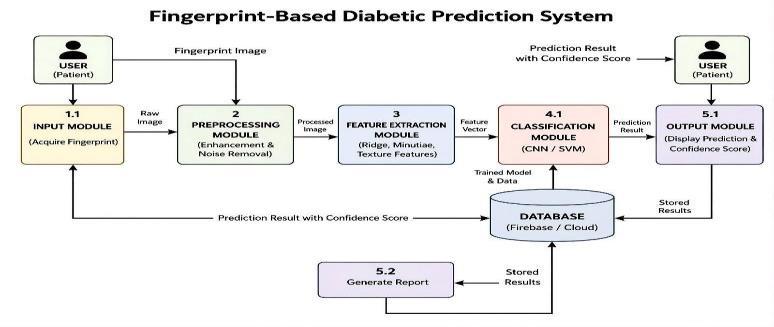
InordertoachievebetterpredictionsfordiabetesthroughsecuredataandconvenientArtificialIntelligence(AI)back end components, the multi-tier architecture was utilized to design the Fingerprint Based Diabetes Prediction System. Multi-layerarchitectureofFingerprintBasedDiabetesPredictionSystemcontainsfourtierswheresomeorallpartsof
© 2026, IRJET | Impact Factor value: 8.315 | ISO 9001:2008 Certified Journal | Page1393
International Research Journal of Engineering and Technology (IRJET) e-ISSN: 2395-0056
Volume: 13 Issue: 04 | Apr 2026 www.irjet.net p-ISSN: 2395-0072
Fingerprint Based Diabetes Prediction System can be found. Overall architecture of the Fingerprint Based Diabetes PredictionSystemconsistsofUserInterfaceTier,ApplicationLogicTier(ProcessingLogic),DataManagementTier,and ExternalIntegrationTier.
1.UserInterface Layer :
In terms of the user interface layer (frontend), theapplicationoffersa simplified,intuitive,and responsive user interface that is built with Streamlit and mobile compatibility. The users will be able to upload or capture their fingerprints’ pictures, afterwhichthediabeticpredictionresultswillbeavailableimmediately.
2. Back-end Processing Layer (Application Logic Layer) :
Theback-endprocessing layeris where the bulk of the processing for the whole system takes place. The bulk of the processingthatenablestheuserinterfaceaswellastheAIapplicationprograminterface(API)interactionisexecuted at this layer, including: processing captured images/screenshots; extracting all necessary features from the capturedimages/screenshots; classifying features of images/screenshots using CNNs; producing outputs from the processedimages/screenshots;validatinginputdata;andprocessingtheworkflowtoensureaccuracyandreliabilityof theentiresystem.
3. Data Management Layer (Database) :
Firebase Cloud Database serves as the core component for storing and managing the data of the system. The user profiledetails,fingerprints,predictions,andsystemlogsarestoredinthiscloud-baseddatabaseinasecuremanner.
4. External Integration Layer (Third Party Systems)
Theintegrationofthird-partysystemssuchasfingerprintscannerdevices,cloudsystems,andotherfutureintegration systems in healthcare is done through this layer. The integration enhances the usability of the system and allows the solutiontobeapplicableinareal-lifesituation.
VI. CONCLUSION:
“Fingerprint-BasedDiabetic PredictionusingArtificial Intelligence and Machine Learning” proposed in this work is a novelmethodthatutilizesfingerprintsalong with machine learning to diagnose patients' risk of developing diabetes. Thismethodavoidsinvasiveandcumbersomebloodsampletestsandreplacesthemwithconvenient,lessstressful,and moreaccessibletestsbasedonfingerprints.
Usingimageprocessingandadvancedmachinelearningtechniques,includingtheCNNalgorithm,thisproposedsystem iscapableofanalyzingfingerprints'ridgecharacteristics,theirminutiae,andtextureandpredictingdiabetesfromthe datacollected.Preprocessing,featureextraction,andclassificationmakethisprocesssystematicandefficient. Moreover,thisinnovativecombinationofmachinelearningwithbiometricinformationisverycost-effectiveanduseful inremoteandunderdevelopedregionsthat cannotaffordtheservicesofspecialistsandexpensivemedicalequipment. Usingtheweb-basedinterfaceallowsuserstoreceivetheirpredictedresultsimmediately. Summingup,thisprojectrepresentsthecontributiontothedevelopmentofintelligentpreventivehealthcaresolutions thatprovidemeansofearlydetectionofhealthproblems,sucasdiabetes.Thefurtheroptimizationofthissolutionmay includetheexpansionofthecurrentdatabaseofsamplesandenhancementofthesystem'saccuracy.
VII. REFERENCE:
[1] R.C.GonzalezandR.E.Woods,DigitalImageProcessing,4thed.Pearson,2018.
[2] J.Daugman,“Howirisrecognitionworks,”IEEETransactionsonCircuitsandSystemsforVideoTechnology,vol.14, no.1,pp.21–30,Jan.2004.
[3] S. R. K. Branavan et al., “Fingerprint recognition using CNN,” International Journal of Computer Applications, vol. 182,no.1,pp.25–30,2019.
[4] M.R.Islametal.,“Diabetespredictionusingmachinelearningalgorithms,”Journal ofHealthcareEngineering,vol. 2020,ArticleID123456,2020.
[5] Alex Krizhevsky, Ilya Sutskever, and Geoffrey Hinton, “ImageNet classification with deep convolutional neural
International Research Journal of Engineering and Technology (IRJET) e-ISSN: 2395-0056
Volume: 13 Issue: 04 | Apr 2026 www.irjet.net p-ISSN: 2395-0072
© 2026, IRJET | Impact Factor value: 8.315 | ISO 9001:2008 Certified Journal | Page1395 networks,”inAdvancesinNeuralInformationProcessingSystems(NeurIPS),2012,pp.1097–1105.
[6] S.Li,J.Li,andK.Li,“Automateddetectionofdiabeticriskusingbiometricfeatures,”ProcediaComputerScience,vol. 167,pp.2381–2389,2020.
[7] StreamlitDocumentation,“DeployMachineLearningModels,”[Online].Availablehttps://docs.streamlit.io