
International Research Journal of Engineering and Technology (IRJET) e-ISSN: 2395-0056
Volume: 12 Issue: 05 | May 2025 www.irjet.net p-ISSN: 2395-0072
International Research Journal of Engineering and Technology (IRJET) e-ISSN: 2395-0056
Volume: 12 Issue: 05 | May 2025 www.irjet.net p-ISSN: 2395-0072
Farzana
Anjum G1 ,
Divya Rani
2 , Aparna Singh3 , Dr. Nirmala S4
1,2,3Student, Dept. of Computer Science Engineering, AMC Engineering College, Karnataka, India
4Professor, Dept. of Computer Science Engineering, AMC Engineering College, Karnataka, India
Abstract - WiththewidespreadintegrationofInternetof Things(IoT)devicesintransportationsystems,maintaining data confidentiality and system reliability has become increasinglycritical.Traditionalintrusiondetectionsystems (IDS), typically built on conventional machine learning models, face challenges including data privacy risks, high communication overhead, and reduced responsiveness in real-time scenarios. Federated Learning (FL) offers a decentralized approach that enables local model training across distributed devices, preserving data privacy while leveraging collective intelligence. This paper provides a comparative analysis of four FL-based IDS frameworks developedfortransportationIoTenvironments.Eachstudy introducesuniquemethodologies rangingfromlightweight fine-tuningtechniquestofeatureoptimizationstrategiesand real-time deployments on edge hardware. The analysis focusesonevaluatingdetectionaccuracy,systemefficiency, scalability, and deployment feasibility. The comparative findingshighlightcriticaldesignconsiderationsandoutline potential pathways for developing effective, privacypreserving IDS solutions tailored for the transportation sector.
Key Words: Federated Learning, Intrusion Detection System (IDS), Transportation IoT, Edge Computing, Cybersecurity, Privacy Preservation, Distributed Learning
Inrecentyears,smarttransportationsystemshaverapidly adopted Internet of Things (IoT) technologies, enabling advanced functionalities such as automated driving, realtime traffic monitoring, and vehicle-to-everything (V2X) communication. While these developments enhance operationalefficiencyandsafety,theyalsoexposesystems toawidearrayofcyberthreats.TraditionalIDSframeworks oftenrelyoncentralizeddatacollectionandmodeltraining, which can lead to significant drawbacks, including compromised privacy, communication bottlenecks, and limitedscalabilityindynamicvehicularenvironments.
In order to overcome these obstacles, researchers have explored Federated Learning (FL), a distributed machine learning framework that allows distributed devices to
collaboratively develop models without exchanging raw data.Thisapproachmaintainsuserprivacywhileenhancing adaptability and responsiveness across heterogeneous networks.InthecontextoftransportationIoT,FL-basedIDS architectureshaveshownpotentialindetectingcomplexand evolvingattackpatternswhileoperatingefficientlyonedge devices.
This study presents a comparative review of four contemporary FL-IDS models that aim to strengthen cybersecurityintransportationnetworks.Thesecomprise systems engineered for resource-constrained vehicular nodes, models optimized through hybrid server-edge learning, and frameworks integrating deep learning integrated with feature selection algorithms. By analysing each approach in terms of accuracy, deployment strategy, and system requirements, this paper offers significant understanding of the current landscape of FL-IDS and identifiespotentialdirectionsforfutureresearch.
The implementation of Federated Learning (FL) with Intrusion Detection Systems (IDS) has emerged as a significantadvancementinthecybersecuritylandscapeof TransportationIoT(T-IoT).Severalrecentstudiespropose FL-based frameworks to mitigate evolving cyber threats while safeguarding data privacy and reducing centralized dependencies.
In the study by Bhavsar et al. [4], an FL-IDS system optimized for vehicular environments is introduced. This model employs a blend of logistic regression and convolutionalneuralnetworks(CNNs)andisdeployedon real-time edge platforms such as Raspberry Pi and Jetson Xavier. By utilizing embedded devices for local model training and a central aggregator for global model refinement, this architecture successfully maintains data privacy while maintaining high detection accuracy. ExperimentsconductedusingtheNSL-KDDandCar-Hacking datasetsdemonstratedaperformancegainovercentralized IDSmodels,achievingaccuraciesofupto99%.
Lazzarini et al. [2] propose a lightweight FL-based IDS frameworkforIoTsystemsthatutilizesashallowartificial
International Research Journal of Engineering and Technology (IRJET) e-ISSN: 2395-0056
Volume: 12 Issue: 05 | May 2025 www.irjet.net p-ISSN: 2395-0072
neuralnetwork(ANN)andfederatedaveraging(FedAvg)to performbothbinaryandmulticlassclassificationondatasets like ToN_IoT and CICIDS2017. Their study compares centralizedlearningtoFLapproaches,indicatingthatFLcan maintaincomparableaccuracywhilesignificantlyreducing privacy risks. The authors also evaluate advanced aggregation methods (FedAvgM, FedAdam, and FedAdagrad),findingthatFedAvgandFedAvgMgenerally performbetterinheterogeneousenvironments.
In their study, Akinie et al. [3] present a hybrid FL-IDS framework optimized for resource-constrained edge environmentssuchasConnectedandAutonomousVehicles (CAVs). The proposed system leverages server-side pretrainingandon-devicefine-tuningtoreducecomputational and memory overhead. Using a transfer learning-inspired approach, only the classification head is updated on the edge, preserving energy while maintaining model adaptability.Thesystemachievedmemorysavingsofupto 42% and training time reduction of up to 75%, all while sustainingdetectionaccuracylevelsupto99.2%.
AnotherremarkablecontributionisbyKarunamurthyetal. [1],whointegrateaChimpOptimizationAlgorithmwithFL toimprovefeatureselectionanddetectionperformancein IoT-based networks. Their approach allows distributed trainingusingdeeplearningclassifierswhilesimultaneously reducingdimensionalitytoenhanceclassificationaccuracy. UsingtheMQTTdataset,theproposedsolutionaccomplishes adetectionaccuracyof95.59%,outperformingtraditional machine learning-based IDS methods. Their work also emphasizes scalability and robustness against complex cyberattacks,includingDDoSandbruteforceattacks.
Collectively,thesestudiesdemonstratethepotentialofFLin safeguarding T-IoT networks while offering varying strategies for overcoming resource constraints, data heterogeneity, and communication bottlenecks. The utilization of edge devices for local inference, novel aggregation and optimization techniques, and hybrid training strategies are recurring themes that indicate the directionoffutureadvancementsinthisdomain.
TheincreasingrelianceonInternetofThings(IoT)devices in transportation systems such as connected and autonomousvehicles(CAVs),smarttrafficcontrolunits,and roadsidesensors hasintroducedanewlayerofcomplexity andvulnerabilitytomoderncyber-physicalinfrastructures. These systems are frequently targeted by sophisticated cyber threats, including denial-of-service attacks, data tampering,spoofing,andunauthorizedaccess.Traditional IntrusionDetectionSystems(IDS),whichrelyoncentralized data collection and training, are ill-suited for such environmentsduetotheirinabilitytoscale,maintaindata privacy, and deliver real-time responses. Centralized
approachesalsogiverisetocriticalprivacychallengesand suffer from communication overhead, latency issues, and model drift due to non-uniform data distribution across devices.
Although Federated Learning (FL) has developed into a viable alternative by permitting collaborative learning withoutrawdatasharing,existingFL-IDSframeworksstill facechallengesrelatedtocomputationalconstraintsonedge devices, feature selection complexity, model accuracy degradation,andinefficientaggregationstrategies.Thereis a lack of standardized evaluation across diverse architectures,whichmakesitdifficulttodeterminethemost efficient and scalable FL-IDS approach for Transportation IoTenvironments.
This research undertakes a comprehensive comparative study of four recent Federated Learning-based IDS frameworks that have been developed for securing TransportationIoTsystems.Theprimarygoalistoidentify the architectural elements, learning strategies, and optimizationtechniquesthatenableaccurate,efficient,and privacy-preservingthreatdetectionindistributedvehicular andinfrastructure-basedenvironments.Byanalysingmodels thatemploydiversemethodologies suchashybridserveredgelearning,shallowneuralnetworks,convolutionaldeep learning classifiers, and metaheuristic-based feature selection this study aims to uncover patterns and tradeoffs that influence model performance under real-world constraints.
The selected frameworks have been evaluated using benchmarkdatasetsthatreflectthecomplexitiesoftrafficrelatedcyberthreats,includingNSL-KDD,CICIDS2017,ToNIoT, and MQTT datasets. Each system offers a distinct approach to handling non-IID data, limited computational resources, and the demand for minimal communication overhead between clients and the central aggregator. Through this comparative analysis, the research seeks to highlight the benefits and drawbacks of current FL-IDS solutions and propose a direction for future development that emphasizes robustness, adaptability, and real-time feasibility in Transportation IoT applications. By synthesizingtheseinsights,thestudyfacilitatesthegrowth of secure, decentralized IDS models capable of defending against evolving cyber threats while ensuring data confidentiality and operational efficiency across vehicular networks.
The architecture of a Federated Learning-based Intrusion Detection System for Transportation IoT is designed to ensuresecurity while preserving privacyandmaintaining system efficiency. At the heart of this architecture lies a
International Research Journal of Engineering and Technology (IRJET) e-ISSN: 2395-0056
Volume: 12 Issue: 05 | May 2025 www.irjet.net p-ISSN: 2395-0072
central aggregator, typically located on a server or cloud platform,whichisresponsibleforcoordinatingthelearning process. This component does not gather raw data from devices; rather, it aggregates model parameters sent by distributedclientstogenerateanupdatedglobalmodel. Eachedgedevice,suchasaconnectedvehicle,roadsideunit (RSU),orembeddedIoTsensor,collectslocalnetworktraffic dataandcreatesalocalreplicaoftheIDSmodelusingthis data.ThesemodelsmaybebuiltusingshallowANNs,CNNs, or hybrid ML-DL combinations, based on the specific framework. Importantly, only the updated model weight updates or gradients are shared back to the central aggregator ensuringthatsensitiverawdataremainsonthe edgeenvironment.
In some implementations, such as the one proposed by Akinieetal.,ahybridserver-edgearchitectureisemployed. Here, the heavier pre-training is conducted on the server using proxy datasets, and only lightweight fine-tuning is performedonedgedevices,whichhelpsreducememoryand computation loads. Bhavsar et al.'s FL-IDS uses real-time data collection from CAVs and employs CNNs for deep learning-basedclassification.Meanwhile,Karunamurthyet al. enhance this architecture with a Chimp Optimization Algorithm to select the most relevant features before training,therebyreducingthedimensionalityandimproving classificationefficiency.
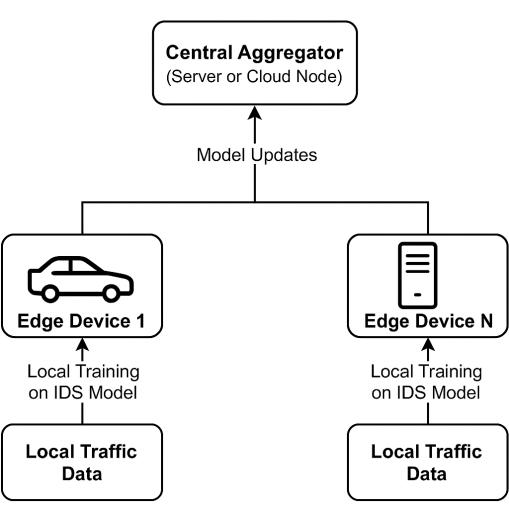
-1: Architecture of a Federated Learning-Based Intrusion Detection System (FL-IDS) for Transportation IoT environments
The methodology adopted in this research involves a comparative evaluation of four Federated Learning-based IntrusionDetectionSystem(FL-IDS)frameworksdesigned for Transportation IoT environments.Eachselectedstudy introduces a distinct architectural model and learning strategy, focusing on enhancing intrusion detection
performance while addressing challenges such as data privacy,resourceconstraints,andreal-timeadaptability.The primary objective of this methodological approach is to assesstheeffectiveness,scalability,andpracticalityofeach frameworkintermsofdetectionaccuracy,communication efficiency,anddeploymentfeasibility.
Incontrast,themodelproposedbyLazzarinietal.utilizesa shallow artificial neural network and compares various aggregation algorithms such as FedAvg, FedAdam, and FedAdagrad to evaluate their performance in binary and multiclassclassificationtasks.Theevaluationiscarriedout on standard benchmark datasets like ToN-IoT and CICIDS2017.Karunamurthyetal.proposeanenhancement to traditional FL-IDS models by integrating a Chimp Optimization Algorithm to perform feature selection, thereby reducing the complexity of the input space and improving the detection performance of deep learning classifiers.
Each framework was examined through a common set of metrics accuracy,falsepositiverate,computationalload, communication efficiency, and adaptability to distributed network environments. The datasets used by the authors were also noted, as they vary in size, data type, and structure,offeringperspectiveonhoweachmodelfunctions undervarioustrafficconditions.Forexample,modelstested onhigh-dimensionaldatasetslikeCICIDS2017andToN-IoT reveal the scalability of the framework, while lightweight datasets such as NSL-KDD help evaluate real-time performanceinconstrainedenvironments.
Through this comparative approach, the study aims to identify key architectural and algorithmic choices that contribute to better intrusion detection in Transportation IoT. Rather than proposing a single unified model, this methodology emphasizes analysing the benefits and drawbacksofdiverseimplementationstoderivegeneralized recommendationsforfutureFL-IDSdesigninvehicularand smartinfrastructurenetworks.
This research analyses and compares four Federated Learning-based Intrusion Detection Systems (FL-IDS) frameworks developed for Transportation IoT environments.Eachmodelemphasizesadifferentaspectof improvingintrusiondetection,suchasprivacypreservation, resource optimization, aggregation strategies, or feature selection. To evaluate these frameworks systematically, parameterssuchasdetectionaccuracy,processingefficiency, scalability,andprivacymeasureswereconsidered.
The FL-IDS proposed by Bhavsar et al. demonstrates excellentreal-worlddeploymentcapabilitiesbyintegrating both logistic regression and CNN classifiers into an edgeserverFLframework.TheirexperimentsonNSL-KDDand
International Research Journal of Engineering and Technology (IRJET) e-ISSN: 2395-0056
Volume: 12 Issue: 05 | May 2025 www.irjet.net p-ISSN: 2395-0072
Car-Hacking datasets achieved accuracies of up to 99%, validating the effectiveness of deep learning models combined withfederatedlearningforvehicularnetworks. However, real-time performance was found to be highly dependentontheedgedevice'scomputationalcapacity.
In contrast, the model by Akinie et al. addresses resource constraintsmoreaggressivelybyproposingahybridserveredge architecture. Pre-training is carried out on a central server,whilelightweightfine-tuningoccursonedgedevices. This approach achieves up to 99.2% detection accuracy whilereducingmemoryusageby42%andtrainingtimeby 75%, making it highly practical for Connected and AutonomousVehicles(CAVs)withlimitedresources.
Meanwhile, the framework developed by Lazzarini et al. focusesonevaluatingdifferentaggregationalgorithmsina federatedsetting.TheiruseofFedAvgandFedAvgMshowed stable and reliable performance, while FedAdam and FedAdagrad slightly underperformed in non-IID environments. Their experiments demonstrated that FL models could achieve comparable performance to centralizedmodelsontheToN-IoTandCICIDS2017datasets, proving the feasibility of FL for distributed IoT security withoutrawdataexchange.
Table -1: ComparativeanalysisofdifferentFederated Learning-basedIntrusionDetectionSystemsfor TransportationIoTintermsofarchitecture,focusarea, datasets,accuracy,optimizationtechniques,resource usage,scalability,andprivacypreservation.
Aspect
FL Architect ure
Bhavsar et al. (FL-IDS)
Akinie et al. (FedFT )
Lazzarini et al. (FedAvg Study)
Edgeserver with CNN& LR Hybrid with finetuning Multiaggregatio nFL
Focus Realtime edge deploym ent Resour ceefficien t& scalable
Aggregatio nmethod analysis
Karunamur thy et al. (Chimp FLIDS)
FLwith Chimpbased feature selection
Dimensional ity reduction
Datasets NSLKDD, CarHacking Custom CAV dataset ToN98*-IoT, CICIDS201 7 MQTT
Accuracy Upto 99% Upto 99.2% ~95–97% 95.59%
Optimizat ion CNNbased feature extractio Pretraining +client fineFedAvg, FedAdam, etc. Chimp Optimizatio nAlgorithm
n tuning
Resources Moderat e 42% less memor y,75% faster
Scalability
Privacy
Good withfew clients High scalabil ity
Model updates only
Lowto moderate Reduced computation
Handles heterogen eitywell
Moderate, focuson feature efficiency
Strong privacy, low device load FullFL privacy Fullprivacy +local feature selection
TheincreasingdeploymentofIoTdevicesintransportation systems has introduced new vulnerabilities that demand efficient, scalable, and privacy-preserving security mechanisms. Federated Learning (FL) offers a promising solution by enabling collaborative model training across distributed nodes without requiring the exchange of raw data. This research provided a comparative study of four recent FL-based Intrusion Detection Systems (FL-IDS) designedspecificallyforTransportationIoTenvironments. Theanalysisrevealedthatdifferentarchitecturesprioritize different aspectsofsystem design,rangingfrom real-time deploymentfeasibility,asdemonstratedbyBhavsaretal.,to resourceoptimizationthroughhybridserver-edgelearning modelsproposedbyAkinieetal.Similarly,theexplorationof multiple aggregation algorithms by Lazzarini et al. emphasized the importance of aggregation choice in maintaining model stability under heterogeneous data conditions, while Karunamurthy et al.'s feature selection approachunderscoredtheroleofdimensionalityreduction inimprovingdetectionefficiency.
Overall, the findings indicate that no single FL-IDS frameworkprovidesauniversalsolution;rather,theoptimal design depends heavily on the target deployment environment, available computational resources, data characteristics, and security requirements. Future endeavoursmayconcentrateondevelopingadaptiveFL-IDS models that combine lightweight model architectures, intelligentfeatureselection,dynamicaggregationstrategies, and robust mechanisms for handling non-IID and imbalanced data. By integrating these advancements, it is possibletobuildintrusiondetectionsystemsthatnotonly safeguardsmarttransportationnetworksbutalsoalignwith the evolving needs of privacy, scalability, and real-time threatdetection.
International Research Journal of Engineering and Technology (IRJET) e-ISSN: 2395-0056
Volume: 12 Issue: 05 | May 2025 www.irjet.net p-ISSN: 2395-0072
Whilethecurrentstudyhas highlightedthestrengths and limitationsofexistingFederatedLearning-basedIntrusion DetectionSystemsforTransportationIoT,severalavenues remainopenforfurtherexplorationandenhancement.One important direction is the development of adaptive FL frameworks capable of dynamically selecting aggregation strategiesbasedonthenatureofparticipatingclients'data distribution. This would allow models to maintain high accuracy even in highly non-IID and heterogeneous environments, which are typical in large-scale transportationnetworks.
Another area for future research lies in optimizing communicationoverheadinfederatedsettings.AlthoughFL reducesrawdatatransmission,frequentmodelupdatescan still strain bandwidth, especially in vehicular networks where connectivity is intermittent. Techniques such as model compression, sparsification, and asynchronous updates could be further explored to minimize network congestionwithoutcompromisingmodelperformance.
Moreover, integrating blockchain or secure multiparty computation(SMPC)protocolsintoFL-IDSframeworkscan enhance trustworthiness and transparency among collaborating devices. Such integration would not only strengthen the privacy guarantees but also ensure that malicious participants cannot compromise the training process.
Inaddition,expandingthescopeofFL-IDSmodelstodetect emerging attack types, such asadversarial attacks against deeplearningmodelsandcoordinatedmulti-vehiclethreats, will be critical to maintaining system resilience. Future studiescouldalsoexploremulti-modallearningapproaches thatincorporatevarioussensormodalities suchasLiDAR, radar,andcamerafeeds alongwithnetworktrafficdatato improve the overall detection capabilities of autonomous transportationsystems.
Lastly,real-worlddeploymentsandlongitudinalstudiesin operationalCAVecosystemsarenecessarytovalidateFL-IDS models under practical constraints like mobility, varying deviceresources,andreal-timelatencyrequirements.Such studies would help bridge the gap between theoretical advancements and practical implementations in smart transportationinfrastructures.
First and foremost, we extend our sincere thanks to our guide, Dr. Nirmala S for her invaluable guidance, constant encouragement, and insightful feedback throughout the study Herexpertiseandsuggestionshavebeeninstrumental inshapingthisproject.
WearealsodeeplythankfultoourHeadofDepartment,Dr. V. Mareeswari for providing a conducive environment for learningandresearch.
Wearedeeplygratefultoourinstitution,AMCEngineering College, for providing the necessary resources and infrastructuretocarryoutthisprojectsuccessfully.Wealso acknowledge the faculty members of our Department of ComputerSciencefortheirsupportandmotivation.
[1]A.Karunamurthy,K.Vijayan,P.R.Kshirsagar,andK.T. Tan, "An optimal federated learning-based intrusion detection for IoT environment," Scientific Reports, vol. 15, no. 8696, 2025. [Online]. Available: https://doi.org/10.1038/s41598-025-93501-8
[2]R. Lazzarini, H. Tianfield, and V. Charissis, "Federated LearningforIoTIntrusionDetection,"AI,vol.4,no.3,pp. 509–530, Jul. 2023. [Online]. Available: https://doi.org/10.3390/ai4030028
[3]R.Akinie,N.K.Gyimah,M.Bhavsar,andJ.Kelly,"FineTuning Federated Learning-Based Intrusion Detection Systems for Transportation IoT," arXiv preprint, arXiv:2502.06099, 2025. [Online]. Available: https://arxiv.org/abs/2502.06099
[4] M. H. Bhavsar, Y. B. Bekele, K. Roy, J. C. Kelly, and D. Limbrick,"FL-IDS:FederatedLearning-BasedIntrusion DetectionSystemUsingEdgeDevicesforTransportation IoT,"IEEEAccess,vol.12,pp.52215–52230,Apr.2024. [Online]. Available: https://doi.org/10.1109/ACCESS.2024.3386631