
International Research Journal of Engineering and Technology (IRJET) e-ISSN: 2395-0056
Volume: 13 Issue: 03 | Mar 2026 www.irjet.net p-ISSN: 2395-0072
International Research Journal of Engineering and Technology (IRJET) e-ISSN: 2395-0056
Volume: 13 Issue: 03 | Mar 2026 www.irjet.net p-ISSN: 2395-0072
Harikesh Pandey1 , Dr Nidhi Gupta2, Dr Arun Prakash Agrawal3
1 PhD Scholar, Department of Computer science & Engineering Sharda University, Greater Noida UP, India
2 Associate Professor, Department of Computer science & Engineering, Sharda University, Greater Noida UP
3 Professor, School of Computer Science Engineering & Technology, Bennett University, Greater Noida UP
Abstract - The character recognition system is a crucial part of pattern recognition. Because different people write in different ways, handwritten character identification is an intriguing, difficult, and complex undertaking. Such systems' accuracy is largely dependent upon the process of feature extraction and selection. Many scholars have suggested a variety of feature extraction and classification methods for a few scripts, such as Devanagari. In light of this, this article offers a thorough analysis of feature extraction and classification techniques that have been taken into consideration thus far for both online and offline Handwritten Character Recognition (HCR) for Devanagari script, which is crucial for research on Optical Character Recognition (OCR). The authors' methods, the dataset they employed, and the accuracy of the work currently accessible for the OCR research are all presented in this article. The most recent research, research gaps, difficulties, and prospects for future work in the field of Devanagari text recognition are presented in this article. To help future researchers, methods for feature extraction and classification in the field of Devanagari character recognition are also methodically outlined. Deep learning techniques are reportedly being used in place of conventional feature extraction and classification techniques in order to improve recognition accuracy in this field
Key Words: Devanagari script. Handwritten character recognition. Feature extraction. Classification and deep learning
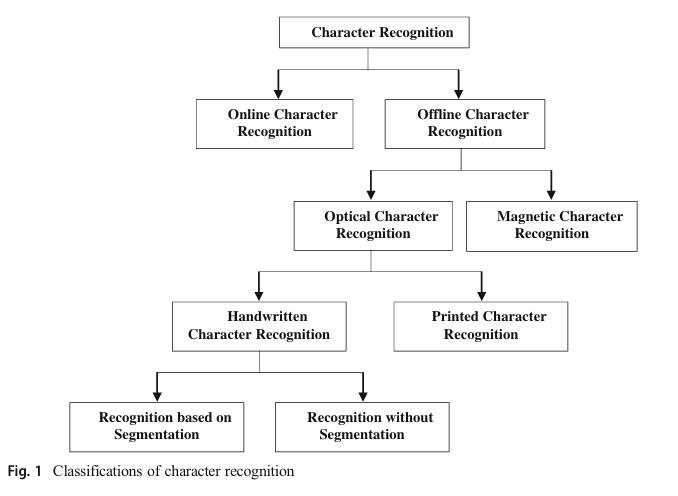
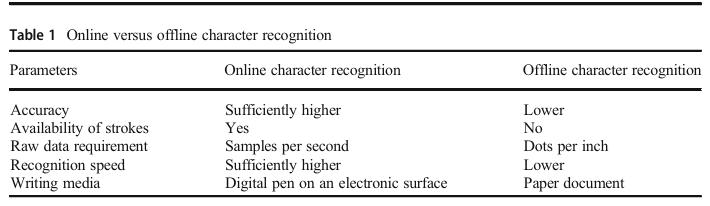
Within the field of pattern recognition, character recognition is a field of current research. It automatically transforms physicaltextdata(numbers,letters,andsymbols)intoamachine-readabledigitalrepresentation[58].Therearetwotypes of character recognition: offline and online. Online character recognition entails writing on an electronic surface, such as anelectronictablet,withaspecialpenordigitizer.Inparticular, penup/downdata,speed,andasequenceofstrokesare used to record characters. As soon as a character is written, these algorithms detect it instantly [45]. The process of convertingofflinehandwrittencharactersintoamachine-readableformatisknownasofflinecharacterrecognition.Offline character recognition can be further divided into optical and magnetic character recognition because it uses optical or magnetic scanning to extract information from a paper document [57]. Character shapes, a wide range of character symbols,documentquality,andthelackofstrokeinformationmakeofflinecharacterrecognitionmoredifficult[45]. Asaresult,offlinecharacterrecognitionismoredifficultthanonlinecharacterrecognition.Fig.1showsthecategorization of character recognition. As shown in Table 1, offline and online Both handwritten and printed characters can be recognized. The main problems with handwritten character identification are the wide range of composition styles, includingcharacterthickness,speed,andshape.Incomparisontohandwrittencharacterrecognition frameworks,printed character recognition frameworks currently produce higher recognition accuracy. As a result, handwritten character recognition is still limited. Furthermore, a segmentation approach may or may not be used for handwritten character recognition
International Research Journal of Engineering and Technology (IRJET) e-ISSN: 2395-0056
Volume: 13 Issue: 03 | Mar 2026 www.irjet.net p-ISSN: 2395-0072
For automatic number plate identification, check reading, postcode recognition, signature verification, and as a reading assistancefor the blind, among otherapplications,a computer system thatrecognizeshandwrittencharacters accurately, robustly,andreliablywouldbeveryhelpful.
The remaining portion of the paper is organized as follows: The background, uses, and difficulties of Devanagari HandwrittenCharacterRecognition(HCR)aredescribedinSection2.AnoverviewoftheDevanagariscriptisexaminedin Section 3. The motivation for readers and academics working in the relevant field is presented in Section 4. Section 5 presents the HCR approach. The literature review on feature extraction and classification techniques taken into considerationforDevanagariHCR,alongwithacomparisonanalysis,isprovidedinSection6.Section7listsresearchgaps. Section 8 presents challenges for the current work. A few suggestions for the future of Devanagari character recognition havebeencoveredinSection9.Lastly,Section10presentsfindings.
Itiscrucialtoprovidebackgroundknowledgeontheunderlyingissues,applications,andtechnicaldifficultiesinorderto determine the importance of optical character recognition (OCR) techniques in general. The field of pattern recognition
International Research Journal of Engineering and Technology (IRJET) e-ISSN: 2395-0056
Volume: 13 Issue: 03 | Mar 2026 www.irjet.net p-ISSN: 2395-0072
andimageanalysishasbeenencouraged by OCR,whichismethodicallya sub-component of pattern recognition.Table2 providesaquickoverviewofthedevelopmentofscriptrecognition.
Techniquesthatattemptautomaticopticalcharacterorscriptidentificationorrecognitionareinhighdemand thesedays. This subsection [22] lists several sorts of strategies that address diverse needs of various domains of such applications. ReadersofairlineticketsAutomaticrecognitionoflicenseplatesSystemsforhandlingbillsReadingacheck Classification of data usingthelearningprocessModifying outdated papersReadingandverifyingemployeecodesAnalysisofforensic documentsProcessingofformsReadinghandwrittennotesandSignatureverification
Year(s)withCaption Highlights
Period OCRGeneration
1870–1940 InitialConcepts
KeyDevelopments
EarlyideasofOCRemerged.Retinascannerandsequentialscannerwereinventedtoassist visuallyimpairedpeople.Punchedcardswereusedfordataentry.
1940–1950 Early Development DevelopmentofmodernOCRconceptsbeganandexperimentswereconductedtorecognize printedcharacters.
1950–1960 FirstOCR Machines
FirstOCRmachinesappearedandbecamecommerciallyavailable.Devices,suchtheIBM 1418,wereabletoidentifyasmallnumberoftextstylesandcharactershapes.
1960–1965 1stGeneration OCR Systemscouldrecognizeregularmachine-printedcharactersbutsupportedonlyalimited numberoffonts.Recognitionaccuracyimproved.
1965–1975 2ndGeneration OCR
1975–1985 3rdGeneration OCR
Moreefficientandcost-effectiveOCRsystemsdeveloped(e.g.,IBM1287).Automaticpostal coderecognitionsystemswereintroduced.OCR-AandOCR-Bstandardfontsweredefined.
Early handwritten characters and poor printing might be recognized because to hardware developments.OCRmachinesbecamemoresophisticated
1985–1995 4thGeneration OCR OCR systems could process complex documents containing text, tables, and mathematical symbols.Supportformultiplelanguagesandscriptsincreased.
1995–
2010 RobustOCR Systems
2010–Present ModernOCR
Image processing and pattern recognition techniques were integrated with Artificial Intelligencetoimproveaccuracyandefficiencyindocumentprocessing.
The accuracy of recognition was enhanced by deep learning techniques OCR are using differentareaasmobiledevice,realtimeapplicationandmanymorefortextextractionfrom images
Since the accuracy of the OCR system directly depends on the quality of the input image, high-quality or high-resolution images (with some basic structural qualities like highly distinguishing text and background) are desirable. Many errors mustbeeliminatedinordertosuccessfullyautomateOCRproceduresbecausetheyfrequentlyhaveasignificantimpacton imagequality[15,52].Theseflawsareexplainedasfollows:
Degradation and blurring for character segmentation and recognition to be more accurate, character sharpness is necessary. Either a slight shift in point of view or catching a moving object causes uneven concentration. It causes input imagestobecomeblurryanddegraded,whichfurtherlowersanOCRsystem'saccuracy[71].
Complexity of characters Additionally, the form and shape of handwritten Devanagari characters make them more intricate.Theyhaveasizablecharactersetwithadditionalloops,curves,andothercharactercharacteristics.
Complicated background Additionally, the OCR system may face far more difficulties when working over a complicated backgroundthanwhenworkingoveratypicalbackground.
International Research Journal of Engineering and Technology (IRJET) e-ISSN: 2395-0056
Volume: 13 Issue: 03 | Mar 2026 www.irjet.net p-ISSN: 2395-0072
VariouscharactersizesandformsBecausehandwrittencharactersvaryinsizeandshape,segmentationandclassification becomedifficulttasksforhandwrittencharacterrecognition.
Absence of a standard test database Regretfully, there isn't a large publicly accessible standard handwritten character databaseforDevanagariscriptthatcanbeusedasabenchmarkfortestingandcomparingtheefficacycommonplatform. Background noise In general, it is evident that throughout the scanning process, noise is introduced to the document or image.Lateron,whendoingdigitalizationorbinarization,itbecomesdifficulttoeliminatesuchbackgroundnoise.
Complexity of the scene many man-made items, like buildings and paintings, have similar structural characteristics and seemliketextinanaturalsetting.ItmakesitdifficultforOCRsystemstodiscerntextfromnon-textintheprocessedimage duetodifficultieswithtextrecognition.
Characters with similar shapes Identifying symbols or characters with similar shapes presents another difficulty for characteridentification.TherearenumerouscharacterpairingsinDevanagari scriptthatshareasimilarshape,including फandघ.
SkewnessSkewcorrectionhasremainedabarrierforopticalcharacterrecognitionsystems[19,65].Ifaskewedimageis entered straight into the OCR system without using any appropriate preprocessing techniques, poor outcomes could be seen.
Textlayoutortypefacevariationsbecausetheyoverlap,charactersinscripttypefacesandcursiveoritalicstylescanmake segmentationchallenging.Whentheclassnumberishigh,meaningthattherearemanypatternsub-spacesandsignificant within-classvariances,itwillbechallengingtoidentifythecharacters.
Different human writing styles each person writes in a unique way, which might make it challenging to identify the characters.Individualdifferencesexistincharactersize,shape,alignment,etc.
3. Overview of the Devanagari script
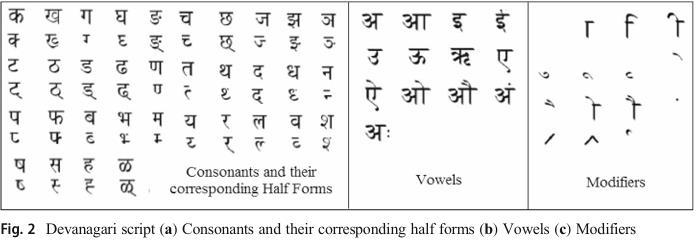
Devanagari isa scriptfrom India,Nepal,Tibet,andthe SouthAsiansubcontinentthatisa memberoftheBrahmic family [2]. More than 500 million people use it to write in a variety of languages, including Hindi,and other languages of the subcontinentofSouthAsia[23,55].AsshowninFig.2,theDevanagariscripthas13vowels,34consonants,and14vowel modifiers.
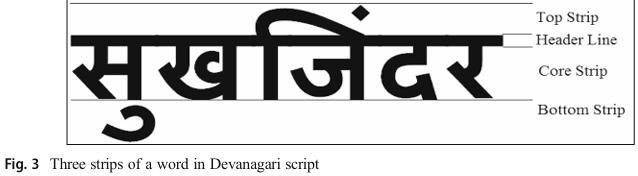
Apartfromabovementionedacompoundcharactersthataremadebytwoormore characters.Compoundcharactersand modifierscanbeattachedtothetoporbottomofthebasiccharacter,adjacenttoeachother[21].Thevowelsplayacrucial role to change the shape accordingly added position of consonants, these vowels are also called matras or modifier. All characters,includingtextandnumbers,arewrittenfromlefttoright,andlowerandupperlettersarenotcomprehended. Certain composition rules in Devanagari script allow for the combination of vowels, consonants, and modifiers [13]. AnothercharacteristicofDevanagariisthehorizontallineontopofcharacterscalledaheaderlineorshirorekha[30].
Devanagariwordscriptisdistinguishby topbottomandcorestrips,whileheaderlinesplitsthebottomandcorestrips, whereasthevirtualbaselinesplitsthetopandcorestrips.Inasense, beingfamiliarwithalanguage'sscriptfacilitatesthe useofone'smentalvocabularytointerpretwordsassociatedwiththatscript.Figure2showstheconsonants,halfforms, vowels, and modifiers in the Devanagari script. Three strips of a word in the Devanagari script are displayed in the followingFig.3
International Research Journal of Engineering and Technology (IRJET) e-ISSN: 2395-0056
Volume: 13 Issue: 03 | Mar 2026 www.irjet.net p-ISSN: 2395-0072
Generallyspeaking,therearetwotypes ofapproachestohandwrittencharacterrecognition: the classicapproach,which use conventional techniques for feature extraction and classification, and the deep learning approach, which is shown in Fig.4.
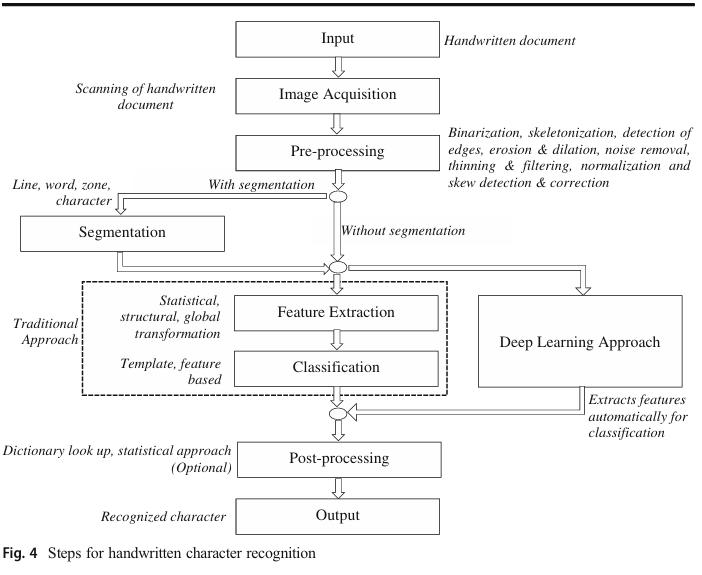
Ahandwrittendocument on paper isscanned tocreate anelectronicversionknownasdigitizationora bitmapimage.It producesadigitalimagethatcanbeusedforpre-processing.
4.2 Pre-processing
It is an initial stage that creates a normalized bitmap image with the goal of minimizing the degradation of the acquired image. Binarization, skeletonization, dilation of images, edge detection, noise removal, image enhancing techniques for contraststretching,thinningandfilling,normalization,skewdetectionandcorrection,andmorepre-processing[6,34,47].
4.3 Segmentation
International Research Journal of Engineering and Technology (IRJET) e-ISSN: 2395-0056
Volume: 13 Issue: 03 | Mar 2026 www.irjet.net p-ISSN: 2395-0072
Segmentation,whichdividesthescannedpageintoparagraphs,lines,words,andcharacters,isanimportantpartofHCR [93]. Because there are many different writing styles, segmenting handwritten characters is a difficult task [77]. The precision of HCR systems strongly requires on identifying the optimal segmentation sites for words, characters, paragraphs,andlines[34].Thecomponentsofsegmentationareasfollows:
Segmenting lines: It is the first step in the segmentation process and a challenging task. Based on projection profile, Hough-transform,smearing techniques,andthinningoperations,researchershavecreateda varietyoflinesegmentation approachesthatcanbebroadlycategorizedintofourtypes.
Word segmentation: The handwritten text is divided into words using word segmentation. For this aim, the majority of current methods employ a vertical projection profile. Several studies additionally divide a handwritten text in pitch method.
Segmentingzones:InDevanagari horizontal zoneareusedforsplitsthetextupper orbottomor middle, thisheaderline alsoknownasshirorekha,alwayssplitsthezonetheupperzonefromthemiddlezone.Thetoporhigherzonedenotesthe area orterritoryabovethe headline,whereas thearea orregionimmediatelybelowthe headlineandabovetheloweror bottomzoneisreferredtoasthemiddlezone.Thelowestareathathassomevowelcomponentsaspartofvowelmodifiers isthelowerorbottomzone.UpperandlowermodifiershavenotalwaysbeenrequiredinHindiwords.
Charactersegmentation:splitsa text regioninto multipleregionsofsinglecharacters.Vertical projection profile analysis was an early method for character Multimedia Tools and Applications segmentation. Character segmentation involves extracting the individual characters without including some components of adjoining characters, even though these characters are not touching. Recognition-free and recognition-based segmentation are the methods used for character segmentation.Inthecaseofoverlappingortouchingcharactersitsbecomemorecomplex.
Inpatternrecognitionfundamentalroleisfeatureextraction.Thecharacteristicsarespecificdetailstakenfromsegmented characters (words or symbols) that set one character apart from the others. The Handwritten character recognition accuracy affected by extraction methods means better approach provide better accuracy. There are other methods for extracting features, but it is crucial to extract those that can distinguish between different patterns or character classes. Somemainfeaturesaredescribedbelow:
Statistical features Statistical features are characteristics of the bitmap image's pixel value distribution. The statistical distributionofpoints,suchasmoments,zones,histograms,orprojections,canbeusedtocalculatetheseproperties.
Featuresofthestructurebyprovidingbothlocalandglobalaspects,structuralfeaturesillustratea pattern'stopologyand geometry,geometricfeaturesofasymbolorcharacter,suchasloops,strokedirections,strokeintersections,andendsare definetheseproperties.
Featuresbasedonglobaltransformationthepixelrepresentationcanbechangedintoacorrespondingdenserformusing global transformation techniques including the Fourier transform, discrete cosine transform, wavelet transform, Hough transform, and moments. By a linear combination of sequences represent signals that signals are linear combination of simpler, well-defined functions. The sequence expansion offers a concise encoding by employing the coefficient of the linear combination matching features are compared with pixel-by-pixel of features based on template matching reveals patterns.Characterrecognitionusingthismethodusuallydoesnotrequirepreprocessingsuchasthinningand trimming [16]. These approaches, however, are more susceptible to changes in font and character size. These characteristics are usedtorecognizecompoundcharactersandarenotsuitablefortextswithanoisybackground.
4.5
In order to determine the class membership in the pattern recognition system, the classification or recognition phase makes use of the characteristics that were retrieved in the previous phase [10]. Matching feature is obtained with comparison of input parameter with class input. It can be carried out typically using feature-based techniques or a template
4.6
Researchersarere-experimentingthecurrentissuesusingdeeplearningtechniquestobetterthecurrentoutcomes.The introductionofresearcher’srecentyearshaveseenthedevelopmentofseveraldeeplearningdesigns,includingrecurrent
International Research Journal of Engineering and Technology (IRJET) e-ISSN: 2395-0056
Volume: 13 Issue: 03 | Mar 2026 www.irjet.net p-ISSN: 2395-0072
neuralnetworks,deepconvolutionalneuralnetworks,anddeepbeliefnetworks.Nowadays,researchersareextensively usingmachinelearningapproachesforcharacterrecognition.Deeplearningtechniquesareessentiallymadeupofseveral hiddenlayers,eachofwhichismadeupofseveralneuronsthatdeterminethedeepnetwork'sappropriateweight
4.7 Post processing
Thisstageisnotnecessarystillsometimethisisenhancedtheaccuracy.Iftheoutputislimitedbyalistoftermsthatare allowedtoappearinadocument,theaccuracyoftheHCRsystemcanbeimproved.Ithelpstoimprovetheoutcomesofthe classification.Twopopularpost-processingmethodsforerrorcorrectionaredictionarylookupandstatisticalanalysis [90].
Despite numerous obstacles and a lack of a commercial market, there has always been a significant demand for study in thefieldofHCRforIndianlanguages[28].AlthoughinitialresearchonDevanagarirecognitionwasdescribedin1977[95] using a structural approach, research on Indian HCR has received a lot of interest in recent years. The several feature extractionmethodsforDevanagariHCRthathavebeenputforthoverthepreviousfewdecadesarebrieflysummarizedin thefollowingsubsections
5.1
This section presents the featureextraction techniques that have been described by different researchers in this specific field. While Bajaj et al. [17] took into account density, moment, and descriptive component features for handwritten Devanagari numeral/character identification, Arica and Yarman-Vural [11] computed both statistical and structural features. Elnagar and Harous [33] used end, branch, and cross point features based on strokes and cavity information to identifyhandwrittenHindinumerals.
In 2004, Kaur derived features based on zoning and Zernike moments to identify the Devanagari script. Gradient, structural, and concavity (GSC) features were retrieved by Kompalli et al. [53] for machine-printed and multi-font Devanagaritextrecognition.WhileSharmaetal.[9]employeddirectionalchaincodeinformationofthecharactercontour pointsasfeaturesforrecognition.[43]havesuggestedaboxtechniquethatdividesthenumericalrepresentationsspatially into boxes in order to recognize handwritten digits. Additionally, Pal et al. [44] recognized Devanagari numerals using gradient-basedfeaturesandchaincoding
Pal et al. [44] employed the data obtained from the arctangent of the gradient and Gaussian filter as a feature for HCR. MoreandRege[72]usedbasicgeometricandZernikemomentstoidentifyDevnagarihindicharactersandnumbers,Shaw et al. [9] used the histogram of chain code directions in the image strips as a feature vector to recognize handwritten Devanagariwords.Theimagestripswerescannedfromlefttorightusingaslidingwindow.
UsingtheDevanagarihandwrittendataset,Kumar[56]conductedacomparativeexaminationofseveralfeatureextraction techniques, including Kirsch directional edges, distance transforms chain code, gradient, and directional distance distribution. Additionally, this article presented a novel feature by quantizing gradient direction into four directional levels, where each gradient map is separated into 4 x 4 sections. For the purpose of handwritten numeral recognition, Bhattacharya and Chaudhuri [20] retrieved high-level features based on contour representations of all four frequency componentsofthewaveletfilteredimage:high–high,high–low,low–high,andlow–low.Basuetal.[18]usedaQuad-Treebased Longest Run (QTLR) feature to recognize or classify handwritten numbers. By calculating shadow and CH properties, Arora et al. [14] were able to identify handwritten Devanagari compound characters. For feature extraction, Aggarwal et al. [3] employed the gradient representation. Samples with 7200 characters were standardized to 90 × 90 pixels.
Kumaretal.[64]investigatedhybridcharacteristicsforGurumukhiscriptofflinehandwrittencharacterrecognition.They used the Ada Boost method in conjunction with a variety of characteristics and classifiers to assess the system's performance. On a corpus of 14,000 characters, the authors achieved a maximum accuracy of 96.3%. A technique for identifyinghandwrittenArabicwordsbasedonstructuralcharacteristicswascreatedbyAbuzaraidaetal.[1].Theauthors investigated the KNN classifier and achieved 99.10% accuracy on the 2500-word corpus. Kaur and Kumar [51] investigated different feature selection techniques for handwritten word recognition. The authors used Random Forest (RF) classification and Chi-Squared Attribute (CSA) based feature sections to obtain 87.42% recognition accuracy on the corpusof40,000handwrittenwords(Gurumukhi).
International Research Journal of Engineering and Technology (IRJET) e-ISSN: 2395-0056
Volume: 13 Issue: 03 | Mar 2026 www.irjet.net p-ISSN: 2395-0072
Classification algorithms like Naive Bayes Classifier, Nearest Neighbor, Logistic Regression, Decision Trees, Random Forest, Neural Network, and KNN Classification essentially analyze the training database in order to classify the testing/targetdatabaseinstatisticsandmachinelearning[19].DeoreandPravin[26]producedadatasetof5800isolated images that included 58 different character classes: 12 vowels, 36 consonants, and 10 numerals. The authors created a two-stageVGG16deeplearningmodeltoidentifyhandwrittencharactersinDevanagari.Theirmodelshadtestingaccuracy increasesof 94.84%(First Model)and 96.55%(Second Model) with training losses of0.18and0.12,respectively.Ghosh [36]extractedstructuralanddirectionalfeaturesfrompublicallyavailablesignaturesamples.
TheylookedatthedeeplearningnetworkknownastheRecurrentNeuralNetwork(RNN).Theyusedtwomodelstodetect andverifyofflinesignatures:BidirectionalLong-ShortTermMemory(BLSTM)andLong-ShortTermMemory(LSTM).The authors came to the conclusion that, in terms of accuracy, their suggested RNN-based system for signature verification outperformed Convolutional Neural Networks (CNN) and other cutting-edge techniques. Convolutional Neural Networks (CNNs)wereemployedbyNarangetal.[48]toidentifyavarietyofoldmanuscriptswritteninDevanagariscript. Usinga corpus of 5484 characters, they investigated a deep learning model for feature extraction and achieved 93.73% recognition accuracy. Alrobah and Albahli [7] created a method that uses a Conventional Neural Network (CNN) as a feature extractor to recognize handwritten Arabic letters. To increase the recognition accuracy, the authors merged two classifiers:SVMandeXtremeGradientBoosting(XGBoost).OntheHijaaArabicdataset,theyattainedarecognitionrateof 96.3%.Adeeplearning-basedmethodforhandwritten word recognitionin Gurumukhiscript wascreatedby Singh etal. [41].
They used a word-based, holistic approach to class labeling in order to get acceptable recognition outcomes.For their datasetofGurmukhiwords,theauthors'recognitionaccuracywas97%.ACNNarchitecturewascreatedbyMushtaqetal. [59] to identify handwritten Urdu characters. For their corpus of Urdu characters (74, 285 training and 21, 223 testing samples),theauthorsachieved98.82%recognitionaccuracy.AmethodforArabichandwritingidentificationbasedonthe Generic Feature-Independent Pyramid Multilevel Model (GFIPML) was developed by Korichi et al. [54].The authors improvedtheirsystem'sperformanceevaluationbyusingtheAHDBdataset.AthoroughsurveyforArabictextrecognition utilizingseveraldeeplearningtechniqueswaspublishedbyAlrobahandAlbahli[8].Someflaws,problems,anddifficulties with Arabic text recognition have been noted by authors. A CNN and RNN-based odia character recognition by Dey et al.[29].
On their corpus of characters with 112 classes, the authors' recognition accuracy was 86.56%. Convolutional Neural Networks (CNN) and Mathematical Morphology Operations (MMO) were used by Elkhayati et al. [32] to segment Arabic wordsforrecognition.WhencomparedtobasicCNN,theauthors'proposeddirectedCNNproducedsuperiorresults. The effectiveness of segmentation-based and segmentation-free methods for CNN and transfer learning-based Devanagari conjunctcharacteridentificationhasbeencomparedbyGuptaandBag[40].Toreducethecomplexityofclassification,the authors employed a CNN-RNN hybrid architecture. For the several methodologies they used, they obtained recognition accuracies of 94.56% (analytic approach), 99.30% (CNN-based holistic approach), and 94.65% (CNN-RNN-based holistic approach).Fortheaimofrecognition,Prashanthetal.[25]createdacorpusof38,750picturesofDevanagarinumbers.
In order to identify handwritten Devanagari numerals, the authors investigated many CNN architectures, including CNN, ModifedLenetCNN(MLCNN),andAlexnetCNN(ACNN).Significantrecognitionoutcomeshavebeenattainedby authors. Mittal and Sachdeva [23] created a system that uses the ResNet model of a convolutional neural network (CNN) to recognizehandwrittenDevanagaricompoundletters.Fortheexperimentalwork,theyinvestigatedtheirowncorpusand obtainedgoodrecognitionoutcomes.ACNN-basedsystemforGurumukhicitynamerecognitionwascreatedbySharmaet al. [6]. By investigating the Adam optimizer with the CNN model, the authors were able to achieve 99.13% recognition accuracyonthecorpusof4000words(citynames).
Table 3 BriefSummaryofHandwrittenCharacterRecognitionofDevanagariScript Authors Feature Classifier DataSet(Size) Accuracy(%)
Aroraetal.[13] Combined Multi-Layer Perceptrons
Aroraetal.[15] LongestRun Shadowand MLPand Combinational
International Research Journal of Engineering and Technology (IRJET) e-ISSN: 2395-0056
Volume: 13 Issue: 03 | Mar 2026 www.irjet.net p-ISSN: 2395-0072
Aroraetal.[12] Structural
Bhattacharyaet al.[21]
Deshpandeetal. [27]
Dixitetal.[30]
Dongreand Mankar[31]
GhoshandRoy [37]
GhoshandRoy [38] Structural& Directional(ZSD) andZonewise Slopesof DominantPoints (ZSDP)
GuptaandBag [39] Shadowand cumulative stretchfeature
Hanmandluetal. [43]
Kaleetal.[47]
Kubaturetal. [55]
Kumar[56]
Kumaretal.[61] MultipleBLSTMNN Raw,Convex, Curvatureand WritingDirection
Maheshand Sumit[66]
Maheshand Sumit[67]
Maheshand Sumit[68]
(Lexicon based);71.86 (ROVER combination)
International Research Journal of Engineering and Technology (IRJET) e-ISSN: 2395-0056
Volume: 13 Issue: 03 | Mar 2026 www.irjet.net p-ISSN: 2395-0072 © 2026, IRJET | Impact Factor
Maheshand Sumit[69] Gradientbased SVM
ManeandRagha [70] Eigen Deformation
Narangetal.[50] Intersection points,open endpoints, centroid, horizontalpeak
CNN,NN, Multilayer
Perceptron,RBFSVM,Random Forest
Narangetal.[49] SIFTandGabor filter Poly-SVM
Paletal.[44] Gradientand Gaussianfilter
Paletal.[42] Gradient MirrorImage Learning
Pantetal.[35] Geometricand Statistical RadialBasis Function(RBF)
Shelkeetal.[6] Multistageviz. Structural, Random Transformand Euclidean Distance Multistageviz. NeuralNetwork andTemplate Matching
ShelkeandApte [4] PixelDensity Multistageviz. FuzzyInference Systemand Structural Parameters
Table 4 BriefSummaryofHandwrittenCharacterRecognitionofDevanagariScript(featurewise)
Features
etal.[12]
GhoshandRoy [38]
ShelkeandApte [4]
Multistageviz.FuzzyInference SystemandStructuralParameters
Statistical Deshpandeet RegularExpressions(RE)&EMD
International Research Journal of Engineering and Technology (IRJET) e-ISSN: 2395-0056
Volume: 13 Issue: 03 | Mar 2026 www.irjet.net p-ISSN: 2395-0072
Features Authors Classifier
features al.[27]
Hanmandluet al.[43] Fuzzy
Kaleetal.[47] FeedForwardNeuralNetwork
and Ragha[70] ElasticMatching
Gradient features Kumar[56] SVMandMLP
and Sumit[66] SVM
Maheshand Sumit[69] SVM
Paletal.[44] Quadratic
[42]
[30]
etal. [55] ArtificialNeuralNetwork
Structuraland Statistical features Aroraetal.[13] Multi-LayerPerceptrons(MLP) 1,500
Aroraetal.[15] MLPandCombinational 4,900 90.74 Dongreand Mankar[31] MLP
GhoshandRoy [37] SVM
GhoshandRoy [38] SVM
Multi-features Pantetal.[35] RadialBasisFunction(RBF)
GuptaandBag [39] RandomForest;SVM;MLP 3,000 95.10;95.57;96.09
Kumaretal. [61] Raw,Convex,Curvatureand WritingDirection
Volume: 13 Issue: 03 | Mar 2026 www.irjet.net
Apte
Prashanthetal.
Characterrecognitionisoneofthe manyareasofpatternrecognitionwheredeeplearning-basedtechniquescanbeused [5,26].Duetoitspotentpotential,thiswillassistinresolvingnumerouschallengingtasks/steps,suchasfeatureextraction and image modifying the parameters and structure of several deep learning models. Even while deep learning-based methodshavealotofpromisetoreplacemoretraditionalmethods,therearestillseveralresearchobstaclestoovercome [60]:
a.Determiningtheamountofnetworklayersand,consequently,additionalneuronsindeeplearning-basedmodelsisa difficulttask.
b.Sincetheaccuracydependsonthetrainingsamples,alargerdatasetordatabaseisrequired.
c.Sincethenetworksofdeeplearning-basedmodelshaveavarietyofparameters,choosingthebestparameterisanother researchdifficulty.
d.Reducingorloweringanumberofcharacteristics,includingasmemoryspace,computingcalculations,andbandwidth requirements,aredifficulttasksinthedevelopmentofeffectivedeeplearning-basedmodels.
Future research in the field of handwritten character recognition could go in many different directions because current methods for segmentation, feature extraction, and classification can be expanded to increase the Here are some recommendationsforfutureapproachesforhandwrittencharacterrecognitionresearch:
a. Creation of suitable and efficient preprocessing methods: Developing suitable and efficient preprocessing methods, such as detecting and correcting text degradation/wrapping, orientation, and tilting, can increase recognitionaccuracy.Additionally,Theaccuracyofcharacterrecognitionsystemscanbeincreasedbydeveloping anappropriatemethodforconvertingartistictextintolineartext.
b. Maintain character shape: Following binarization or normalization, characters may change shape and important informationmaybelost.Therefore,itisnecessarytomaintainthecharacter'sshape.
c. Using an architecture with several classifiers: Combining the decisions of several independent classifiers can improvecharacterrecognitionresults.Thecombination canbecarriedoutinaccordancewiththeirdesign,such ascascade,parallel,orhierarchical,basedontheoutcomesgeneratedbyeachclassifier.
d. Utilize the different optimizers: In order to increase the recognition rates of deep convolution neural networks, researchersmayemploythedifferentoptimizersinconjunctionwithadeeplearningapproach.
International Research Journal of Engineering and Technology (IRJET) e-ISSN: 2395-0056
Volume: 13 Issue: 03 | Mar 2026 www.irjet.net p-ISSN: 2395-0072
8. Conclusion
Hindi is the most widely spoken language in India, which is based on the Devanagari script. Devanagari is one of the workingscriptsfortheHindilanguageingovernmentofficesinIndia apartfromEnglish.Inviewofthat,researchonthe Devanagari script is focused on in this article so as to serve as a guide and update for readers working in the area of handwritten character recognition. . This paper presents a widespread survey on feature extraction and classification methods considered so far for online and offline HCR for Devanagari script, which is essential in OCR research as presented in Tables 3 and 4. There is a lack of a standard database on various Indic scripts for experimental work. Devanagariisoneofthesescripts.Inthisarticle,alsovariouschallengesareidentifiedwhichwillgiveadirectionforfuture researchers.Futureresearchwillnotbedirectlyconcernedwithcharacterrecognition,butalsowords,phrases,andeven completedocumentrecognition.
References
[1] Abuzaraida MA, Elmehrek M, Elsomadi E (2021) Online handwriting Arabic recognition system using knearest neighborsclassifierandDCTfeatures.InternationalJournalofElectricalandComputerEngineering11(4):3584–3592
[2]AcharyaS,PantAK,GyawaliPK(2015)DeeplearningbasedlargescalehandwrittenDevanagaricharacterrecognition. Proceedings of the 9th international conference on software, knowledge, information management and applications (SKIMA),1–6.https://doi.org/10.1109/SKIMA.2015.7400041
[3] AggarwalA, Rani R,Dhir R(2012) HandwrittenDevanagari character recognition using gradient features.International JournalofAdvancedResearchinComputerScienceandSoftwareEngineering2(5):85–90
[4] Shelke S, Apte S (2015) A fuzzy based classification scheme for unconstrained handwritten Devanagari character recognition. Proceedings of the International Conference on Communication, Information & Computing Technology (ICCICT),pp1–6
[5]Pandey,H.,Gupta,N.,&Agrawal,A.P.(2025).PSILO-XAI-ResDCN:HandwrittenCharacterRecognitionUsingOptimized ExplainableResidualDeepLearningMechanism.InternationalJournalofImageandGraphics,2750081.
[6] Shelke S, Apte S (2010) A novel multi-feature multi-classifier scheme for unconstrained handwritten Devanagari character recognition. Proceedings of the 12th international conference on Frontiers in hand writing recognition, 215–219.https://doi.org/10.1109/ICFHR.2010.41
[7]AlrobahN,AlbahliS(2021)AhybriddeepmodelforrecognizingArabichandwrittencharacters.IEEEAccess9:87058–87069
[8] AlrobahN,AlbahliS(2022)Arabichandwrittenrecognitionusingdeeplearning:asurvey.ArabJSciEng:1–21
[9]ShawB,ParuiSK,ShridharM(2008b)Off-linehandwrittenDevanagariwordrecognition:aholisticapproachbasedon directionalchaincodefeatureandHMM.Proceedingsoftheinternationalconferenceoninformationtechnology,203–208. https://doi.org/10.1109/ICIT.2008.33
[10] Ansari S, Bhavani S, Sutar U (2016) Devanagari handwritten word recognition using efficient and fast feedforward neuralnetworkclassifier.IntJAdvRes4(10):2034–2043
[11] Arica N, Yarman-Vural FT (2001) An overview of character recognition focused on off-line handwriting.IEEE Trans SystManCybernPartCApplRev31(2):216–233
[12] Arora S, Bhatcharjee D, Nasipuri M, Malik L (2007) A two stage classification approach for handwrittenDevanagari characters.Proceedingsoftheinternationalconferenceoncomputationintelligenceandmultimediaapplications,399–403. https://doi.org/10.1109/ICCIMA.2007.254
[13] Arora S, Bhatcharjee D, Nasipuri M, Basu DK, Kundu M, Malik L (2009) Study of different features onhandwritten Devanagaricharacter.Proceedingsofthe2ndinternationalconferenceonemergingtrendsin engineeringandtechnology, 929–933
International Research Journal of Engineering and Technology (IRJET) e-ISSN: 2395-0056
Volume: 13 Issue: 03 | Mar 2026 www.irjet.net p-ISSN: 2395-0072
[14]AroraS,BhatcharjeeD,NasipuriM,BasuDK,KunduM(2010)Recognitionofnon-compoundhandwrittenDevnagari characters using a combination of MLP and minimum edit distance. International Journal of Computer Science Security 4(1):1–14.https://doi.org/10.48550/arXiv.1006.5908
[15] Arora S, Bhatcharjee D, Nasipuri M, Kundu M, Basu DK (2010b) Performance comparison of SVM and ANNfor handwrittenDevanagaricharacterrecognition.InternationalJournalofComputerScienceIssues7(3):1–10
[16]BagS,HaritG(2013)AsurveyonopticalcharacterrecognitionforBanglaandDevanagari scripts.IndianAcademyof Sciences38(1):133–168
[17]BajajR,DeyL,ChaudhuryS(2002)Devanagarinumeralrecognitionbycombiningdecisionofmultiple connectionist classifiers.SADHANA27(1):59–72
[18] Basu S, Das N, Sarkar R, Kundu M, Nasipuri M, Basu DK (2010) A novel framework for automatic sorting of postal documentswithmulti-scriptaddressblocks.PatternRecogn43(10):3507–3521
[19] Sharma N, Pal U, Kimura F, Pal S (2006) Recognition of off-line handwritten Devnagari characters using quadratic classifier. Proceedings of the 5th Indian conference on computer vision, graphics and image processing, 805–816. https://doi.org/10.1007/11949619_72
[20]BhattacharyaB,ChaudhuriBB(2009)HandwrittennumeraldatabasesofIndianscriptsandmultistage recognitionof mixednumerals.IEEETransPatternAnalMachIntell31(3):444–457
[21]BhattacharyaN,RoyPP,PalU(2018)Sub-stroke-wiserelativefeatureforonlineIndichandwriting recognition.ACM TransAsianLow-ResourceLangInfProcess18(2):1–16
[22]SethiIK,ChatterjeeB(1977)MachinerecognitionofhandprintedDevanagarinumerals.PatternRecogn9(2):69–76
[23]SachdevaJ,MittalS(2022)HandwrittenofflineDevanagaricompoundcharacterrecognitionusingCNN.In:Gupta,D., Polkowski,Z.,Khanna,A.,Bhattacharyya,S.,Castillo,O.(eds)Proceedingsofdataanalyticsandmanagement.Lecturenotes ondata engineeringandcommunicationstechnologies,vol 90.Springer,Singapore. https://doi.org/10.1007/978-981-166289-8_18
[24]RamtekeAS,RaneME(2012)OfflinehandwrittenDevanagariscriptsegmentation.IntJSciTechnolRes1(4):142–145
[25] Prashanth DS, Mehta R, RamanK, Bhaskar V (2022)Handwritten Devanagari character recognition using modified lenetandalexnetconvolutionneuralnetworks.WirelPersCommun122(1):349–378
[26]DeoreSP,PravinA(2020)Devanagarihandwrittencharacterrecognitionusingfine-tuneddeepconvolutionalneural networkontrivialdataset.Sadhana45(243):1–13
[27] Deshpande PS, Malik SL, Arora TS (2008) Fine classification and recognition of handwritten Devnagari characters withregularexpressionsandminimumeditdistancemethod.JComput3(5):11–17
[28] Singh S, Garg NK (2020) Review of optical Devanagari character recognition techniques. In: Satapathy S,Bhateja V, JanakiramaiahB,ChenYW(eds)intelligentsystemdesign.AdvancesinIntelligentSystemsandComputing1171:97–106
[29]DeyR,BalabantarayRC,MohantyS(2022)OfflineOdiahandwrittencharacterrecognitionwithafocusoncompound characters.MultimedToolsAppl81:10469–10495
[30]DixitA,NavghaneA,DandawateY(2014)HandwrittenDevanagaricharacterrecognitionusingwaveletbasedfeature extraction and classification scheme. Proceedings of the annual IEEE India conference (INDICON), 1–4. https://doi.org/10.1109/INDICON.2014.7030525
[31] Dongre VJ, Mankar VH (2015) Devanagari offline handwritten numeral and character recognition usingmultiple features and neural network classifier. Proceedings of the 2ndInternational conference on com puting for sustainable globaldevelopment,425–431.https://ieeexplore.ieee.org/abstract/document/710028
2026, IRJET | Impact Factor value: 8.315 | ISO 9001:2008 Certified Journal | Page941
International Research Journal of Engineering and Technology (IRJET) e-ISSN: 2395-0056
Volume: 13 Issue: 03 | Mar 2026 www.irjet.net p-ISSN: 2395-0072
[32] Elkhayati M, Elkettani Y, Mourchid M (2022) Segmentation of handwritten Arabic graphemes using adirected convolutionalneuralnetworkandmathematicalmorphologyoperations.PatternRecogn122:108288
[33] Elnagar A, Harous S (2003) Recognition of handwritten Hindu numerals using structural descriptors.Journal of Experimental&TheoreticalArtificialIntelligence15(3):299–214
[34] Farkya S, Surampudi G (2015) Hindi speech synthesis by concatenation of recognized and written Devnagri script usingsupportvectormachinesclassifier.InternationalJournalofComputerandInformationTechnology9(1):491–495
[35] Pant AK, Pandey SP, Joshi SR (2012) Offline Nepali handwritten character recognition using MLP and RBF neural networks. Proceedings of the3rd Asian Himalayas international conference on internet (AHICI), 1–5. https://doi.org/10.1109/AHICI.2012.6408440
[36] Ghosh R (2021) A recurrent neural network based deep learning model for offline signature verification and recognitionsystem.ExpertSystAppl168:114249
[37] Ghosh R, Roy PP (2015a) A novel feature extraction approach for online Bengali and Devanagari character recognition. Proceedings of the 2nd international conference on signal processing and integrated networks (SPIN), 483–488.https://doi.org/10.1109/SPIN.2015.7095313
[38]GhoshR,RoyPP(2015b)Studyoftwozone-basedfeaturesforonlineBengaliandDevanagaricharacter recognition. Proceedings of the 13th International Conference on Document Analysis and Recognition (ICDAR),401-405 https://doi.org/10.1109/ICDAR.2015.7333792
[39]GuptaD,BagS(2019)Handwrittenmultilingualwordsegmentationusingpolygonalapproximationof digitalcurves forIndianlanguages.MultimedToolsAppl78:1–26.https://doi.org/10.1007/s11042-0197286-0
[40] Gupta D, Bag S (2022) Holistic versus segmentation-based recognition of handwritten Devanagari conjunct characters:aCNN-basedexperimentalstudy.NeuralComput&Applic,1–17
[41] Singh S, Sharma A, Chauhan VK (2021b) Online handwritten Gurmukhi word recognition using fine tuned deep convolutional neural network on offline features. Machine Learning with Applications 5:100037. https://doi.org/10.1016/j.mlwa.2021.100037
[42]Pal U, WakabayashiT, Kimura F (2009b)ComparativestudyofDevanagari handwritten characterrecognition using differentfeaturesandclassifiers.Proceedingsofthe10thInternationalconferenceondocumentanalysisandrecognition, 1111–1115.https://doi.org/10.1109/ICDAR.2009.244
[43] Hanmandlu M, Murthy OVR, Madasu VK (2007b) Fuzzy model based recognition of handwritten Hindi characters. Proceedings of the9th biennial conference of the Australian pattern recognition society on digital image computing techniquesandapplications,454–461.https://doi.org/10.1109/DICTA.2007.4426832
[44] Pal U, Sharma N, Wakabayashi T, Kimura F (2007a) Handwritten numeral recognition of six popular Indian scripts. Proceedings of the 9th International conference on document analysis and recognition (ICDAR), 749–753. https://doi.org/10.1109/ICDAR.2007.4377015
[45] Pagare G, Verma K (2015) Associative memory model for distorted on-line Devanagari character recognition. Proceedings of the 5thInternational conference on advances in computing and communica tions, 46–49. https://doi.org/10.1109/ICACC.2015.42
[46]JayadevanR,KolheSR,PatilPM,PalU(2011)OfflinerecognitionofDevanagariscript:asurvey.IEEETransactionson Systems,Man,andCybernetics-PartC:ApplicationsandReviews41(6):782–796
[47] Kale KV, Chavan SV, Kazi MM, Rode YS (2013) Handwritten Devanagari compound character recognition using Legendre moment: an artificial neural network approach. Proceedings of the international symposium on computational andbusinessintelligence,274–278.https://doi.org/10.1109/ISCBI.2013.62
[48] NarangSR,KumarM,JindalMK(2021)DeepNetDevanagari:adeeplearningmodelforDevanagariancientcharacter recognition.MultimedToolsAppl80(13):20671–20686.https://doi.org/10.1007/s11042021-10775
International Research Journal of Engineering and Technology (IRJET) e-ISSN: 2395-0056
Volume: 13 Issue: 03 | Mar 2026 www.irjet.net p-ISSN: 2395-0072
[49] Narang SR, Jindal MK, Ahuja S, Kumar M (2020) On the recognition of Devanagari ancient handwritten characters usingSIFTandGaborfeatures.SoftComput24(22):1–11
[50] Narang SR, Jindal MK, Kumar M (2019b) Devanagari ancient documents recognition using statistical feature extractiontechniques.SADHANA44(141):1–8
[51] Kaur H, Kumar M (2021) Performance evaluation of various feature selection techniques for offline handwritten Gurumukhiplacenamerecognition.Proceedingsofdatadrivenapproachtowardsdisruptivetechnologies,559–571
[52] Kompalli S, Nayak S, Setlur S, Govindaraju V (2005) Challenges in OCR of Devanagari documents.Proceedings of the8thInternationalConferenceonDocumentAnalysisandRecognition1:327–331
[53] Kompalli S, Setlur S, Govindaraju V (2006) Design and comparison of segmentation driven and recognition driven Devanagari OCR. Proceedings of the2nd international conference on document image analysis for libraries, 1–7. https://doi.org/10.1109/DIAL.2006.1
[54] Korichi A, Slatnia S, Aiadi O, Khaldi B (2022) A generic feature-independent pyramid multilevel model for Arabic handwritingrecognition.MultimedToolsAppl81:1–21
[55]KubaturS,Sid-AhmedM,AhmadiM(2012)AneuralnetworkapproachtoonlineDevanagarihandwrit tencharacter recognition.Proceedingsoftheinternationalconferenceonhighperformancecomputingandsimulation(HPCS),209–214. https://doi.org/10.1109/HPCSim.2012.6266913
[56] Kumar S (2009) Performance comparison of features on Devanagari hand-printed dataset. International Journal of RecentTrendsinEngineering1(2):33–37
[57] Kumar S (2016) A study for handwritten Devanagari word recognition. Proceedings of the international conference oncommunicationandsignalprocessing,1009–1014
[58]KumarM,JindalSR(2019)Astudyonrecognitionofpre-segmentedhandwrittenmulti-lingualcharacters.ArchComput MethEng.https://doi.org/10.1007/s11831-019-09332-0
[59]MushtaqF,MisgarMM,KumarM,KhuranaSS(2021)UrduDeepNet:offlinehandwrittenUrducharacterrecognitionusing deepneuralnetwork.NeuralComput&Applic33(22):15229–15252
[60] Weng Y, Xia C (2020) A new deep learning-based handwritten character recognition system on mobile computing devices.MobileNetworksandApplications25:402–411
[61] KumarP, Saini RK, Roy PP, Pal U(2018b) A lexicon-free approach for 3D handwriting recognition using classifier combination.PatternRecognLett103:1–7
[62] Kumar M, Jindal SR, Jindal MK, Lehal GS (2019) Improved recognition results of medieval handwritten Gurmukhi manuscriptsusingboostingandbaggingmethodologies.NeuralProcessLett50(1):43–56
[63] Kumar M, Jindal MK, Sharma RK, Jindal SRGS (2020) Performance evaluation of classifiers for the recognition of offlinehandwrittenGurmukhicharactersandnumerals:astudy.ArtifIntellRev53:20752097
[64] Kumar M, Jindal MK, Sharma RK, Jindal SR, Singh H (2021) Improved recognition results of offline handwritten Gurumukhi characters using hybrid features and adaptive boosting. Soft Comput 25(17):11589–11601. https://doi.org/10.1007/s00500-021-06060-1
[65]LiangJ,DeMenthonD,DoermannD(2008)Geometricrectificationofcamera-captureddocumentimages.IEEETrans PatternAnalMachIntell30(4):591–605
[66] Mahesh J, Sumit S (2014) Gradient local auto-correlation for handwritten Devanagari character recognition. Proceedings of the international conference on high performance computing and applications (ICHPCA), 1–5. https://doi.org/10.1109/ICHPCA.2014.7045339
2026, IRJET | Impact Factor value: 8.315 | ISO 9001:2008 Certified Journal | Page943
International Research Journal of Engineering and Technology (IRJET) e-ISSN: 2395-0056
Volume: 13 Issue: 03 | Mar 2026 www.irjet.net p-ISSN: 2395-0072
[67] Mahesh J, Sumit S (2016) Similar handwritten Devanagari character recognition by critical region estimation. ProceedingsoftheIEEEInternationalConferenceonAdvancesinComputing,CommunicationandInformatics(ICACCI),pp 1936–1939
[68] Mahesh J, Sumit S (2018a) Handwritten Devanagari character recognition using layer-wise training of deep convolutionalneuralnetworksandadaptivegradientmethods.JournalofImaging41(4):1–14
[69] Mahesh J, Sumit S (2018b) Handwritten Devanagari similar character recognition by fisher linear discriminant and pairwiseclassification.InternationalJournalofImageandGraphics18(4):1–18
[70] ManeV,Ragha L(2009) Handwritten character recognition using elastic matching and PCA. Proceedings of the InternationalConferenceonAdvancesinComputing,CommunicationandControl,pp410–415
[71] Meshesha M, Jawahar CV (2008) Matching word images for content based retrieval from printed document images. IntJDocAnalRecognit11(1):29–38
[72]MoreVN,RegePP(2008)DevanagarihandwrittennumeralidentificationbasedonZernikemoments.Proceedingsof theIEEEregion10conferenceonTENCON,1–6.https://doi.org/10.1109/TENCON.2008.4766863
HarikeshPandeyispursuingPhDintheDepartmentofComputerScience&EngineeringatSharda University,GreaterNoida,India.HisresearchinterestsincludeMachineLearningandNetworking, withafocusoninnovativeapplicationinthesefields.
Email:2020401889.hai@sharda.ac.in
DrNidhiGuptaisanAssociateProfessorintheDepartmentofComputerScienceandEngineering atShardaUniversity,GreaterNoida,India.SheholdsaPh.D.inComputerScienceandEngineering and has over 19 years of academic experience. Her research interests encompass Machine Learning, Data Analysis, Computer Vision, Information Retrieval, and Databases. Dr. Gupta has publishedmorethan25researchpapersinreputedSCI,WebofScience,Scopus-indexed,andUGCCAREjournals.

Dr.ArunPrakashAgrawalisaseasonedacademicianwithastrongbackgroundinengineeringand computer science. He holds a Ph.D. in Computer Science & Engineering and has held significant positions in academia, where he has contributed to various research and teaching initiatives. His work includes numerous publications, participation in international conferences, and mentoring Ph.D.scholars’facultyandstudents.Additionally,Dr.Agrawalhasshownleadershipinorganizing academic events and conferences, underscoring his commitment to advancing research and education in his field. His research interests include Software Engineering, Software Testing, Nature-InspiredOptimization,andMachineLearning.