International Research Journal of Engineering and Technology (IRJET) e-ISSN: 2395-0056 Volume: 13 Issue: 05 | May 2026
www.irjet.net
p-ISSN: 2395-0072
Feasibility and Energy Performance Evaluation of Shape Memory AlloyBased Kinetic Facades in Tropical Climate Buildings Ar. A. Arthi1, Ar. V. Vidya2, Ar. Z. Fathima Taskeen3 1Post Graduate Student, M. Arch Construction Project Management, Faculty of Architecture, Dr .M.G.R Educational and
Research Institute, Maduravoyal, Chennai, India. 2Associate Professor, Faculty of Architecture, Dr. M.G.R Educational and Research Institute, Maduravoyal, Chennai, India. 3Additonal HOD, Faculty of Architecture, Dr. M.G.R Educational and Research Institute, Maduravoyal, Chennai, India.
---------------------------------------------------------------------***---------------------------------------------------------------------
Abstract - The building sector significantly contributes to
global energy consumption, particularly in tropical climates where cooling loads dominate. This study investigates the feasibility and performance of Shape Memory Alloy (SMA)based kinetic facades as an adaptive building envelope solution. The research evaluates thermal performance, daylight optimization, and energy savings through simulation and comparative analysis. Case studies from Indian commercial buildings and global kinetic façade systems were examined. Results indicate that SMA-driven passive systems can reduce cooling loads, improve daylight distribution, and enhance energy efficiency while minimizing mechanical complexity. The study concludes that SMA-based kinetic facades present a promising, low-energy alternative to conventional dynamic façade systems in tropical regions.
Breakeven analysis Baseline Comparative Analysis
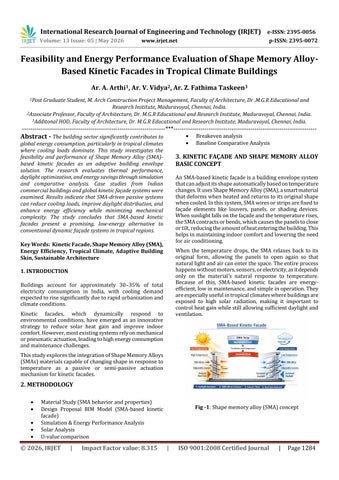
3. KINETIC FAÇADE AND SHAPE MEMORY ALLOY BASIC CONCEPT An SMA-based kinetic façade is a building envelope system that can adjust its shape automatically based on temperature changes. It uses Shape Memory Alloy (SMA), a smart material that deforms when heated and returns to its original shape when cooled. In this system, SMA wires or strips are fixed to façade elements like louvers, panels, or shading devices. When sunlight falls on the façade and the temperature rises, the SMA contracts or bends, which causes the panels to close or tilt, reducing the amount of heat entering the building. This helps in maintaining indoor comfort and lowering the need for air conditioning.
Key Words: Kinetic Facade, Shape Memory Alloy (SMA), Energy Efficiency, Tropical Climate, Adaptive Building Skin, Sustainable Architecture
When the temperature drops, the SMA relaxes back to its original form, allowing the panels to open again so that natural light and air can enter the space. The entire process happens without motors, sensors, or electricity, as it depends only on the material’s natural response to temperature. Because of this, SMA-based kinetic facades are energyefficient, low in maintenance, and simple in operation. They are especially useful in tropical climates where buildings are exposed to high solar radiation, making it important to control heat gain while still allowing sufficient daylight and ventilation.
1. INTRODUCTION Buildings account for approximately 30–35% of total electricity consumption in India, with cooling demand expected to rise significantly due to rapid urbanization and climate conditions. Kinetic facades, which dynamically respond to environmental conditions, have emerged as an innovative strategy to reduce solar heat gain and improve indoor comfort. However, most existing systems rely on mechanical or pneumatic actuation, leading to high energy consumption and maintenance challenges. This study explores the integration of Shape Memory Alloys (SMAs) materials capable of changing shape in response to temperature as a passive or semi-passive actuation mechanism for kinetic facades.
2. METHODOLOGY
Material Study (SMA behavior and properties) Design Proposal BIM Model (SMA-based kinetic facade) Simulation & Energy Performance Analysis Solar Analysis U-value comparison
© 2026, IRJET
|
Impact Factor value: 8.315
Fig -1: Shape memory alloy (SMA) concept
|
ISO 9001:2008 Certified Journal
|
Page 1284