
International Research Journal of Engineering and Technology (IRJET) e-ISSN:2395-0056
Volume: 12 Issue: 11 | Nov 2025 www.irjet.net p-ISSN:2395-0072
International Research Journal of Engineering and Technology (IRJET) e-ISSN:2395-0056
Volume: 12 Issue: 11 | Nov 2025 www.irjet.net p-ISSN:2395-0072
1234UG Student, Department of Electrical & Electronics Engineering, CEC Bilaspur, Chhattisgarh, India
5Assistant Professor, Department of Electrical & Electronics Engineering, CEC Bilaspur, Chhattisgarh, India
Abstract - Thegoalofthisstudyistocreateasimulation modelusingMATLABthatcanbeusedtoexaminedifferent kinds of three-phase faults in electrical transmission line systems. Single line-to-ground, double line-to-ground, and line-to-line faults all of which are frequent in longdistance power transmission networks as well as symmetrical (triple line-to-ground) faults are included in the study. The changes in system characteristics, such voltage and current, under various fault scenarios are investigated through simulation. The results of this study advanceourknowledgeoffaultbehaviorandofferauseful toolforMATLAB-basedfaultanalysisandsystemprotection studies.
Key Words: Line to line fault, Line to ground fault, Double line to ground fault, symmetrical and asymmetrical faults, MATLAB software
1. INTRODUCTION
The stability and dependability of the electrical energy supply are crucial in contemporary power systems. However, a variety of disruptions and unusual operating situationsareconstantlypresentinpower systems,which mightresultinmalfunctions. Whenthecurrentandvoltage in a circuit diverge from their typical levels because of insulation failure, short circuiting, or an unforeseen connectionofliveconductorstothegroundoroneanother, this is known as a fault. If not dealt with quickly and efficiently, such incidents can seriously harm electrical equipment,disruptthepowersupply,andevenjeopardize thestabilityandsafetyofthesystem.
Electrical power system design, operation, and protection all depend heavily on fault analysis. It offers important detailsaboutthesizeoffaultcurrents,voltagedips,andthe system's transient behavior when it is faulted. In order to ensure that faults are identified and fixed as quickly as possible,thistypeofanalysisisessentialforfiguringoutthe specificationsandsettingsofprotectivedeviceslikerelays, circuit breakers, and fuses. Accurate fault analysis also helps with stability studies, equipment sizing, and the creationofbackupplanstoimprovesystemreliability.
Symmetrical and asymmetrical faults are the two primary categories into which defects in a three-phase power system are often divided. Balanced fault currents and voltagesareindicativeofsymmetricalfaults,whichhavean equalimpactonallthreephases.Conversely,asymmetrical
faultscauseunbalancedsystemconditionsandincludeone or two phases. Single-line-to-ground, line-to-line, doubleline-to-ground, and three-phase faults are the fault types that are most frequently researched. Asymmetrical faults are more common and complex, necessitating in-depth analytical and simulation-based research, whereas symmetrical faults are less common but usually more severe.
Power systems failure analysis and simulation have made extensive use of computational tools such as MATLAB/Simulink in recent years. Because these technologies allow for accurate modeling of transmission lines, generators, transformers, and loads, engineers may analyzesystemperformanceundervariousfaultsituations. Through their insights into fault current magnitudes, voltage profiles, and system stability during disturbances, the simulated results help build efficient protection strategies.
All things considered, fault analysis is an essential part of power system engineering that increases operational dependability, promotes the design of protective mechanisms, and ensures the safety of personnel and equipment.Inordertokeepelectricalnetworksfunctional and intact under real-world operating situations, it is essential to have a thorough understanding of failure behaviorandhowitimpactsthesystem.
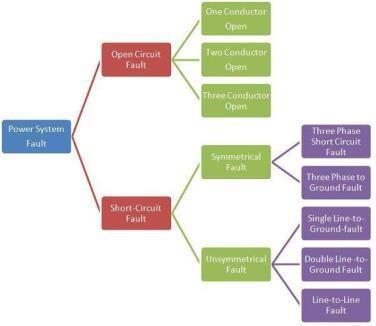
Power system faults are primarily divided into two categories:
AsymmetricalFault
SymmetricalFault.
The picture below illustrates the various kinds of power systemfaults.
International Research Journal of Engineering and Technology (IRJET) e-ISSN:2395-0056
Volume: 12 Issue: 11 | Nov 2025 www.irjet.net p-ISSN:2395-0072
2.1
When an electrical power system encounters an unbalanced disturbance that results in unequal current flowinallthreephases,thefaultstateisreferredtoasan asymmetricfault. Asymmetric faults, suchas single lineto-ground,line-to-line,ordoubleline-to-groundfailures, introduce voltage and current imbalance that can significantly impact system stability, equipment performance, and power quality. In contrast, symmetrical faults impact all phases equally. These issuesaremoreprevalentinreal-worldapplicationsand are frequently brought on by conductor degradation, insulation failure, or unintentional contact with grounded items. Maintaining dependable power system performance requires accurate asymmetric fault detection,analysis,andmitigation. Typically,methodslikesymmetrical componentanalysis are employed to make the investigation of these defects easier and to create protective schemes that guarantee quicksystemrecoveryandfaultisolation.
2.1.1
Itismainlydividedintothreecategories. They’re:
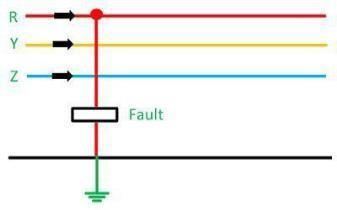
Single line -to- ground (L-G) Fault - When one conductor hits the neutral conductor or falls to theground,asinglelineofgroundfaulthappens. Single line-to-groundfaultsaccountfor 70–80% ofpowersystemfaults.
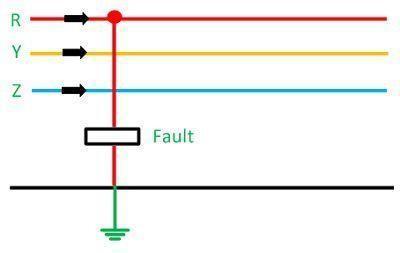
Singleline-to-ground(L-G)fault
Line -to- line (L-L) fault – Whentwowiresshort circuit, a line-to-line fault happens. The strong winds are the main cause of this kind of issue. Thelineconductorsmaycomeintocontactwith one another because to the strong wind, resulting in a short circuit. Between 15 and 20 percentofdefectsareofthistype.
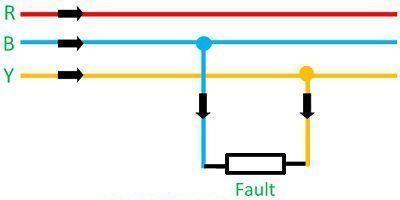
Line-to-line(L-L)fault
Double line -to- ground (L-L-G) fault – In a double line-to-ground fault, the ground and the two lines make touch with one another. These kindsofproblemsareover10%likelytooccur.
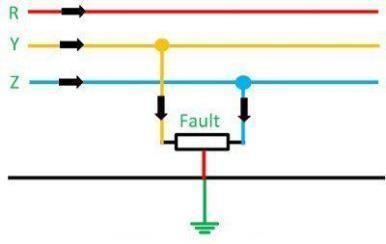
Doubleline-to-groundfault
2.2
An electrical failure in a power system is said to be symmetrical if it affects all three circuit phases equally, resultinginbalancedfaultcurrentsflowingthrougheach line. Themostcommoncauseofthissituationisathreephase short circuit, which is regarded as the most serious but is also the most straightforward to mathematically analyze due to its symmetry. In spite of thefault,thesystem remains balanced because the fault currentsinasymmetricalfaultarethesamesizeandare displaced by 120 degrees. Symmetrical component analysisisusedbypowersystemengineerstodetermine these currents and create protection devices that can swiftly isolate the fault, reducing damage and guaranteeingsystemstability.
Understanding symmetrical faults is essential for creatingdependableandsecureelectricalnetworks,even if they are less frequent in real-world applications than unsymmetricalones.
The two subcategories of symmetrical faults are three- phase line-to-ground fault and line-to-lineto-linefault.
Line – line – line (L-L-L) fault - Thesefaultsare balanced,meaningthatthe systemmaintainsits symmetry even after the fault has occurred. Although the L-L-L fault is the most severe and involves the biggest current, it happens infrequently. This high current is utilized to calculatethecircuitbreaker’srating.
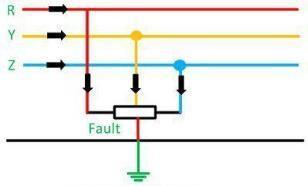
Threelinetoground(L-L-L)fault
International Research Journal of Engineering and Technology (IRJET) e-ISSN:2395-0056
Volume: 12 Issue: 11 | Nov 2025 www.irjet.net p-ISSN:2395-0072
Three phase line -to- ground (L-L-L-G) faultAll three phases of the system are included in thethree-phaselinetogroundfault. TheL-L-L-G fault happens between the system’s ground and the three phases. This kind of issue is almost twotothreepercentlikelytooccur.
3.CAUSES OF ELECTRICAL FAULTS
Therearemanyreasonswhyelectricalfailuresoccur,but they are mostly caused by anomalous situations in electricalsystemsthatinterferewithnormalcurrentflow. Amongthemainreasonsare:
Overstressing, aging, moisture, filth, vibrations, or corrosive vapors can all cause insulation to fail, causing the insulation between conductors or to ground.
Short circuits, which can lead to overheating, equipment damage, or fire when an unauthorized low resistance channel results in excessive current flow.
Overvoltage circumstances that result in insulation failure and excessive current can be caused by electrical resonance, switching surges, lightning surges, or industrially produced voltages.
Broken conductors that result in open circuits or ground faults because of aging, mechanical stress, or physical damage
Dust or contaminant buildup on insulatorsweakenstheinsulation.
Therefore, insulation failure, conduction path failure, environmental effects, equipment failures, and human mistake compromising system safety and dependability aretherootcausesofelectricaldefects.
4.CIRCUIT AND DESCRIPTION
Fig. 1 shows how a simulation model made with the MATLAB software to exercise the Sim Power System is used to enforce the simulation of various faults. It is composed of a single three-phase source and a single
three-phase motor with two windings. Additionally, a transmission line connects one R-L cargo and one threephaseVIdimension.Forthepurposeofmeasuringvoltage and current faults, three-phase faults occur between the motor line and thethree-phaseVIdimension.A compass is connectedin order to measure the voltage and current waveforms. Additionally, One Step is used to determine who's The step function is among MATLAB's most useful toolsforcontroldesign.
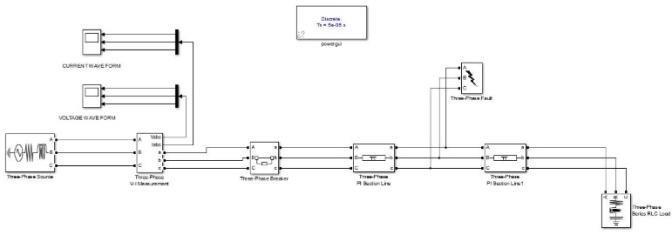
Fig -1:RepresentationofTransmissionlinemodelforFault monitoring
5.1 Cause of Asymmetrical Fault on current and voltage –
5.1.1 (S-L-G) Fault -
InFigures5.1.1(a)and5.1.1(b),thevoltageandcurrent waveforms depict a single-line to ground fault in the system.
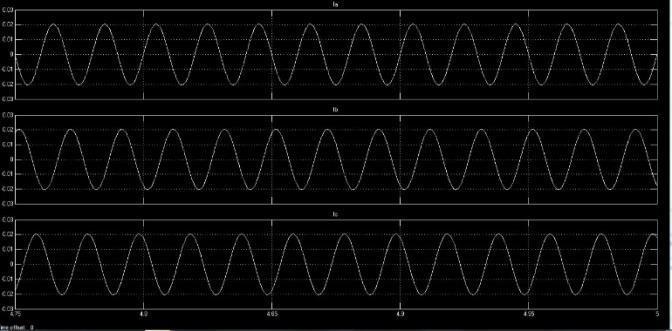
Fig 5.1.1(a) : Current Waveform
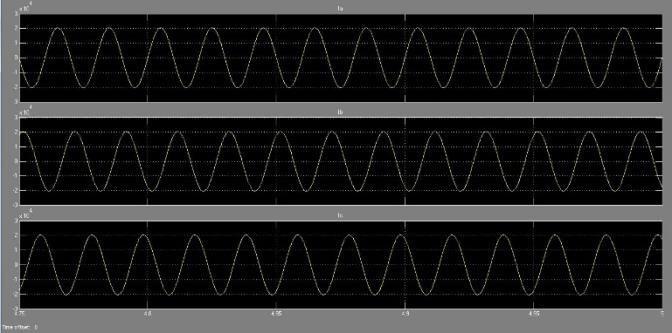
Fig 5.1.1(b) Voltage Waveform
Volume: 12 Issue: 11 | Nov 2025 www.irjet.net p-ISSN:2395-0072
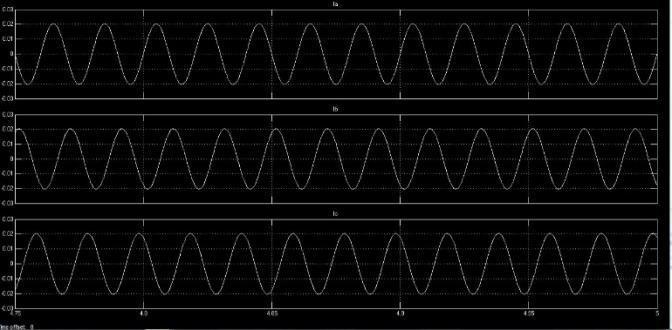
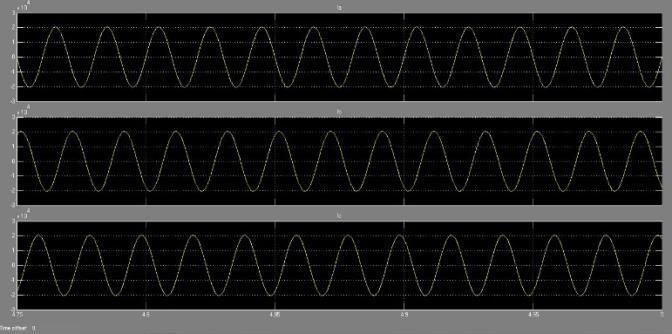
5.1.2 Line-to-line (L-L) Fault
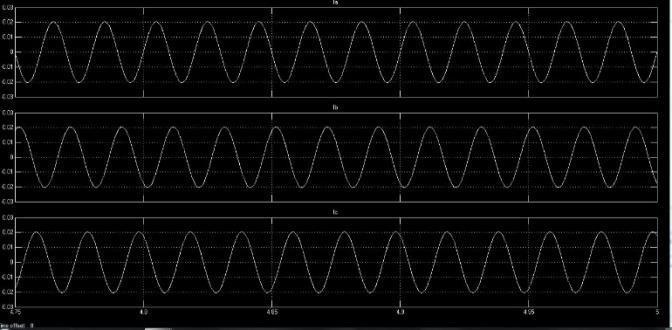
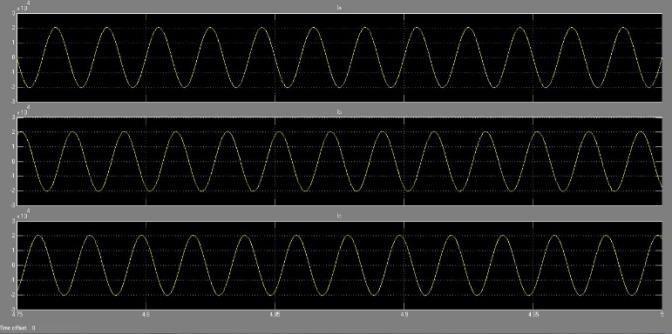
InFigures5.1.2(a)and5.1.2(b),thevoltageandcurrent waveformsdepictaline-to-linefaultinthesystem.
5.1.3 Double line-to – ground (L-L-G) FAULT
InFigures5.1.3(a)and5.1.3(b),thevoltageandcurrent waveforms depict a double line to ground fault in the system.
5.2 Causes of symmetrical fault on current and. voltage –
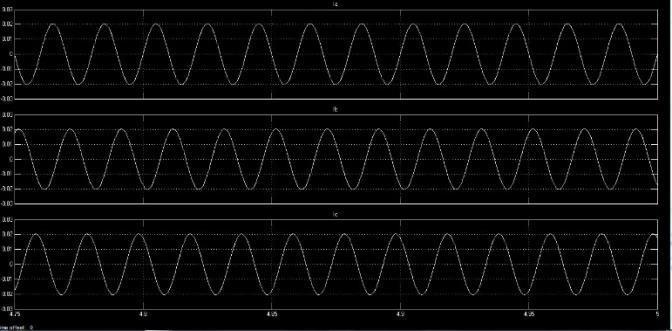
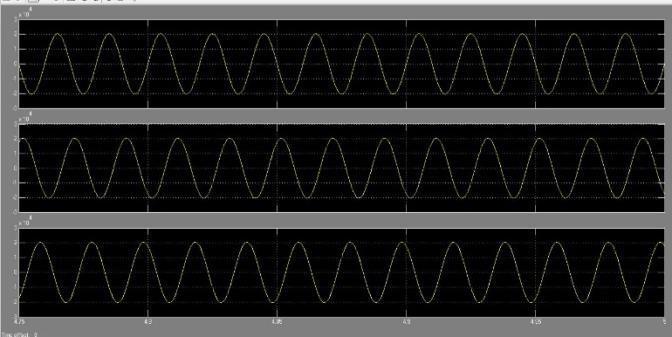
5.2.1 Line -to- line (L-L-L) Fault
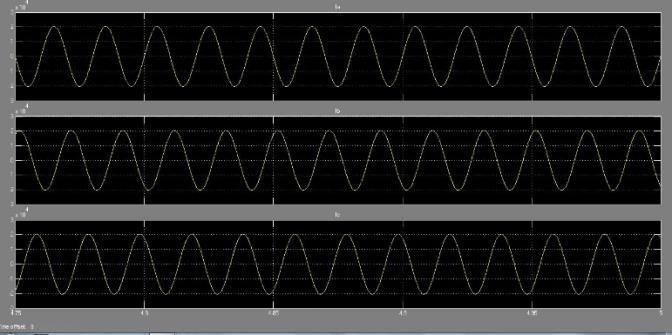
In Figures 5.2.1(a) and 5.2.1(b), the voltage and current waveforms depict a line -line -line to ground fault in the system.
International
Volume:
5.2.2 Three phase line- to- ground (L-L-L-G) Fault
In Figures 5.2.2(a) and 5.2.2(b), the voltage and current waveformsdepictaThreephaselinetogroundfaultinthe system.
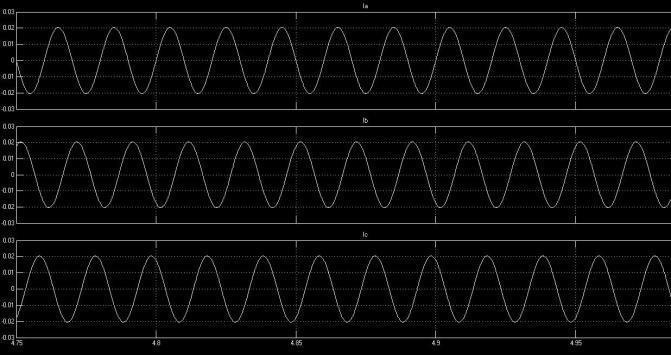
(a) Current Waveform
6.CONCLUSIONS
In conclusion, a thorough grasp of fault monitoring and analysis in power transmission systems is provided by the extensive simulation study carried out using MATLAB/Simulink. Simulink’s capacity to predict and assess the effects of different symmetrical and asymmetrical defects on system performance is clearly demonstrated by the study. Through the simulation of several fault circumstances, including single line-toground, double line-to-ground, line-to-line, and threephase faults, the study demonstrates the unique characteristics of voltage and current waveforms both duringandfollowingafault.
The simulation outputs' oscillations, abrupt voltage dips, andcurrentsurgesemphasizehowcrucialitistoidentify faults accurately and implement mitigation plans in a timely manner in order to preserve the power system’s stability and safety. The study also indicates how MATLAB/Simulink can serve as a dependable platform for testing preventive strategies and validating theoretical concepts of power system functioning under faultyconditions.
Additionally, the study confirms that using simulation to monitor defects helps determine their type and severity as well as their impact on load-side performance, equipment safety, and overall power quality. It emphasizes how important it is to create automatic and intelligent fault detection systems that can function in real time so that malfunctioning areas may be isolated more quickly and regular operations can resume. The results of the simulation demonstrate that ongoing monitoring can lower maintenance costs, stop cascade failures, and improve the reliability of contemporary electricalnetworks.
Engineers can forecast system reactions under various fault situations and create more robust grid systems that can tolerate dynamic disturbances by combining sophisticated modeling, waveform analysis, and fault diagnostics within Simulink. The development of smarter, more effective, and fault-tolerant power infrastructures that guarantee a steady and uninterrupted supply of electricity while reducing operationalrisksandboostingthedependabilityofthe entire power system network is ultimately made possiblebythissimulation-basedstudy.
[1]. O. Ikotun, “Using Matlab/Simulink Software Package to Investigate Fault Behaviors in HVDC System,” Mathematics, 2022. Useful for HVDC fault modellingandSimulinkimplementation.
[2].D.Don-Africa,“A Simulink ModelforTransmission Line Fault Detection,” (conference/project paper). Presents Simulink models for SLG / LL / DLG / LLLG faultsinlongtransmissionlines.
[3].3.Y.Xietal.,“Transmissionlinefaultdetectionand classificationbasedonSA-MobileNetV3,”ScienceDirect, 2023 ML-based classification using Simulinkgenerated data; good if you want deep-learning approachesforclassification.
[4]. “Fault Detection in IEEE 9-Bus System Using MATLAB & Simulink,” (project/paper, Jan 2025). Implements fault detection on the IEEE-9 bus test system handyforcomparativestudiesonastandard testbed.
[5].“FaultDetectioninIEEE9BusSystemUsingMatlab & Simulink” (2025) – Presents fault detection methodology for power systems with simulation of different fault types using MATLAB Simulink and wavelettransformsforanalysis.
[6]. A. Luo, H. Xiao, F. Ma, Z. Shuai, and Y. Wang, “DistributionStaticcompensatorbasedonanimproved
International Research Journal of Engineering and Technology (IRJET) e-ISSN:2395-0056
Volume: 12 Issue: 11 | Nov 2025 www.irjet.net p-ISSN:2395-0072
direct power control Strategy,” IET Pow. Elect., vol. 7, no.4,pp.957-964,April2014.
[7]. J. Nagrath & D. P. Kothari, Modern Power System Analysis(2e),TataMcGrawHill,1988.
[8]. C. J. Kim and B. d. Russell, “Classification of faults andswitchingEventsbyinductivereasoningandexpert system methodology,” In IEEE Transactions on Power Delivery,vol.4,no.3,pp.1631-1637,July1989.