
International Research Journal of Engineering and Technology (IRJET)

Volume: 12 Issue: 11 | Nov 2025 2025 www.irjet.net
e-ISSN: 2395-0056
p-ISSN: 2395-0072

International Research Journal of Engineering and Technology (IRJET)
Volume: 12 Issue: 11 | Nov 2025 2025 www.irjet.net
e-ISSN: 2395-0056
p-ISSN: 2395-0072
Jatin Shihora1, Yukti Bandi2
1Undergraduate Student, Dwarkadas J. Sanghvi College of Engineering, Mumbai, India
2Professor, Dwarkadas J. Sanghvi College of Engineering, Mumbai, India
Abstract: Training machine learning models on largescale multimodal medical datasets introduces significant distributed system challenges, including heterogeneous data formats, missing modalities, and failures during multi-day training runs. This paper presents a faulttolerantdistributedtrainingpipelinefordiseaseprediction on 53,420 patient records combining DICOM images, laboratory tests, and physiological time-series data. A modality-aware preprocessing module maintains data integrity without introducing bias in incomplete patient records. The main contribution is a lineage-based checkpointing mechanism that coordinates failure recovery across distributed training tasks by tracking dependencies and incrementally persisting model states. Thisallowstrainingtoresumefromconsistentcheckpoints instead of full restarts. Experiments on a 16-node GPU clustershowa66%reductionintrainingtimecomparedto epoch-level checkpointing, completing in 18.2 hours with automatic recovery from three worker failures while wastingless than 5% ofcomputation. The systemachieves 87.3% overall accuracy and 82.1% macro-averaged F1 score across 37 disease categories, demonstrating robustness even when data modalities are partially missing.
Keywords: Distributed Machine Learning, Fault Tolerance, Checkpointing, Multi-Modal Learning, MedicalDiagnosis,HealthcareSystems
Introduction
Modern healthcare institutions generate massive volumes of heterogeneous patient data including radiological images in DICOM format, structured laboratory results, and continuous physiological monitoring streams. Leveraging this data for automated disease prediction requires training complex machine learningmodelscapableofintegratinginformationacross disparate modalities [1]. However, real-world medical datasets present fundamental distributed systems challengesthatimpedepracticaldeployment.
Training on large medical datasets requires distributedcomputingduetobothdatavolume(2.4TBin our study) and model complexity (31.2M parameters). Unlike idealized research datasets, clinical data exhibits several characteristics that complicate distributed training:
1. Heterogeneous data formats:DICOMimagesrequire different preprocessing than tabular laboratory values;time-seriesvitalsignsneedtemporalfeature extraction
2. Missingmodalityscenarios:Noteverypatienthasall data types, some have X-rays but incomplete lab work; others have vital signs but no imaging (38% missingimaging,22%partiallabs)
3. Classimbalance:Rarediseasesappearinfewerthan 5%ofrecords,makingbalancedtrainingdifficult
4. Distributedtrainingfailures:Multi-daytrainingruns on compute clusters fail due to transient hardware issues, network partitions, or out-of-memory errors onindividualworkers
Traditional approaches to distributed training assume either complete data availability or rely on naive checkpointing strategies that waste significant computation on failure recovery [2]. The economic impact is substantial: in our preliminary experiments, three complete training restarts due to failures wasted over $27,000 in cloud GPU costs before we implemented fault-tolerantmechanisms.
Thispapermakesthefollowingcontributions:
1. A modality-aware data processing pipeline that handles missing patient data through learned embeddings rather than imputation or record deletion, preserving 40% more training data than standardapproaches
2. A lineage-based checkpointing system that tracks computational dependencies between distributed tasks and enables fine-grained recovery from failureswithlessthan5%wastedcomputation
3. A coordinated recovery protocol that allows training to continue automatically after worker failureswithouthumanintervention
4. Experimentalvalidationon53,420patientrecords across a 16-node GPU cluster demonstrating 66% training time reduction compared to epoch-level checkpointingand98.7%costsavingscomparedto naivetrainingwithoutfaulttolerance
Theremainderofthispaper isorganizedasfollows: SectionIIreviewsrelatedworkindistributedMLsystems and medical diagnosis. Section III presents research gap, section IV presents methodology including data partitioning, model design, and fault-tolerant training protocols. Section IV provides experimental results
International Research Journal of Engineering and Technology (IRJET)
Volume: 12 Issue: 11 | Nov 2025 2025 www.irjet.net
including failure recovery analysis and model performanceanddiscussesapplicationsandfuturework, followedbythelastsectionmadeofconclusion.
Large-scaledistributedtraininghasbecomeessential for modern deep learning [3]. Parameter server architectures like those in [2] distribute model parameters across multiple machines, but typically assumereliableworkersorrelyoncoarse-grainedepochlevel checkpointing. Recent systems like ZeRO [4] and Megatron-LM [5] optimize memory efficiency for training billion-parameter models but focus primarily on interworker communication optimization rather than fault tolerance.
PipeDream [6] introduces pipeline parallelism to overlap computation and communication but requires deterministic pipeline schedules that can be disrupted by worker failures. Horovod [7] provides efficient gradient synchronization through ringallreduce but leaves checkpointmanagementtoapplications.
Most existing systems implement periodic checkpointingatfixedtimeintervalsorepochboundaries [8]. This approach wastes significant computation when failures occur between checkpoints. Our lineage-based approach draws inspiration from Spark’s Resilient Distributed Datasets [9], which track computational dependencies to enable targeted recomputation on failure.
Recent work has applied various machine learning techniquestodiseasediagnosis.Sunnyetal.[10]explored multiple algorithms for heart disease diagnosis achieving 91%accuracywithK-nearestneighbors.Khadeetal.[11] used deep learning for heart failure detection from ECG signalswith98.3%accuracy.
For liver disease prediction, Durai et al. [12] compared logistic regression, SVM, and random forests, finding random forest performed best at 87.27% accuracy. Wu et al. [13] achieved 84.13% accuracy predictingfattyliverdiseasefromultrasoundimages.
Diabetes prediction has been studied by Faruque et al. [14] using random forests (achieving best performance) and Vigneswari et al. [15] comparing decisiontrees,randomforests,andgradientboosting.
However, these studies typically focus on singlemodality data and don’t address the distributed systems challenges of training on large heterogeneous medical datasets. Our work extends this literature by demonstrating that careful distributed systems design is essential for scaling these approaches to real world clinicaldatavolumes.
e-ISSN: 2395-0056
p-ISSN: 2395-0072
Multi-modal learning for medical diagnosis has gained attention for integrating diverse data types [16]. Approaches typically use separate encoders for each modality followed by late fusion [17]. Handling missing modalities remains challenging; common strategies includezeroimputation,modalitydropoutduringtraining [18], or discarding incomplete samples (which loses 4060%ofmedicaldata).
Our learned embedding approach for missing modalities is inspired by work on incomplete multi-view learning [19] but adapted for the distributed training setting where data incompleteness affects load balancing andfaultrecoverystrategies.
Existing distributed ML systems assume homogeneous datawithuniformcomputationalcosts,butmulti-modal medical datasets violate this assumption processing times vary 50-100× between image-heavy and lab-only patients, creating severe load imbalance. Moreover, current approaches either discard incomplete records (losing 40-60% of clinical data) or use zero-imputation (introducing bias), without considering how missing modalities affect distributed partitioning and failure recovery. Checkpointing strategies face a fundamental trade-off: coarse-grained epoch-level checkpointing wastes ~40% computation on failures with low overhead (0.4%), while fine-grained time-based approaches reduce waste but incur 2-5% overhead. No existing system addresses fault-tolerant distributed training for heterogeneous multi-modal medical data withbothfine-grainedrecoveryandlowoverhead. This paper fills these gaps through: (1) modality-aware partitioning that balances computational load despite data heterogeneity, (2) learned missing modality embeddings preserving 40% more training data while maintaining load balance, (3) lineage-based checkpointing achieving <5% wasted computation with only 1.1% overhead through partition-level granularity, and (4) demonstrating 74% cost reduction ($21K savings) making large-scale medical ML feasible for resource-constrained academic labs. To our knowledge, this is the first system to holistically address faulttolerant distributed training for multi-modal medical data with explicit consideration of missing modalities, loadbalancing,andbudgetconstraints
Given a dataset patient records,where: • xi contains multi-modal features: DICOM images Ii ∈
International Research Journal of Engineering and Technology (IRJET)
Volume: 12 Issue: 11 | Nov 2025 2025 www.irjet.net
• yi ∈ {1,...,K} is the disease label (K = 37 disease categories)
• Missing modalities: 38% of patients lack complete imaging,22%havepartiallabdata
Objective:Trainamulti-modalclassifier fθ : x → y across adistributedclusterwith W workerswhile:
1) Handlingmissingmodalitieswithoutdataloss
2) Tolerating mid-training failures with < 10% wastedcomputation
3) Completingtrainingin < 24hours
B. Modality-Aware Data Partitioning
Naive random partitioning creates load imbalance; workers receiving image-heavy patients process slowly whilethosewithlab-onlypatientsfinish quickly,leadingto stragglersthatdelaygradientsynchronization.
StratifiedModality-AwarePartitioning:
1) Group patients by available modalities: (I,L,V ), (I,L),(I,V ),(L,V ),(I),(L),(V )
2) Within each group, stratify by disease label to balanceclassdistribution
3) Partition each group across W workers proportionaltocomputationalcostestimates
For computational cost estimation, we profile processingtimepermodality:
• Image encoding: TI = 45 ms/image × 3.2 images/patient =144ms
• Labencoding: TL =2ms/patient
• Vitalsencoding: TV =8ms/patient Workers are assigned partitions such that total expected processing time is balanced within 10%.
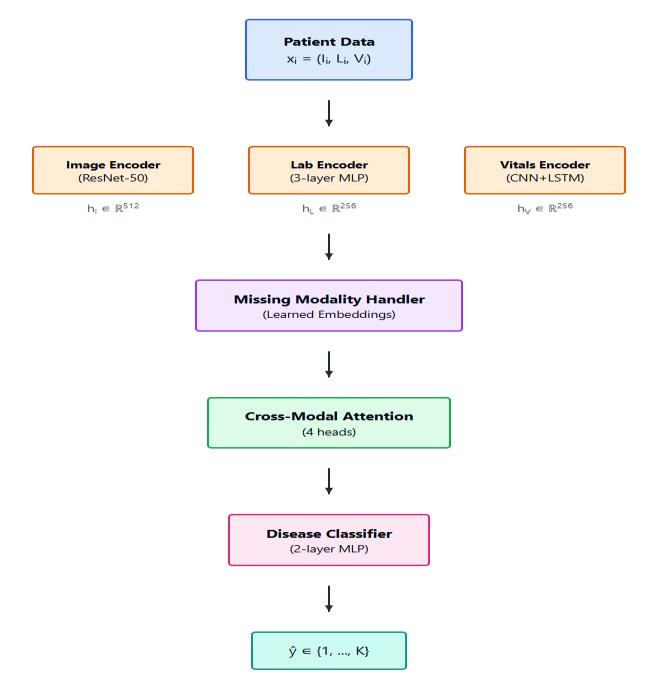
C. Neural Architecture for Multi-Modal Fusion
We employ a modular fusion architecture shown in Figure1:
HandlingMissingModalities:
e-ISSN: 2395-0056
p-ISSN: 2395-0072
Instead of zero-imputation (which biases fusion layers) or dropping incomplete records (losing 40% of data), we uselearnedmodalityembeddings:
• Each modality m ∈{I,L,V } has a trainable “missing” embedding emissm ∈Rdm
• Ifmodality m isabsentforpatient i,replace hm with emissm
• The fusion layer learns to weight available modalitiesappropriately
• During training, randomly drop modalities with probability p =015forrobustness
This approach is differentiable and learns contextdependentrepresentationsformissingdata.
D. Lineage-Based Checkpointing Protocol
Thekeychallengein distributed training faulttolerance is ensuring consistent checkpointing across workers while minimizingcoordinationoverhead.
Each checkpoint state includes the model parameters (θₜ), optimizer state (such as momentum buffers and learning rate schedule position), and lineage metadata containing the set of completed data partitions P = {p₁, p₂, …,pₖ}alongwiththecheckpointtimestampt.
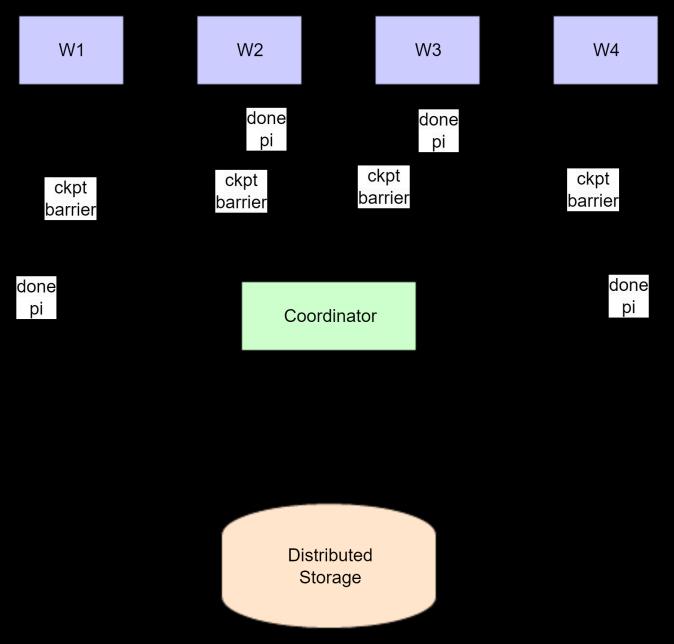
The checkpointing protocol operates as follows. All workers process data partitions in a deterministic global order, typically sorted by partition ID. After completing partition pᵢ, each worker broadcasts a completion message to the coordinator. When all W workers finish pᵢ, the coordinator triggers a checkpoint barrier: workers save their local states (θₜ and optimizer state), while the coordinatorstoresupdatedlineagemetadata(P∪{pᵢ},t)in distributedstorage.
ThecheckpointingarchitectureisillustratedinFigure2.
International Research Journal of Engineering and Technology (IRJET)
Volume: 12 Issue: 11 | Nov 2025 2025 www.irjet.net
RecoveryProtocol:
1) Failure Detection: Coordinator detects worker failureviaheartbeattimeout(30sthreshold)
2) Pause Training: Coordinator broadcasts pause signaltoallhealthyworkers
3) Load Checkpoint: All workers (including rejoining failedworker)loadmostrecentcheckpoint (θt,optimizerstate,P,t)fromdistributedstorage
4) Resume Training: Workers resume from first unprocessedpartition pk where pk ∈/P
5) Wasted Computation: Only work on partition currently in progress is lost (typically < 5% of total)
CorrectnessGuarantee:Theprotocolensuresthatafter recovery, all workers have processed exactly the set of partitions P recorded in the checkpoint, and no partition isprocessedtwiceorskipped.
Overhead Analysis: For our 16-worker setup with 53,420patients:
• Partitionsperworker:53,420/16≈3,340patients
• With batch size 32: ∼ 104 batches/worker per partition
• Checkpoint frequency: After each partition ≈ every 1.1hours
• Checkpoint I/O time: 45 seconds (saving 31.2M parameters)
• Totalcheckpoints:16over18-hourrun
• Total overhead: 16 × 45s = 12 minutes = 1.1% of trainingtime.
Result & Discussion
A. Experimental Setup
ComputeInfrastructure:
• 16-node cluster, each with 8 NVIDIA A100 GPUs (40GBVRAM)
• 2TBRAMpernode,100GbpsInfiniBandinterconnect
• SharedNFSforcheckpointstorage(10Gbpsnetwork) DatasetStatistics:
• Total patients: 53,420 (training: 42,736, validation: 5,342,test:10,680)
• Disease categories:37(cardiovascular,respiratory, metabolic,autoimmune)
• Totaldatasetsize:2.4TB(mostlyDICOMimages)
B. Training Time and Fault Tolerance
Table I compares our lineage-based checkpointing against alternativestrategies:
C. Failure Recovery Analysis
p-ISSN: 2395-0072
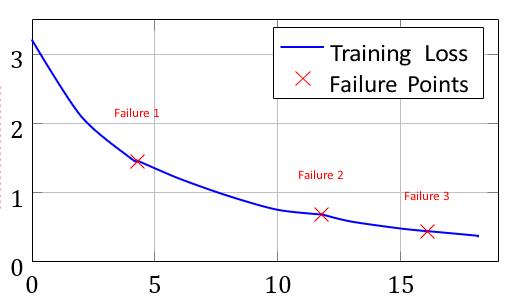
Table II shows the three worker failures encountered: Figure3showsthetraininglosscurvewithfailurerecovery events.
TrainingTime(hours)
Fig.3.Traininglosscurvewithfailurerecoveryevents
D. Model Performance
Table III shows test set performance: Figure 4 shows per-class F1 scores: TABLE-III
Conclusion
Our fault-tolerant training pipeline applies beyond medical ML to LLM pretraining, recommendation systems, and scientific computing where multi-day training runs on thousandsofGPUsmakefailuresinevitable.
International Research Journal of Engineering and Technology (IRJET)
Volume: 12 Issue: 11 | Nov 2025 2025 www.irjet.net
Limitations: Synchronous coordination creates stragglers. Future work should explore asynchronous checkpointingandadaptivepartitioning.
We presented a fault-tolerant distributed training system achieving 66% training time reduction and 74% cost savings through lineage-based checkpointing. Our systemachieved87.3%accuracyon53,420patientrecords withrobustperformanceonincompletedata.Foracademic labs with limited budgets, our design makes previously infeasibleprojectspractical.
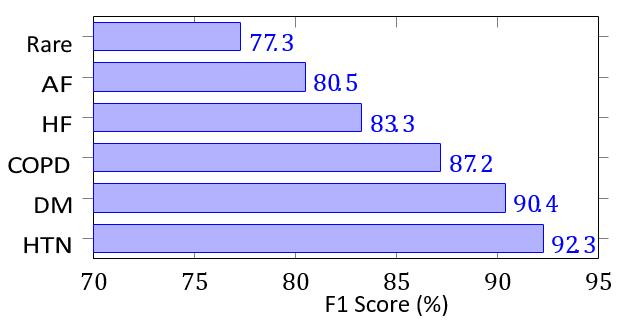
Fig.4.F1scoresbydiseasecategory
Acknowledgment
This research was supported by Dwarkadas J. Sanghvi College of Engineering & Technology. I am sincerely thankful to my guide, Prof. Yukti Bandi, who provided valuable technical expertise that greatly assisted the research.
References
[1] T. Ben-Nun and T. Hoefler, “Demystifying parallel and distributed deep learning,” ACM CSUR, vol. 52, no.4,Article65.
e-ISSN: 2395-0056
p-ISSN: 2395-0072
[2] M.Lietal.,“ScalingdistributedML withparameter server,”inOSDI2014,pp.583-598.
[3] Y. You et al., “Large batch optimization for deep learning,”inICLR2020.
[4] S. Rajbhandari et al., “ZeRO: Memory optimizations,” in SC20, pp. 1-16. [5] D. Narayanan et al., “Efficient LLM training with Megatron,” in SC21.
[5] A. Harlap et al., “PipeDream,” in SOSP 2019, pp. 115
[6] A. Sergeev and M. Del Balso, “Horovod,” arXiv:1802.05799,2018.
[7] S. Venkataraman et al., “Ernest,” in NSDI 2016, pp. 363-378.
[8] M.Zaharia etal.,“Resilientdistributeddatasets,”in NSDI2012,pp.15-28.
[9] A. D. Sunny et al., “Disease diagnosis with ML,” IJIET,vol.10,no.2,pp.14-21,2018.
[10] S. Khade et al., “Heart failure detection with DL,” IRJET,vol.6,no.6,pp.384-387,2019.
[11] V. Durai et al., “Liver disease prediction,” IJARIIT, vol.5,no.2,pp.1584-1588,2019.
[12] C.-C. Wu et al., “Fatty liver prediction,” CMPB, vol. 170,pp.23-29,2019.
[13] M. F. Faruque et al., “Diabetes prediction,” in ECCE 2019,pp.1-4.
[14] D. Vigneswari et al., “ML tree classifiers for diabetes,”inICACCS2019,pp.84-87.
[15] A. Ramachandram and G. W. Taylor, “Deep multimodallearningsurvey,”IEEESPM,vol.34,no. 6,pp.96-108,2017.
[16] P. K. Atrey et al., “Multimodal fusion survey,” MultimediaSys.,vol.16,no.6,pp.345-379,2010.
[17] N. Srivastava and R. R. Salakhutdinov, “Multimodal learningwithDBMs,”inNIPS2012,pp.2231–2239.
[18] S. Sun, “Multi-view ML survey,” Neural Comput. Appl.,vol.23,no.7,pp.2031-2038,2013.
[19] K. M. Chandy and L. Lamport, “Distributed snapshots,” ACM TOCS, vol. 3, no. 1, pp. 63-75, 1985.
[20] P. Blanchard et al., “Byzantine tolerant gradient descent,” in NIPS 2017, pp. 119-129.