
International Research Journal of Engineering and Technology (IRJET) e-ISSN: 2395-0056 p-ISSN:2395-0072

Volume:13Issue: 04 | Apr 2026 www.irjet.net


International Research Journal of Engineering and Technology (IRJET) e-ISSN: 2395-0056 p-ISSN:2395-0072
Volume:13Issue: 04 | Apr 2026 www.irjet.net
Tejas D. Fegade, Sahil R. Shaikh, Akash C. Kharat
Tejas D. Fegade Dept. of Computer Engineering Sahyadri Valley College of Engineering and Technology Junnar, India
Sahil R. Shaikh Dept. of Computer Engineering Sahyadri Valley College of Engineering and Technology Junnar, India
Akash C. Kharat Dept. of Computer Engineering Sahyadri Valley College of Engineering and Technology Junnar, India
Prof. Khatal Kavita, Dept. of Computer Engineering, Sahyadri Valley college of Engineering and Technology, Junnar, India.
Abstract - Modern agriculture increasingly demands cost-efficient operations, creating a growing need for flexible access to advanced farming machinery. However, manysmallandmid-scalefarmersfinditdifficulttoafford or maintain such equipment due to high investment and upkeep costs. The “Farming Rental Equipment Services” system offers a practical solution by providing a digital platform where farmers can conveniently access machinery on a rental basis. The platform simplifies tasks suchasequipmentsearch,reservation,tracking,andusage management, helping maximize equipment availability and reduce overall operational effort. By incorporatingtechnology- driven features, the system improvestransparency,widensaccessibility,andenhances user convenience. Ultimately, it supports better resource utilization, boosts productivity, and encourages more sustainableagriculturalpractices
Index Terms Equipment Rental System, Agriculture Technology, Farm Resource Management, Digital Farming,SmartAgriculture,SustainableOperations
1.INTRODUCTION
AgricultureisakeysectorinIndia,butmanyfarmerscannot affordexpensivemachinery.Traditionalmethodsofrenting equipmentareinefficientandlacktransparency.
TheFarmingRentalEquipmentServicesplatformprovidesa digitalsolutionwherefarmerscaneasilysearch,book,and use agricultural equipment on rent. It ensures real-time availability,securepayments,andbetterresourceutilization. This system reduces costs, improves productivity, and supportsmodern,sustainablefarmingpractices.
Recent developments in agricultural technology have enabledthecreationofdigitalplatformsthatfacilitatefarm equipmentsharing.Cloud-basedandmobileapplicationsnow allowfarmerstoviewavailability,bookmachinery,andmake secure payments. Integration of IoT sensors and data analyticshasfurtherimprovedtracking,maintenance,and resourceoptimization.

However, existing rental systems often rely on manual coordination or informal networks, leading to inefficiencies such as delayed equipment access, lack of transparency, and poor utilization records. To address these limitations, the proposed Farming Rental Equipment Services platformoffers a web-based solution that connects farmers and equipment owners, ensuring real-time tracking, secure payments, and betterresourcemanagement.
A.MajorModules
Theplatformisstructuredaroundsixessentialmodules, each designedtohandlespecificresponsibilitiesandensuresmooth systemoperation.
1. User Management: Responsible for user registration, authentication, profile management, and access control. This module ensures secure handlingof user data and restricts systemaccesstoauthorizedusers.
2. Equipment Management: Handles the addition, up dating, and tracking of agricultural machinery. It maintains detailed records of equipment availability, specifications, and status, enablingfarmerstoquicklyfindandrentneededequipment.
3. Booking: Facilitates reservation of equipment, allowing users to schedule rental periods, check availability, and managemodificationsorcancellationsefficiently.
4. Payment: Managessecurefinancialtransactions,including billing and payment tracking, ensuring that all rentals are properlyaccountedfor.
5. Notification: Sends timely alerts and reminders to users regarding booking confirmations, equipment availability, pay mentstatus,andsystemupdates.
6. Administration: Provides oversight oftheplatform, including monitoring user activity, supervising equipment management, generating reports, and enforcing policies. This ensures the system operates smoothly and any issues are promptlyaddressed.

International Research Journal of Engineering and Technology (IRJET) e-ISSN: 2395-0056 p-ISSN:2395-0072
Volume:13Issue: 04 | Apr 2026 www.irjet.net
The development of the system is divided into five structuredphasestoensuresystematicprogress,accuracy, andareliablefinalproduct:
1.Requirement Analysis and Design: Gatheringfunctional and non-functional requirements from stakeholders and preparing detailed design documents, including database schemasandmoduleinteractions.
2.Frontend and Backend Development: Buildingtheuser interface for seamless interaction, along with server-side logic, database connections, and APIs to handle requests efficiently.
3. Module Integration:Combiningallindividualmodules intoacohesivesystem,ensuringsmoothcommunicationand workflowbetweenthem.
4.Testing and Validation: Performingunit,integration,and systemtestingtodetectandfixbugs,optimizeperformance, andverifycompliancewithrequirements.
5.DeploymentandMaintenance: Launchingthesystemin aliveenvironmentandprovidingongoingsupport,updates, and maintenance to ensure reliability, security, and adaptabilitytoevolvinguserneeds.
This phased approach guarantees a robust, efficient, and user-friendly equipment rental platform that meets the needsofbothfarmersandadministrators.
A. Existing System Architecture
Thecurrentagriculturalequipmentmanagementsystemis mostlymanual orpartiallydigital,whichleadstomultiple operational challenges. Farmers often face difficulties in accessing machinery promptly due to limited communication channels and the absence of a centralized platform.Administratorsalsostruggletomaintainrecords, track bookings, and process payments efficiently. These issues result in delays, reduced transparency, and underutilizationofresources
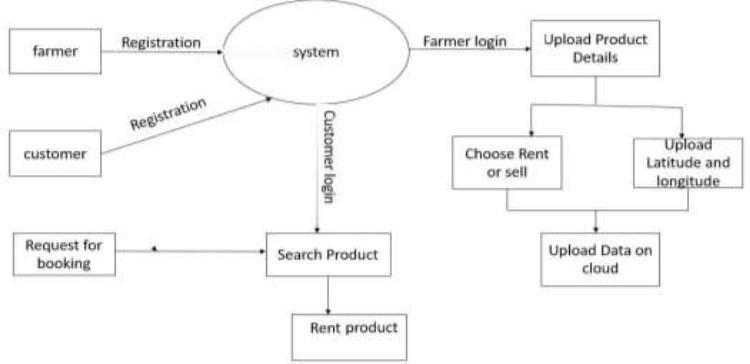
.Keylimitations:
•Relianceonmanualbookingandrecord-keeping
•Minimalcommunicationbetweenfarmersandequipment owners
•Absenceofacentralizeddatabaseforusersandequipment
•Delaysinpaymentprocessingandbookingconfirmations
Fig.1.ExistingSystemArchitecture
The existing system largely depends on manual processesfor booking and record maintenance. Communication between farmers and equipment owners is limited, causing delaysand inefficiencies. The lack of a centralized database makes it challenging to track equipment usage and payments accurately
B. Proposed System Architecture
Theproposed Farming Rental EquipmentServicesplatform is designed using a three-tier architecture consisting of the Presentation Layer, Application Layer, and Database Layer. This design provides modularity, scalability, and ease of maintenance.
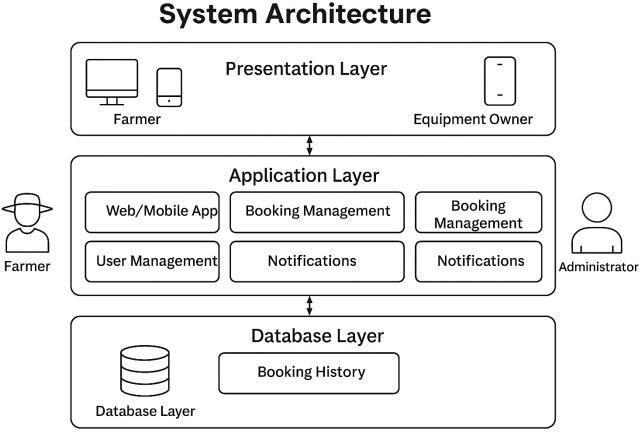
Fig.2.ProposedSystemArchitecture
The proposed platform automates equipment booking, payments,andtracking.Thethree-tierstructureincludes
Volume:13Issue: 04 | Apr 2026 www.irjet.net
International Research Journal of Engineering and Technology (IRJET) e-ISSN: 2395-0056 p-ISSN:2395-0072
• PresentationLayer: Provideswebandmobileinterfaces forseamlessuserinteraction.
• ApplicationLayer: Managesbookings,payments,andrealtimeequipmentavailability
• Database Layer: Securelystoresuserprofiles,equipment details, booking histories, and transaction records. This architecturesupportsreal-timeupdates,dataintegrity,and efficientresourceutilization.
By addressing the limitations of the current system, this architecturedeliversastructured, scalable,andmaintainable solution.Farmersandequipmentownerscaninteractinreal time,whileadministratorsgaincomprehensiveoversightof all operations, ensuring efficient and transparent managementofresources.
A. SystemFunctionality
TheFarmingRentalEquipmentServicesplatformprovidesa comprehensivesolutionforfarmersandequipmentowners. Itsmainfunctionalitiesinclude:
• User Registration and Login: Secureaccountcreationand authentication.
• Equipment Listing: Owners can list equipment with specifications,availability,andrentalprice
• Real-Time Availability: Farmerscancheck equipment availabilityforspecificdatesandlocations.
• Booking and Payment: Online booking with secure paymentandautomaticreceiptgeneration.
• DeliveryandReturnTracking: Systemtracksequipment fromdispatchtoreturn.
• Notifications: Automatedalertsforbookingconfirmations, cancellations,ormaintenanceschedules.
• Admin Dashboard: Monitorstransactions,useractivity, andcomplaints.
B. WorkflowAnalysis
The system workflow begins with user authentication, followed by equipment browsing and booking. Once confirmed,notificationsaresenttotheowner,andthesystem tracksdeliveryandreturn.Alloperationsareloggedinthe databaseforauditandtransparency.
C. KeyFeatures
• Home Page Equipment Display: Shows available equipmentwithimages,briefspecifications,andavailability status.
• Login and Registration: Secure access and account management.
• Payment Methods: Multiple options including credit/debit cards, UPI, and digital wallets with automatic receipt generation.
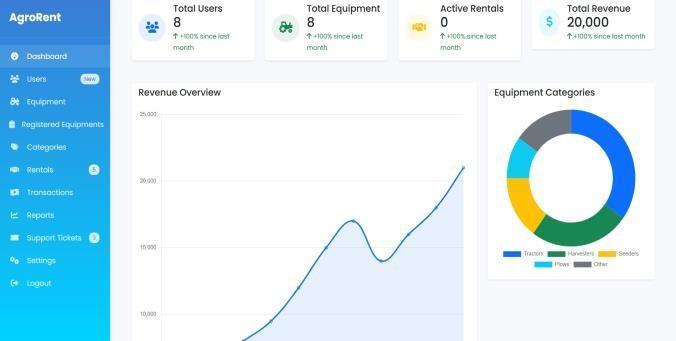
Fig.3.DashboardandBookingInterface
D. TestCasesandResults
Critical modules were tested to ensure reliability and functionality:
TABLEI SUMMARYOFTESTCASES
Test Case ID Description Result
TC01 UserRegistration Passed
TC02 LoginValidation Passed
TC03 Equipment Booking Passed
TC04 Payment Processing Passed
TC05 Notification Delivery Passed
TC06 AdminMonitoring Passed
E. AnalysisofResults
Thesystemdemonstrated:
• Efficiency: Reduced booking-to-confirmation time to seconds.
• Usability: Simpleandintuitiveinterface.
• Reliability: Preventsdoublebookingandmaintainsfull logs.
• Scalability:Supportsmultiplesimultaneoususerswithout performancedegradation.
Volume:13Issue: 04 | Apr 2026 www.irjet.net
International Research Journal of Engineering and Technology (IRJET) e-ISSN: 2395-0056 p-ISSN:2395-0072
Overall,theplatformeffectivelyoptimizesequipmentusage andimprovesresourcemanagementforsmallandmedium scalefarmers.
A.Conclusion
TheFarming RentalEquipmentServicesprojectsuccessfully demonstrates a software-based platform for renting agricultural machinery. It addresses challenges faced by farmers in access ing expensive equipment and optimizes resourceutilizationforequipmentowners.
1) SummaryofWorkDone
Keyactivitiesperformedinclude:
• Requirement Analysis: Collected requirements from farmersandequipmentowners
• System Design: Developed a modular and scalable architecture including booking, equipment management, userinterfaces,andsecureaccesscontrol.
• Implementation: Developedcorefunctionalitiessuchas equipmentlisting,onlinebooking,real-timeavailability,and paymentprocessing.
• Testing: Verified functionality, usability, and reliability undermultiplescenarios.
• Documentation: Prepared detailed documentation covering system overview, implementation, and future scope.
2) KeyFindingsandAchievements
• Farmers can access required equipment promptly, im provingproductivity.
• Equipment owners can generate income from idle machinery.
•Thesystemensurestransparency,automated notifications,andreducedadministrativeburden.
• Modular design supports future integration with technologieslikeIoTandAI.
• Testing confirms reliability, efficiency, and support for multipleconcurrentusers.
3) Limitations
•NoIoT-basedreal-timetrackingforequipmentusageyet.
•Internetconnectivityisrequired,whichmaylimitaccessin ruralareas.
•Paymentgatewaysandmulti-languagesupportareplanned forfutureupdates.
The platform is designed to be scalable and adaptable for futureenhancements,including:
• DevelopmentofnativeAndroidandiOSapplicationsfor ruralaccessibility
. • Integration of IoT sensors for real-time monitoring of usage,fuelconsumption,andmaintenance.
• AI-powered recommendations for equipment based on historicalusage,croptype,andweatherconditions.
• Dynamic pricing using machine learning models to optimizerentalrates.
• Integrationwithmultipledigitalpaymentmethods(UPI, wallets,onlinebanking).
•Fleetmanagementforlargecommercialfarms.
•Multi-languagesupporttoimproveaccessibility.
•Cloud-based deployment for better scalability, security, and globalaccess.
Overall,thesystemprovidesapracticalandefficientsolutionfor agricultural equipment rental, with potential to evolve into a comprehensivesmartagricultureecosystem.
[1]V. Jadhav, V. Ugale, R. Kadam, P. Patil, and T. Ghongade, “AGRORENT: An Agricultural Equipment Rental System,” International Research Journal of Modernization in Engineering Technology and Science, vol. 6, no. 4, Apr. 2024. [Online].Available: https://www.irjmets.com/paper//issue4april2024/52074/fi nal/fin.pdf
[2]S.Wolfert,L.Ge,C.Verdouw,andM.-J.Bogaardt,“BigDatain Smart Farming– A Review,” Wageningen Univer sity and Research, The Netherlands, 2025. [Online]. Available: https://www.sciencedirect.com/science/article/pii/S15375 11020301234
[3]A. Subeesh and N. Chauhan, “Agricultural Digital Twin for Smart Farming:A Review,”DepartmentofComputer Science and Engineering, NIT Hamirpur, and Centre of Excellence on Agri-Electronics and Automation in Agriculture, ICAR-CIAE Bhopal, India, 2025. [Online]. Available: https://www.sciencedirect.com/science/article/pii/S15375 11020405678
Volume:13Issue: 04 | Apr 2026 www.irjet.net
International Research Journal of Engineering and Technology (IRJET) e-ISSN: 2395-0056 p-ISSN:2395-0072
[4] P. Coelho, C. Silva, L. M. Ferreira, and B. Franca, “Operational Improvement of an Industrial Equipment Rental System Using Dis crete Event Simulation,” CEMMPRE, Department of Mechanical En gineering, University ofCoimbra, Portuga2025.[Online].Available: https://www.sciencedirect.com/science/article/pii/S0360 83522030789X
©2026,IRJET | Impact Factor value: 8.315 | ISO 9001:2008 Certified Journal |Page830