
International Research Journal of Engineering and Technology (IRJET) e-ISSN: 2395-0056 p-ISSN: 2395-0072

Volume:12Issue:06|Jun 2025 www.irjet.net

International Research Journal of Engineering and Technology (IRJET) e-ISSN: 2395-0056 p-ISSN: 2395-0072
Volume:12Issue:06|Jun 2025 www.irjet.net
Chinmay Deodhar 1 , Soham Kulkarni 2
1 Department of Information Dwarkadas J, Sanghvi College of Engineering, Mumbai, India
2 Department of Information Dwarkadas J, Sanghvi College of Engineering, Mumbai, India
Abstract: In recent years, the proliferation of fake news and misinformation has become a significant problem, creating a need for accurate and efficient detection and classification methods. This research paper compares the performance of several machine learning models, including Support Vector Machines (SVM), Multinomial Naive Bayes, Random Forest, XGBoost, Convolutional Neural Networks (CNN), Recurrent Neural Networks (RNN), Long Short-Term Memory (LSTM), and Bidirectional Encoder Representations from Transformers (BERT) in detecting and classifying fake news and non-fake news articles. The models were trained and evaluated on a dataset of news articles labelled as either fake or non-fake. Our results show Random Forest and CNN outperform the other models, achieving an accuracy of 94% and 94.25%, respectively. SVM and RNN also achieved reasonably high accuracy, with accuracies of 89% and 93.64%, respectively. The accuracies of Multinomial Naive Bayes, LSTM, and XGBoost were 86%, 80%, and 61%, respectively. The lower accuracy of BERT (61%) is attributed to training the model on a smaller dataset due to limited computing resources. Our findings suggest that Random Forest and CNN are promising models for detecting and classifying fake news and non-fake news articles. They can be used to develop effective solutions for combating fake news and misinformation.
Keywords: fake news, satire, misinformation, natural language processing, CNN, BERT, transformers
Introduction
Fake news and misinformation have become increasingly prevalentinthedigitalage.Socialmediaplatformsandthe internet make it easy for false information to spread quickly, leading to serious consequences such as influencing public opinion and affecting elections. The distinction betweenfakenewsand non-fakenewsarticles, such as satire or opinion pieces, can be blurred, making it challenging to detect and classify them accurately. In recentyears,therehavebeensignificanteffortstodevelop effective solutions for detecting and combating fake news. Machine learning models have been proposed as a promisingapproachfordetectingandclassifyingfakenews articles. These models use various features of the articles, such as language patterns and metadata, to differentiate between real and fake news. A wide range of models has been proposed in the literature, including Support Vector Machines (SVM), Random Forest, XGBoost, Convolutional Neural Networks (CNN), Recurrent Neural Networks (RNN), Long Short-Term Memory (LSTM), and Bidirectional Encoder Representations from Transformers

(BERT). In this paper, we compare the performance of severalmachinelearningmodelsindetectingandclassifying fake news and non-fake news articles. The models are trainedandevaluatedonadatasetofnewsarticlesmanually labelled as either fake or non-fake. We evaluate the performance of the following models: SVM, Multinomial NaiveBayes,RandomForest,XGBoost,CNN,RNN,LSTM,and BERT.Theresultsofthisstudycanprovideinsightsintothe most effective machine learning models for detecting and combating fake news and misinformation. In particular, our findings suggest that ensemble methods and deep learning models may be more effective in detecting fake news and non-fake news articles than traditional machine learning models.
A number of studies have investigated the effectiveness of different machine learning techniques in detecting fake news. For example, Golbeck et al. [1] created a dataset of fake news and satire articles and tested the accuracy of different classifiers, including SVM, Naive Bayes, and Random Forest. They found that Random Forest outperformedtheotherclassifierswithanaccuracyof94%. Similarly, Khan et al. (2021) [3] comparedtheperformance of several machine learning models, including SVM, Naive Bayes, and Deep Learning, and found that Deep Learning achievedthehighestaccuracyof92%.
Anotherareaofresearchhasfocusedontheuseoflinguistic and semantic cues to differentiate between fake news and satire. Levi et al. [2] explored this approach by analyzing theuseoflanguagepatternsinfakenewsandsatirearticles. Theyfoundthatwhilebothtypesofarticlesoftencontained exaggerationand mockery,fakenewsarticles tendedto use more hyperbolic language and appeal to emotion, while satirearticlesreliedmoreonironyandsarcasm.
In addition to analyzing the content of articles, researchers have also investigated the role of social media in spreading fake news. Asr and Taboada [4] noted that social media platforms are often the primary means by which fake news isdisseminatedandhighlightedtheimportanceofusingbig dataanalyticstodetectpatternsofmisinformation. Liu et al. [7] specifically looked at the detection of satirical news on socialmediaandfoundthatusingfeaturessuchastheuseof emoticons and hashtags could improve the accuracy of fake newsdetection.
Other studies have explored the use of more sophisticated techniques, such as deep learning algorithms, in detecting

International Research Journal of Engineering and Technology (IRJET) e-ISSN: 2395-0056 p-ISSN: 2395-0072
Volume:12Issue:06|Jun 2025 www.irjet.net
fake news. For example, Das and Clark [5] used a convolutional neural network (CNN) to classify news articlesaseither fakeorsatirical, achievinganaccuracyof 95%. Rubin et al. [6] alsoused a deep learning approach, specifically a Long Short-Term Memory (LSTM) network, to analyze satirical cues in news articles and achieved an accuracyof76%.
While these studies demonstrate the potential of machine learningindetectingfakenews,itisimportanttonotethat there are still limitations to the effectiveness of these systems. There is often a trade-off between accuracy and speed, as more complex algorithms may require more computingresources.
Golbeck et al. [1] collected a dataset of fake news and satire articles and performed a basic analysis on this datasaetusingcertainalgorithmssuchasSVM,NaïveBayes andRandomForestClassifier.
Levi et al. [2] tookasimilarapproach,using semanticand linguisticcuestodistinguishbetweenfakenewsandsatire articles.
Khan et al. [3] conducted a benchmark study comparing the performance of different machine learning models in detecting fake news. They found that Random Forest had thehighestaccuracy,followedbyMultinomialNaiveBayes andRNN.
Asr and Taboada [4] emphasizedtheimportanceofusing qualitydatatotrainmachinelearningmodels,highlighting the challenges of identifying reliable sources and labelling dataaccurately.
Finally, Liu et al. [7] investigatedthedetectionofsatirical newsspecificallyonsocialmediaplatforms,usingaFrench dataset. They found that machine learning models can effectively distinguish between satirical and non-satirical news,evenwhenpresentedinashortformat.
Methodology
I. Preprocessing:
The dataset was preprocessed by tokenizing the text, converting it to lowercase, and removing stop words, punctuations, and URLs. The text was then vectorized usingthetermfrequency-inversedocumentfrequency(TFIDF)method.
II. ModelSelection:
Several machine learning models were trained and evaluated on the dataset, including Support Vector Machine (SVM), Multinomial Naive Bayes, Random Forest, XGBoost, Convolutional Neural Network (CNN), Recurrent NeuralNetwork(RNN),LongShort-TermMemory(LSTM), BERT,andXLNet.
III. TrainingandEvaluation:
The dataset was split into training, validation, and test sets using an 80/20 split. The training set, consisting of 21,368 articles,wasusedtotrainthemodels.Thevalidationsetwas used to tune the hyperparameters of the models. The test set, consisting of 5342 articles, was used to evaluate the performanceofthemodels.Theaccuracymetricwasusedto evaluatetheperformanceofthemodels.
IV. PerformanceComparison:
The performance of the models was compared based on theiraccuracyscoresonthetestset.Theresultsshowedthat the Random Forest model achieved the highest accuracy score of 94%, followed by the CNN model with an accuracy score of 94.25%. The SVM and Multinomial Naive Bayes models achieved accuracy scores of 89% and 86%, respectively.TheXGBoost,RNN,andLSTMmodelsachieved accuracyscoresof68%,93.64%,and80%,respectively.The BERT model achieved an accuracy score of 61%, which is lower than the other models, possibly due to the limited trainingdatausedforthismodel.
A statistical analysis was performed to determine if the difference in accuracy between the models was statistically significant. The results showed that the Random Forest and CNN models had a statistically significant difference in accuracycomparedtotheothermodels.
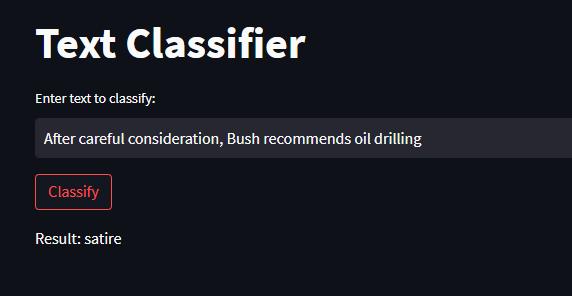
Thebest-performingmodels,RandomForestandCNN,were implemented as web applications for fake news and satire detectionandclassification.
Overall, the methodology used in this study provides a comprehensive evaluation of various machine learning models for the task of fake news and satire detection and classification.
The proposed system for fake news vs satire detection and classification focuses on analyzing the headlines of newsarticles.Byconsideringonlytheheadlineasinput,the system aims to provide a quick and efficient method for distinguishing between fake news and satire. Thesystem utilizes various features based on the headline text to achievethisgoal:
TextualFeatures:
The system analyzes the textual content of the headlines, including word frequency, n-grams, sentiment analysis, and lexical patterns. These features help capture linguistic cues and stylistic differences that can indicate whether the headline is associated withfakenewsorsatire.

International Research Journal of Engineering and Technology (IRJET) e-ISSN: 2395-0056 p-ISSN: 2395-0072
Volume:12Issue:06|Jun 2025 www.irjet.net
StructuralFeatures:
The system examines the structural elements of the headlines, such as length, use of quotations, presence of sensationalist language, and formatting styles. These featurescanprovideinsightsintotheheadline'sintentand whether it aligns with the conventions of news reporting orsatire.
MachineLearning Models:
The system employs machine learning models trained on labelled data to learn patterns and characteristics specific to fake news and satire headlines. These models, such as SupportVectorMachines(SVM)orRandomForests,utilize the extracted textual and structural features to make predictionsabouttheclassificationoftheheadline.
FeatureSelection and Extraction:
The system performs feature selection and extraction techniques to identify the most informative features from the headline text. This helps improve the efficiency and accuracyoftheclassificationprocess.
Itisimportanttonotethatthesystem'sscopeislimitedto analyzing the headline text only. While additional information, such as article content or metadata, could provide valuable context, the proposed system focuses solely on the headline to offer a quick and practical solution for users. By considering the features derived from the headline text, the system aims to accurately differentiate between harmful fake news and harmless satirebasedonthelimitedinputavailable.
The performance of various machine learning models was evaluated for the task of detecting and classifying fake news and satire. The SVM model achieved an accuracy of 89%,followedbytheMultinomialNaiveBayesmodelwith an accuracy of 86%. The Random Forest model outperformed all other models, achieving an accuracy of 94%.TheXGBoostmodel,however, achieved a relativelylowaccuracyof68%.
Deep learning models, such as CNN, RNN, and LSTM, were alsoevaluatedforthetaskoffakenewsdetection.TheCNN model achieved an accuracy of 94.25%, making it one of thebest-performingmodels.TheRNNmodelalsoachieved a high accuracy of 93.64%. However, the LSTM model achievedarelativelyloweraccuracyof80%.
Pre-trained language models, such as BERT, were also evaluated for the task of fake news detection. The BERT model achieved anaccuracy of61%, which is relatively low comparedtotheothermodels.Thiscanbeattributedtothe fact that the BERT model was trained on a smaller dataset duetoalackofcomputingresources.

Overall,theRandomForestmodelwasfoundtobethebestperforming model for fake news detection, followed by the CNNandRNNmodels.TheBERTmodel,althoughpromising, needs to be further explored with a larger dataset to improveitsperformance.
TABLEI
AComparisonoftheVariousModelsImplementedandtheir Accuracies
Volume:12Issue:06|Jun 2025 www.irjet.net
Inconclusion, our research providesvaluableinsightsinto the detection and classification of fake news versus satire using various machine learning models. The high accuracies achieved by Random Forest and CNN suggest that these models could be useful in identifying and filteringoutfakenewsandsatirefromnewsarticles. However, our study also highlights the complexity of the problem and the need for more nuanced approaches. The fact that some articles could be interpreted as both fake news and satire emphasizes the importance of contextaware models that can account for various linguistic and contextualcues.
While our study used a publicly available dataset, future work could explore the use of larger and more diverse datasets to train and test these models. Moreover, advanced natural language processing techniques such as deeplearningandtransformermodelslikeBERTandGPT3 could be employed to further improve the performance ofthesemodels.
Overall, our research contributes to the ongoing efforts to combatthespreadofmisinformationandfakenews,which has become a significant societal issue in recent years. By usingmachinelearningmodelstodistinguishbetweenfake news and satire, we can help ensure that readers are providedwithaccurateandreliableinformation.
We gratefully acknowledge the guidance and support of ourcollegeprofessors,whoseexpertisegreatlycontributed to the development of this research. We also thank the participants, colleagues, and research team members for their valuable contributions. Finally, we express our heartfelt appreciation to our families and friends for their unwaveringsupportthroughoutthisendeavor.
References
[1] Golbeck,Jennifer&Everett,Jennine&Falak,Waleed& Gieringer, Carl & Graney, Jack & Hoffman, Kelly & Huth, Lindsay & Ma, Zhenya & Jha, Mayanka & Khan, Misbah&Kori,Varsha &Mauriello,Matthew&Lewis, Elo & Mirano, George & IV, William & Mussenden, Sean & Nelson, Tammie & Mcwillie, Sean & Pant, Akshat & Cheakalos, Paul. (2018). Fake News vs Satire: A Dataset and Analysis. 17-21. 10.1145/3201064.3201100.
[2] Levi, Or & Hosseini, Pedram & Diab, Mona & Broniatowski, David. (2019). Identifying Nuances in Fake News vs. Satire: Using Semantic and Linguistic Cues.31-35.10.18653/v1/D19-5004.
[3] Khan,JunaedYounus &Khondaker,Md.TawkatIslam &Afroz,Sadia&Uddin,Gias&Iqbal,Anindya.(2021). A benchmark study of machine learning models for online fake news detection. Machine Learning with Applications. 4. 100032. 10.1016/j.mlwa.2021.100032.
2395-0056 p-ISSN: 2395-0072
[4] Asr, Fatemeh & Taboada, Maite. (2019). Big Data and quality data for fake news and misinformation detection. Big Data & Society. 6. 205395171984331. 10.1177/2053951719843310.
[5] Das, Dipto & Clark, Anthony. (2019). Satire vs Fake News: You Can Tell by the Way They Say It. 10.1109/TransAI46475.2019.00012.
[6] Rubin, Victoria & Conroy, Nadia & Chen, Yimin & Cornwell, Sarah. (2016). Fake News or Truth? Using Satirical Cues to Detect Potentially Misleading News. 10.18653/v1/W16-0802.
[7] Rubin, Victoria & Conroy, Nadia & Chen, Yimin & Cornwell, Sarah. (2016). Fake News or Truth? Using Satirical Cues to Detect Potentially Misleading News. 10.18653/v1/W16-0802.
[8] https://monkeylearn.com/blog/natural-languageprocessing-techniques/ Natural Language Processing Techniques
[9] Steven, Cibambo. (2019). Web Scraping Wikipedia using Python and BeautifulSoup. 10.13140/RG.2.2.34480.71685.
[10] Abadi, M., Barham, P., Chen, J., Chen, Z., Davis, A., Dean, J., Devin, M., Ghemawat, S., Irving, G., Isard, M., Kudlur, M., Levenberg, J., Monga, R., Moore, S., Murray, D. G., Steiner, B., Tucker, P., Vasudevan, V., Warden, P., . . . Zheng, X. (2016). TensorFlow: A system for large-scale machinelearning.ArXiv./abs/1605.08695
[11] Paszke, A., Gross, S., Massa, F., Lerer, A., Bradbury, J., Chanan, G., Killeen, T., Lin, Z., Gimelshein, N., Antiga, L., Desmaison, A., Köpf, A., Yang, E., DeVito, Z., Raison, M., Tejani, A., Chilamkurthy, S., Steiner, B., Fang, L., . . . Chintala,S.(2019).PyTorch:AnImperativeStyle,HighPerformance Deep Learning Library. ArXiv. /abs/1912.01703
[12] https://docs.streamlit.io/StreamlitDocumentation