
International Research Journal of Engineering and Technology (IRJET) e-ISSN: 2395-0056
Volume: 13 Issue: 04 | Apr 2026 www.irjet.net p-ISSN: 2395-0072

International Research Journal of Engineering and Technology (IRJET) e-ISSN: 2395-0056
Volume: 13 Issue: 04 | Apr 2026 www.irjet.net p-ISSN: 2395-0072
J Andrea1, Shaila Mary J2
1Student, Department of Computer Science, Mount Carmel College, Autonomous, Bengaluru, India
2Assistant Professor, Department of Computer Science, Mount Carmel College, Autonomous, Bengaluru, India
Abstract– Automatedloan approval systems using machine learning are widely used to assess credit risk and support lending decisions. While these models achieve high predictive performance, they may also inherit historical biases, leading to unfair outcomes across demographic groups. This paper presents a fairness-aware framework that jointly evaluates accuracy and algorithmic fairness. A dataset of 20,000 loan applications is used to train Logistic Regression, Decision Tree, Random Forest, and hybrid ensemble models. Fairness is measured using Demographic Parity Difference, Disparate Impact Ratio, and Equal Opportunity Difference. Results show that Random Forest achieves the highest accuracy but exhibits measurable bias. A reweighting-based mitigation approach is applied to develop a Fair Random Forest model, achieving 0.8965 accuracy with reduced disparities in approval rates and true positive rates. Hybrid ensembles provide competitive performance but do not outperform the fairness-aware model. The results demonstrate that fairness can be improved with minimal impact on accuracy, supporting ethically aligned loan approval systems.
Key Words: Fairness in machine learning models, algorithmic bias, loan approval, credit scoring, Random Forest,reweighting,disparateimpact,ethicalAI.
1.1 Background
Machine learning (ML) has become central to credit risk assessment and loan approval, where predictive models estimatethelikelihoodofloanrepaymentbasedonhistorical application data [1, 2]. Such systems offer scalability, consistency, and improved predictive power compared to manual orrule-basedcreditscoring. However,ML models trainedonhistoricaldatacanreflectandreinforceexisting social and institutional biases, particularly along sensitive attributessuchasgender,race,orage[3–5]. Inhigh-stakes domains such as finance, this raises serious ethical and regulatory concerns, including potential violations of antidiscrimination laws and fairness regulations such as the EqualCreditOpportunityAct.
Conventional loan approval models primarily optimize predictiveaccuracyorrelatedperformancemeasures,often ignoring fairness considerations. As a result, they may assign systematically different approval probabilities to groupsthatdifferonlyin protected attributes, leading to disparatetreatmentordisparateimpact.Thecoreproblem addressedinthisworkis:
How can a loan approval prediction model be designed to maintain high predictive performance while reducing unfair bias across protected demographic groups, with a focus on gender?
Thisresearchpursuesthefollowingobjectives:
• Developmachinelearningmodelforbinaryloan approvalprediction.
• Evaluatemodelsusingstandardclassification metrics(ac-curacy,precision,recall,F1-score).
• Quantifyalgorithmicbiasusinggroupfairness metrics.
• Apply fairness mitigation via a reweighting technique attrainingtime.
• Compare baseline, hybrid ensemble, and fairnessawaremodels.
• Identifyamodelthatprovidesafavorabletrade-off betweenaccuracyandfairness.
• Binaryclassificationofloanapproval(approvedvs.not ap-proved).
• Fairnessanalysisprimarilywithrespecttogenderasa protectedattribute.
• ClassicalMLmodels(LogisticRegression,Decision Tree,RandomForest,andensembles)ratherthan deeplearning.
International Research Journal of Engineering and Technology (IRJET) e-ISSN: 2395-0056
Volume: 13 Issue: 04 | Apr 2026 www.irjet.net p-ISSN: 2395-0072
Section2reviewsliteratureoncreditscoringandfairnessawareML.Section3describesthedataset.Section4presents preprocessing steps. Section 5 introduces the proposed methodology. Section 6 outlines system implementation. Section7detailsthe experimentalsetup. Section8reports results and analysis. Sections 9–12 discuss applications, limitations,conclusions,andfuturework.
2.1
Traditionalcreditscoringreliesonstatisticalmodelssuchas Logistic Regression due to their interpretability and reliability [1, 2]. More advanced approaches, including DecisionTrees,RandomForests,andboostingmethods,often achievebetterpredictiveperformanceonstructuredfinancial data[6,7].
2.2 Algorithmic Fairness and Bias
Machine learning models can inherit and amplify biases presentinhistoricaldata,leadingtounfairoutcomesacross demographic groups [3, 5, 8]. Several fairness definitions exist,includingdemographicparityandequalopportunity[4, 8]. Tools such as IBM’s AI Fairness 360 (AIF360) support fairnessevaluationandmitigation[10].
Fairness metrics measure disparities across groups. DemographicParityensuresequalapprovalrates[4],while DisparateImpactevaluatestheirratiousingthe“four-fifths rule”[9].EqualOpportunityfocusesonequaltruepositive ratesacrossgroups[4,5].
Fairnesstechniquesincludepre-processing,in-processing, andpost-processingmethods[3,8,11].Reweighting,apreprocessingapproach,assignssampleweightstoreducebias bybalancingprotectedgroupsandoutcomes[10,11].This studyadoptsreweightingduetoitssimplicityandmodelagnosticnature
2.5 Research Gap
Many prior works in credit risk modeling emphasize accuracyandcalibrationwhileneglectingfairnessmetrics and mitigation strategies. Even when fairness is
considered,comprehensivecomparisonsbetweenbaseline, ensemble, and fairness-aware models in a single loan approvalpipelinearelimited.Thisworkaddressesthisgap bysystematically:
• Evaluatingmultiplemodelsonbothperformance andfair-ness.
• Applyingreweighting-basedmitigationforawidely usedensemblemodel(RandomForest).
• Comparingfairness-awareandhybridensemblesin aunifiedexperimentalframework.
3.1
The dataset consists of 20,000 historical loan application records from a publicly available credit dataset (e.g., Kaggle/UCI-style loanpredictiondata)[12]. Eachrecord includes demographic, employment, and financial attributes,alongwithabinarytargetindicatingwhetherthe loanwasrepaid(loanpaidback:1)ornot(0).
Keyfeaturesinclude:
• Demographic: gender(protectedattribute),age.
• Financial: income,loanamount,credit-related variables.
• Employment: employmentstatusandrelated indicators.
Thetargetvariableisabinarylabel: loanpaidback(1)vs. not paid back (0), used to approximate loan approval behavior.
Genderistreatedastheprimaryprotectedattributeduetoits historicalrelevanceindiscriminationwithinlendingsystems [3,5].Attributessuchasincomeandcreditscore,although potentially correlated with socio-economic status, are considered legitimate risk factors directly related to loan repaymentabilityandarethereforenottreatedasprotected attributes.
Inadditiontogender,otherdemographicattributesarealso analyzedtoexaminepotentialbiasinmodelpredictions.The protectedattributesanalyzedinclude:
• Gender
• Age
• MaritalStatus
• EducationLevel
International Research Journal of Engineering and Technology (IRJET) e-ISSN: 2395-0056
Volume: 13 Issue: 04 | Apr 2026 www.irjet.net p-ISSN: 2395-0072
Biasdetectionandfairnessevaluationmetricsarecomputed separatelyforeachoftheseattributestoassessdisparitiesin modeloutcomesacrossdifferentdemographicgroups.
Furthermore, an intersectional analysis is performed by combining multiple protected attributes into a single composite feature. This enables the evaluation of how overlappingdemographiccharacteristicsimpactfairnessand modeldecisions.
While multiple attributes are analyzed for bias detection, fairnessmitigationusingreweightingisap-pliedprimarily withrespecttogender. Thisensuresmethodologicalclarity while still providinga comprehensive fairness assessment acrossmultipledimensions.
4.1 Data Cleaning
Datacleaningstepsinclude:
• Handling missing and null values through imputation orrowremovalwherenecessary.
• Resolvinginconsistentorout-of-rangevalues.
• Ensuringthatdatatypesandformatsareconsistent acrossfeatures.
4.2 Data Transformation
Numericalfeaturesarestandardized(e.g.,usingz-score scaling)tosupportalgorithmssensitivetofeature magnitude(e.g.,LogisticRegression).Categorical variables(excludingtheprotectedattributeforfairness analysis)areencodedusingappropriateschemessuchas one-hotencodingorordinalencoding.
4.3
Features relevant to loan repayment and not introducing targetleakageareretained.Protectedattributes(e.g.,gender) are excluded from model inputs when appropriate but retained for fairness evaluation. However, indirect proxy variables may still encode similar information. Addressing such latent correlations requires advanced methods such as causal analysis or adversarial debiasing, which are beyond the scope of this study
4.4 Train–Test Split
Thedatasetissplitinto80%trainingand20%testingdata usingstratifiedsamplingtopreservetheclassdistribution. The trainingsetisusedformodelfitting,hyperparameter
tuning,andfairness-awaretraining;thetestsetisusedsolely forfinalevaluation.
5.1 Overall Pipeline
Theproposedpipelineconsistsofthefollowingstages:
1. Datapreprocessingandfeatureengineering.
2. TrainingbaselineMLmodels.
3. Quantifyingbiasusingfairnessmetricsonbaseline models.
4. Applyingreweighting-basedfairnessmitigation.
5. Trainingfairness-awaremodels(FairRandomForest).
6. Traininghybridensemblemodels.
7. Evaluatingallmodelsonperformanceandfairness.
8. Selectingthemodelthatbestbalancesaccuracyand fairness.
The proposed system architecture for loan approval predictionensuresbothhighpredictiveperformanceand fairness through an integrated pipeline. It includes data preprocessing, bias detection, fairness mitigation, and model evaluation. The system operates in the following stages:
• Input Layer: Raw loan application data is collectedandfedintothesystem.
• Preprocessing Layer: Datacleaning,encodingof categorical variables, and feature scaling are performedtopreparethedatasetformodeling.
• Protected Attribute Identification: Sensitive attributes such as gender are identified for fairnessanalysis.
• Model Training Layer: Baseline models and fairness-aware models are trained using processeddata.
• Bias Detection Layer: Fairness metrics are computed to identify disparities in predictions acrossdifferentdemo-graphicgroups.
• Fairness Mitigation Layer: Areweighting-based technique is applied during training to assign weightstosamplestoreducebias.
• Evaluation Layer: Modelsareevaluatedbasedon bothperformanceandfairnessmetrics.
International Research Journal of Engineering and Technology (IRJET) e-ISSN: 2395-0056
Volume: 13 Issue: 04 | Apr 2026 www.irjet.net p-ISSN: 2395-0072
• OutputLayer:Thefinalmodel(FairRandomForest) isselectedforprediction
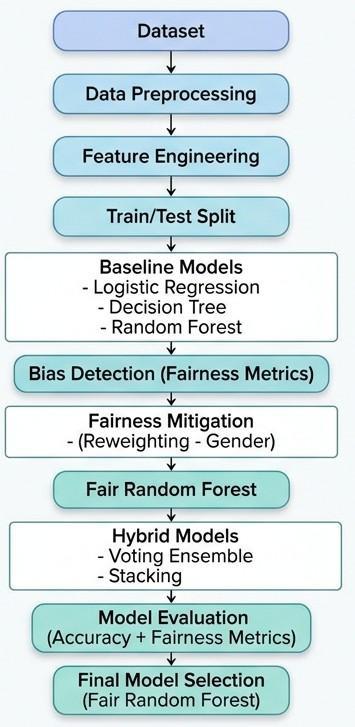
Fig - 1: Input–Process–Output(IPO)BasedFairness-Aware LoanPredictionSystemArchitecture
This architecture embeds fairness throughout the pipelineratherthantreatingitasapost-processingstep. Bias is detected using fairness metrics and reduced throughreweighting,whilehybridmodelsareexplored forperformance.Thefinalmodelisselectedbasedona balancebetweenaccuracyandfairness
Threeprimarybaselineclassifiersareused:
Logistic Regression: alinear,interpretablemodeloften usedasabaselineincreditscoring[1,2].
Decision Tree: a tree-based model that produces human-readabledecisionrules.
Random Forest: an ensemble of decision trees constructed via bootstrap sampling and feature subsampling,typicallyofferingstrongperformanceon tabulardata[6,7].
Toexploreperformanceimprovements,ensemblemethods areconsidered:
• Voting(LogisticRegression,DecisionTree,Random Forest)
• Voting(LogisticRegression+RandomForest)
• Stackingensemble
These models combine multiple learners to enhance predictiveperformance.
Thefollowinggroupfairnessmetrics,computedforgender groups,areused:
DemographicParity Difference: differenceintheratesof favorableoutcomes(approvals)acrossgroups.
Disparate Impact Ratio: ratiooffavorableoutcomerates, oftencomparedtothe0.8threshold[9].
Equal Opportunity Difference: differenceintruepositive rates(TPR)acrossgroups[4].
Smallerabsolutevaluesofdifferencesandratioscloserto1 indicate improved fairness. These fairness metrics help evaluatewhetherthemodeltreatsdifferentdemographic groupsequitably.Whileamodelmayachievehighaccuracy, itcanstillproducebiasedoutcomesifpredictionsarenot evenly distributed across protected groups. Therefore, thesemetricsareessentialtoassessthetrade-offbetween modelperformanceandfairness,ensuringthatthesystem doesnotdisadvantageanyparticulargroup.
Apre-processingreweightingtechniqueinspiredbyAIF360 [10,11]isemployed:
1. Thejointdistributionofprotectedattribute(gender) andoutcome(loanrepaid)isestimated.
2. Each sample is assigned a weight inversely proportionaltotheempiricalprobabilityofits(gender, outcome)combination.
3. Theclassifier(RandomForest)istrainedusingthese sampleweights,reducingcorrelationbetweengender andpre-dictions.
This produces a Fair Random Forest model that explicitlyaccountsforgroupfairnessduringtraining.
All models are evaluated on the held-out test set. Performanceisassessedusingaccuracy,precision,recall,and F1-score. Fairness is measured via the metrics above. Comparisonfocuseson:
• BaselineRandomForestvs.FairRandomForest.
• BaselineRandomForestvs.hybridensembles.
International Research Journal of Engineering and Technology (IRJET) e-ISSN: 2395-0056
Volume: 13 Issue: 04 | Apr 2026 www.irjet.net p-ISSN: 2395-0072
• Accuracy–fairnesstrade-offsacross
6.1 Development Environment
ThesystemisimplementedinPythonusing:
• Scikit-learnforMLmodelsandmetrics[6].
• PandasandNumPyfordatahandling.
• MatplotlibandSeabornforvisualization.
Optionally,AIF360orsimilarlibrariesforfairness metricsandreweighting[10].
7.1 Hardware and Software
Experimentsarerunonastandardworkstationwith:
• CPU:IntelCorei3.
• RAM:8–16GB.
• Storage:SSD-basedsystem.
Softwareenvironment:
• ProgrammingLanguage:Python
• Environment:JupyterNotebookandAnaconda
• Libraries:
- Scikit-learn(modeltrainingand evaluation)
- PandasandNumPy(dataprocessing)
- MatplotlibandSeaborn(data visualization)
- Joblib(modelpersistence)
7.2 Performance Metrics
Thefollowingstandardclassificationmetricsarecomputedto evaluatemodelperformance:
Accuracy: Measures the overall proportion of correctly classifiedinstances.
Accuracy= TP + TN
TP + TN + FP + FN (1)
Precision: Measures the proportion of predicted positive in-stancesthatareactuallypositive.
Precision= TP (2)
TP + FP
Recall: Measures the proportion of actual positive instancesthatarecorrectlyidentified.
Recall= TP (3)
TP + FN
F1-score: Harmonic mean of precision and recall, providingabalancebetweenthetwo.
F1-score=2 × Precision ×Recall (4)
Precision+ Recall
7.3 Fairness Metrics
Foreachmodel,fairnessmetricsacrossgendergroupsare computed as described in Section 5. Approval rates and confusionmatricesarealsoanalyzedpergrouptoprovide interpretability.
8.1 Baseline Performance
Amongbaselinemodels,RandomForestachievesthehighest accuracy(around0.89+),outperformingLogisticRegression andDecisionTree,consistentwithpriorworkoncreditrisk prediction[6,7]. ThebaselineRandomForestthusserves astheprimaryreferenceforsubsequentcomparisons.
8.2 Fairness Evaluation Before Mitigation
Whenevaluatedonthetestset,thebaselineRandomForest model exhibits differences in approval rates and true positive rates across gender groups. The representative approvalratesare:
Male:0.8937
Female:0.8768
Other:0.8857
Thesevaluescorrespondtoencodedcategories(Male=0, Female=1,Other=2).Thefairnessmetrics–Demographic Parity Difference (≈ 00169), Disparate Impact Ratio (≈ 098), and Equal Opportunity Difference (≈ 00107) –indicate the presence of mild but non-negligible bias. Specifically, one group receives slightly lower approval ratesandreducedtruepositiveratescomparedtoothers.
8.3 Fairness-Aware Random Forest
Afterapplyingthereweighting-basedmitigationtechnique duringtraining,theFairRandomForestmodelachievesan accuracy of 0.8965, which is comparable to the baseline RandomForest.Theapprovalratesacrossgendergroups becomemorealigned:
International Research Journal of Engineering and Technology (IRJET) e-ISSN: 2395-0056
Volume: 13 Issue: 04 | Apr 2026 www.irjet.net p-ISSN: 2395-0072
Male:0.8922
Female:0.8805
Other:0.8857
Asbefore,thesecorrespondtoencodedcategories(Male=0, Female = 1, Other = 2). The reduction in variation across groupsreflectsimprovedfairness.Thefairnessmetricsmove closertotheiridealvalues,withlowerDemographicParity andEqualOpportunitydifferencesanda DisparateImpact Ratio closer to 1. This shows the reweighting approach effectively reduces bias while maintaining comparable predictiveperformance.
Hybridmodelsachievestrongperformancebutdonot surpassthefairness-awareRandomForest:
• Voting(Logistic+RandomForest):accuracy≈ 0.89475
• Stacking:accuracy≈0.89575
Whilethesemodelsperformwell,theyexhibitslightly higherbias.Thisindicatesthatincreasedmodelcomplexity doesnotnecessarilyimprovefairness.
Table - 1: Comparison of All Models
Model Accuracy Observation
RandomForest 0.8975 Best baseline performance
Hybrid 1 (Voting –All) 0.8930 Nosignificant improvement
Hybrid 2 (Logistic+ RF) 0.89475 High recall, not superior
Hybrid 3 (Stacking) 0.89575 Slight bias observed
Fair Random Forest 0.8965 Best fairness performance
The results indicate that while hybrid models perform competitively,theydonotoutperformtheoriginalRandom Forest model in terms of overall accuracy. Although some hybrid approaches improve recall and maintain strong performance,theydonotprovideasignificantadvantageover thebaseline.Thissuggeststhatmodelcomplexity does not necessarilyguaranteebetterresults,especiallywhenthebase modelisalreadyhighlyoptimized.
8.5
TheFairRandomForest’sconfusionmatrixindicates:
Lowfalsenegativesandhightruepositives,important for minimizing denial of credit to truly creditworthy applicants.
Balanced trade-off between false positives and false negatives across groups, reducing disparate misclassificationburdens.
The Random Forest models provide the best overall performance.TheFairRandomForest:
• Maintainshighaccuracy(0.8965)
• Reducesbiasacrossdemographicgroups
• Offers the best balance between accuracy and fairness. This makes it suitable for fairnesssensitiveapplication.
Theproposedframeworkcanbeappliedin:
• Automatedloanapprovalsystems
• Creditriskassessmentplatforms
• Financialsystemsrequiringfairnesscompliance
• Fairness evaluated mainly with respect to gender; intersectionalfairnessisnotaddressed
• Useofasingledatasetmaylimitgeneralization
• Onlyreweightingisexplored;advancedmethodsmay furtherimprovefairness
• Proxyvariablesforgendermaystillexist
Table - 2: Final Model Comparison: Accuracy vs. Fairness
Model Accuracy Fairness
RandomForest Highest Moderate
Fair Random Forest Slightlylower Best
StackingHybrid High Slightlymorebias
The Fair Random Forest model provides the best balance betweenaccuracyandfairness.WhilethebaselineRandom Forestachievesslightlyhigheraccuracy,itexhibitsmorebias. Thefairness-awaremodelreducesdisparitieswithminimal impactonperformance,makingitmoresuitableforethical decision-making.
• Accuracyremainsveryhigh(approximately0.8965).
• Lowestdemographicbiasamongallmodels.
• Incorporatesfairnessmitigationusingreweighting.
• StrongjustificationforethicalAIdeployment.
International Research Journal of Engineering and Technology (IRJET) e-ISSN: 2395-0056
Volume: 13 Issue: 04 | Apr 2026 www.irjet.net p-ISSN: 2395-0072
This paper presented a systematic fairness and bias analysis of machine learning models for loan approval decision systems. Baseline models, particularly Random Forest,achievedstrongpredictiveperformancebutexhibited measurable disparities across gender groups. By incorporatingreweighting-basedfairnessmitigationintothe trainingofaRandomForestclassifier,aFairRandomForest model was obtained that significantly reduced these disparitieswhilemaintaininganaccuracyof0.8965.Hybrid ensemblemodelsofferedcompetitiveperformance butdid notprovideabetteraccuracy–fairnessbalance.Theresults demonstrate that fairness-aware machine learning can meaningfullymitigatebiasincreditdecisionsystemswithout substantial sacrifices in accuracy, supporting the developmentofmoretrustworthyandcompliantfinancialAI systems.
Futureresearchcanfocuson:
• Extendingfairnesstomultipleprotectedattributes.
• Exploringadvancedfairnessmitigationtechniques
• Deployingthemodelinreal-worldsystems
[1] T.Hastie,R.Tibshirani,andJ.Friedman, The Elements of Statistical Learning, 2nd ed. New York, NY, USA: Springer,2009.
[2] D.J.HandandW.E.Henley,“Statisticalclassification methods in consumer credit scoring,” J. Royal Stat. Soc.: Series A,vol.160,no.3,pp.523–541,1997.
[3] S. Barocas and A. D. Selbst, “Big data’s disparate impact,” California LawReview,vol.104,no.3,pp.671–732,2016.
[4] M. Hardt, E. Price, and N. Srebro, “Equality of opportunity in supervised learning,” in Advances in Neural Information Processing Systems, 2016, pp. 3315–3323.
[5] S. Corbett-Davies and S. Goel, “The measure and mismeasure of fairness,” arXiv preprint arXiv:1808.00023,2018.
[6] F.Pedregosa et al.,“Scikit-learn: Machinelearningin Python,” J. Machine Learning Research, vol. 12, pp. 2825–2830,2011.
[7] Y. Xia et al., “A novel tree-based dynamic heterogeneousensemblemethodforcreditscoring,” Expert Systems with Applications,vol.159,p.113615,
2020.
[8] S.VermaandJ.Rubin,“Fairnessdefinitionsexplained,” in IEEE/ACM Intl. Workshop on SoftwareFairness,2018, pp.1–7.
[9] R.B.Schwab,“Thefour-fifthsruleandlegalstandards ofdisparateimpact,” Labor Law Journal,vol.42,no.8, pp.495–502,1991.
[10] R.K.N.Bellamy et al.,“AIfairness360: Anextensible toolkitfordetectingandmitigatingalgorithmicbias,” IBM J. Research and Development,vol.63,no.4/5,pp. 4:1–4:15,2019.
[11] F. Kamiran and T. Calders, “Data preprocessing techniquesforclassificationwithoutdiscrimination,” Knowledgeand Information Systems,vol.33,no.1,pp. 1–33,2012.
[12] Kaggle,“Loanpredictiondataset,”[Online].Available: https://www.kaggle.com/.Accessed:Mar.24,2026.
[13] J.N.Crook,D.B.Edelman,andL.C.Thomas,“Recent de-velopmentsinconsumercreditriskassessment,” European J. Operational Research,vol.183,no.3,pp. 1447–1465,2007.
[14] C.Dwork et al.,“Fairnessthroughawareness,”in Proc. 3rd Innovations in Theoretical Computer Science Conf.,2012,pp.214–226.
[15] R. Zemel et al., “Learning fair representations,” in Intl. Conf. on Machine Learning,2013,pp.325–333.
[16] M.Feldman et al.,“Certifyingandremovingdisparate im-pact,”in ACM SIGKDD Conf.,2015,pp.259–268.
[17] A.Chouldechova,“Fairpredictionwithdisparate impact,” Big Data,vol.5,no.2,pp.153–163,2017.
[18] N.Mehrabi et al.,“Asurveyonbiasandfairnessin machinelearning,” ACM Computing Surveys,vol.54, no.6,pp.1–35,2021.
[19] A.Agarwal et al.,“Areductionsapproachtofair classifica-tion,”in Intl. Conf. on Machine Learning, 2018,pp.60–69.
[20] T.CaldersandS.Verwer,“ThreenaiveBayes methodsfordiscrimination-freeclassification,” Data Mining and Knowledge Discovery,vol.21,no.2,pp. 277–292,2010.
[21] R.Binns,“Fairnessinmachinelearning:Lessons frompo-liticalphilosophy,”in FAT* Conf.,2018,pp. 149–159.
[22] S.Lessmann et al.,“Benchmarkingstate-of-the-art classi-ficationalgorithmsforcreditscoring,” European J. Opera-tional Research,vol.247,no.1,pp. 124–136,2015.
[23] G.Pleiss,M.Raghavan,F.Wu,J.Kleinberg,andK.Q. Weinberger,“Onfairnessandcalibration,”in Advances in Neural Information Processing Systems,
International Research Journal of Engineering and Technology (IRJET) e-ISSN: 2395-0056
2017,pp.5680–5689.
[24] M.J.Kusner,J.Loftus,C.Russell,andR.Silva, “Counter-factualfairness,”in Advances in Neural Information Pro- cessing Systems,2017,pp.4066–4076.
[25] C.Corbett-Davies et al.,“Algorithmicdecision makingandthecostoffairness,”in ACM SIGKDD Conference,2017,pp.797–806.
[26] S.A.Friedler,C.Scheidegger,and S.Venkatasubrama-nian,“The(im)possibilityof fairness,” arXiv preprint arXiv:1609.07236,2016.
Volume: 13 Issue: 04 | Apr 2026 www.irjet.net p-ISSN: 2395-0072 © 2026, IRJET | Impact Factor value: 8.315 | ISO 9001:2008
|