
International Research Journal of Engineering and Technology (IRJET) e-ISSN: 2395-0056
Volume: 13 Issue: 04 | Apr 2026 www.irjet.net p-ISSN: 2395-0072

International Research Journal of Engineering and Technology (IRJET) e-ISSN: 2395-0056
Volume: 13 Issue: 04 | Apr 2026 www.irjet.net p-ISSN: 2395-0072
Pruthviraj Ambadas Hatkar1
1B. E. Mechanical Engineering from SNJB's Late Sau. K. B. Jain College of Engineering, Chandwad (Maharashtra)
Abstract - Electrically insulated flange joints are essential in cathodically protected pipeline systems, as they interruptelectricalcontinuitybetweenmetalliccomponents and reduce the risk of galvanic corrosion. These joints typically utilize non-conductive elements such as insulating sleeves, washers, and gaskets made from epoxy-based composites. Despite being designed to sustain specified bolt preloadlevels,repeatedcrackingofepoxyinsulatingsleeves was observed during controlled torque-based assembly. These failures occurred even when recommended torque values and cross-pattern tightening sequences were carefully followed, indicating the presence of additional factorsaffectingthestressdistributionwithintheassembly.
This study investigates the root cause of sleeve failure through a systematic approach involving geometric compatibility analysis, load transfer assessment, contact stress evaluation, and bending stress modelling. Special attention is given to the interaction between metallic washers and epoxy sleeves, particularly in situations where dimensionalinconsistenciesinfluenceloaddistribution.
A numerical case study based on an M20 bolted joint is presented to quantify stress intensification resulting from washer outer diameter variation, inner diameter misalignment, and inadequate sleeve support. Analytical results reveal that deviations from concentric loading significantly increase localized contact pressure and bending stresses. Given the brittle behavior and limited tensile capacity of epoxy materials, such stress concentrationscanreadilyinitiatecracking.
The results confirm that the observed failures were primarily caused by geometric misalignment and uneven stress distribution rather than excessive preload. Design modifications ensuring proper alignment and uniform load transfer effectively eliminated sleeve damage without altering torque requirements. The study emphasizes the importance of dimensional precision and symmetric load distribution in bolted assemblies incorporating brittle insulatingcomponents.
Key Words: Electrically insulated flange joints, Epoxy insulating sleeves, Bolt preload, Failure analysis, Contact stress, Bending stress
1.1 Background
Pipeline systems in the oil and gas sector are frequently exposed to harsh environmental conditions such as moisture, chemically active soils, and stray electrical currents. These factors significantly accelerate corrosion, leading to material degradation, reduced structural integrity,andincreasedrisk offailure.Ifleftunaddressed, corrosion can compromise safety, cause environmental damage,andresultinsubstantialeconomiclosses.
To mitigate these effects, cathodic protection (CP) systems are widely adopted. These systems operate by modifying the electrochemical behavior of pipeline surfaces, thereby suppressing corrosion reactions. As a result, cathodic protection plays a crucial role in enhancing durability, maintaining structural reliability, and extending the operational lifespan of pipeline infrastructure.
1.2
Electricallyinsulatedflange jointsarecritical components within cathodic protection systems. Their primary function is to ensure electrical separation between different sections of a pipeline, which is essential for maintaining the effectiveness of corrosion control measures.
Thesejointsserveseveralimportantpurposes:
Electricallyisolatingpipelinesegmentstosupport controlledCPoperation
Minimizingtheimpactofstrayelectricalcurrents
Safeguarding connected equipment from electrochemicaldamage
In addition to electrical isolation, insulated flange joints mustsatisfymultipleengineeringrequirements,including:
Adequate mechanical strength to withstand bolt preloadandoperationalforces
Reliable sealing performance to prevent leakage underpressure
Long-termstabilityofinsulatingpropertiesunder serviceconditions
International Research Journal of Engineering and Technology (IRJET) e-ISSN: 2395-0056
Volume: 13 Issue: 04 | Apr 2026 www.irjet.net p-ISSN: 2395-0072
1.3
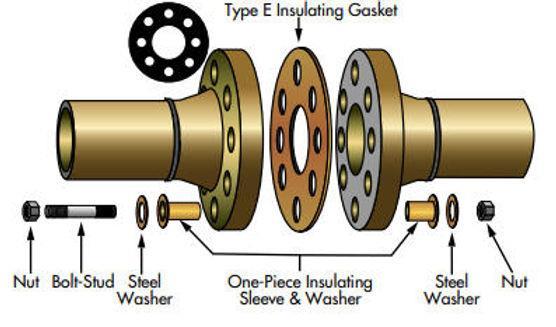
An electrically insulated flange joint consists of several interconnected components, including flanges, bolts, insulating gaskets, insulating sleeves, insulating washers, andmetallicwashers.Theoverallperformanceofthejoint depends on how these components interact under mechanicalloading.
The insulating sleeve is a key element within this assembly, contributing to both electrical isolation and mechanicalbehavior.Itsprimaryfunctionsinclude:
Preventing electrical contact between the bolt shankandtheflangebore
Enabling the transmission of compressive forces through adjacent components within the bolted jointassembly
Duringinstallationandservice,thesleeveissubjectedtoa combinationofcompressive,tensile,andbendingstresses. Since it is typically made from epoxy-based composite material, which exhibits brittle characteristics and relativelylowtensilestrength,itisparticularly vulnerable to stress concentrations and uneven loading. Consequently, the performance of the sleeve is highly dependent on proper load distribution and geometric alignmentwithinthejoint.
Duringtheassemblyofinsulatedflangejointsinanoiland gas pipeline application, repeated failures of epoxy insulating sleeves were observed. These failures occurred despite following recommended assembly procedures, including controlled torque application and cross-pattern tighteningtoachieveuniformpreload.
Thefollowingkeyobservationswerenoted:
Cracking of insulating sleeves during bolt tightening
Failure occurring before reaching the specified designtorque
Consistent recurrence of failure across multiple assemblies
Thesepatternssuggestthattheissueisnotduetorandom defects or improper procedures, but rather indicates a systematic problem related to joint design, geometry, or loadtransferbehavior.
Existing research on bolted flange joints has primarily focused on aspects such as gasket sealing efficiency, preload distribution, and stress behavior in metallic components.Whilethesestudiesprovidevaluableinsights intojointperformance,theyoftenoverlookthemechanical responseofnon-metallicinsulatingelements. Specifically:
The internal stress distribution within insulating sleeveshasnotbeenextensivelystudied
The impact of dimensional inconsistencies between washers and sleeves remains underexplored
The influence of load path deviations on brittle insulatingmaterialsisnotwellunderstood
This highlights a significant gap in current research, particularly in applications where insulating components playacriticalfunctionalrole.
The main objective of this study is to investigate the failure mechanism of epoxy insulating sleeves in electrically insulated flange joints and to develop a clear understanding of the factors contributing to their prematurecracking.
Thespecificobjectivesare:
To determine the root cause of sleeve failure duringtorque-controlledassembly
To develop an analytical explanation based on loadtransferandstressdistribution
Toassessthe effectofgeometriccompatibilityon jointperformance
To propose and validate design improvements thatensureuniformloaddistributionandprevent failure
2. Literature Review:
Bolted flange joints have been extensively researched due to their critical function in maintaining both structural integrity and leak-tight performance in pressurecontaining systems. The behaviour of these joints is primarily governed by the relationship between applied torque, resulting bolt preload, and the distribution of contactstressesacrosstheinterface.Earlycontributionsby J. H.Bickfordlaidthe foundationforunderstandingbolted
International Research Journal of Engineering and Technology (IRJET) e-ISSN: 2395-0056
Volume: 13 Issue: 04 | Apr 2026 www.irjet.net p-ISSN: 2395-0072
joint mechanics, highlighting that achieving adequate preload and maintaining its uniform distribution are essentialforreliablejointperformance.
Further studies have explored the influence of geometric parameters on the mechanical response of flange joints. Research by M. Koch, S. Böhm, and F. Klein demonstrated that even small deviations in geometry can significantly alter stress distribution patterns and increase fatigue loading in bolts. These findings emphasize that bolted assemblies are highly sensitive to dimensional variations, making precise component compatibility crucial for optimalperformance.
Finite Element Analysis (FEA) has been widely adoptedto studystressbehaviourinboltedflangejointsundervarious loading conditions. Investigations by H. Fukuoka and T. Nomura showed that flange rotation and non-uniform contactconditionscangenerateunevenstressfieldswithin thejoint.Similarly,M.DaidieandJ.Bouchardreportedthat assembly-related factors, such as misalignment and inconsistent tightening, can lead to unequal preload distributionamongbolts.Suchirregularitiesoftenresultin localizedstressconcentrations,whichmayinitiatedamage orfailure.
Thesealingbehaviourofflangejointsandtheperformance of gasket materials have also received considerable attention. Studies by K. Sawa and T. Hirose, along with S. Abid and M. Khan, highlighted that maintaining consistent contactpressureacrosstheflangeinterfaceisessentialfor ensuringbothsealingeffectivenessandstructuralstability. Variations in contact conditions or stiffness can create localizedregionsofhighstress,increasingthelikelihoodof leakageorcomponentfailure.
Materialcharacteristicsplayavitalroleindeterminingthe failure response of joint components, particularly when non-metallic materials are involved. The principles of contact mechanics, as described by K. L. Johnson, explain howstresslevelscanincreasesignificantlywhenloadsare transmittedthroughreducedorunevencontactareas.This phenomenonisespeciallycriticalforbrittlematerialssuch asepoxycomposites,whichexhibitlimitedtensilestrength and are highly susceptible to cracking under bending or tensilestresses.
Research on composite and non-metallic bolted joints furtherreinforcestheimportanceofuniformloadtransfer. Work by C. McCarthy, M. McCarthy, P. Camanho, and C. Davila showed that non-uniform load distribution in compositejointsleadstostressconcentrations,particularly near edges and discontinuities, ultimately resulting in prematurefailure.Theseobservationsaredirectlyrelevant to insulating sleeves, which share similar mechanical characteristicsduetotheircompositenature.
Additional investigations have examined the effects of design parameters such as gasket thickness, stiffness variation,andthermalloading.StudiesbyR.C.SinghandP. K. Jain demonstrated that geometric changes can significantly influence internal stress distribution, while Y. Zhang and X. Liu highlighted that temperature variations can alter load paths and redistribute stresses within the joint. Together, these findings indicate that both design features and operating conditions must be carefully consideredtoensurereliablejointperformance.
Despite the substantial body of research on bolted flange assemblies, most existing work concentrates on metallic components, gasket behaviour, and overall sealing performance. In contrast, the mechanical behaviour of insulating elements, such as epoxy sleeves, has received comparatively limited attention, particularly under assembly-induced loading conditions. Furthermore, the effectofdimensionalincompatibilitybetweenwashersand sleeves on stress distribution has not been thoroughly investigated.
Accordingly, the present study addresses this gap by examining how washer–sleeve geometric mismatch influences load transfer mechanisms and stress concentration within the joint. Through a combination of analytical modelling and a practical case study, this work aims to provide a clearer understanding of failure mechanisms in insulated flange joints and to propose design improvements that enhance their reliability and performance.
A detailed case study was carried out on an electrically insulated flange joint used in an oil and gas pipeline system,whererepeatedfailuresofepoxyinsulatingsleeves were observed during assembly. The purpose of this investigation was to systematically document the joint configuration, assembly conditions, and failure characteristics in order to determine the root cause of the observeddamage.
Theflangeassemblyconsistedofstandardpipelineflanges connected using M20 bolts. A complete insulation kit was installed within the joint, comprising an epoxy-based insulatingsleeve,insulatingwashers,metallicwashers,and an insulating gasket. Stainless steel bolts were used, and tightening was performed using a calibrated torque wrench.Across-patterntighteningsequencewasfollowed toensureuniformpreloaddistribution,inaccordancewith standardassemblypractices.
ThespecifiedtorquerangefortheM20boltswas250–300 Nm. However, despite strict compliance with the recommended torque values and tightening procedure, consistent cracking of the epoxy insulating sleeves was observed during assembly. Notably, the failure occurred
International Research Journal of Engineering and Technology (IRJET) e-ISSN: 2395-0056
Volume: 13 Issue: 04 | Apr 2026 www.irjet.net p-ISSN: 2395-0072
before reaching the upper limit of the specified torque, indicating that excessive tightening was not the primary cause.
A detailed examination of the failed sleeves revealed that cracks were predominantly located near the neck region. The fracture surfaces exhibited characteristics typical of brittle failure, suggesting that the epoxy material experienced stress levels beyond its tensile or flexural capacityduringinstallation.
To further investigate the issue, dimensional measurements of the assembly components were conducted. The analysis revealed a mismatch between the outer diameter of the metallic washer and that of the insulating sleeve, with the washer having a smaller outer diameter. This discrepancy resulted in incomplete contact between the washer and the sleeve, causing uneven load transferandlocalizedstressconcentration.
The observations from this case study demonstrate that the failure was consistent and repeatable under the given assembly conditions. Based on these findings, it can be inferred that the root cause is associated with geometric incompatibility and non-uniform load distribution within the joint, rather than material defects or improper assemblyprocedures.
The present study adopts a systematic and multi-stage methodology to investigate the failure of epoxy insulating sleevesinelectricallyinsulatedflangejoints.Theapproach combines field observations, dimensional verification, analytical modelling, and design validation to develop a comprehensive understanding of the failure mechanism anditsunderlyingcauses.
Theinvestigationbeganwithadetailedvisualexamination offailedinsulatingsleevescollectedfromtheassemblysite. The objective was to determine the nature, location, and pattern of failure, and to identify any recurring characteristics.
Thefollowingstepswereundertaken:
Visualinspectionofcrackedsleeves
Identification of crack initiation and propagation regions
Documentationoffracturecharacteristics
Photographicrecordingforfurtheranalysis
Theinspectionrevealedthatcracksconsistentlyoriginated neartheneckregionofthesleeve.Theuniformityinfailure location indicated the presence of localized stress concentrationratherthanrandommaterialdefects.
To assess possible geometric incompatibilities, all critical components of the insulation assembly were measured using precision instruments such as vernier callipers and micrometres.
Theparametersevaluatedincluded:
Outerdiameter(OD)oftheepoxyinsulatingsleeve
Innerdiameter(ID)ofthesleeve
Innerandouterdiametersofthemetallicwasher
Thicknessofwashers
Diameteroftheflangebolthole
The measurements revealed a significant mismatch betweentheouterdiameterofthemetallicwasherandthe insulating sleeve. Specifically, the washer outer diameter wassmallerthanthatofthesleeve,resultinginincomplete contactandanunevenloadtransferinterface.
The assembly procedure was reviewed in detail to verify whether the observed failures could be attributed to installationerrorsorproceduralinconsistencies. Thefollowingconditionswereconfirmed:
Useofacalibratedtorquewrench
Torqueappliedwithinthespecifiedrangeof250–300Nm
Adoptionofacross(star)tighteningsequence
Properlubricationofboltthreads
Since all assembly practices adhered to standard guidelines, the possibility of human error or improper tighteningwaseffectivelyruledout.
4.4
A qualitative load path analysis was conducted to understandhowboltpreloadwastransmittedthroughthe jointcomponentsunderbothidealandactualconditions.
Ideal Condition:
Load is transferred uniformly from the bolt head → metallic washer → insulating washer → flange surface
Actual Condition:
Due to the smaller outer diameter of the metallic washer, a portion of the load was transferred directlytotheedgeoftheinsulatingsleeve
International Research Journal of Engineering and Technology (IRJET) e-ISSN: 2395-0056
Volume: 13 Issue: 04 | Apr 2026 www.irjet.net p-ISSN: 2395-0072
Thisdeviationinloadtransferresultedin:
Reductionineffectivecontactarea
Developmentoflocalizedcompressivestresses
Induction of bending stresses within the sleeve, particularlyneartheneckregion
4.5 Analytical Stress Modelling
Toquantifythestressesactingontheinsulatingsleeve,an analyticalapproachwasadopted.
Step 1: Bolt Preload Estimation
The preload generated in the bolt was estimated using standard torque–preload relationships, considering frictionaleffectsandtighteningconditions.
Step 2: Contact Stress Evaluation
Contact stresses were calculated based on the reduced load-bearing area caused by the washer–sleeve mismatch. Thisreductionsignificantlyincreasedlocalizedpressure.
Step 3: Bending Stress Estimation
Due to eccentric load transfer, bending stresses were evaluated at the sleeve neck, where failure was consistentlyobserved.
Step 4: Combined Stress Assessment
The combined effect of compressive and bending stresses wasassessedandcomparedwiththeallowablestrengthof theepoxymaterial.
The analysis demonstrated that the resulting stress levels exceededthematerial’spermissiblelimits,leadingtocrack initiationandpropagation.
4.6 Root Cause Identification
Based on the combined findings from inspection, measurement, and analytical evaluation, the root cause of failurewasidentifiedas:
Dimensional incompatibility between the metallic washerandinsulatingsleeve
Resulting in non-uniform load transfer and localizedstressconcentration
This confirmed that the failure mechanism was designrelatedratherthanmaterial-orprocess-induced.
To validate the identified root cause, a series of design modifications were implemented and tested under the sameassemblyconditions.
Modification 1: Increase in Washer Outer Diameter
Change: Use of a metallic washer with an outer diameterequaltoorgreaterthanthesleeveouter diameter
Issue Addressed: Reduced contact area and localizedcompressivestress
Outcome:
o Uniformloaddistributionachieved
o Nocrackingobserved
Modification 2: Alignment of Washer Inner Diameter
Change: Use of a washer with an inner diameter closelymatchingthesleeveinnerdiameter
Issue Addressed: Misalignment between washer andsleeveleadingtoeccentricloading
Outcome:
o Improvedconcentricloadtransfer
o Eliminationofunevenstressdistribution
o Nofailureobserved
Modification 3: Geometric Compatibility with Flange Hole
Change: Ensuring proper matching between the flangeholeradiusandthesleeveneckradius
Issue Addressed: Excessive clearance and improperseatingofthesleevewithintheflange
Outcome:
o Improvedfitandalignment
o Reduction in unintended movement and stressconcentration
o Nocrackingobserved
The successful elimination of failure after implementing these modifications confirms that the issue was primarily due to geometric incompatibility and improper load distribution.Thestudydemonstratesthatrelativelysimple design corrections can significantly enhance the reliability ofinsulatedflangejointassemblies.
International Research Journal of Engineering and Technology (IRJET) e-ISSN: 2395-0056
Volume: 13 Issue: 04 | Apr 2026 www.irjet.net p-ISSN: 2395-0072
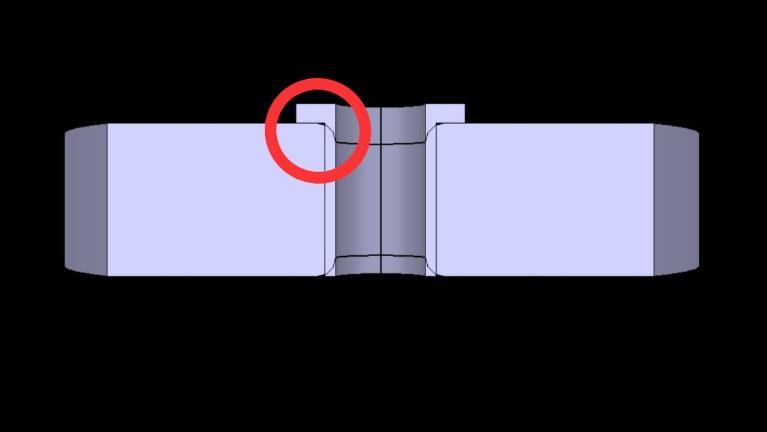
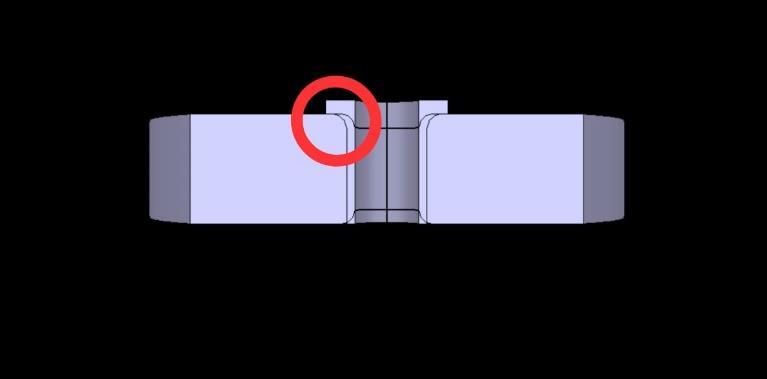
Following the identification of the root cause and implementation of the corrective design specifically, increasing the outer diameter of the metallic washer to match or exceed that of the insulating sleeve a series of validation trials were conducted. The purpose of these trials was to evaluate the effectiveness of the proposed modification under practical assembly and service conditions.
The flange joint was reassembled using the modified washer configuration while keeping all other parameters unchanged. Tightening was performed using a calibrated torque wrench in a controlled, multi-stage cross-pattern sequencetoensureuniformpreloaddistribution.
The assembly was successfully tightened up to 400 Nm, exceeding the original specified torque rangeof250–300Nm.
No visible cracking or damage to the epoxy insulating sleeves was observed during or after tightening.
The sleeves maintained structural integrity throughout the process, demonstrating improved resistancetoassembly-inducedstresses. These results indicate that the modified configuration can safelywithstandhigherpreloadlevelswithoutfailure.
To assess the performance of the modified joint under operating conditions, a hydrostatic pressure test was conductedafterassembly.
Thejointwaspressurizedasperstandardpipeline testingrequirements.
No leakage, pressure drop, or instability was observedduringthetest.
The insulating components remained intact, confirming that the design modification did not compromisesealingperformance.
This verifies that the joint maintains both mechanical integrityandleak-tightnessunderpressure.
A detailed post-assembly inspection was carried out to evaluate load distribution and seating conditions of the jointcomponents.
Uniform contact was observed between the metallic washer, insulating washer, and flange surface.
Noevidenceoflocalizedindentation,edgeloading, orunevencontactwasfound.
Theepoxysleevewasproperlysupportedalongits circumference, indicating effective and balanced loadtransfer.
These findings confirm that the revised design eliminates stressconcentrationcausedbyimpropercontact.
To ensure the robustness of the proposed solution, multiple assembly trials were performed under identical conditions.
No cracking or damage to the insulating sleeves wasobservedacrossrepeatedtrials.
The joint exhibited stable and consistent behaviourinallcases.
The performance remained predictable and reliableunderrepeatedassemblyconditions.
This demonstrates the repeatability and practical applicabilityofthedesignimprovement.
The validation results clearly demonstrate that correcting the washer geometry effectively eliminates the stress concentrationresponsibleforsleevefailure.Theimproved design ensures uniform load distribution, enhances assembly reliability, and maintains both mechanical strength and sealing performance under operational conditions.
Overall, the study highlights the importance of geometric compatibility in bolted assemblies incorporating brittle insulating materials and confirms that appropriate design modificationscansignificantlyimprovesystemreliability.
Volume: 13 Issue: 04 | Apr 2026 www.irjet.net p-ISSN: 2395-0072
The results obtained from this investigation provide a clear and consistent understanding of the failure mechanism associated with epoxy insulating sleeves in electrically insulated flange joints. The analysis confirms that the observed failures were not caused by material deficiencies or improper assembly practices, but were primarily driven by an inherent issue in load transfer arising from geometric incompatibility within the joint components.
Dimensional evaluation revealed that the outer diameter of the metallic washer was smaller than that of the insulating sleeve. This mismatch significantly reduced the effective contact area available for load transfer during bolttightening.Fromthestandpointofcontactmechanics, a reduction in contact area leads to a corresponding increase in localized stress, which was further substantiatedthroughanalyticalcalculationsperformedin thisstudy.
Theloadpathassessmentprovidedadditionalinsightinto the failure mechanism. Under ideal conditions, bolt preload is expected to be transferred uniformly through the metallic washer and insulating washer to the flange surface. However, due to the dimensional mismatch, part oftheappliedloadwasdivertedtowardtheouter edgeof the epoxy sleeve. This resulted in the development of localized compressive stresses at the contact interface, along with bending stresses induced at the sleeve neck regionduetoeccentricloadingconditions.
Given the brittle nature of epoxy materials and their relatively low tolerance to tensile and bending stresses, this combined stress state exceeded the material’s allowablelimits.Consequently,crackinitiationoccurredat the most critical region, which aligns with the failure patternsobservedduringinspection.
Theoutcomesofthevalidationtrialsstronglysupportthis interpretation. After modifying the washer geometry to ensure full and uniform contact with the sleeve, the load transfer became more evenly distributed. This eliminated stress concentration zones and prevented the development of excessive localized stresses. The absence of cracking, even under higher-than-design torque levels, clearly demonstrates that the root cause of failure was related to design and geometry rather than operational conditions.
Overall, the findings of this study emphasize the critical importance of geometric compatibility and proper load pathdesigninboltedassemblies,particularlywhenbrittle, non-metallic components are involved. The results also highlight that even relatively small dimensional inconsistencies can significantly alter stress distribution andleadtoprematurefailureifnotproperlyaddressed.
This study presented a comprehensive failure analysis of epoxy insulating sleeves used in electrically insulated flangejointsundertorque-controlledassemblyconditions in an oil and gas pipeline application. The investigation established that the recurring sleeve failures were not attributed to material defects or improper assembly procedures, but were primarily caused by geometric incompatibilitywithintheinsulationkitcomponents.
Detailed analysisrevealedthatthemismatchbetween the outer diameter of the metallic washer and the insulating sleeve resulted in an uneven load transfer mechanism. Thisgeometricinconsistencyreducedtheeffectivecontact areaandledtosignificantstressconcentrationduringbolt tightening. Analytical modelling further showed that, in addition to elevated contact stresses, eccentric load transfer introduced bending stresses at the sleeve neck region. Due to the brittle nature and limited tensile capacity of epoxy materials, the combined stress state exceeded allowable limits, leading to crack initiation and propagation.
The proposed design modification ensuring that the metallicwasherouterdiameterisequaltoorgreaterthan that of the insulating sleeve successfully restored uniform load distribution across the joint interface. Validationtrialsconfirmedthatthemodifiedconfiguration eliminated sleeve cracking, even under torque levels exceeding the original design range. This clearly demonstratesthatthefailurewasdesign-inducedandcan be effectively mitigated through appropriate geometric correction.
Overall, the study highlights the critical importance of dimensional compatibility and load path alignment in bolted assemblies incorporating brittle, non-metallic components. It emphasizes that even minor geometric deviations can significantly influence stress distribution and lead to premature failure. The findings provide practical design recommendations for insulation kits and contribute to improving the reliability, safety, and longterm performance of electrically insulated flange joints in pipelinesystems.
1. “Influence of Geometric Imperfections of Flange Joints on the Fatigue Load of Preloaded Bolts” –M.Koch,S.Bohm,F.Klein
2. 3. “Finite Element Analysis of Bolted Flanged Joints SubjectedtoExternalLoads”– H. Fukuoka, T. Nomura
International Research Journal of Engineering and Technology (IRJET) e-ISSN: 2395-0056
Volume: 13 Issue: 04 | Apr 2026 www.irjet.net p-ISSN: 2395-0072
4. “A Study on the Sealing Performance of Bolted FlangeJoints”–K.Sawa,T.Hirose
5. “InvestigationofSealingPerformancewith Bolted FlangeJoints”–S.Abid,M.Khan
6. “Study of Behaviour of Bolted Flanges with Gaskets”–A.Bickford
7. “Analysis of Bolted Flanged Panel Joint for GRP SectionalTanks”–A.Shariati,M.R.Ramesh
8. “Effect of Gasket Thickness on Stress Distribution inFlangeJoint”–R.C.Singh,P.K.Jain
9. “Performance Analysis of Flange Bolt Joint under TemperatureField”–Y.Zhang,X.Liu
10. “Efficient Assembly of Bolted Joints Using Finite ElementMethod”–M.Daidie,J.Bouchard
11. “Reduced Order Modelling of Bolt Loosening in BoltedJoints”–M.Jiang,Y.Wang