
International Research Journal of Engineering and Technology (IRJET) e-ISSN: 2395-0056
Volume: 13 Issue: 03 | Mar 2026 www.irjet.net p-ISSN: 2395-0072

International Research Journal of Engineering and Technology (IRJET) e-ISSN: 2395-0056
Volume: 13 Issue: 03 | Mar 2026 www.irjet.net p-ISSN: 2395-0072
Prof. T. Vinay Simha Reddy¹, C. Jaya Simha², D. Thanmayee³, Ramya Sri⁴, G.Krishna Vamsi Reddy⁵
¹Assistant Professor, Department of Artificial Intelligence and Machine Learning, Malla Reddy University, Maisammaguda, Hyderabad, India
²³´µ Students, Department of Artificial Intelligence and Machine Learning, Malla Reddy University, Maisammaguda, Hyderabad, India
Abstract - Facial recognition technology has become one of the most important applications of artificial intelligence and computer vision in modern digital systems. Traditional identification methods such as ID cards and passwords suffer from issues like duplication, security risks, and inefficiency. To overcome these limitations,thispaperpresentsFaceMapAI,anintelligent systemthatperformsreal-timefacerecognitionandfacial landmark detection using deep learning techniques.The system utilizes a deep convolutional neural network (CNN)integratedwithanadaptiveattentionmechanismto improveaccuracyandrobustness.Itcapturesfacialimages throughacamera,preprocessesthem,andextractsunique facial features for recognition. The system also detects facial landmarks such as eyes, nose, and mouth, enabling applications like drowsiness detection and identity verification.
Key words: Face Recognition, CNN, Facial Landmark Detection, Artificial Intelligence, Computer Vision, Drowsiness Detection
Inthemoderndigitalera,identityverificationhasbecome essentialacrossorganizationsandinstitutions.Traditional systems based on passwords or ID cards are prone to errors, security breaches, and inefficiency. Facial recognition provides a contactless and secure solution by usinguniquebiologicalfeatures.FaceMapAIisdesignedto automatically detect and recognize human faces using artificialintelligence.Thesystemanalyzesfacialstructures suchasthedistancebetweeneyes,noseshape,andjawline to create a unique identity representation. It improves accuracyevenundervaryinglightingconditionsandfacial expressions.This system is useful in applications like automated attendance, security access control, and surveillance.
Faciallandmarkdetectionidentifieskeypointsontheface suchaseyes,nose,andmouth.These landmarks help in understandingfacialstructureandareusedinrecognition,
expression analysis, and drowsiness detection.Typically, models detect 68, 81, or even more landmark points depending on the dataset and application.The main objective of facial landmark detection is to accurately localize these points under various real-world conditions, including changes in facial expressions, head pose, lighting,andocclusions.
Traditional methodslike ASMand AAMhadlimitations in real-world scenarios. Deep learning models such as CNN overcome these limitations by automatically learning featuresfromdataandimprovingdetectionaccuracy.Deep learning has significantly improved the accuracy and robustness of facial landmark detection systems. Unlike traditional methods that rely on handcrafted features, deep learning models automatically learn hierarchical featurerepresentationsfromrawimagedata.Thisenables betterperformanceincomplexreal-worldconditionssuch asocclusion,posevariation,andilluminationchanges.
Recent advancements in computer vision and artificial intelligence have significantly improved facial recognition and drowsiness detection systems. Various researchers haveproposed methods using machinelearning and deep learning techniques to enhance accuracy and real-time performance.TraditionalapproachessuchasActiveShape Models(ASM)andActiveAppearanceModels(AAM)were widelyusedforfaciallandmarkdetection.However,these methods depend on handcrafted features and often fail under varying lighting conditions, occlusions, and head movements. With the evolution of deep learning, ConvolutionalNeuralNetworks(CNNs)haveemergedasa powerful tool for facial landmark detection. Unlike traditional methods, automatically learn relevant features from large datasets, improving robustness and accuracy. These models are capable of handling variations in facial expressions, pose,andillumination,makingthem suitable forreal-worldapplications. Sawantetal.(2025)proposed a real-time driver drowsiness detection system based on eye-blink patterns. Their method utilized facial landmark
International Research Journal of Engineering and Technology (IRJET) e-ISSN: 2395-0056
Volume: 13 Issue: 03 | Mar 2026 www.irjet.net p-ISSN: 2395-0072
detection to compute the Eye Aspect Ratio (EAR) for identifyingfatigue.Thesystemshowedgoodperformance under normal conditions but struggled in low-light environmentsandwhenfacialocclusionsoccurred.
FaceMapAI–ADeepConvolutionalNeuralNetworkwith Adaptive Attention for Robust Real-Time Face Landmark Detection,isdesignedtoprovideanaccurateandefficient solution for real-time facial landmark detection and drowsiness monitoring. The system leverages advanced deep learning techniques combined with adaptive attention mechanisms to overcome the limitations of traditionalandexistingmethods.Thecoreoftheproposed system is a Convolutional Neural Network (CNN) that automaticallyextractsfacialfeaturesfrominputimagesor livevideostreams.Unliketraditionalapproachesthatrely on handcrafted features, the CNN learns meaningful representations directly from data, improving robustness againstvariationsinlightingconditions,facialexpressions, head poses, and occlusions To further enhance performance, an adaptive attention mechanism is integrated into the CNN architecture. This mechanism enables the model to dynamically focus on critical facial regions such as the eyes, nose, and mouth while ignoring irrelevantbackgroundinformation.Asaresult,thesystem achieves higher accuracy in detecting facial landmarks even in challenging real-world scenario. The system processes real-time video input through a camera, where each frame is analyzed to detect the face and extract landmark points. These landmarks are then used to compute important parameters such as the Eye Aspect Ratio (EAR), which helps in identifying eye closure and detecting drowsiness. When the EAR value falls below a predefined threshold for a certain duration, the system identifiestheuserasdrowsyandtriggersanalert.
Table -1: FacialLandmarkDetectionAccuracy
Table -2: DrowsinessDetectionPerformanc
The Face Map AI system focuses on detecting facial featuresandidentifyingfaciallandmarksinrealtimeusing deep learning techniques. The system utilizes a deep convolutional neural network integrated with adaptive attention mechanisms to accurately detect facial landmarksunderdifferentconditionssuchasvariationsin lighting, pose, and facial expressions. The methodology is designed to ensure reliable detection while maintaining efficient performance for real-time applications.The integration of deep learning models, image processing techniques, and adaptive attention mechanisms enables the Face Map AI system to achieve accurate and robust faciallandmarkdetectioninreal-timeenvironments.
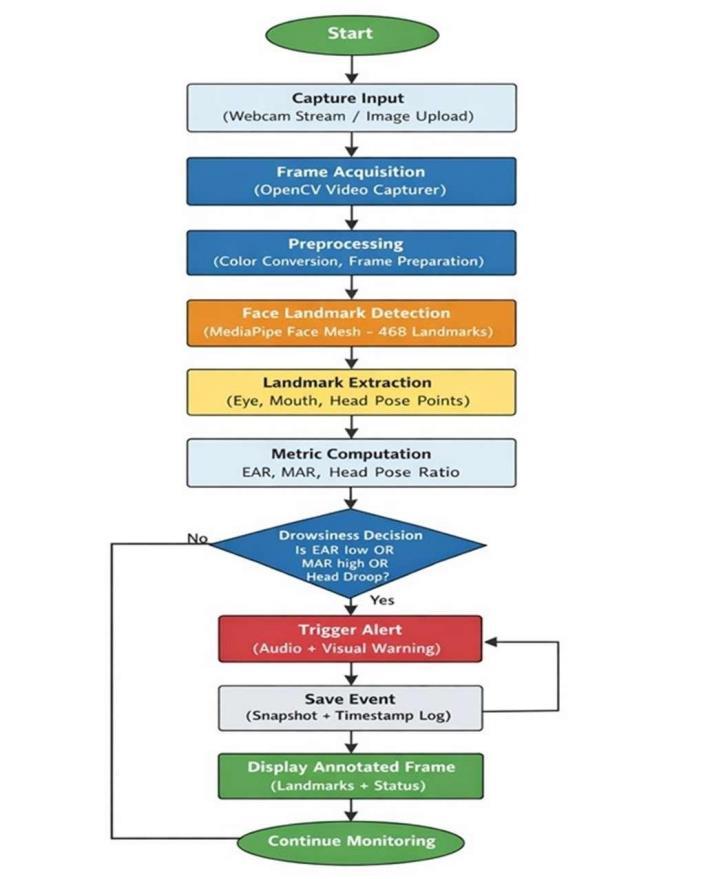
Fig -1 : Flowchart of the Face Map Ai Driver Drowsiness DetectionSystem
International Research Journal of Engineering and Technology (IRJET) e-ISSN: 2395-0056
Volume: 13 Issue: 03 | Mar 2026 www.irjet.net p-ISSN: 2395-0072
For identification and analysis, the system compares the detected facial features with previously learned patterns stored in the trained model. The model evaluates the similarity between the detected features and known patterns to determine the identity or structural characteristics of the face. If a match is found, the system provides the corresponding identification result. If no matchisidentified,thesystemconsidersthefaceasanew or unknown instance. The final output is displayed through a user interface where the detected facial landmarksandrecognitionresultsareshowninrealtime. This interface allows users to observe the detection processandinteractwiththesystemeffectively.
The Face Map AI system follows a modular architecture that divides the system into different functional layers. This layered design enhances maintainability and allows developers to modify individual components without impacting the entire system. The architecture consists of three main layers: the presentation layer, the application processinglayer,andthedatabaselayer. Thepresentation layer provides the graphical user interface through which users interact with the system. This layer enables administratorstoregisterusers,capturefacialimages,and monitorrecognitionresultsinrealtime.
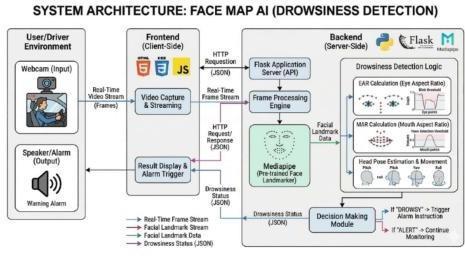
The application layer performs the main processing tasks ofthesystem.Itincludesfacedetectionalgorithms,feature extraction models, recognition mechanisms. Machine learningmodelsprocessthecapturedimagesandcompare themwithstoredfacialdatatoidentifyoranalyzetheface. The database layer is responsible for managing the structuredstorageofsysteminformation.Itstoresalluser profiles, facial image datasets, and recognition records to ensure organized data management. The system continuously updates the database with newly captured samples to improve recognition accuracy over time. Efficient indexing and retrieval mechanisms enable quick access to stored facial features during the comparison process. This structured data management also supports
system scalability, allowing the application to handle multipleusersandlargedatasetseffectively.
The Face Map AI system was tested using a dataset containing facial images collected from registered users. The evaluation focused on measuring the system’s ability to correctly detect and recognize faces under different environmental conditions. Performance evaluation metrics such as precision, recall, and F1-score were used toassesstheeffectivenessoftherecognitionmodel.These metrics provide insights into how accurately the system identifies valid faces and avoids incorrect matches. The experimental results showed that the system achieved high precision values, indicating that most recognized identities were correct. The recall values were also high, demonstrating that the system successfully detected the majorityoffacespresentin thetestdataset. Thebalanced F1-score confirmed that the system maintained reliable performance across different evaluation scenarios. Overall,theresultsindicatethatFaceMapAIiscapableof performing real-time face recognition with high accuracy andminimalprocessingdelay


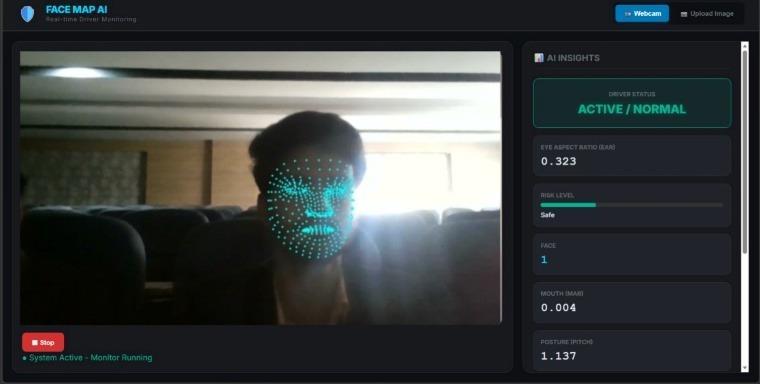

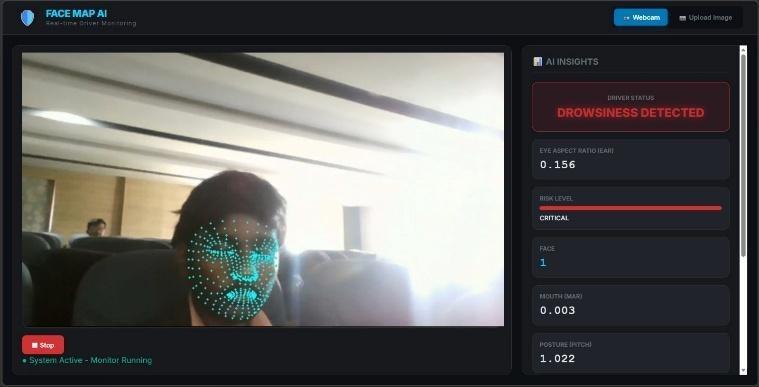
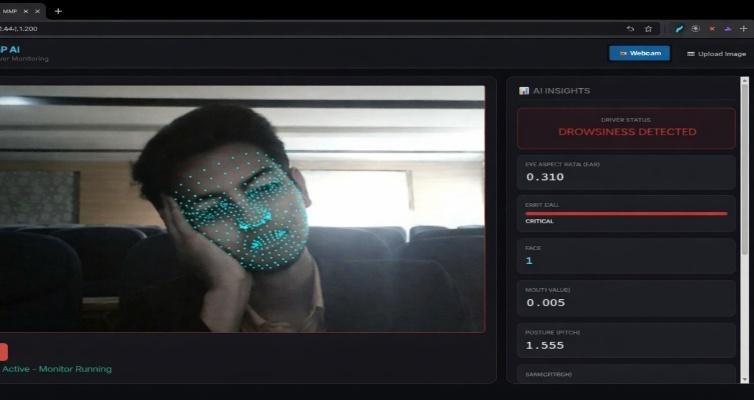
The Face Map AI project demonstrates the potential of artificial intelligence and computer vision technologies in developing intelligent identity verification systems. By combining facial recognition algorithms with structured data management, the system provides a reliable and efficientsolutionforautomatedidentification. Thesystem effectively replaces traditional manual verification methods with a modern biometric authentication mechanism. The use of machine learning models enables accurate recognition of individuals even under varying environmentalconditions.Performanceevaluationresults confirm that the system achieves high accuracy and reliability in facial recognition tasks. The modular architecture and scalable design allow the system to be deployedinenvironmentssuchaseducationalinstitutions, workplaces, and security systems. Future enhancements may include integration with mobile applications, the use ofadvanceddeeplearning models for improved accuracy, and cloud-based storage systems for large-scale deployment. Overall, Face Map AI represents an innovative approach to biometric authentication and intelligent identity management in modern digital systems.
We would like to express our sincere gratitude to our faculty and mentors for their valuable guidance and support throughout this project. We are thankful to Malla Reddy University for providing the necessary resources and environment to carry out our research successfully. We also extend our appreciation to our colleagues and friends who encouraged us and offered constructive suggestionsduringthedevelopmentofFaceMapAI.
International Research Journal of Engineering and Technology (IRJET) e-ISSN: 2395-0056
Volume: 13 Issue: 03 | Mar 2026 www.irjet.net p-ISSN: 2395-0072
[1]V.Sawant,S.Patil,andR.Kulkarni,“Real-TimeDriver Drowsiness Detection System,” International Journal of AdvancedResearchinComputerScience,2025
[2]S. Baul and A. Singh, “Driver Drowsiness Detection Using MediaPipe,” International Journal of Computer Applications,2025.
[3]Y. Essahraoui, R. Khrouf, and F. Khaloufi, “Real-Time DrowsinessDetectionUsingEyeandMouthLandmarks,” IEEEAccess,2025.
[4]R. Hussein, M. Alrashidi, and H. Alharthi, “Facial Landmark-Based Drowsiness Detection,” Journal of ArtificialIntelligenceResearch,2025.
[5]J. Redmon and A. Farhadi, “YOLOv3: An Incremental Improvement,”2018.
[6]C. Lugaresi, et al., “MediaPipe: A Framework for Building Perception Pipelines,” arXiv preprint arXiv:1906.08172,2019.