

International Research Journal of Engineering and Technology (IRJET) e-ISSN: 2395-0056
Volume: 13 Issue: 03 | Mar 2026 www.irjet.net p-ISSN: 2395-0072
FABRICATION OF HYDRAULICFLOORCRANE
ABISHEK R 1 , AKASH B 2 , ANTONY RAJ 3
1III Year, Dept of Mechanical Engineering, Lakshmi Ammal Polytechnic College, Tamilnadu, India
2III Year, Dept of Mechanical Engineering, Lakshmi Ammal Polytechnic College, Tamilnadu, India
3III Year, Dept of Mechanical Engineering, Lakshmi Ammal Polytechnic College, Tamilnadu, India
4III Year, Dept of Mechanical Engineering, Lakshmi Ammal Polytechnic College, Tamilnadu, India
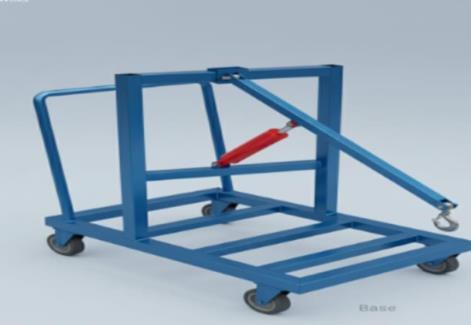
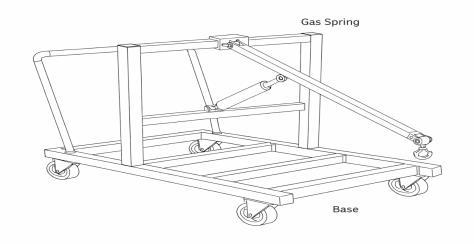
Abstract: A hydraulicfloorcrane is a mechanical lifting device used to lift and move heavy loads in workshops, garages, and industrial environments. The primary objective of this project is to design and fabricate a portable and efficient crane utilising a hydraulic jack system. The crane works on the principle of Pascal’s law, where pressure applied to a confined fluid is transmitted equally in all directions, allowing heavy loads to be lifted withminimaleffort.Thefabricatedcraneconsistsofmajor componentssuchasabaseframe,verticalsupportcolumn, boomarm,hydraulicjack,wheels,andliftinghook
Keywords: Hydraulic System, Hydraulic Floor Crane, Pascal’s Law, Material Handling, Hydraulic Jack, Lifting Mechanism, Fabrication, Mechanical Design.
1.
INTRODUCTION
A hydraulic floor crane is a lifting device used in workshops,garages,andindustriestoliftheavyloadssuch as engines, machines, and equipment. It works using a hydraulic jack system, which multiplies force to lift heavy objects with less manual effort. The fabrication of a hydraulic floor crane involves designing and assembling componentssuchasthebaseframe,boom,hydraulicjack, wheels, and lifting hook to create a portable and efficient liftingmachine.
1.1PROBLEM STATEMENT
In many workshops, garages, and small industries, lifting andmovingheavycomponentssuchasengines,machinery parts, and equipment is a difficult and time-consuming task. Manual lifting methods require more human effort andmaycauseworkerfatigue,injuries,andaccidents.
1.2 OBJECTIVES
The main objective of this project is to design and fabricate a hydraulic floor crane that can safely lift and move heavy loads in workshops and industries. Another objective is to create a portable and cost-effective lifting deviceusingahydraulicsystembasedonPascal’slaw.
II. COMPONENTS AND DESCRIPTION
Frame
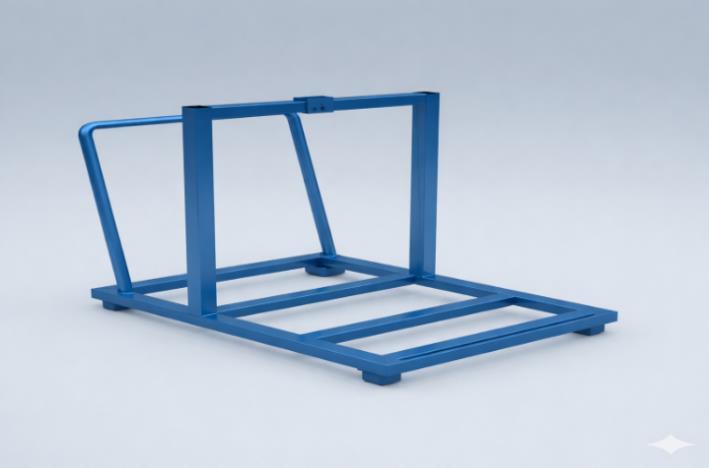
The base frame is the main supporting structure of the hydraulic floor crane. It is usually made of strong mild steel to provide stability and strength. The base supports allothercomponentsofthecraneandhelpsdistributethe loadevenly.Italsoholdsthewheelsthatallowthecraneto moveeasilyonthefloor.
The hydraulic jack is the main lifting mechanism of the crane. It works on the principle of Pascal’s Law. When force is applied to the jack handle, hydraulic pressure is created inside the fluid, which moves the piston and lifts theboomarmalongwiththeload.

Hook
International Research Journal of Engineering and Technology (IRJET) e-ISSN: 2395-0056
Volume: 13 Issue: 03 | Mar 2026 www.irjet.net p-ISSN: 2395-0072
Thehookisanimportantcomponentofthehydraulicfloor craneusedtoholdandlifttheloadsafely.Itisattachedto the end of the boom arm with the help of a chain or shackle.Thehook isusuallymadeof high-strengthforged steel to withstand heavy loads without bending or breaking.

Boom (or) arm
The boom is the main lifting arm of the hydraulic floor craneusedtoraiseandsupporttheload.Itisusuallymade of strong steel or mild steel to handle heavy weights withoutbending.Oneendoftheboomisconnectedtothe vertical support column, while the other end carries the hookandchainusedtoholdtheload.

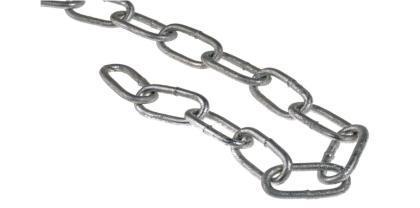
Thechain isanimportantcomponentusedto connect the load to the hook in a hydraulic floor crane. It is typically made of high-strength alloy steel to safely support heavy loads. The chain helps secure the load to the crane and allowsforslightflexibilityduringlifting.
Thenutandboltareimportantfasteningcomponentsused inthefabricationofahydraulicfloorcrane.Theyareused tojoinandsecuredifferent partsof thecrane, suchasthe base frame, boom arm, support column, and other structuralcomponents.Propertighteningofnutsandbolts ensuresthestability,safety,anddurabilityofthehydraulic floorcranestructure.

WORKING PRINCIPLE
The hydraulic floor crane works based on Pascal’s Law, which states that pressure applied to a confined fluid is transmitted equally in all directions. When the operator pumpsthehandleofthehydraulicjack,pressureiscreated in the hydraulic fluid inside the cylinder. This pressure moves the piston upward, which pushes the boom arm of thecrane.
III.ADVANTAGES
The hydraulic floor crane offers several advantages in lifting and handling heavy loads. It requires less manual effortbecausethehydraulicsystemmultipliestheapplied force,makingliftingeasier.Thecraneisportableandeasy
International Research Journal of Engineering and Technology (IRJET) e-ISSN: 2395-0056
Volume: 13 Issue: 03 | Mar 2026 www.irjet.net p-ISSN: 2395-0072
to move due to the wheels attached to the base frame. It provides safeandstablelifting ofheavycomponentssuch asenginesandmachineryparts.
IV. APPLICATIONS
Hydraulic floor cranes are used in automobile workshops to remove and install vehicle engines. They help in lifting and positioning heavy machine parts during industrial maintenance Thesecranes areusedfor materialhandling infactoriesandworkshops. Theyassistinassemblingand disassemblingheavyequipmentinmanufacturingunits.
FUTURE SCOPE
Hydraulic floor cranes can be improved with electric or battery-powered hydraulic systems for easier lifting Future designs may include lightweight high-strength materials to increase portability and durability. The integration of smart sensors and load indicators can enhance safety and prevent overloading. Foldable and compact designs can make cranes easier to store and transport. Hydraulic floor cranes may be integrated with automationandroboticsystemsinmodernindustries.
CONCLUSION
The fabrication of a hydraulic floor crane offers an efficient and economical solution for lifting and handling heavy loads in workshops and industrial settings. It operates on the hydraulic principle, which enables the lifting of heavy objects with less manual effort. The crane is portable, easy to operate, and reliable for various maintenance and assembly tasks. Proper design, quality materials, and safe operation ensure high performance anddurability
REFERCENCES
1. Michael G. Kay, “Material Handling Equipment,” 2012.Okolie Paul Chukwulozie et al., “Steel Work Design and Analysis of a Mobile Floor Crane,” British Journal of Applied Science & Technology,2016.
2. J.O.Oyejideetal., “DesignandFabricatioSingleActing Hydraulic Crane,” IOSR Journal of MechanicalandCivilEngineering,2018.
BIOGRAPHIES



ABISHEKR,IIIrdYear
MechanicalDepartment,Lakshmi Ammal PolytechnicCollege,Kovilpatti.
ABISHEK R, IIIrd Year
Mechanical Department, Lakshmi Ammal PolytechnicCollege,Kovilpatti
ANTONY RAJ P,IIIrd Year
Mechanical Department, Lakshmi Ammal PolytechnicCollege,Kovilpatti.