
International Research Journal of Engineering and Technology (IRJET) e-ISSN: 2395-0056
Volume: 12 Issue: 11 | Nov 2025 www.irjet.net p-ISSN: 2395-0072
Jayvant
1,2,3,4
International Research Journal of Engineering and Technology (IRJET) e-ISSN: 2395-0056
Volume: 12 Issue: 11 | Nov 2025 www.irjet.net p-ISSN: 2395-0072
Jayvant
1,2,3,4
Navnath Mane 1 , Suraj Dagdu Pawar 2 , Vijaykumar Kerba Mane3 , Dipak S. Patil4
Department of Mechanical Engineering G H Raisoni College of Engineering and Management, Wagholi, Pun, India
Abstract - Agricultural productivity in India is limited due to the dependence of small-scale farmers on traditional, laborintensive methods. Modern machinery is often too expensive or too bulky for marginal farmers who own less than one hectare of land. This research focuses on the fabrication of a low-cost mechanical seed planter aimed at improving sowing performance, reducing labor, and ensuring uniform seed placement. The use of locally available materiasls and simple fabrication methods helps reduce the overall cost, making the machine more accessible to small farmers. The design, which integrates a seed hopper, metering mechanism, furrow opener, and covering device, ensures both precision and efficiency in sowing. Field testing is conducted to validate performance parameters such as seed spacing, depth accuracy, and time savings.
Key Words: Seed Planter, Agricultural Mechanization, Seed Sowing machine
1.
The demand for food is expected to exceed production capabilitiesduetotheincreasingpopulationandrisingper capitafoodconsumption.Mereexpansionoffarmlandisnot sufficient;higheryieldsfromtheexistingagriculturalland must be ensured. India has made some progress in this direction, yet many small-scale and low-income farmers continuetorelyonoutdatedandtime-consumingmethods because they cannot afford expensive modern machinery. Thesefarmerstypicallyownlessthan1hectoroflandand dependonmanuallabourorcattleforploughingandsowing. In contrast, farmers in developed countries can cultivate hundreds of acres using advanced machinery. Because farmingislabour-intensiveandplaysavitalroleinnational growth and development, engineers have attempted to reduce human effort by mechanizing farm operations. Researchershaveexploredseveralinnovativeapproaches, including mechanical and solar-powered systems, seedmeteringtechnologies,andAdriano-basedautomatedsensor systems.India,beingpredominantlyanagriculturalnation withnearly75%ofitspopulationdependentonfarming,still practiceslargelyoutdatedtechniques.Poormechanization and low power availability are key reasons for low agriculturalproductivity.Therefore,thereisanurgentneed todevelopefficient,modernmachineryforoperationssuch assowing,spraying,weeding,andsimilartaskstoenhance productivity and support multiple cropping cycles. To achieve this goal, agricultural machines must be properly designed and adapted to suit specific crop requirements.
With India’s large and rapidly growing population, agriculture continues to be crucial for sustainable development.Conventionalmanualpracticesarestillwidely used, but they are time-consuming, costly, and result in significantseedwastage,especiallyonlargerfarms.Hence, thereisanurgentneedformechanizationtoreducelabour involvement, increase productivity, and ensure timely completion of farm operations. This Work addresses the needs of small-scale farmers and focuses on developing a low-cost,automatedmachineforoptimizingploughingand seed-sowingoperations.Althoughitmaynotbeasversatile astractors,itissignificantlymoreaffordableandcansave valuable time, allowing farmers to pursue other incomegenerating activities without compromising agricultural productivity. Several researchers have contributed to the advancement of seed-sowing technologies aimed at improvingefficiency,precision,andproductivity.Manually operatedandautomatedmachines suchasokraplanters, paddy seeders, and jab planters have shown moderate improvementsinfieldcapacity,reducedseeddamage,and lower labour requirements. Innovations such as disc-type and pneumatic seeders have improved user comfort and operationalefficiency,whileroboticsystemsequippedwith sensorsmonitorsoilconditionstooptimizeseedplacement andresourceutilization.Traditionalsowingmethods,such asmanuallydroppingseedsintofurrowscreatedbyploughs, often result in poor control over seed depth, inconsistent spacing,andconsiderableseedwastage.Manyseedsremain uncovered or are lost due to erosion, animals, or weather conditions, leading to low germination rates and overseeding issues, which negatively affect crop yield due to competition for resources. The invention of the seed drill marked a major technological breakthrough by enabling uniformseeddepthandpropersoilcoverage,significantly improving germination and overall yield [1]. Multiple researchers have developed innovative seed-sowing machinestoenhanceplantingefficiency,minimizeseedloss, and reduce labour costs. These include autonomous and manually operated devices, solar-powered systems, and robotscontrolledbymicrocontrollersorsmartphones.Key advancementsincludetheuseofsensors,adjustableseedmetering mechanisms, and integration with fertilizer and pesticidedispensingsystems.Thematerialsusedarecosteffectiveandsuitableforsmall-scalefarming.Overall,these innovationsemphasizeprecisionsowing,affordability,ease ofuse,andadaptabilitytovariousseedtypesandfarming conditions[2].Severalstudiesunderlinetheimportanceof technological innovations in seed-sowing equipment to improveagriculturalproductivity.Researchershighlightthat
International Research Journal of Engineering and Technology (IRJET) e-ISSN: 2395-0056
Volume: 12 Issue: 11 | Nov 2025 www.irjet.net p-ISSN: 2395-0072
advancementsinsowingtechnologysignificantlyinfluence cropcostandyield,stressingtheneedformechanizationto meet future food demands, improve accuracy, and reduce input costs [3]. Proper seed placement and spacing are essentialforachievingoptimalyields.Adoptionofmodern sowing methods enhances crop production without degradingsoilquality.Collectively,thesestudiesemphasize the crucial role of efficient sowing techniques in modern agriculture[4].
Seedsdonotfallattheproperdistanceordepth.
Manyseedsarewastedduetopoorcontrolofseed flow.
Sowing is time-consuming and reduces work efficiency.
The operator becomes tired because of the high physicaleffortrequired.
Themachinecannothandleseedsofdifferentsizes.
It is not suitable for uneven or rough field conditions.
Germinationbecomespoorduetoinadequatesoil–seedcontact.
Farmersexperiencenon-uniformplantgrowthand loweryields.
Tomanufactureaseed-sowingmachinethatcan beoperatedbyasingleoperator.
Todispensefertilizeralongwiththesowedseeds.
Tolevelthegroundtoasmallextent.
Toenablethemachinetosowvarioustypesof seedssuchasmaize,wheat,etc.
Tomaintainauniformdistancebetweentwo seedsduringthesowingprocess.
Literature Review: Studied existing seed-sowing toolstounderstandtheirlimitations.
ProblemIdentification:Identifiedissuesrelatedto unevensowing,highlabourrequirements,andlow efficiency.
Design & Calculations: Prepared design sketches, selected the best concept, and performed basic calculationsforseedspacing,wheelsize,andframe dimensions.
MaterialSelection:Choselow-cost,lightweight,and easily available materials such as mild steel and PVC.
Fabrication:Includedcutting,welding,drilling,and assembling components such as the frame, seed
box, furrow opener, metering mechanism, and wheels.
Testing: Conducted field trials to check seed spacing,sowingdepth,andeaseofoperation.
Modification:Madenecessarychangesbasedontest resultstoimproveperformance.
FinalTesting:Confirmedthatthemodifiedmachine provides uniform sowing with reduced effort and time.
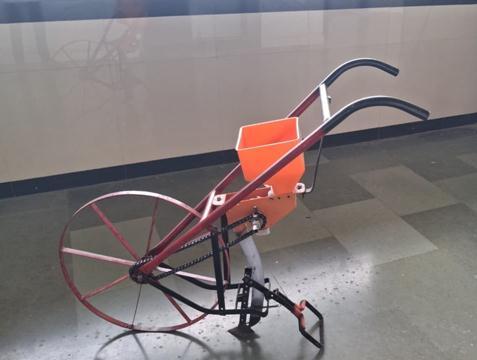
Inourcountry,farmingisstillcarriedoutusingtraditional methods.Meanwhile,therehasbeensignificantdevelopment intheindustrialandservicesectorscomparedtoagriculture. Sprayingistraditionallydonebylabourusingabackpacktype sprayer, which requires considerable human effort. Weeding is generally done with the help of bulls, which becomes costly for farmers with small land holdings. To overcome these problems, we designed equipment that benefitsfarmersbyperformingbothsprayingandweeding operations efficiently. The seed-metering mechanism operates throughthe rotationofthe wheels when pushed manually. It picks seeds from the hopper and drops them throughaseedtubeintothefurrowcreatedbytheopener. Theseedsarethencoveredwithsoilandlightlypressedbya rollerorwheeltoensurepropergermination.Thisseeding technique provides uniform seed spacing, accurate depth placement,andreducedhumanlabour.Figure1showsthe multi-purposeseed-sowingmachine,andTable1presents the comparison between manual, tractor-operated, and multi-purposeseedmachines.
Volume: 12 Issue: 11 | Nov 2025 www.irjet.net
These low-cost mechanical seed planters successfully overcome the drawbacks of traditional sowing methods becausetheyareportable,inexpensive,andhighlyeffective. Theprototypeprovidesproperrowspacing,uniformseed placement,reducedlabor,andthepotentialforhigheryields. In the future, this machine can incorporate fertilizer dispensing, and a solar-powered mechanism will further enhanceitsusabilityandsustainability.
[1] RatneshKumar,AadharGovil,ParthDaga,ShubhGoel, Saurabh Dewangan “Design of automatic seed sowing machine for agriculture sector”, Material Today Proceedings,Volume63,2022,pp(1-6).
[2] Adedeji Kasali A, Lamidi Sheriff B, Oke Elijah S, Abeshindioke Olanrewaju, “Design, Fabrication, and DevelopmentofanAutomatedseedSowingmachine”, International Journal of Research in Engineering and Science,Volume11(1),2023,pp(432-442).
[3] NageshB.Adaline,GaneshP.Ghune,GaneshB.Lavate, Rahul R. Mane, “Desing and Manufacturing of seed Sowing Machine”, International Journal of Advance Research,IdeasandInnovationsinTechnology,Volume 2(2),2017,pp(705-708).
[4] ThoratSwapnilV,MadhuL.Kasturi,PatilGirishV,Patil Rajkumar N, “Design and Fabrication of Seed sowing Machine”,InternationalResearchJournalofEngineering andTechnology,Volume:4(9),2018,pp(704-707)
BIOGRAPHIES

Jayvant Navnath Mane, final year
B.Tech.MechanicalStudentofGH RaisoniCollegeofEngineeringand Management,Wagholi,Pune,India.



Suraj Dagdu Pawar, final year B.Tech.MechanicalStudentofGH RaisoniCollegeofEngineeringand Management,Wagholi,Pune,India.
VijaykumarKerbaMane,finalyear B.Tech.MechanicalStudentofGH RaisoniCollegeofEngineeringand Management,Wagholi,Pune,India.
Dr. Dipak S. Patil, Faculty, Mechanical Department of G H RaisoniCollegeofEngineeringand Management,Wagholi,Pune,India.