
International Research Journal of Engineering and Technology (IRJET) e-ISSN:2395-0056
Volume: 12 Issue: 05 | May 2025 www.irjet.net p-ISSN:2395-0072
International Research Journal of Engineering and Technology (IRJET) e-ISSN:2395-0056
Volume: 12 Issue: 05 | May 2025 www.irjet.net p-ISSN:2395-0072
Battula Balnarsaiah1 , Paduru Bimbasri2 , Paluri Sai Varun Raj3, Nitesh Gaikwad4
1Associate Professor, Dept. Artificial Intelligence and Machine Learning, Nalla Malla Reddy Engineering College, Hyderabad, India
2 Dept. Artificial Intelligence and Machine Learning, Nalla Malla Reddy Engineering College, Hyderabad, India
3 Dept. Artificial Intelligence and Machine Learning, Nalla Malla Reddy Engineering College, Hyderabad, India
4 Assistant Professor, Dept. Electronics and Communication Engineering, Nalla Narsimha Reddy Group Of Institutions, Hyderabad, India
Abstract - Over the last ten years, automated gender identificationusingfacialimageshasemerged asasignificant area of research, demanding effective strategies for both feature extraction and classification. Accurate feature extraction is necessary in traditional machine learning methods,whileConvolutionalNeuralNetworks(CNNs),atype of deep learning model, perform this directly using raw data. CNNs can accommodate variations in facial cues across different races, making them efficient for gender classification. However, the performance of pretrained CNN models is investigated in low-data situations. Methodology involves library imports, data organization, distribution exploration, and image visualization. Then comes label encoding and implementation of various CNN architectures, as well as performance metrics and predictions, 92 % for training 8,643 images and testing 2,882 images, and it requiresonlyfourfolds.Thestudynotablydeviatesfromusing complete face images, focusing on areas with eyebrows aroundoneeyeonlytoidentifythegender.
Key Words: Gender Classification, Convolutional Neural Network,FacialCues
Artificial intelligence has become instrumental in addressing various challenges associated with human recognition. Biometric data such as facial features, fingerprints, voice, and iris patterns are commonly utilized by AI systems. Among these, gender recognition based on facial imageryremainsa complextask,primarilydueto the dynamic nature of human facial characteristics. Variations such as facial hair, aging, and changes in head orientation can significantly affect model accuracy. To address these challenges, researchers have suggested numerous models and methods intended to enhance the reliability and achievinghigh-performanceoutcomes.
DeepLearning(DL)hasreceivedsubstantialattentionforits capabilitiesinautomaticfeatureextraction,objectdetection, and classification tasks. Deep Convolutional Neural Networks (DCNNs), one example of an advanced design, haveshownimpressiveaccuracyinthesedomains.Inspired by developments across multiple fields, deep learning
techniques have also been increasingly applied to facial genderclassification.
This study narrows the scope of gender classification from full facial images to focusing solely on the eye region. As a result, both the dataset and the area of interest are more specifically defined. Significant progress has been made in classifying gender from eye images, especially with the development of deep learning and neural networks. Early work on gender classification, such as the research by Jabber and Hashim et al (2018) [1], focused on robust eye feature extraction using eye angles to enhance gaze classification efficiency. These initial approaches relied heavily on manually extracted features and traditional machinelearningtechniques.Forexample,LianHCetal[2] achieved 94.81% accuracy by employing Local Binary Patterns (LBP) in combination with Support Vector Machines (SVM). In contrast, challenges with background complexityaffectedtheiraccuracyrates.Withtheadventof DL,researchersbeganleveragingCNNsandotheradvanced Neural Network (NN) architectures for more accurate gender classification from eye images. Notable studies include those that utilized CNN-based models. CIMTAY and YILMAZ et al (2021) [3] used pretrained CNNs to classify gender from eye images, demonstrating significant improvements in accuracy, although specific percentages werenotreported.
Sri and Gupta et al (2022) [4] achieved notable accuracies by focusing on the morphometry of eyes using DL models. Advanced NN architectures have further pushed the boundaries of this research. Huang et al. (2017) developed Whole-Component CNNS (WC-CNN) [5] for age and gender classification,achievingahighaccuracyrate,thoughspecific figures were not detailed. Keshaveni et al (2024) [6] introduced an innovative approach combining AVOA-LSTM and Mask R-CNN for segmenting and classifying the sunglass image-based eye region, achieving accuracies that significantly surpassed traditional methods. Another significant advancement is the incorporation of attention mechanisms and key region fusion. Kong et al. (2021) [7] proposed a lightweight facial expression recognition
International Research Journal of Engineering and Technology (IRJET) e-ISSN:2395-0056
Volume: 12 Issue: 05 | May 2025 www.irjet.net p-ISSN:2395-0072
method incorporating these techniques. This approach, adaptable for gender classification tasks, focuses on critical eye regions,although specificaccuracyimprovements were not quantified. Several studies have tailored their approaches to particular scenarios or conducted comparativeanalysesofmethods.Vetrekaretal.(2021)[8] conducted an extensive survey of gender classification under eyeglass occlusion using multispectral imaging, highlighting challenges and solutions for occluded eye images,withreportedaccuraciesrangingfrom85%to90%. Arshad et al. (2023) [9] focused on online eye status detection in the wild using CNNs, achieving robust performance in real-world applications. Patil and Hangarge et al (2023) [10] evaluated pretrained CNNs for gender classification, achieving higher accuracies than traditional methods,withreportedfigurestypicallyexceeding90%.
Recent studies have introduced novel techniques and emerging technologies. Chen et al. (2018) [11] developed a computer-aided tool for diagnosing Turner syndrome by recognizingfacialfeatures,indirectlycontributingtogender classification methodologies, although specific accuracy rates were not provided. Yasaswini Paladugu et al (2023) [12]presentedan end-to-endgenderdeterminationsystem using images of human eyes, streamlining the process from image acquisition to classification with reported accuracies around 92%. Anas E.R et al (2017) [13] applied a DNN approach for detecting human gender from eye images, achieving accuracy rates close to 95%. Some research has explored gender estimation from non-facial features like eyebrows and hands. Dong, Yujie & Woodard et al [14] achieved 96% and 97% accuracy with eyebrow shape classification.Similarly, Widjaja E,LimGH etal (2008) [15] demonstrated around 90% accuracy using fingernail images.
Develop a gender classification system utilizing CNNs to analyse eye images and distinguish between male and female eyes. It focuses on eye images for gender classification. Leverage CNNs for hierarchical feature learning. Deal with issues including occlusions, facial emotions,andchangesinillumination.
The proposed system employs a Convolutional Neural Network (CNN) architecture, a type of deep learning algorithm known for its ability to identify patterns and featureswithinimages.CNNsarewidelyusedinavarietyof applications, including image classification, segmentation, medicalimageanalysis,andvisualrecognitioninimagesand videos. In this study, we initially applied an image preprocessing step to convert raw data into a more structured and informative format. Fig-1 shows the structureoftheCNNmodelthatwasusedinthisstudy.
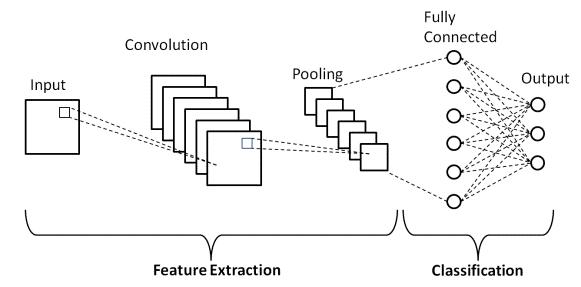
The proposed CNN architecture includes an Input Layer: 75x75x3 dimensions, accommodating color images. Convolutional Layers: The architecture incorporates three convolutional layers, featuring 32, 64, and 128 filters, each activatedusingtheReLUfunction.PoolingLayers:Toreduce spatial dimensions, max-pooling layers are applied after each convolutional layer. Fully Connected Layers: ReLU activation is applied to two successive dense layers containing256and128neurons,respectively.OutputLayer: Softmaxlayerwithtwoneuronstopredicttheprobabilityof eachclass(maleandfemale).
Loss Function: For multi-class classification tasks, categorical cross-entropy is used, which works well. Optimiser: Adam optimiser with an initial learning rate of 0.001, was chosen because of its capacity to modify the learningratedynamicallythroughouttraining. BatchSize:A batchsizeof32imageswasusedforeachtrainingiteration tobalancecomputationalefficiencyandmodelperformance. Epochs:Topreventoverfitting,trainingwascarriedoutover 50 epochs with early halting based on validation loss. Here wehaveusedfourtypesofarchitecture:ObileNet,ConvNet, Inception, and Xception. Among all these deployed models, ConvNetArchitecturehastheupperhandoveralltherestof the models. Now we needtoconvert ourdata into training and testing sets. We will use 75% of the images as our trainingdataandtestourmodelontheremaining25%with Scikit-learn’strain_test_splitfunction.
Training Dataset: The training dataset consists of 8643 images,4729imageswithmaleeyes,and3914imageswith female eyes. Test Dataset:It also consists of 2882 images, 1594 images with male eyes, and 1288 images with female eyes.
Data Collection and Annotation: Collect Diverse Eye Image Dataset: Gather images from various sources, including public datasets, custom collections, and crowdsourcing. Ensure diversity in demographics (age, ethnicity, gender). Include variations in lighting, expressions, and occlusions. Annotate the Dataset: Label images accurately as male or female. Use multiple
International Research Journal of Engineering and Technology (IRJET) e-ISSN:2395-0056
Volume: 12 Issue: 05 | May 2025 www.irjet.net p-ISSN:2395-0072
annotators to reduce bias and validate annotations. Regularlyverifytheaccuracyofannotations.
Data Pre-processing: Pre-process Images: Standardise imagesizeforconsistentinputtotheCNN.
Normalise pixel values to improve training efficiency. Rotation,flipping,andbrightnessmodificationswereamong the data augmentation techniques used to increase the trainingdataset'sdiversity.
Model Development: Build a CNN Model. A Convolutional Neural Network (CNN) architecture was developed, consisting of fully connected, pooling, and convolutional layers. For regularization, use dropout layers and ReLU activation functions. Train CNN Model, split data into training(70%),validation(15%),andtestsets(15%).Select binary cross-entropy as the loss function; for effective training,utilizetheAdam optimizer.Utilizingthevalidation set,trainthemodelandverifyitsaccuracy.
Model Evaluation and Optimisation: Using evaluation criteria like accuracy, precision, recall, and F1-score, the model's performance was evaluated. To verify model reliability and examine performance across various demographics, use cross-validation. Fine-tune and optimize the Model, adjust hyperparameters (learning rate, batch size, and epochs), refine the model architecture if needed, andretrainandre-evaluatethemodel.
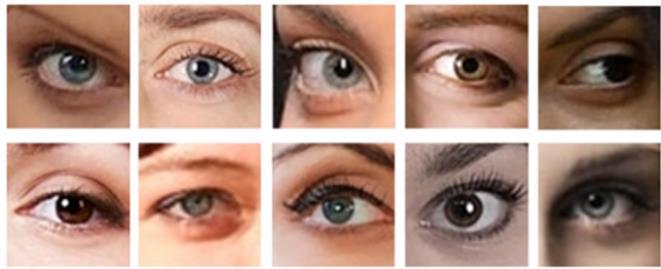
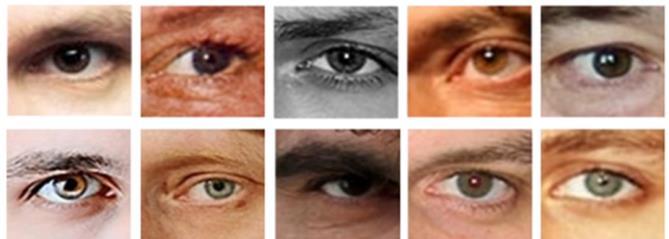
Various global datasets have been utilized in gender estimation studies. In this work, a global dataset was employed to facilitate comparison of the results across different datasets. Two datasets were sourced from the Kaggle platform. As this study focuses on a comparative analysis of cutting-edge CNN models utilizing solely eye images, the 'Female and Male' dataset was utilized. This dataset consists solely of eye regions extracted from fullface images, typically containing the entire or partial eyebrow area. Moreover, it provides eye images of 5202 females(Fig-2)and6323males(Fig-3).
Low-frequency background noise is usually removed, the image's intensity is normalized, light reflections are eliminated to reduce noise, and the facial image is prepped for more efficient feature extraction by image preprocessing. We started by resizing the pictures to 75 × 75 pixelsonoursystem.Then,theimageswereconvertedinto pixel value arrays, with each pixel's value transformed into a float and scaled by dividing by 255.0, bringing the pixel valuesintothe0-1range.
Evaluating a Convolutional Neural Network (CNN) for gendercategorizationbasedontheeyeareanecessitatesthe useofwell-definedmeasures.Thesemeasuresarecriticalin determining the model's accuracy, robustness, and overall performance. One such indicator is accuracy, which counts the percentage of accurately predicted instances (including truepositivesandtruenegatives)outofthetotalnumberof cases.Interpretation:Showswhetherthemodelisgenerally accurate.
Precision is the ratio of true positive predictions to total positivepredictionsgeneratedbythemodel.
Recallcalculatestheratiooftruepositivepredictionstothe totalnumberofactualpositiveinstances.
F1 Score is the harmonic mean of precision and recall, providingasinglemetricthatbalancesbothconcerns.
Atablethatprovidesanoverviewofaclassificationmodel's performanceiscalledaconfusionmatrix.Thecountsoffalse
International Research Journal of Engineering and Technology (IRJET) e-ISSN:2395-0056
Volume: 12 Issue: 05 | May 2025 www.irjet.net p-ISSN:2395-0072
positives(FP),false negatives(FN),truepositives(TP), and truenegatives(TN)aredisplayed.
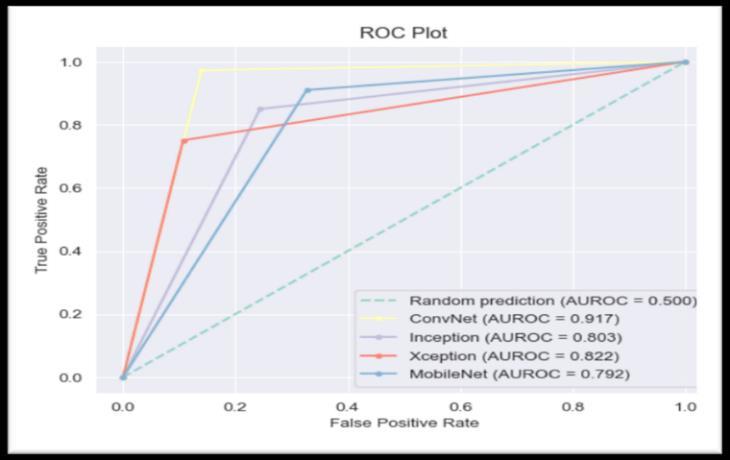
Provides a detailed breakdown of classification results, helping to identify areas where the model is performing well or poorly. For various threshold settings, the true positiverate(recall)isplottedversusthefalsepositiverate using a ROC curve. The model's total capacity to differentiate between classes is summarized by the AUC (Area Under the Curve). Interpretation: Outstanding model performance is indicated by a higher AUC. Perfect categorization is shown by an AUC of 1, whereas random guessing with no discrimination is suggested by an AUC of 0.5. Loss Function: The difference between the expected and actual labels is measured by the loss function. Crossentropy loss isoftenused forclassificationjobs. Lower loss valuescorrespondtogreatermodelperformanceintermsof predictionaccuracy.
The results obtained from the CNN model for eye regionbased gender classification are presented. The model was trained, validated, and tested on the Kaggle Dataset (KD), focusing specifically on the eye region. The results include accuracy, loss graphs, and confusion matrices. The model's performance results are training accuracy: 94.2%, validation Accuracy: 93.8% and test accuracy: 92.2%. Hence, the training and validation curves are displayed in Fig-4below.
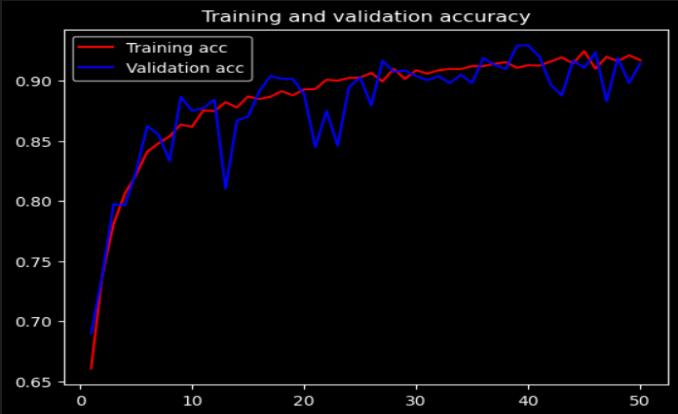
Fig -4: Thedatasetsfortrainingandvalidationcurves changedwitheachepoch
Plotsdisplaytheloss andaccuracyinFig-5fortraining and validationdatasetsoverepochs.Thesecurveshelpdiagnose overfittingorunderfittingbycomparingmodelperformance on training versus validation data. The methodology employed for developing and evaluating a CNN for eye region-based gender classification was systematically designed to ensure robust model performance and reliable evaluation. In conclusion, eye region-based gender classification offers promising benefits for various applications, including accuracy and efficiency. However, challenges such as limited features and privacy concerns exist. Effective model development and deployment are achievable by leveraging appropriate software tools and hardware configurations. Achieving a balance between these characteristics is critical for successful implementationinreal-worldscenarios.
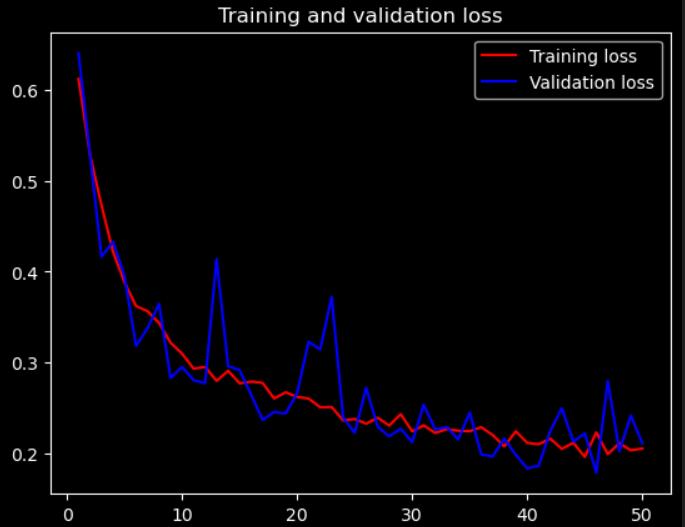
Fig -5: Duringthetrainingprocedure,trainingand validationlossaretracked
The confusion matrix, shown in Fig-6, offers an in-depth analysisofthemodel’sperformanceonthetestdataset.The numbers of false positives (FP), false negatives (FN), true positives(TP),andtruenegatives(TN)areshown.

Fig -6: ConfusionMatrix
International Research Journal of Engineering and Technology (IRJET) e-ISSN:2395-0056
Volume: 12 Issue: 05 | May 2025 www.irjet.net
Based on important measures like accuracy, precision, recall, F1 score, and the ROC curve with AUC, as shown in Fig-7,Table-2evaluatestheCNNmodel'sperformance.
Table -2: ClassificationReport
Thislatencyisthesystem'stimetoclassifyaneyeimage,25 milliseconds per image. Throughput is the number of imagesclassifiedpersecond,40persecond theamountof memory consumed by the CNN during classification, measured at 150 MB. The efficiency of resource use during modelinference.CPUUtilisationis35%andGPUUtilisation is 20%. Inference Time is the total time from receiving an imagetooutputtingtheclassificationresult,28milliseconds perimage.
In this section, we evaluate the performance of the developed CNN model for eye region-based gender classification with previously existing methods, focusing on the dataset sizes, validation strategies, and achieved accuracies. The previously existing system for gender classification based on eye region images utilised a relatively smaller dataset and achieved moderate accuracy. ThetrainingDatasetconsistsofsomephotos,3,494;female
eyesare1,747;Maleeyesare1,747.TestDataset:numberof images 200, female eyes are 100, male eyes: 100 The Validation Strategy is 5-fold cross-validation, achieving a performanceaccuracyof83%."
Theproposedsystemenhancesthedatasetsizesignificantly and utilises a more robust CNN architecture to improve classification accuracy. The training dataset consists of several images: 8,643 female eyes, 3,914 male eyes, and 4,729. Test Dataset: The number of images is 2,882, female eyesare1,288,andmaleeyesare1,594.ValidationStrategy: Cross-validation is 4-fold cross-validation. Performance accuracyis92%,andthecomparisonsummaryisillustrated inTable-3.
Table -3: SummaryofComparison
Inthisresearch,ourobjectivewastoimplementeyeregionbased gender classification using CNNs. We began by collecting a dataset of facial images containing annotated eye regionsand correspondinggenderlabels.Theseimages underwent preprocessing steps such as resizing, normalisation, and augmentation to enhance the diversity andqualityofthedata.Thetrainedmodelwassubsequently evaluated on a separate test set to measure its accuracy, precision, recall, and F1 score. Overall, research is successfully demonstrated the feasibility and effectiveness of eye region-based gender classification, achieving competitive performance metrics and providing valuable insightsintotheapplicationofDLinthisdomain.
Explore advanced CNN architectures such as attentionbasedmodelsorcapsulenetworkstoimproveclassification accuracyandrobustness.Investigatetechniquestomitigate challenges related to occlusions, variations in lighting, and image quality issues for better performance in real-world scenarios. Extend gender classification beyond the eye region to other facial features like the nose or mouth for a more comprehensive analysis of gender-related facial characteristics. Explore the intersection of gender classificationwithotherdemographicattributessuchasage or ethnicity to develop more nuanced approaches to demographic analysis and targeted marketing strategies. These research directions provide a roadmap for further advancements in eye region-based gender classification, potentiallyenhancingaccuracy,applicability,andinclusivity indemographicanalysisandtargetedmarketing.
International Research Journal of Engineering and Technology (IRJET) e-ISSN:2395-0056
Volume: 12 Issue: 05 | May 2025 www.irjet.net p-ISSN:2395-0072
[1] Jabber NH, Hashim IA. Robust Eye Features Extraction Based on Eye Angles for Efficient Gaze Classification System. In 2018 Third Scientific Conference of Electrical Engineering (SCEE) 2018 Dec19(pp.13-18).IEEE.
[2] Li J, Lu BL. A framework for multi-view gender classification.InInternationalConferenceonNeural InformationProcessing2007Nov13(pp.973-982). Berlin,Heidelberg:SpringerBerlinHeidelberg.
[3] CIMTAY, Y., & YILMAZ, G. N. (2021). Gender classification from eye images by using pretrained convolutional neural networks. The Eurasia Proceedings of Science, Technology, Engineering andMathematics,14,39-44.
[4] Sri, T. A., & Gupta, S. (2022). Gender prediction based the morphometry of eyes using deep learningmodels. ECSTransactions, 107(1),6665.
[5] Huang, C. T., Chen, Y., Lin, R., & Kuo, C. C. J. (2017, December). Age/gender classification with wholecomponent convolutional neural networks (WCCNN). In 2017 Asia-Pacific Signal and Information Processing Association Annual Summit and Conference(APSIPAASC)(pp.1282-1285).IEEE.
[6] Keshaveni, N. (2024). An AVOA-LSTM with MRCNN for segmenting and classifying the sunglass imagebased region identification. Multimedia Tools and Applications,83(12),35073-35095.
[7] Kong, Y.,Ren,Z.,Zhang,K.,Zhang,S.,Ni,Q.,&Han,J. (2021). Lightweight facial expression recognition method based on attention mechanism and key region fusion. Journal of Electronic Imaging, 30(6), 063002-063002.
[8] Vetrekar, N., Ramachandra, R., Raja, K., & Gad, R. S. (2021). Gender classification under eyeglass occluded ocular region: an extensive multi-spectral imaging study. In AI and Deep Learning in Biometric Security (pp.175-203).CRCPress.
[9] Arshad, M. W. (2023). Detection Of Human Gender From Eyes Images Using Dnn Approach. Jurnal Teknoinfo, 17(2),336-340.
[10] Patil, B., & Hangarge, M. (2023, August). Pretrained Convolutional Neural Networks for Gender Classification. In First International Conference on Advances in Computer Vision and Artificial Intelligence Technologies (ACVAIT 2022) (pp. 319326).AtlantisPress.
[11] Chen,S.,Pan,Z.X.,Zhu,H.J.,Wang,Q.,Yang,J.J.,Lei, Y., ... & Pan, H. (2018). Development of a computeraided tool for the pattern recognition of facial features in diagnosing Turner syndrome: comparison of diagnostic accuracy with clinical workers. Scientificreports, 8(1),9317.
[12] Yasaswini Paladugu, D. R. S. (2023). End-To-End Gender Determination ByImagesOfAnHumanEye.
Journal of Survey in Fisheries Sciences, 10(2S), 394405.
[13] Anas, E. R., Henriquez, P., & Matuszewski, B. J. (2017, February). Online eye status detection in the wild with convolutional neural networks. In International conference on computer vision theory andapplications (Vol.7,pp.88-95).SciTePress.
[14] Dong Y, Woodard DL. Eyebrow shape-based features for biometric recognition and gender classification: A feasibility study. In2011 International Joint Conference on Biometrics (IJCB) 2011Oct11(pp.1-8).IEEE.
[15] WidjajaE,LimGH,AnA.Anovelmethodforhuman gender classification using Raman spectroscopy of fingernailclippings.Analyst.2008;133(4):493-8.