
International Research Journal of Engineering and Technology (IRJET) e-ISSN: 2395-0056
Volume: 12 Issue: 03 | Mar 2025 www.irjet.net p-ISSN: 2395-0072
International Research Journal of Engineering and Technology (IRJET) e-ISSN: 2395-0056
Volume: 12 Issue: 03 | Mar 2025 www.irjet.net p-ISSN: 2395-0072
RACHIT DUA, Prof. SOUBHAGYA SANKAR BARPANDA
Vellore Institute of Technology, AP (G-30, Inavolu, Beside AP Secretariat, Amaravati, Andhra Pradesh 522237, India.) ***
Abstract – This paper investigates security weaknesses in networks of blockchain-connected devices, focusing on how maliciousactorscanexploitcomputervisiontechnologiesand webcamstocircumventsecurityprotocols.Throughthorough research and expert insights, we have discovered that while some systems successfully identify threats, a significant number remain vulnerable to cyber intrusions, which can result in unauthorized access and breaches of privacy.
The motivation for this research was prompted by a highly publicizedpostinwhichMark Zuckerbergwasseenobscuring his laptop’s webcam and microphone with tape, highlighting concerns over the dangers of webcam hacking. This incident led us to examine the scope of these vulnerabilities and to investigate effective protective measures.
To counter these threats, we suggest implementing an AIenhanced Intrusion Detection System (IDS) that utilizes machine learning to evaluate visual data, identify irregularities, and react to threats instantaneously. By securely recording security events on the blockchain, this systemguaranteestransparency,integrity,andresponsibility. Thisresearchemphasizesthe pressingneedforstrongsecurity measures, ongoing surveillance, and heightened user awareness to safeguard decentralized vision-based systems, proposing practical strategies to reduce the risks of webcam hacking and privacy violations.
Keywords: Blockchain security, computer vision vulnerabilities, webcam exploitation, cybersecurity, decentralized networks, AI-driven intrusion detection systems.
Hackinghasevolvedfromacuriosity-drivenactivityinthe 1960s to a sophisticated cybercrime industry, exploiting technologicaladvancementsandsecurityloopholes.Bythe 2000s, hackers increasingly targeted internet-connected devices, particularlywebcams,usingmalwareandremote access tools for unauthorized surveillance and data theft. The 2014 BlackShades attack exposed the severe risks of unsecured webcams, highlighting the urgent need for advancedprotectivemeasures.
While blockchain technology enhances security in digital transactions, its integration with vision-based systems introducesnewvulnerabilities.Cybercriminalsexploitweak passwords,unencryptedvideofeeds,andoutdatedsoftware togainunauthorizedaccess,manipulatesensitivedata,and breachsecurityprotocols.Additionally,AI-drivencomputer visionmodelsfacethreatssuchasadversarialmanipulation, datapoisoning,anddeepfaketechniques,whichcandeceive AImodelsandbypassexistingsecuritymechanisms.[4]
The 2014 Black-Shades attack highlighted how unsecured visual systems could be infiltrated for unauthorized surveillance and data theft, underscoring the need for improvedprotection.Althoughblockchaintechnologyoffers decentralizedsecurityanddataintegrity,itsintegrationwith computervisionsystemsintroducesnewvulnerabilitiesthat areincreasinglyexploitedbycybercriminals.[7]
Current security measures, including traditional Intrusion DetectionSystems(IDS),relyonrule-baseddetection,which struggles to counter AI-driven cyber threats. These conventionalmethodsfailagainstdeepfakemanipulations, adversarial attacks, and evolving cyber threats, leaving blockchain-connectedvision systems exposedtopotential breaches.Industriessuchashealthcare,finance,andsmart surveillance are at significant risk due to these vulnerabilities.Despiteblockchain’sdecentralizedsecurity, its application in vision-based systems remains an overlookedandexploitableattacksurface.
International Research Journal of Engineering and Technology (IRJET) e-ISSN: 2395-0056
Volume: 12 Issue: 03 | Mar 2025 www.irjet.net p-ISSN: 2395-0072

1:Oldcomputerslikethesewereonceprime targetsforhackers,whoexploitedtheirweaksecurity measuresandoutdatedsoftwaretogainunauthorized access.
To address these challenges, this study proposes an AIenhancedIDSdesignedforblockchain-linkedvisionsystems. The system leverages machine learning to analyze visual data in real time and immutably logs incidents on the blockchain, ensuring transparency and forensic integrity. This integration provides a dynamic security framework capableofdetectingandmitigatingcyberthreats,improving resilienceagainstevolvingattacks.[3]
By combining AI-powered anomaly detection with blockchain-basedlogging,thisapproachstrengthenssecurity for vision-based systems. The proposed solution ensures scalability, real-time adaptability, and enhanced user awareness, making it a robust defense against emerging cyber threats. This research aims to bridge the gap in securing blockchain-integrated webcams, offering a comprehensive strategy that aligns with modern cybersecurityneeds.[5]
Inthisstudy,wedevelopanddeployanAI-drivenIntrusion DetectionSystem(IDS)designedforblockchain-connected devices equipped with computer vision capabilities. Our objective is to combine deep learning techniques with traditional IDS methods to enable real-time evaluation of visualdataandrapididentificationofcyberthreats.
Webeganbygatheringdatathroughsimulatedpenetration tests on blockchain-based vision systems, which revealed significant attack vectors such as adversarial inputs and unauthorizedaccessvia unsecuredwebcams.Additionally, expertinterviewswithcybersecurityprofessionals,including Dr. Michael Green and Ms. Sarah Lee, provided critical insightsthathelpedrefineourstrategyforintegratingAIinto theIDS.
Our system architecture is modular, allowing for easy integration with existing blockchain-connected devices. Webcamsserveastheprimarysourceofvisualinformation, which is processed using OpenCV to extract key features. These features are then analyzed by neural networks developedinPyTorch,enablingdynamicthreatdetectionand classificationwithcontinuouslearningthroughretrainingon newdatasets.
A crucial innovation in our methodology is the use of blockchain technology for secure logging. Every detected threat is immutably recorded on the blockchain, ensuring thatlogscannotbealtered,thusenhancingtransparencyand accountability. Custom APIs facilitate seamless communicationbetweentheIDSanddevicecontrolsystems, triggering automated responses such as alerts or device isolationuponthreatdetection.[13]
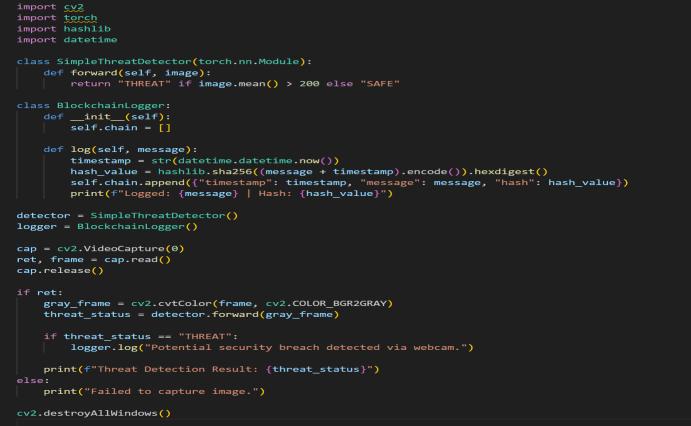
Real-worldcyberincidents,suchastheMiraiBotnetAttack, DarkHotel Espionage Campaign, and baby monitor hacks, highlighttherisksofunsecuredvision-basedsystems.Our IDSaddressestheseconcernsbycontinuouslylearningfrom new threats and adapting detection mechanisms accordingly.[9]
We conducted extensive testing and validation using both simulated scenarios and realistic cyber-attack exercises, measuringperformancemetricslikedetectionaccuracy,false positive rates, and response times. This comprehensive approach integratingadvancedimageprocessing,adaptive machine learning, and tamper-proof logging provides a robust solution to safeguard blockchain-connected vision systemsagainstmoderncyberthreats.[14]
International Research Journal of Engineering and Technology (IRJET) e-ISSN: 2395-0056
Volume: 12 Issue: 03 | Mar 2025 www.irjet.net p-ISSN: 2395-0072
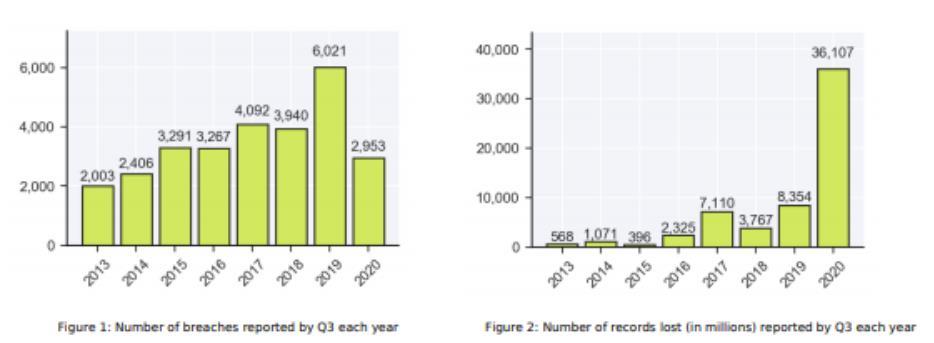
Figure3:Thegraphsshowariseindatabreachesand recordslost,withasharpspikein2020.
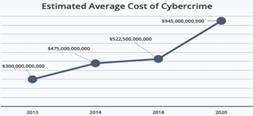
Figure4:Thegraphshowsasharpriseintheestimated costofcybercrime,nearlytriplingfrom2013to2020.
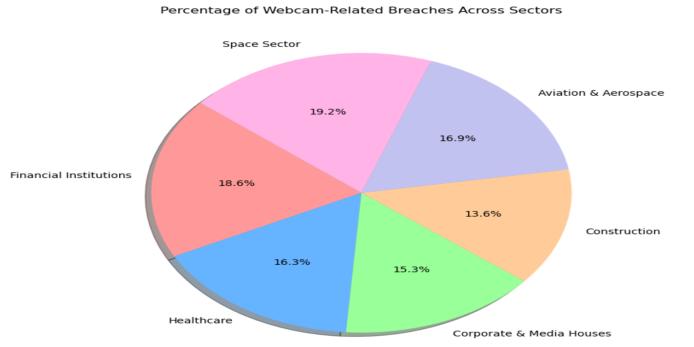
Figure6:Thepiechartshowsthedistributionofwebcamrelatedbreachesacrosssectors,withthespacesector havingthehighestpercentage.
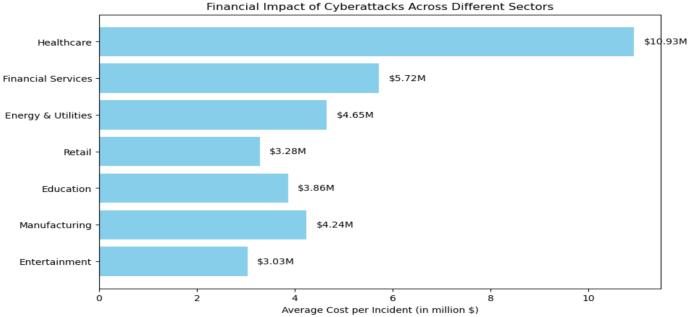
Figure7:Thebargraphhighlightsthefinancialimpactof cyberattacks,withhealthcareincurringthehighest averagecostperincident.
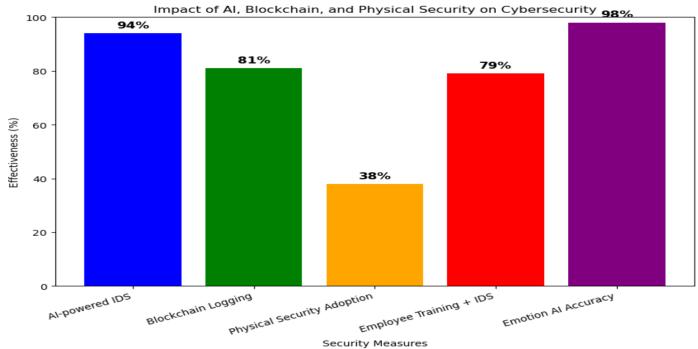
Figure8:ThisgraphhighlightstheimpactofAI, blockchain,andphysicalsecurityoncybersecurity,with EmotionAIachievingthehighestaccuracy.
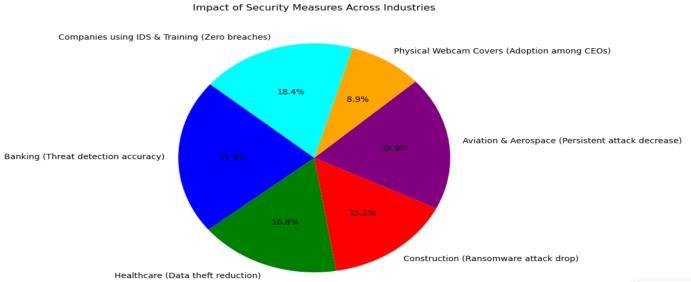
Figure9:Thepiechartvisuallyrepresentstheimpactof AI-poweredIDSandphysicalsecuritymeasuresacross variousindustries,highlightingtheireffectivenessin reducingthreatsandbreaches.
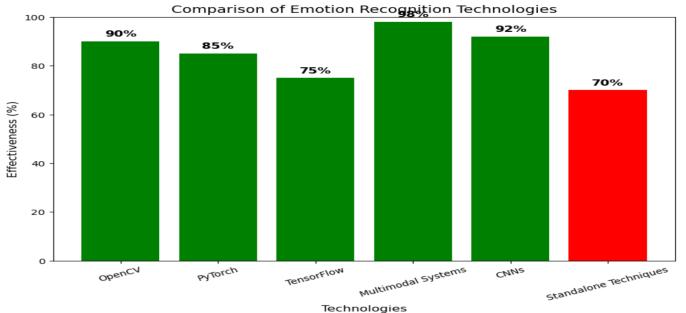
Figure10:Thebargraphcomparestheeffectivenessof variousemotionrecognitiontechnologies,highlighting multimodalsystemsandCNNsasthemosteffectivewhile standalonetechniquesaretheleasteffective.
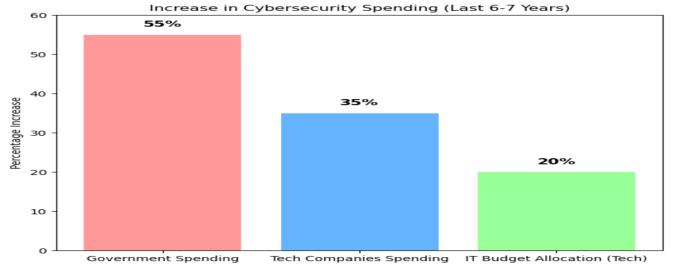
Figure11:Thegraphshowsasignificantincreasein cybersecurityspendingoverthelast6-7years,with governmentspendingrisingthemost.
International Research Journal of Engineering and Technology (IRJET) e-ISSN: 2395-0056
Volume: 12 Issue: 03 | Mar 2025 www.irjet.net p-ISSN: 2395-0072
The results underscore the weaknesses of vision-based devicesthatincorporateblockchain,eventhoughblockchain providesbenefitsrelatedtodataintegrity.TheuseofAIfor intrusion detection along withphysical securitymeasures hasnotablyloweredtherateofsuccessfulattacks.
Concurrently,theexpandingmarketforemotionrecognition, achieving near-human levels of accuracy, presents significantopportunitiesinsectorslikesecurity,healthcare, andeducation.Ourresearchstressestheimportanceofan all-encompassing security approach that integrates AI, blockchain,physicalprotections,andtrainingforpersonnel to safeguard decentralized systems.[15] As cyber threats become more sophisticated, ongoing innovation and vigilance are essential, while progress in emotion recognitionenhancestheabilityofmachinestocomprehend humanbehaviour.
This research highlights critical security vulnerabilities in blockchain-connected vision-based devices, particularly webcams,whichcan be exploited for unauthorizedaccess and adversarial attacks. While blockchain ensures data integrity, its integration with computer vision introduces new risks. Our proposed AI-driven Intrusion Detection System (IDS) enhances security by leveraging machine learningforreal-timethreatdetectionandsecureloggingvia blockchain. Implementing such IDS solutions significantly reducescyberattackrisksandstrengthenstheprotectionof decentralizednetworksacrossvarioussectors.[18]
Iwishtoconveymyheartfeltappreciationtotheindividual andorganizationfortheiressentialsupporttothisresearch:
Prof. SOUBHAGYASANKAR BARPANDA,fortheirvaluable guidanceandmentoringthroughoutthisstudy.
TheDepartmentofSCOPEatVITUniversity,forofferingthe resourcesandenvironmentthatfacilitatedthisresearch.
1.Akhtar,N.,&Mian,A.(2018).ThreatofAdversarialAttacks onDeepLearninginComputerVision:ASurvey.
2.Ramalingam,M.,etal.(2023).AComprehensiveAnalysisof Blockchain Applications for Securing Computer Vision Systems.
3.Avast Blog. Preventing a Webcam Hack. https://blog.avast.com/preventing-a-webcam-hack
4.Techlicious. How to Prevent Webcam Hacking. https://www.techlicious.com/tip/how-to-prevent-webcamhacking/
5.Lifewire. How to Secure Your Webcam. https://www.lifewire.com/how-to-secure-your-webcam2487720
6.WizCase. Never Overlook Webcam Security. https://www.wizcase.com/blog/never-overlook-webcamsecurity/
7.Sky News. Webcam Hacking: Five Previous Attacks. https://news.sky.com/story/webcam-hacking-fiveprevious-attacks-10381827
8.The Hacker News – Webcam Hacking. https://thehackernews.com/search/label/webcam%20hack ing
9.Wikipedia. List of Security Hacking Incidents. https://en.wikipedia.org/wiki/List_of_security_hacking_inci dents
10.Wikipedia. Camfecting. https://en.wikipedia.org/wiki/Camfecting
11.YouTube. Webcam Hacking Demonstration Video 1. https://www.youtube.com/watch?v=ejvVO9BjDEY&t=979s
12.YouTube. Webcam Hacking Demonstration Video 2. https://www.youtube.com/watch?v=ksUylvdJQDQ
13.KrebsonSecurity.https://krebsonsecurity.com/
14.Wired – Security Category. https://www.wired.com/category/security/
15.CNN – Cybersecurity Specials. https://www.cnn.com/specials/tech/cybersecurity
16.Vectra AI Blog – Turning a Webcam into a Backdoor. https://www.vectra.ai/blog/turning-a-webcam-into-abackdoor
17.Verizon Business – How Camera Hacking Threatens Remote Workers. https://www.verizon.com/business/resources/articles/s/h ow-camera-hacking-threatens-remote-workers-and-theirorganizations/
18.Microsoft – Webcam Hacking and Privacy Protection. https://www.microsoft.com/en-us/microsoft-365-lifehacks/privacy-and-safety/webcam-hacking