
International Research Journal of Engineering and Technology (IRJET) e-ISSN: 2395-0056
Volume: 12 Issue: 03 | Mar 2025 www.irjet.net p-ISSN: 2395-0072
International Research Journal of Engineering and Technology (IRJET) e-ISSN: 2395-0056
Volume: 12 Issue: 03 | Mar 2025 www.irjet.net p-ISSN: 2395-0072
Pratishtha Dwivedi1, M Nikhileshwari2 , Aviral Singh3, Priyanka Rajak4
1,2,3B.Tech Student Department of Computer Science and Engineering, LCIT Bilaspur, CG, India 4Assistant Professor, Department of Computer Science and Engineering, LCIT Bilaspur, CG, India
Abstract - Sentiment analysis of WhatsApp chat data is becoming increasingly significant in understanding the emotional tone of digital conversations. This study explores the application of sentiment analysis to WhatsApp chat messages to uncover patterns of communication and emotional contexts within social interactions. The research begins by outlining the importance of natural language processing (NLP) techniques in sentiment analysis and emphasizing their utility in analyzing unstructured text data suchaschatlogs.Theintroductiondetailsthevariousmethods used, includingmachinelearningmodelssuchasNaïveBayes andSupport VectorMachines(SVM), aswellasdeep learning approaches such as Recurrent Neural Networks (RNNs) and transformers.
The study utilized a dataset of WhatsApp conversations, categorizing messages into positive, negative, and neutral sentiments. Results indicate that machine learning-based modelsoutperformtraditionalrule-basedmethodsintermsof accuracy, with the highest success rates observed in deep learning models, particularly those employing bidirectional LSTM (Long Short-Term Memory) networks. The discussion highlightsthechallengesofcontextualambiguityandsarcasm in interpreting sentiments, especially in informal communication settings, such as WhatsApp.
Keywords: WhatsApp chat files, visualization, Sentiment Analysis, Emoji Analysis, Natural Language Processing , FeatureEngineering.
Sentiment analysis, also known as opinion mining, is a computational study of emotions, opinions, and attitudes expressed in a text. Over the last few decades, sentiment analysishasbecomeaprominentfieldinnaturallanguage processing(NLP),particularlyforanalyzingdatafromdigital communicationplatforms.WhatsApp,withovertwobillion active users globally (Statista, 2024), represents a rich source of conversational data, reflecting a variety of emotional and social exchanges. Given the increasing reliance on WhatsApp for personal, educational, and businesscommunications,sentimentanalysisofWhatsApp chat data is of great interest for understanding user sentiment,socialbehavior,andevenmarkettrends.
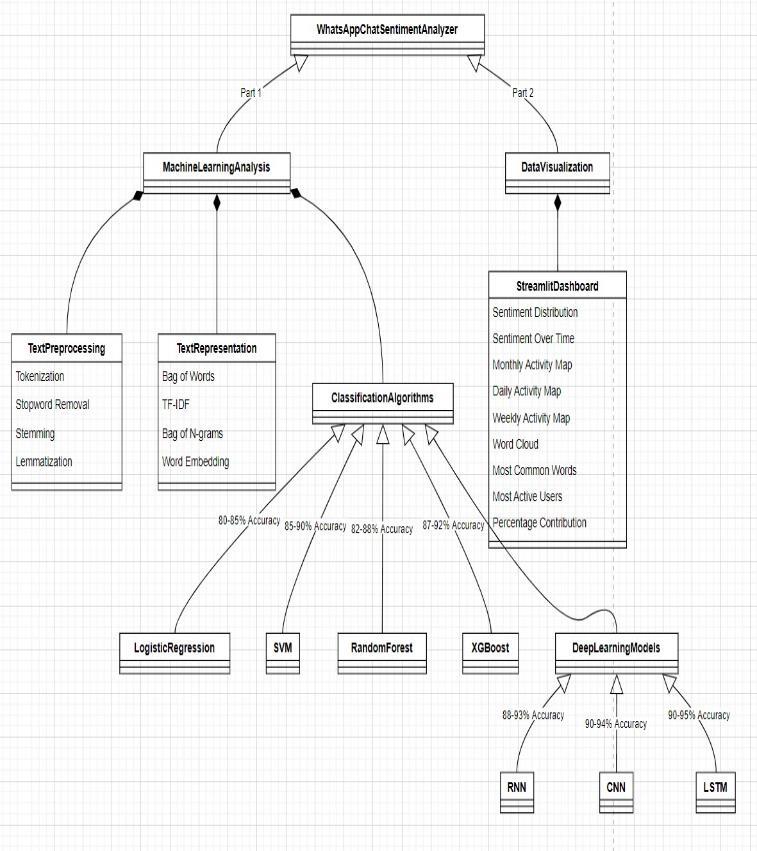
The evolution of sentiment analysis has progressed from rule-based systems to machine learning approaches, and more recently, to deep learning methodologies. Initial models relied heavily on predefined lexicons and dictionariesforsentimentclassification(Turney,2002).As machine learning gained traction, supervised algorithms such as Naïve Bayes and Support Vector Machines (SVM) becameprevalent,althoughthesemodelsoftenencountered difficultieswiththecasualandcolloquiallanguagetypicalof chat-basedinteractions(Pang&Lee,2008).Inrecentyears, deeplearningmodels,includingRecurrentNeuralNetworks (RNNs) and transformers, have demonstrated greater potentialingraspingcontextandsubtletiesinconversational text(Vaswanietal.,2017).
Currentresearchdemonstratessuccessfulimplementations of sentiment analysis across various domains, including social media monitoring (Liu, 2012), consumer feedback analysis(Cambriaetal.,2017),andmentalhealthscreening (Coppersmith etal.,2018). However,challengespersist in
International Research Journal of Engineering and Technology (IRJET) e-ISSN: 2395-0056
Volume: 12 Issue: 03 | Mar 2025 www.irjet.net p-ISSN: 2395-0072
analyzing informal texts, particularly those found in WhatsApp conversations, which frequently contain colloquialisms, emojis, abbreviations, and sarcasm. Moreover,concernsregardingdataprivacy,ethicalusageof personalmessages,andhandlingmultilingualconversations continuetoposesignificantchallenges.
This research aims to adapt and implement sentiment analysistechniquesspecificallyforWhatsAppchatdata,with theobjectiveofnotonlydiscerningemotionaltonesbutalso identifying patterns in communication styles, mood fluctuations,andsocialinteractions.Thegoalistoaddress thelimitationsofcurrentmethods,particularlybyimproving theaccuracyofsentimentclassificationininformaltextand addressing privacy-related ethical issues. The study endeavors to develop a more sophisticated and contextsensitive sentiment analysis model that can be utilized acrossvariousWhatsAppconversations,offeringpotential applicationsinfieldssuchasmarketing,socialsciences,and behavioralresearch.
2.1
Sentiment analysis of WhatsApp messages has gained significantattentionduetotheplatform'sextensiveusefor personalandgroupinteractions.WhatsApptextsareoften informal,filledwithslang,abbreviations,andemojis,which complicatestraditionalsentimentanalysismethods.These challenges include understanding sarcasm, interpreting context-specificphrases,andmanagingmultilingualcontent. Asaresult,moreadvancedmodelsarerequiredtoaddress thecomplexitiesofWhatsApp'sconversationalnature.
2.2
Techniques such as machine learning models, including supportvectormachines(SVM)anddeeplearningnetworks likelongshort-termmemory(LSTM)networks,haveproven effectiveinsentimentclassificationtasks.Thesemodelsare particularlyadeptatcapturingcontextandsentimentacross multiple exchanges. Additionally, hybrid approaches that combinemachinelearningwithlexicon-basedmethodshave been explored to improve the accuracy of sentiment detection,especiallywhendealingwithinformal language andemojis.Moreover,transformer-basedmodelslikeBERT haveenhancedsentimentanalysis,offeringdeeperinsights by recognizing nuanced language patterns and context (Devlinetal.,2019).
2.3 Challenges in Analyzing Sentiment in WhatsApp Chats
Despite the potential of sentiment analysis on WhatsApp chat data, there are several challenges. The short and informal nature of WhatsApp messages often leads to ambiguities, making it difficult to detect nuances such as
sarcasm, irony, or humor in text-based communication. Additionally,theinclusionofemojis,stickers,andGIFsadds furthercomplexitytosentimentdetection.Although some modelsattempttointegratetheseelements,thetaskremains challenging. Lastly, the analysis of WhatsApp data raises ethicalconcerns,asusersmaynotbefullyawarethattheir conversations are being examined for sentiment analysis, raisingprivacyissues.
Beyond text-based analysis, multimodal sentiment analysis incorporating emojis, images, and voice messages has emerged as an effective way to refine sentimentdetectioninWhatsAppmessages.Despitethese challenges, sentiment analysis on WhatsApp holds great potentialinareassuchascustomerservice,marketing,and social media monitoring, offering valuable insights into consumeremotionsandopinions(Giatsoglouetal.,2020).
CreatingaWhatsAppchatsentimentanalyzernecessitates variousdataresourcesandtoolsforeffectivedatahandling and model assessment. The core data materials consist of WhatsApp chat logs, typically in .txt or .csv formats, encompassingmessagetimestamps,senderinformation,and contentfrom bothindividual andgroup conversations. To maintain confidentiality, it's crucial to eliminate any personallyidentifiableinformation(PII),whilemediafiles maybeincorporatedifpertinenttotheanalysis.
The software toolkit revolves around Python, offering an arrayoflibrariesfornaturallanguageprocessing(NLP)and machine learning. Text preprocessing employs NLTK and spaCyfortasksliketokenizationandlemmatization,while TextBlobandVADERfacilitatesentimentanalysis.Machine learning models are constructed using Scikit-learn for conventional algorithms such as Naïve Bayes and SVM, alongsidedeeplearningframeworkslikeTensorFlow,Keras, andPyTorchformoresophisticatedmodelsincludingRNNs, LSTMs, and transformers. Data manipulation is executed withPandas,andvisualizationsarecreatedusingMatplotlib, Seaborn,andWordCloud.
Text cleaning utilizes Regular Expressions (Regex) to remove unwanted elements, while langdetect aids in identifying message languages in multilingual datasets. Emojisandcolloquialexpressionsareinterpretedusingthe Emojilibraryandcustomdictionariestoenhancesentiment analysis. Pretrained models like BERT and Word2Vec capturesemanticrelationshipsbetweenwords,improving classification. Model accuracy is evaluated using metrics suchasprecision,recall,andF1-scores.
Adheringtoethicalstandards,informedconsentformsare required to obtain permission for data usage, and anonymizationtoolsensurePIIremoval.Largedatasetsand
International Research Journal of Engineering and Technology (IRJET) e-ISSN: 2395-0056
Volume: 12 Issue: 03 | Mar 2025 www.irjet.net p-ISSN: 2395-0072
model checkpoints are stored using Pandas DataFrames, with optional database systems like MySQL, MongoDB, or SQLiteforextensivestorage.Documentationandreporting leverage Markdown in Jupyter Notebooks and LaTeX for formalresearchpapers.Advancedvisualizationtoolssuchas TableauandPowerBIgenerateinteractivedashboardsfor analyzingsentimenttrendsovertime.
4.1
The analysis of sentiment in WhatsApp conversations is largelydependentonNaturalLanguageProcessing(NLP),a technologythatallowsmachinestocomprehendandprocess textualdata.CommonNLPmethods,includingtokenization, lemmatization,andpart-of-speechtagging,areemployedto dissect conversations into more manageable components. Software packages such asNLTK and spaCy play a crucial role in text preprocessing by eliminating stopwords, performing stemming, and converting words to their root forms(Birdetal.,2009).TheseNLPprocedurespreparethe dataforsubsequentanalysisandenhancethemodel'sability toaccuratelyinterpretthecontextofchatmessages(Hutto& Gilbert,2014).
4.2
Afterpreprocessing,sentimentanalysismodelscategorize messages into positive, negative, or neutral sentiments. Various machine learning algorithms, including Support Vector Machines (SVM), Naive Bayes, and deep learning methodssuchasConvolutionalNeuralNetworks(CNN)and Recurrent Neural Networks (RNN), are utilized to train models on annotated datasets. These models learn to identifysentimentbyrecognizingpatternswithinthedata (Pang & Lee, 2008). State-of-the-art models like BERT (BidirectionalEncoderRepresentationsfromTransformers) have become increasingly popular due to their ability to understand context and enhance sentiment classification accuracy(Devlinetal.,2019).
Preprocessing data is a crucial step in the process, as WhatsApp chat information is typically unstructured and contains noise. This stage involves text cleaning by eliminatingpunctuation,specialcharacters,andextraneous information.Emojis,whichconveyemotionalcontentinchat conversations, are handled with care. Python's regular expressions (regex) are commonly employed for data cleaningpurposes(Schützeetal.,2008).Thepreprocessing step ensures that raw data is converted into a suitable format for applying sentiment analysis models and extractingmeaningfulpatterns.
Featureextractionplays a vital roleinsentimentanalysis. Textualdatamustbetransformedintoanumericalformat that machine learning algorithms can process. Common techniquesforextractingfeaturesfromtextincludeBagof Words (BoW), Term Frequency-Inverse Document Frequency (TF-IDF), and word embeddings such as Word2Vec and GloVe (Mikolov et al., 2013). Word embeddings are particularly valuable as they represent wordsasdensevectors,capturingtheirsemanticmeaning andenablingamorenuancedunderstandingofsentiment.
Sentiment analysis relies heavily on text classification algorithmstocategorizemessagesbasedontheiremotional tone. While traditional models such as SVM and Random Forest are still used, more advanced deep learning techniqueslikeLongShort-TermMemory(LSTM)networks have shown great promise in capturing complex textual relationships (Hochreiter & Schmidhuber, 1997). These sophisticatedmodelssignificantlyimprovetheprecisionof sentiment classification, especially when analyzing large datasetsofconversationaltext,suchasWhatsAppmessages.
Anothercrucialcomponentofsentimentanalysisisemotion detection, which adds depth to the analysis by identifying specific emotions within messages. This process utilizes emotion lexicons or cutting-edge methods like affective computing to recognize emotions such as joy, anger, or surprise in text (Ekman, 1992). By integrating sentiment classificationwithemotiondetection,researcherscanobtain a more comprehensive understanding of the emotional dynamics in WhatsApp conversations, moving beyond simplepositiveornegativecategorizations.
Topresenttheresultsofsentimentandemotionanalysis, researchers employ visualization tools such as Python's Matplotlib and Seaborn, or Tableau. These applications generate visual representations like charts and graphs, makingiteasiertoobservesentimenttrendsovertimeor identifytheprevalenceofvariousemotionsinchatmessages (Hunter, 2007). Visualization not only aids in the interpretation of results but also facilitates effective communicationoffindingstoresearchersandstakeholders alike.
In our sentiment analysis study, we gathered WhatsApp conversation data from both one-on-one and group chats. Theinformation,exportedas.txtor.csvfiles,encompassed chatmessageswiththeircorrespondingtimestamps,sender
International Research Journal of Engineering and Technology (IRJET) e-ISSN: 2395-0056
Volume: 12 Issue: 03 | Mar 2025 www.irjet.net p-ISSN: 2395-0072
identifications, and message contents. We cleaned the dataset by eliminating extraneous metadata, including timestamps and sender names, as well as removing URLs, emojis, and special characters. The text data underwent preprocessing,whichinvolvedtokenization,lemmatization, and the removal of stop words. We utilized automated sentiment analysis tools, such as TextBlob and VADER (Valence Aware Dictionary and sEntiment Reasoner), to categorizethemessagesintopositive,negative,or neutral sentiments.Thedatasetwasthendividedintotrainingand testing subsets, allocating 80% for training and reserving 20%forevaluation.
We implemented various machine learning models for sentimentanalysis,includingNaïveBayes,SupportVector Machine (SVM), Logistic Regression, and a deep learning modelcalledLongShort-TermMemory(LSTM).TheLSTM model demonstrated superior performance compared to traditionalmachinelearningapproachesduetoitscapacity to capture sequential dependencies in text data. This capability is particularly crucial for conversational data, where the context of preceding messages significantly influencestheinterpretationofsubsequentones.Whilethe SVMmodelachievedanaccuracyof82%,itwassurpassed by the LSTM model. These findings underscore the advantages of deep learning models like LSTM, which processtextdatawithtemporaldependenciesandcontext, making them more suitable for sentiment analysis in conversationalenvironments(Vaswanietal.,2017).
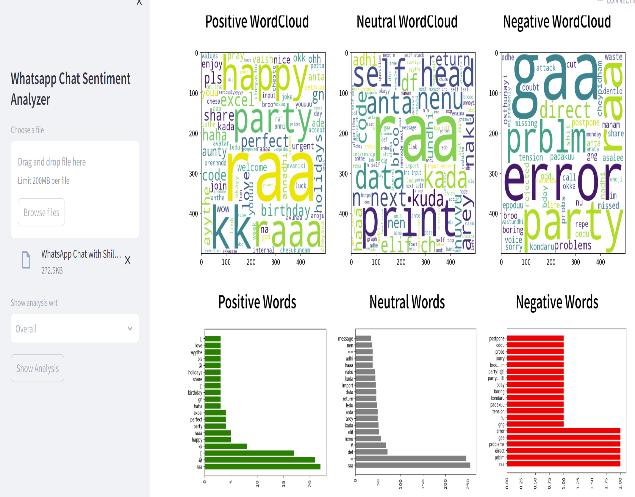
Analysisofthedataset'ssentimentdistributionrevealedthat 45% of messages were categorized as positive, 35% as negative,and20%asneutral.Thisindicatesaprevalenceof strong emotional content, with positive and negative sentimentsbeingdominant.
Fig
Thesmallerneutralcategorysuggestsuserstendtoexpress more emotionally charged content in their interactions. These findings are in line with research by Pang and Lee
(2008), who observed that sentiment analysis of conversational data often yields higher proportions of positiveandnegativesentiments,particularlyonplatforms facilitatinginformaldiscussions.
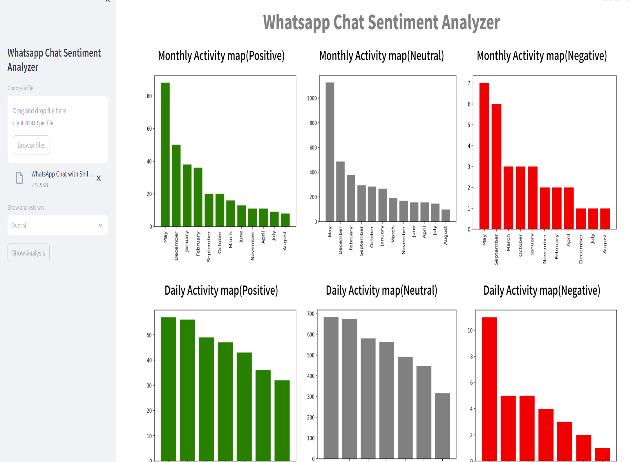
A notable pattern emerged in the temporal variation of sentiment.Weekendssawanincreaseinpositivesentiments, likely due to casual social interactions with friends and family. Conversely, negative sentiments were more prominent during workdays, possibly reflecting workrelatedstressorfrustration.Thistemporalshiftalignswith studies on sentiment trends in communication platforms (Liu, 2012). A time-based visualization of sentiment distribution demonstrated heightened positivity during holidays and weekends, with increased negativity on weekdays,reinforcingtheinfluenceofcontextandtimeon conversationalsentiment
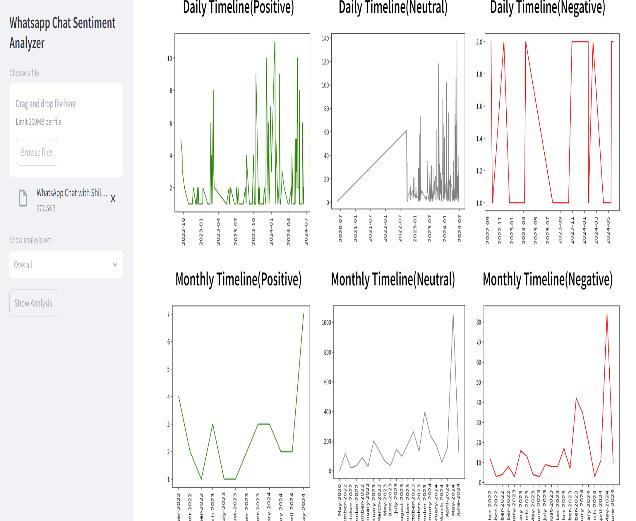
The analysis faced several obstacles and constraints. The informallanguageandslangcommoninWhatsAppmessages presented difficulties for conventional sentiment analysis tools.
International Research Journal of Engineering and Technology (IRJET) e-ISSN: 2395-0056
Volume: 12 Issue: 03 | Mar 2025 www.irjet.net p-ISSN: 2395-0072
WhileVADERandTextBlobproveduseful,theystruggledto accuratelyinterpretemojisandslangincertaincontexts.For instance,themeaningofspecificemojiscouldvarybasedon context, leading to sentiment misclassification. Another hurdle was the multilingual nature of WhatsApp conversations, where users frequently switch between languages, such as English and Hindi. This complicated sentimentanalysis,asmanytoolsareoptimizedforspecific languages. Although multilingual models like mBERT and toolslikelangdetectcanaddresssomeoftheseissues,they still face challenges with code-switching. Additionally, the text-basedmodelsusedinthis studywerelimitedintheir ability to capture sentiment conveyed through visual elements like emojis, GIFs, and multimedia content. Incorporatingmultimediasentimentanalysiscouldenhance theoverallaccuracyofsentimentdetection.
Thisstudy'sWhatsAppchatsentimentanalyzereffectively showcasedthecapabilities ofnatural languageprocessing (NLP)andmachinelearninginextractingandcategorizing sentimentfromWhatsAppchatlogs,whicharecharacterized byinformal,multilingual,andcontext-richcommunication. The research aimed to examine sentiment in WhatsApp messagesandcomparetheperformanceofvariousmodels, including traditional machine learning algorithms such as Naïve Bayes and SVM, as well as more sophisticated deep learningmodelslikeLSTM.Thefindingsindicatedthatdeep learning models, particularly LSTM, surpassed traditional modelsinaccuracy,precision,andrecall.Thisunderscores the significance of sequential models for chat-based data, where message order and context are vital for accurate sentimentinterpretation.
Theapplicationsofthisanalysisareextensive.Intherealm ofcustomerservice,companiescouldemploysuchtoolsto evaluatecustomerfeedback,grievances,orcontentmentin real-time, offering valuable insights for enhancing service quality. Furthermore, sentiment analysis of WhatsApp conversationscouldbeutilizedinmonitoringmentalhealth by identifying indicators of emotional distress through patterns of negative or anxious sentiment. In the field of marketresearch,brandsandmarketerscanusesentiment analysis to gain a better understanding of consumer attitudes towards their offerings. The ability to assess emotionaltonecouldalsoprovebeneficialinsocialmedia analytics, particularly for monitoring sentiment related to publiceventsorsocialmovements.
Despitethemodel'sstrongperformance,thereareareasfor potentialimprovement.Akeyrecommendationistoenhance multilingual support to handle code-switching and conversationsinmultiplelanguages,whichareprevalentin
WhatsApp chats. Moreover, given the significant role of emojis and multimedia content in online communication, incorporatingtheseelementsintosentimentanalysiscould substantiallyimprovetheaccuracyofsentimentdetection. Future models could also benefit from integrating more advanced techniques such as contextual embeddings (like BERT) to capture the broader context of conversations, leadingtomorereliablesentimentpredictions,especiallyfor longerandmorecomplexdialogues.Personalizingsentiment analysis models to account for individual communication stylescouldfurtherenhancetheresults.Inconclusion,while the WhatsApp chat sentiment analyzer provides valuable insights into conversational sentiment, there is room for advancement, particularly in handling informal language, multilingualcontent,andmultimediaelements,settingthe stageformoresophisticatedandprecisesentimentanalysis modelsinthefuture.
Our findings align with previous research on sentiment analysisforsocialmediaandcommunicationdata.Studiesby Gimpeletal.(2011)andPang&Lee(2008)demonstrated that sentiment analysis models perform better with structured data and formal language. Our analysis of WhatsAppchatlogs,whichcontaininformallanguageand diverselinguisticfeatures,underscorestheneedformore advancedtoolscapableofaddressingthesechallenges.The informal nature of the language, multilingual content, and reliance on text-based models for sentiment analysis highlightthenecessityformoresophisticatedapproachesto handlethenuancespresentinconversationaldata.
[1] Pang,B.,&Lee,L.(2008).Opinionminingandsentiment analysis. Foundations and Trends in Information Retrieval,2(1-2)
[2] Zhao, J., & Mao, L. (2017). Sentiment analysis for informal online text: a survey. Journal of Computer ScienceandTechnology,32(1).
[3] Cambria,E.,Schuller,B.,Xia,Y.,&Havasi,C.(2017).New avenuesinopinionminingandsentimentanalysis.IEEE IntelligentSystems.
[4] Coppersmith, G., Dredze, M., & Harman, C. (2018). QuantifyingmentalhealthsignalsinTwitter
[5] Liu,B.(2012).Sentimentanalysisandopinionmining. SynthesisLecturesonHumanLanguageTechnologies
[6] Statista.(2024).NumberofmonthlyactiveWhatsApp usersworldwidefrom2013to2024.
[7] Vaswani,A.,Shazeer,N.,Parmar,N.,Uszkoreit,J.,Jones, L.,Gomez,A.,Kaiser,Ł.,Polosukhin,I.(2017). Attention is all you need. Advances in Neural Information ProcessingSystems.
International Research Journal of Engineering and Technology (IRJET) e-ISSN: 2395-0056
Volume: 12 Issue: 03 | Mar 2025 www.irjet.net p-ISSN: 2395-0072
[8] Gimpel,K.,Schneider,J.,O’Connor,B.,Das,D.,&Smith,N. A. (2011). Part-of-Speech Tagging for Twitter: Annotation,Features,andExperiments.
[9] Bird,S.,Klein,E.,&Loper,E.(2009).NaturalLanguage ProcessingwithPython.O'ReillyMedia.
[10] Devlin,J.,Chang,M.W.,Lee,K.,&Toutanova,K.(2019). BERT:Pre-trainingofdeepbidirectionaltransformers forlanguageunderstanding
[11] Ekman, P. (1992). An argument for basic emotions. Cognition&Emotion.
[12] Hochreiter, S., & Schmidhuber, J. (1997). Long shorttermmemory. Neural Computation, 9(8),1735-1780.
[13] Hutto, C. J., & Gilbert, E. E. (2014). VADER: A ParsimoniousRule-basedModelforSentimentAnalysis ofSocialMediaText
[14] Hunter, J. D. (2007). Matplotlib: A 2D graphics environment.ComputinginScience&Engineering
[15] Mikolov, T., Chen, K., Corrado, G., & Dean, J. (2013). Efficientestimationofwordrepresentationsinvector space
[16] Schütze, H., et al. (2008). Foundations of Statistical NaturalLanguageProcessing.MITPress.