
International Research Journal of Engineering and Technology (IRJET) e-ISSN: 2395-0056
Volume: 13 Issue: 04 | Apr 2026 www.irjet.net p-ISSN: 2395-0072

International Research Journal of Engineering and Technology (IRJET) e-ISSN: 2395-0056
Volume: 13 Issue: 04 | Apr 2026 www.irjet.net p-ISSN: 2395-0072
Mayank Misal1 , Mohit Kapgate2 , Om Patle3 , Kunal Lanje4 ,Prof. Mrunali Chore5
1Student, Computer Science & Engineering, Priyadarshini College of Engineering, Nagpur
2Student, Computer Science & Engineering, Priyadarshini College of Engineering, Nagpur
3Student, Computer Science & Engineering, Priyadarshini College of Engineering, Nagpur
4Student, Computer Science & Engineering, Priyadarshini College of Engineering, Nagpur
5Assistant Professor, Computer Science & Engineering, Priyadarshini College of Engineering, Nagpur
Abstract - Tripplanningcanbechallengingduetothelarge amountoftravelinformationavailableinonline,including destinations, transportation, and activities. Many Preexisting travel planning toolsprovide general Suggestions thatdonotfullyconsiderIndividualentityuserpreferences. To Mitigate this limitation, This study introduces an EXPLOREIT, an intelligent system designed to generate personalizedtravelitinerariesusingLargeLanguageModels (LLMs)andartificialintelligencetechniques.Thedeveloped modelanalysesuserinputssuchaspreferreddestinations, traveldates,budgetconstraints,interests,andtripduration toproducecustomizedtravelplans.ByintegratingAchatbot with recommendation features, the system can suggest suitable attractions, accommodation options, and travel routesthatalignwiththeuser’spreferences.Notonlythat, the platform can Make use of travel-related data such as reviews, ratings, and cost details to enhance the accuracy and usefulness of suggestions. The AI-powered planner works as a web or mobile app that makes trip planning easier for travelers and reduces the time they spend searching and organizing everything on their own. The resultsindicatethatintegratingLLMtechnologyintotravel planningsystemscansignificantlyenhancepersonalization, improve decision-making, and deliver a seamless and engagingtripplanningexperienceforusers
Key Words : Travelplanner;LargeLanguageModel; Recommendersystem;Customizeditinerary;Travelguide system.
Inrecentyears, tourismhasgrown intoone of the largest and fastest-growing service industries, supported by the rapidexpansionofonlineplatformsthatprovideinformation aboutdestinations,transport,accommodation,andactivities. Still,formosttravelers,planningatripremainsacomplex, time-consuming task and requires manually browsing on differentwebsites,Bycomparingscatteredinformationand organizingitintoaclearitinerarythatsuitsthebudget,time, andpersonalinterests.Traditionaltourpackagesandmany existing recommendation systems often deliver generic suggestionsthatfailtocapturethevariationsofindividual preferences.
Recent advances in artificial intelligence (AI), especially large language models (LLMs) and conversational agents,
help make travel planning smarter, more interactive, and morepersonal.Atthesametime,therehavebeenadvances inrecommendersystemsanddata-driventourismplatforms showthatincorporatinguserratings,emotionalresponses, and behavioral patterns can significantly improve the relevanceofsuggestedpointsofinterest.
Many AI-based travel tools still rely on static or outdated data,reducingtheirabilitytoshowreal-timedestinationand hotel availability, pricing, and constraints. Moreover, conventional LLM applications in travel planning struggle withissueslikethecold-startproblem,wherethesystemhas littledatafornewusers,maintainingconsistentpreferences across multiple interactions, and ensuring logical, feasible itinerariesoverseveraldays
So,thereisaneedforatravelplanningsystemthatcombines everythinginoneplace.thatcombinesthenatural-language capabilities of LLMs with real-time, data-driven recommendationand robustpersonalizationmechanisms. Suchasystemshouldbeabletocollectuserrequirements through conversation, access up-to-date travel data, plan multi-daytripsthatarepracticalandachievable,andadapt to user feedback over time. The aim of this research is to designanddevelopanLLM-basedintelligenttravelplanner that solves these gaps by bringing everything together conversational interaction, web-scraped real-time information,andpersonalizedrecommendationintoasingle, user-centricplatform.
Although AI-driven trip planners are becoming more common, travelers still lack a unified system that can generateaccurate,validate,andadaptmulti-dayitineraries aligned with their evolving preferences and constraints. Current tourism advice platforms and packaged solutions offer pre-planned routes and fixed options that rarely account for individual ratings, emotions, and diverse exploration patterns, which leads to less appropriate destinationselectionsandexperiences.Usersaretherefore forcedtomanuallyintegrateinformationaboutattractions, transportation,andaccommodationfromdifferentsources, despite evidence that they prefer a single consolidated resourcefordestinationinformation.
2395-0056
Volume: 13 Issue: 04 | Apr 2026 www.irjet.net p-ISSN: 2395-0072
LLM-based planners have started to reduce the burden of manual planning by generating itineraries from naturallanguage descriptions of user needs, but they face major limitations. Traditional LLM setups in travel domains are limited by high cost involved in fine-tuning, cold-start challengeswhenuserdataislimited,difficultiesinensuring the itinerary is practical and feasible, and insufficient mechanisms for maintaining contextual memory across multi-turn interactions. As a result, generated plans may overlookbudgetlimits,area-specificlimits,oruser-specific patterns,andmaynotremainconsistentwhenusersrefine theirpreferencesoverseveralconversations.
Anotherissueisthatreal-timeinformationisnotfullyused, different types of data in many existing tools. While some systemsalreadyscrapeflightandhotelinformationanduse content-based recommendation engines, their focus is primarilyon matchingprices,ratings,and preferencesfor layovers,ratherthanonintegratingtheseconstraintswith long-horizonreasoningaboutdailytimingsandtravelspeed. Moreover,veryfewplatformsmaintaineasytounderstand, persistentuser modelsthat accumulateknowledge across trips to address cold-start and improve personalized experienceovertime.
Ourobjectofthisprojectisto developaautomatedtravel planningplatformbasedonAIsothatitdeliversaccurate, feasibleandpersonalizeditinerariesthroughcombinationof informationaccessedbyuser,recommendationtechniques, real time data integration and several constraints based uponpreferences.
Firststepisthedesigningofchattinginterfacewherewewill gather formalized preferences from the user in natural languagesuchasdestination, budget,numberoftravelers, interestandallthiswillbestructuredintorequirementsto generateanitinerary.Consideringrealworldscenarioand capturingtheuserchoicesthroughpromptengineering,this wouldhelpinrefinementofplansandgeneratestepbystep.
Second step will integrate this information and integrate reasoning for enhanced itinerary planner based on LLMs, capable of decomposing this user goals into subtasks and classifyingthemasattractionscheduling,transportplanning and accommodation suggestion. Building on ideas to incorporateotherfactorssuchasgeography,culture,budget constraintsandrefinemulti-dayitinerariesforfeasibility.
Thirdstepoftheprojectwillbedatadrivenrecommendation layer that uses APIs based on travel data such as flights, hotels,weather,localpricestoimplementaccordingtouser constraints and preferences, similar to content-based enginesthatmatchbudgets,ratings,layovers.Thislayerwill betightlycoupledwithLLMsothatitinerariesaregrounded andrealistictoimplement.
Fourth step of project brings us to the consistent and interpretablemoduleofthesystemthatismemorymodule
thatstoresandupdatesuserprofilefromtimetotimebased onpreferences,feedback,interactionhistoryandaddressing cold start limitations improving the long-term personalizationinlinewithrecentframeworkbasedupon memorymanagement.
Finally, the project will help to analyze and generate the itinerarybaseduponquantitativeandqualitativemeasures suchasprecision,ratings,satisfactionofuser,usabilityand followingthisthatvalidatestherecommendationsthrough differentinformationaccessedandalsobyanalyzingusers usagewithothertoolsaswell.
Thescopeofprojectisdefinedinawaysothatisfocuson end-to-end planning and personalization for individual leisure travelers, while leaving out several complex functionalities which involves bookings, social companion matching and that traditional research . This system is designed to address this core trip planning based on destination, multiday itinerary generation and recommendationoftransportandaccommodationoptions withinuserspecificbudget.
It concentrates on short to medium trips rather than long relocation and will primarily target domestic or welldocumentedgenerationofitinerarywherethedestinations are mentioned and data can be found easily upon web so integrateandgenerateawell-plannedroute.
Onthetechnologicaldomainprojectincludesaweb-based frontendandbackendcoordinateswithLLMinteractionand dataretrievalupontheintegrationofoneormoreexternal data providers including the hotels reviews, destination reviews and weather forecasting and other available data consistentandpriordatadrivenapproacheshelpstorunthe module and gather content based upon the updated information. The project will also implement basic user memory to store preferences , past trips and feedbacks providingafulllargescaleagentdeveloped.
Certain functionalities such as integrated payments, guaranteed bookingareout of thisscopeandwill provide linkstoexternalapplicationsofferingtheseservicessothat user might check and make it work, similarly highly specializeddomainslikesuchasriskadventureandtravel visaconsultingorlegalcomplianceareconsideredbeyond projectsboundary.
Evaluationwill be conductedwiththecontrolledgroup of users with predefined test scenarios rather than at global productionscalewithusers,predefinedtestscenarios.With theseboundaries,theprojectaimstodeliverarobustsystem that demonstrates how LLM based reasoning, data driven recommendation and persistent personalization can be helpfulinenhancingdigitaltravelplanning.
Volume: 13 Issue: 04 | Apr 2026 www.irjet.net p-ISSN: 2395-0072
The proposed EXPLOREIT is designed to generate personalized travel itineraries by combining Artificial Intelligence, Large Language Models (LLMs), and recommendation system techniques. The methodology follows a structured process that includes data collection, datapreprocessing,itinerarygeneration,recommendation modelling, user interface development, and system evaluation. Each stage of the methodology is described below.
5.1
The first stage of the system involves collecting travel preferences from users through a user-friendly interface. users share key information such as the starting location, destination, travel duration, number of travellers, budget, andpreferredactivities.Toassistusersinselectinglocations efficiently,afeaturethatsuggestsplacesasyoutype,using locationAPIs(suchasGooglePlacesAPI)canbeused.This functionalitydynamicallysuggestspossiblelocationsasthe usertypes,improvingbothaccuracyandusability.
The collected inputs act as the primary parameters for generatingcustomizedtravelitineraries.Theseparameters helpthesystemunderstandthetraveler’spreferencesand constraints, which are then used in later stages of the recommendationprocess.
In the second stage, the system utilizes a Large Language Model(LLM)throughanAPItogeneratepersonalizedtravel itineraries. The model analyses the user’s travel requirementsandprovidestructuredtravelsuggestions.
Toachieveeffectiveresults,promptengineeringtechniques are applied. Prompt engineering involves designing wellstructuredpromptsthatguidetheLLMtogenerateaccurate andmeaningfuloutputs.Thepromptsincludeinformation suchasthedestination,numberoftraveldays,budgetrange, preferredattractions,andactivity. TheLLMprocessesthe prompt and generates detailed itinerary suggestions, includingrecommendedtouristattractions,anddailytravel plans. The output is then analyzed and organized into a structureditinerarythatuserscaneasilyunderstand.
5.3
Tokeepthesystem’stravelinfoaccurateandcurrent,itpulls data fromall kindsofsourcesflights,hotels,touristspots, and prices. It grabs this info using APIs or web scraping tools,grabbingwhatitneedsstraightfromtravelwebsites. The collected data typically includes attributes such as
airlinedetails,flightduration,hotelratings,accommodation prices, facilities, and customer reviews. This information enables the system to generate realistic travel recommendations that match the user’s preferences and budgetconstraints
Aftergatheringthedata,thenextstepistocleanitupand getitintoshapesoitactuallyworkswell.Thismeansrolling up your sleeves for a few things: getting rid of duplicates, tossingoutanythingirrelevant,fixingweirdformatting,and makingsureeverythinglinesup.Iftherearemissingvalues, you deal with them, whether that means filling in gaps or justcuttingthemout.Fornumberslikepricesorratings,you usenormalization,sotheyactuallymakesensenexttoeach other.Bytheendofallthis,thedata’sclean,organized,and readyfortherecommendationenginetouse.
Thissystemusesacontent-basedrecommendationengineto helppeoplefindtraveloptionstheyactuallywant.Itchecks outthedetailsforeachtravelitemlikewhereitis,howmuch itcosts,hotelratings,amenities,andhowlongittakestoget thereandmatchesthosedetailswithwhatuserssaythey're lookingfor
Every travel option gets its own profile, a sort of digital snapshotwithallthesefeatures.Then,theengineusesthings like cosine similarity and TF-IDF to see how closely each optionmatcheswhattheuserlikes.
Bycomparingtheseprofiles,thesystemfiguresoutwhich hotels,attractions,orflightsfitsomeone’spreferencesand budget.So,usersendupwithrecommendationsthatactually makesenseforthem.
Inordertofacilitateseamlessuser-systeminteraction,the user interface is essential. Modern web frameworks and technologiesareusedtocreateaweb-basedinterfacethat offersinteractiveandresponsiveuserexperience.
Theinterfaceallowsuserstoinputtravelpreferences,view generated itineraries, and explore recommended travel options.Thesystempresentsresultsinaclearformatthat may include day-wise travel schedules, attraction descriptions, estimated costs, and map-based navigation. This design improves usability and helps travelers easily understandtheirtravelplans.
International Research Journal of Engineering and Technology (IRJET) e-ISSN: 2395-0056
Volume: 13 Issue: 04 | Apr 2026 www.irjet.net p-ISSN: 2395-0072
Toreallyknowiftherecommendationsystemdoesitsjob, wehavetocheckhowsoliditssuggestionsare.Here’showit goes:first,wesplitthedatasomegoesintotraining,therest into testing. That way, we see how the system deals with optionsithasn’trunintobefore.
Precision’s easy to get. It measures if the system recommendstravelchoicesthatmattertopeople.Welookat howmanyofitspicksmatchwhatuserslike,basedonthe test data. Then we figure out what percentage of its recommendationswereright.Thatnumbergivesusaclear ideaofwhetherthesystem’sheadingintherightdirection.
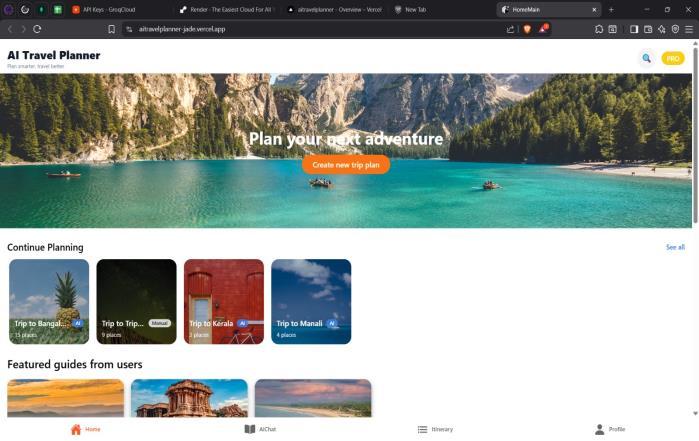
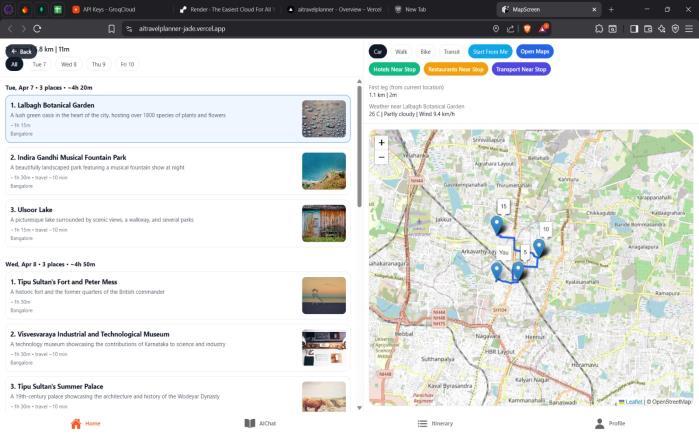
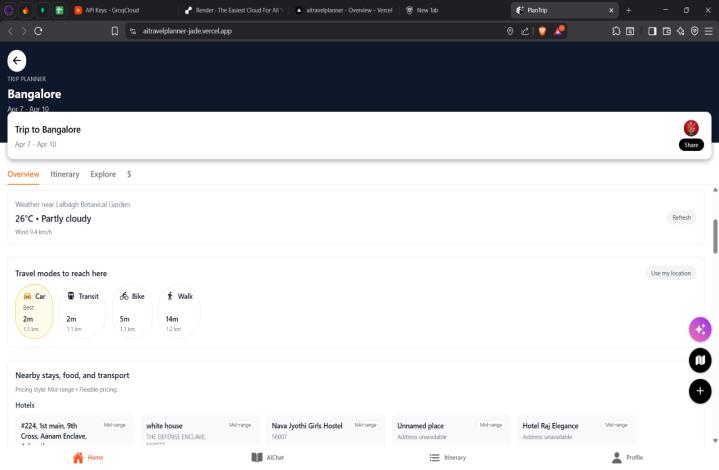
In conclusion, the proposed LLM-based travel planner shows that combining conversational AI,real-time data integration, andpersonalized recommendation techniquescansignificantlyimprovethequality,easeofuse, andpersonalizationoftripplanningcomparedwiththetools typically used. Systems that combine a content-based recommendation engine with chat-based preference gatheringhavealreadydemonstratedtheabilitytoproduce accurate, personalized itineraries and go beyond current technologiesintermsofaccuracyanduserpleasure.
Byaddingapersonalisationlayerwithmemorysupportand structuredplanninglogic,suchsystemscanfurtherenhance cold-start performance, practicality of the itinerary, and long-termconsistencyinmulti-turninteractions.
Overall, the project aligns with current research trends showingthatAI-poweredtravelplatformsimproveplanning efficiency ,minimizeuser effort alsoenhancingthetravel experience with personalized recommendations, better match with user preferences, and guidance for the entire journey
Futureworkcanbuildonthisfoundationbyexpandingdata sources, integrating direct booking, and utilising more detailed user feedback and social features to deliver even moreadaptive,personalisedtravelsupport.
[1]Y.Zhai,X.Wei,andJ.Song,“Designandimplementation ofapersonalizedtourismrecommendationsystembasedon data mining and collaborative filtering algorithms,” Complexity,vol.2020,pp.1–13,2020.
[2] M. Chen, B. Zhang, and J. Zhang, “Personalized travel recommendation system based on social media data and machinelearningalgorithms,” Journal of Ambient Intelligence and Humanized Computing, vol. 10, no. 4, pp. 1367–1376, 2019.
International Research Journal of Engineering and Technology (IRJET) e-ISSN: 2395-0056
Volume: 13 Issue: 04 | Apr 2026 www.irjet.net p-ISSN: 2395-0072
[3] A. Kontogianni, E. Alepis, and C. Patsakis, “Promoting smart tourism personalised services via a combination of deeplearningtechniques,” Expert Systems with Applications, vol.187,Article115964,2022.
[4] Q. Wang and D. Tang, “Research on intelligent recommendationbusinessmodeloftourismenterprisevalue platform from the perspective of value co-creation,” Complexity,2021,ArticleID8441844.
[5] F. Santos, A. Almeida, C. Martins, R. Gonçalves, and J. Martins,“UsingPOIfunctionalityandaccessibilitylevelsfor delivering personalized tourism recommendations,” Computers, Environment and Urban Systems,vol.77,Article 101173,2019.
[6]S.Du,H.Zhang,H.Xu,J.Yang,andO.Tu,“Tomaketravel healthier: A new tourism personalized route recommendationalgorithm,” Journal of Ambient Intelligence and Humanized Computing, vol. 10, no. 9, pp. 3551–3562, 2019.
[7]E.Park,J.Park,andM.Hu,“Tourismdemandforecasting withonlinenewsdatamining,” Annals of Tourism Research, vol.90,Article103273,2021.
[8]C.Bin,T.Gu,Y.Sun,and L.Chang,“Apersonalized POI route recommendation system based on heterogeneous tourism data and sequential pattern mining,” Multimedia Tools and Applications, vol. 78, no. 24, pp. 35135–35156, 2019.