
International Research Journal of Engineering and Technology (IRJET) e-ISSN: 2395-0056
Volume: 13 Issue: 02 | Feb 2026 www.irjet.net p-ISSN: 2395-0072
EXPLAINX-MALDETECT: ENHANCING MALWARE DETECTCION WITH INTERPRETABLE
Mrs. P. Swathi1 ,Lohith.M2, Brijesh Kumar goud. T3, Harshini.K4, Charitharth swamy.M5
1Assistant Professor, Department of IT, TKR College of Engineering and Technology, Telangana, India 2,3,4,5B.Tech Students, Department of IT, TKR College of Engineering and Technology, Telangana, India
Abstract – Explain X-Maledict is an AI-driven malware detection system designed to address the limitations of traditional signature-based antivirus tools, which struggle to detect rapidlyevolvingandzero-daythreats.Existingmalware detection systems often operate as black-box models, offering high accuracy but no transparency into how decisions are made. This lack of interpretability reduces trust and makes detailed threat analysis difficult for security professionals. Explain X-Mal Detect overcomes these challenges by integrating Machine Learning and Deep Learning models such as Random Forest, Decision Tree, Logistic Regression, MLP, anda customdeep neuralnetwork withExplainableAI (XAI) methods like SHAP and LIME. The system classifies files or dataset samples as benign or malicious and automatically removes malware-classified files to prevent system compromise. XAI techniques provide clear, feature-level explanations that help analysts understand why a file was flagged,ensuringtransparencyandinformeddecision-making. Technically, the system uses Python-based ML workflows, a modular architecture for easy updates, andvisualizationtools for interpretability. Overall, Explain XMal Detect improves detection accuracy, enhances trust through explainability, reduces manual analysis time, and contributes to a more secure and insight-driven malware defines ecosystem.
Key Words: Explainable Artificial Intelligence (XAI), MalwareDetection,Zero-DayAttacks,MachineLearning, Deep Learning, SHAP, LIME, Random Forest, Decision Tree,LogisticRegression,MultilayerPerceptron(MLP), Neural Networks, Feature Interpretability, Cybersecurity,AI-DrivenThreatDetection,Transparent Security Systems.
1. INTRODUCTION
Intoday’sdigitalenvironment,malwarehasbecomeoneof themostpersistentandsophisticatedthreatstocomputing systems.Traditionalsignature-basedantivirustoolscanno longer keep pace with rapidly evolving and obfuscated malwarevariants.Thesesystemsmainlyrelyonpredefined signatures,makingthemineffectiveagainstnewlygenerated or zero-day threats. As a result, modern cybersecurity requires intelligent and adaptable detection mechanisms capableofidentifyingunknownthreatswithhighaccuracy. MachineLearning(ML)andDeepLearning(DL)modelshave emergedaspowerfulalternativesformalwaredetectiondue totheirabilitytolearncomplexpatternsfromlargedatasets.
However, despite their accuracy, these models operate as “black boxes,” providing no clarity behind their decisions. This lack of transparency makes it difficult for security analyststointerpretpredictions,validatemodelreliability, or understand system behavior limiting their practical adoption in cybersecurity workflows. To address this challenge,ExplainableArtificialIntelligence(XAI)techniques such as SHAP and LIME have gained importance. These frameworksmakeAImodelsinterpretablebyhighlighting key features that influence a classification decision. By integratingexplainabilitywithML-basedmalwaredetection, it becomes possible to combine accuracy with trust, improving both system reliability and user confidence. Explain X-Mal Detect is a hybrid AI-driven malware detection system designed to classify files as malicious or benign while providing clear interpretability for each prediction. The system utilizes multiple ML/DL models includingRandomForest,DecisionTree,LogisticRegression, MLP, and Deep Learning to analyses static features of dataset samples. When a file is identified as malware, the systemautomaticallydeletesitto prevent potential harm. Through XAIvisualizations, usersgain insightsinto why a filewasflagged,bridgingthegapbetweenhigh-performance detection and transparency. Overall, Explain X-Mal Detect enhances cyber security by offering accurate detection, human understandable explanations, and automated defensiveactions.Thesystemcontributestowardbuilding intelligent, interpretable, and practical malware detection solutionssuitableformodernthreatlandscapes.
1.1 Limitations of Traditional Malware Detection Systems
Traditional malware detection systems mainly rely on signature-basedtechniques,whereknownmalwarepatterns arestoredinadatabaseandmatchedagainstincomingfiles. Whileeffectiveagainstpreviouslyidentifiedthreats,these systemsfailwhendealingwithnew,polymorphic,orzeroday malware, which continuously evolve to evade detection. Frequent signature updates are required, and even minor changesinmaliciouscodecanbypasstraditionaldefenses. Additionally, conventional systems lack adaptability and struggle to scale against the rapidly growing volume of malware.Thisresultsindelayeddetection,increasedfalse negatives, and higher vulnerability to sophisticated cyberattacks,makingtraditionalapproachesinsufficientfor moderncybersecurityneeds.
International Research Journal of Engineering and Technology (IRJET) e-ISSN: 2395-0056
Volume: 13 Issue: 02 | Feb 2026 www.irjet.net p-ISSN: 2395-0072
1.2 for Explainable AI in Modern Malware Detection
Modern malware detection systems increasingly use Machine Learning and Deep Learning models to improve accuracy and handle complex threat patterns. However, many of these models function as black boxes, providing predictionswithoutexplainingthereasoningbehindthem. This lack of transparency reduces trust among security analysts and makes forensic investigation and decision validationdifficult.ExplainableArtificialIntelligence(XAI) addresses this challenge by offering human-interpretable explanationsformodeldecisions.TechniquessuchasSHAP andLIMErevealfeature-levelcontributions,helpinganalysts understandwhyafileisclassifiedasmaliciousorbenign.By integrating XAI with AI-driven detection, systems like ExplainX-MalDetect ensure transparency, improveanalyst confidence, reduce manual analysis time, and support informedcybersecuritydecision-making.
2. PROPOSED SYSTEM
The proposed system, ExplainX-MalDetect, aims to significantly enhance traditional malware detection approaches by integrating advanced AI techniques with interpretability features. Unlike conventional malware detection tools that often operate as “black boxes,” this systemfocusesnotonlyonaccuratelyidentifyingmalicious software but also on providing transparent and understandable explanations for its decisions. The core objectiveofExplainX-MalDetectistoempowercybersecurity analystswithanintelligenttoolthatcombineshighdetection accuracywithhuman-readableinsights.Thisdualapproach improvestrustinautomateddetectionresultsandfacilitates faster,moreinformeddecision-makinginthreatresponse. Thesystememploysstate-of-the-artmachinelearningand deep learning algorithms trained on diverse malware datasets to identify both known and emerging threats. Beyond detection, ExplainX-MalDetect incorporates an interpretabilitymodulethatbreaksdownAImodeloutputs intomeaningfulexplanations.Theseexplanationshighlight which features or behavioural patterns influenced the detection decision, making it easier for analysts to verify alerts and understand malware characteristics. Moreover, thesystemsupportsreal-timescanningandthreatanalysis, ensuring prompt identification of malware as it infiltrates systems or networks. The automated alert mechanism immediatelynotifiessecurityteamsofpotentialrisks,while detailed, interpretable reports provide comprehensive informationforincidentinvestigation.ExplainX-MalDetect alsofeaturesusermanagementandsecureaccesscontrols, ensuringthatonlyauthorizedpersonnelcanaccesssensitive dataandconfiguredetectionparameters.Thesystemallows for continuous learning by periodically updating and retraining AI models with newly discovered malware samples, thus adapting to the evolving threat landscape. Integrationcapabilitieswithexistingcybersecuritytoolsand
platforms further enhance the usability of the system, enablingseamlessincorporationintoorganizationalsecurity workflows. Overall, the proposed system addresses the majorlimitationsofcurrentmalwaredetectionsolutionsby combining cutting-edge AI accuracy with explainability, therebyimprovingbothdetectionperformanceandanalyst confidence.
2.1 System Architecture
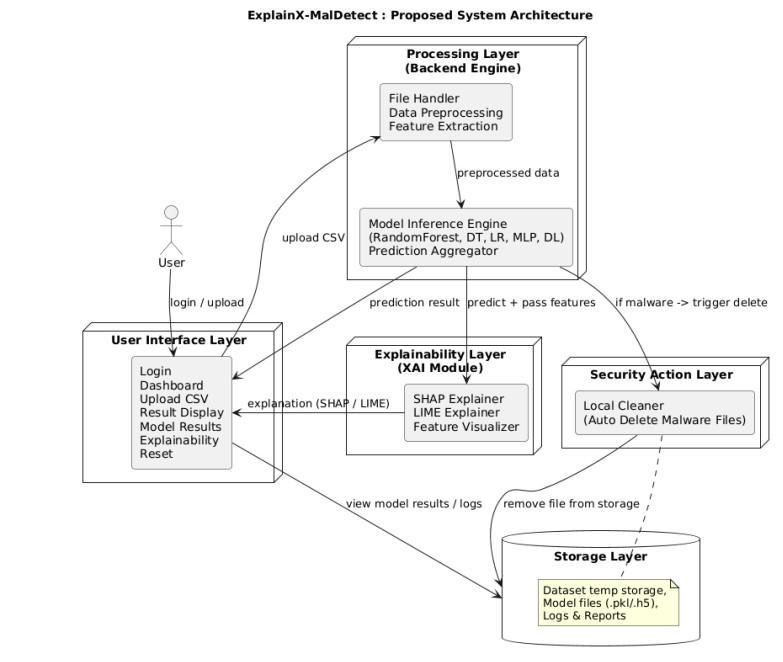
TheExplainX-MalDetectsystemarchitectureisdesignedasa modular,end-to-endpipelinethatensuresefficientmalware detection along with transparent decision-making. The architecture begins with data ingestion, where executable files or dataset samples are collected and preprocessed throughfeatureextractionandnormalization.Thesefeatures are then passed to multiple Machine Learning and Deep Learningmodels,includingRandomForest,DecisionTree, LogisticRegression,MLP,andacustomdeepneuralnetwork, whichcollaborativelyclassifyinputsasbenignormalicious. Onceafileisidentifiedasmalicious,anautomatedresponse module isolates and removes it to prevent system compromise. Simultaneously, Explainable AI components suchasSHAPandLIMEanalyzethemodelpredictionsand generate feature-level explanations, which are visualized through an interpretability dashboard for analyst review. Themodulardesignallowseasyintegrationofnewmodels or explanation techniques, ensuring scalability, maintainability,andadaptabilitytoevolvingmalwarethreats whilemaintaininghighaccuracyandtrust.
2.2 Automated Malware Detection and Mitigation Process
The proposed system implements an automated malware detection workflow that minimizes human intervention while ensuring rapid threat response. After feature extraction,thetrainedMachineLearningandDeepLearning
International Research Journal of Engineering and Technology (IRJET) e-ISSN: 2395-0056
Volume: 13 Issue: 02 | Feb 2026 www.irjet.net p-ISSN: 2395-0072
modelsanalyzetheinputdatatoidentifymaliciousbehavior patterns. Once a file is classified as malicious, the system immediatelytriggersamitigationmechanismthatisolates and removes the infected file from the environment. This proactiveapproachpreventsmalwarepropagation,reduces system exposure time, and enhances overall security resilience. Automation not only improves response speed but also significantly lowers the workload on security analysts, enabling them to focus on high-level threat investigationandsystemimprovement.
2.3 Explainability and Analyst-Centric Decision Support
Akeystrengthoftheproposedsystemliesinitsintegration of Explainable Artificial Intelligence (XAI) to support informeddecision-making.Insteadofprovidingonlybinary classification results, the system generates detailed explanationsusingSHAPandLIMEtechniquestohighlight themostinfluentialfeaturesbehindeachprediction.These explanationshelpanalystsunderstandthereasoningofthe detectionmodels,verifyalerts,anddistinguishbetweentrue threatsandfalsepositives.Bytransformingcomplexmodel behaviorintointerpretableinsights,thesystembuildstrust, improves transparency, and supports effective forensic analysis, making it suitable for real-world cybersecurity environments
3. IMPLEMENTATION DETAILS
The implementation of ExplainX-MalDetect follows a systematicworkflowthatintegratesmachinelearning,deep learning, explainable AI (XAI), and automated malwarehandlingmechanisms.Thesystemwasdevelopedto ensure high detection accuracy, transparency of decisionmaking,andautomaticremovalofharmfulfiles.Theentire methodologyisexecutedthroughmodularcomponents,each responsible for a specific stage of the malware detection pipeline.TheimplementationbeginswiththeInputModule, wheretheuseruploadsafilethroughtheinterface.Oncethe fileisreceived,thesystemchecksitsformatandconvertsit into a suitable representation for further analysis. This uploaded file is then passed into the Preprocessing Unit, which extracts important static attributes such as file metadata,opcodepatterns,strings,andAPIcallfrequencies. For datasets, missing values are handled, features are normalized, and redundant attributes are removed to improvetrainingefficiency.Afterpreprocessing,thefeature vector is forwarded to the Hybrid Machine Learning and DeepLearningClassificationEngine,whichformsthecoreof theproposedmethodology.Thisengineconsistsofmultiple models including Random Forest, Decision Tree, Logistic Regression, Multi-Layer Perceptron (MLP), and a Deep Learning model. Each model is trained using labelled malware and benign datasets. During execution, these modelsworkeitherthroughensemblevotingorbyselecting thebestperformingclassifier.Thefinaloutputofthisstageis
thepredictionlabelindicatingwhetherthefileisMalwareor Benign.Onceclassificationiscomplete,thesystemactivates theExplainableAI(XAI)Module,whichusesSHAP(SHapley Additive exPlanations) and LIME (Local Interpretable ModelAgnostic Explanations) to generate meaningful insights.SHAPassignsimportancevaluestoeachfeatureand shows how they influenced the model’s prediction, while LIME builds local surrogate models around the specific sample to provide human-understandable explanations. Thesevisualandtextualexplanationshelpusersunderstand whythemodelclassifiedthefileasmalware,addressingthe black-boxbehaviouroftraditionalML/DLmodels.Following the explanation step, the system triggers the Automated Malware Handling Module. If the prediction indicates a malicious file, the system automatically deletes or quarantinesittopreventfurtherexecutionorpropagation within the user environment. All detection results, explanations,timestamps,andremovedfilelogsarestored intheinternal database.ThisallowstheAdminModuleto monitormalwareactivity,reviewlogs,andanalysepatterns over time. Finally, the results are delivered to the user through the Front-End Dashboard, which presents the predictionoutcome,SHAPandLIMEexplanationgraphs,and thestatusoftheprocessedfile.Thisinterfaceensureseaseof use, transparency, and an improved user experience. The entireimplementationissupportedthroughPython-based ML/DL frameworks, visualization libraries, and a secure backendthatcoordinatestheworkflow.
4. RESULTS AND PERFORMANCE ANALYSIS
The results and performance analysis of the proposed ExplainX-MalDetectsystemdemonstrateitseffectivenessin accurately identifying malicious files while maintaining transparencyindecision-making.Experimentalevaluation shows that the integrated Machine Learning and Deep Learning models achieve high classification accuracy, precision,recall,andF1-score,indicatingreliabledetection of both known and previously unseen malware samples. Ensemble-based models such as Random Forest perform strongly in handling complex feature interactions, while deep learning models improve generalization for sophisticatedattackpatterns.TheinclusionofExplainableAI techniques does not introduce significant computational overhead and successfully provides clear feature-level insightsforeachprediction.Overall,thesystemreducesfalse positives,improvesdetectionconfidence,andoutperforms traditional signature-based approaches, validating its suitabilityforrealworld,explainablemalwaredetection.
5. CONCLUSIONS
In conclusion, the proposed ExplainX-MalDetect system effectively addresses the shortcomings of traditional malwaredetectionapproachesbycombiningrobustMachine Learning and Deep Learning models with Explainable Artificial Intelligence techniques. The system not only
International Research Journal of Engineering and Technology (IRJET) e-ISSN: 2395-0056
Volume: 13 Issue: 02 | Feb 2026 www.irjet.net p-ISSN: 2395-0072
achieveshighdetectionaccuracyagainstevolvingandzeroday threats but also ensures transparency by providing meaningful,featurelevelexplanationsforeveryclassification decision. This interpretability enhances trust, supports informedanalysis,andreducesthetimerequiredformanual investigation by security professionals. With its modular architecture, automated mitigation capabilities, and emphasisonexplainability,ExplainX-MalDetectcontributes to a more reliable, transparent, and intelligence-driven cybersecurityecosystem,makingitwellsuitedformodern malwaredefenseenvironments.
6. FUTURE WORK
Future work on ExplainX-MalDetect can focus on further enhancing its adaptability, scalability, and detection capabilities.Thesystemcanbeextendedtosupportrealtime malware detection by integrating streaming data analysis and online learning models. Incorporating advanced deep learning architectures and ensemble techniques may improve robustness against highly obfuscated and polymorphic malware. Future versions can also include behavior-based and dynamic analysis, such as monitoring system calls and network traffic, to complement static feature analysis. Additionally, deploying the system in a cloud-based or distributed environment and integrating automatedthreatintelligencefeedscanimprovescalability and responsiveness. Enhancing XAI visualizations and enabling analyst feedback loops would further strengthen trustandcontinuouslyrefinedetectionperformance.
ACKNOWLEDGEMENT
At the outset, we sincerely express our gratitude to the managementandtheDepartmentofInformationTechnology fortheircontinuoussupport,whichenabledthesuccessful completionofourprojectwithinthestipulatedtime.Weare thankful to the management for their constant encouragement throughout the project duration. We also extendoursincerethankstoourbelovedPrincipal,Dr.D.V. Ravi Shankar, and the Head of the Department, Dr. R. Muruganantham,fortheirkindcooperation,motivation,and forprovidingthenecessaryfacilitiesrequiredforcompleting the project report. Furthermore, we express our heartfelt gratitude to Mrs. P. Swathi, Professor and Project Coordinator,aswellasourguide,forprovidinglaboratory facilities and for offering valuable insights, constructive suggestions, and continuous guidance that significantly enhancedthequalityofthismajorproject.
REFERENCES
[1] Breiman,L.,“RandomForests,”MachineLearning,vol. 45,no.1,pp.5–32,2001.
DOI:10.1023/A:1010933404324
[2] Ribeiro,M.T.,Singh,S.,andGuestrin,C.,“WhyShouldI TrustYou?ExplainingthePredictionsofAnyClassifier,” Proceedings of the 22nd ACM SIGKDD International ConferenceonKnowledgeDiscoveryandDataMining, 2016. DOI:10.1145/2939672.2939778
[3] Lundberg, S. M., and Lee, S.-I., “A Unified Approach to Interpreting Model Predictions,” Advances in Neural InformationProcessingSystems(NeurIPS),2017.DOI: 10.48550/arXiv.1705.07874
[4] Saxe, J., and Berlin, K., “Deep Neural Network Based MalwareDetectionUsingTwoDimensionalBinary Program Features,” Proceedings of the 10th International Conference on Malicious and Unwanted Software (MALWARE), 2015. DOI:10.1109/MALWARE.2015.7413680
[5] Anderson,H.S.,andRoth,P.,“Ember:AnOpenDataset for Training Static PE Malware Machine Learning Models,” arXiv preprint, 2018. DOI: 10.48550/arXiv.1804.04637
[6] Shafiq, M. Z., Tabish, S. M., Mirza, F., and Farooq, M., “PeMiner: Mining Structural Information to Detect MaliciousExecutablesinRealTime,”RecentAdvancesin Intrusion Detection, Springer, 2009. DOI:10.1007/978-3-642-04342-0_9