
International Research Journal of Engineering and Technology (IRJET) e-ISSN: 2395-0056
Volume: 12 Issue: 03 | Mar 2025 www.irjet.net p-ISSN: 2395-0072
EXPERIMENTALLY INVESTIGATING THE STRUCTURAL INTEGRITY OF FOLDED FERROCEMENT PANELS ON VARYING NUMBER AND TYPE OF WIRE MESH LAYERS
Dr.C.Sivanesan 1 , Mr.V.Vijay Kumar 2 , Mrs.S.Sivabakyaselvi 3
1Professor, Department of Civil Engineering, Government College of Engineering Srirangam, Trichy-12. (India);
2Assistant Professor, Department of Civil Engineering, Government College of Engineering Srirangam, Trichy-12. (India);
3Assistant Professor, Department of Civil Engineering, Government College of Engineering Srirangam, Trichy-12. (India).
Abstract - This study investigates the flexural behavior of foldedferrocementpanelsreinforcedwithsquareweldedand woven mesh. Ferrocement, recognized for its enhanced elasticity and durability, is ideal for roofing systems, particularly in affordable housing initiatives in developing economies. The experimental analysis focuses on how the number and type of wire mesh layers affect the ultimate flexural strength and load-deflection characteristics of these panels.Thefindingsindicatethatpanelswithincreasedmesh layers exhibit superior flexural strength and reduced deflection. Specifically, panels reinforced with square woven mesh showcase better performance in terms of load capacity and stiffness com-pared to those with square welded mesh. Furthermore, combining different mesh types optimizes the structural response, demonstrating the potential of ferrocement panels in modern construction practices. This research contributes to the understanding of effective reinforcement strategies for enhancing the performance of ferrocement structures.
Key Words: Folded Ferrocement Panels, Flexural Deformation,WireMesh
1. INTRODUCTION
The industrialization of construction technology has emerged as a highly accepted and preferred method in modern building construction to minimize onsite construction. This can be achieved through various strategies, including the utilization of advanced cementbased composites for structural applications, such as ferrocement.Ferrocement,aformofrein-forced concrete made with closely spaced mesh or small diameter rods encapsulatedinmortar,offersarobustsolutiontoroofing andstructuralissues,particularlyindevelopingeconomies withhighdemandforaffordablehousing.Thematerial,first utilized by Pier Luigi Nervi in the 1940s, is known for its superior performance and versatility, providing greater elasticityandresistancetocracking.Theuseofprefabricated ferrocement components not only enhances construction efficiency but also significantly reduces time, safety concerns, environmental impact, and overall costs.
Refurbishment and strengthening of deteriorating civil infrastructuresusingsuchinnovativematerialsensurethat older structures meet con-temporary safety and serviceability standards, making ferrocement a valuable materialinmoderncivilengineeringandconstruction.
1.1 Definition
ThedefinitionbyACICommittee549was:"Ferrocement isatypeofthinwallreinforcedconcreteconstruction,where usually hydraulic cement is reinforced with layers of continuousandrelativelysmalldiametermesh.Meshmaybe madeofmetallicmaterialsorothersuitablematerials".Inthis definition, ferrocement is not confined to only steel wire mesh but other types of meshes as well. However, the definition ignores an important type of reinforcement currentlyinuseinferrocement,i.e.thecombinationofsteel rodsandwiremesh
1.2 Constituents of Ferrocement
The constituents of ferrocement include the hydraulic cementmortarwhichshouldbedesignedaccordingtothe standard mix design procedures for mortar and concrete whichincludesPortlandcement,water,sand,wiremeshand admixtures
1.2.1
Cement
Thecementshouldbefreshofuniformconsistency andfreeoflumpsandforeignmatterandofthetypeorgrade de-pendingontheapplication.
1.2.1
Cement
Thecementshouldbefreshofuniformconsistency andfreeoflumpsandforeignmatterandofthetypeorgrade de-pendingontheapplication.
1.1.2
Water
Potablewaterisfitforuseasmixingwateraswellasfor curingferrocement.
International Research Journal of Engineering and Technology (IRJET) e-ISSN: 2395-0056
Volume: 12 Issue: 03 | Mar 2025 www.irjet.net p-ISSN: 2395-0072
1.2.3.
Fine Aggregates
Normal weight fine aggregate clean, hard, and strongfreeoforganicimpuritiesanddeleterioussubstances andrelativelyfreeofsiltandclay
1.2.4.
Wire Mesh
Steel meshes for ferrocement includes square woven or square welded mesh and chicken wire mesh of hexagonal shape and expanded metal mesh. Some mesh filaments are galvanized. Properties of the resulting ferrocementproductcanbeexpectedtobeaffectedbymesh size,type,ductility,manufactureandtreatment
2. LITERATURE REVIEW
Vincent Prabakar Rajaiah, et.al, conducted an ExperimentalStudyandconcludedthatthenumberofwire meshlayersdidnotsignificantlyaffectthecrackingloadbut did improve the ultimate flexural strength and ductility. Foldedpanelswithdoublewiremeshlayersshowedhigher strengthandreduceddeflectioncomparedtoflatandtrough panels,highlightingtheirpotentialforimprovedperformance inconstructionapplications.
Mohamad N. Mahmood et.al, investigated the flexural behaviorofflatandfoldedferrocementpanels.Theyfound that adding wire mesh layers significantly improved the flexural strength of both panel types, with folded panels performingbetterthanflatones.Specifically,foldedpanels with 2 and 3 wire mesh layers showed a 37% and 90% increase in flexural strength, respectively, compared to single-layerpanels.Flatpanelshada65%and68%increase in strength with 2 and 3 layers, respectively, compared to plain mortar panels. Additionally, more wire mesh layers enhancedtheductilityandenergyabsorptionofbothpanel types.
R.Jayasreeet.al,conductedacomprehensiveinvestigation intotheflexuralbehavioroffoldedferrocementpanelsvis-àvisflatandtroughpanels,withanemphasisonload-carrying capacity,deformation,andenergydissipationcapacity.The study revealed that augmenting the wire mesh layers significantly enhances the panels' load-carrying capacity, mitigates crack width, and retards crack propagation. The empiricalresultsforvariouspanelgeometriesandwiremesh layers were systematically compared with theoretical predictions.
3. OBJECTIVES OF EXPERIMENTAL STUDY
Alotofworkhasbeendonetostudythebehaviorofflat ferrocement panels but investigation of the behavior of foldedferrocementpanelswithlengthlongerthanonemeter isverylimited.Theaimofthispresentworkistostudythe effect of varying the number and type of steel wire mesh layersontheflexuralbehavioroffoldedferrocementpanels
(SquareWovenMeshwithoneandtwoLayer,SquareWelded MeshWithoneandtwoLayerandCombinationofaLayerof SquareWovenandSquareWelded),toobtaintheultimate flexuralstrengthandtheloaddeflectionbehavior.
The various parameters considered in this study are as follows:-
1. Effect of number of mesh layers on the flexural strengthoffoldedferrocementpanels.
2.Effectofvaryingthetypeofwiremeshlayerson theflexuralstrengthoffoldedferrocementpanels
4. EXPERIMENTAL WORKS
The experimental program involved preparing and testing folded ferrocement slab panels under two-point loadingconditions,focusingonthenumberandtypeofwire meshlayersastheprimaryvariable.Inconstructingfolded ferrocement panels, Materials included Ordinary Portland Cement(Grade53),itsconforming(IS:12269–1987).The PhysicalpropertiesofthecementarereportedinTable1.
Table -1: PropertiesofCement
Sandpassingthrougha2.36mmI.S.sieveandthe PhysicalPropertiesarereportedinTable2.
Table -2: PropertiesofSand
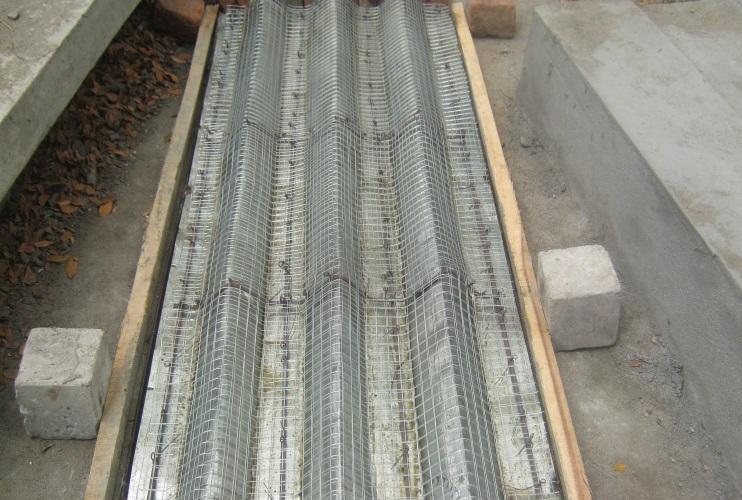
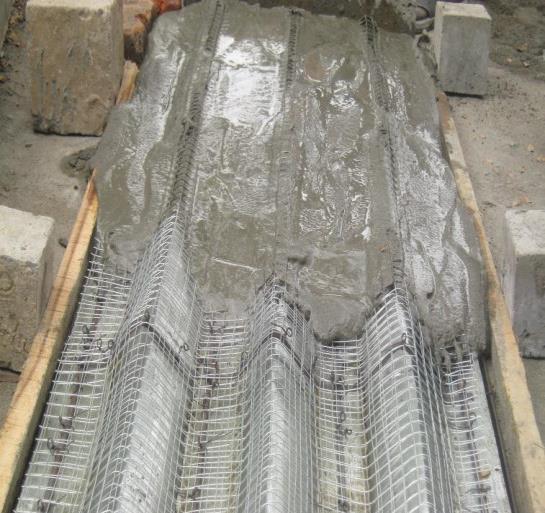
Potablewater,SquareWeldedandWovenmeshes with1.6mmdiameterwiresandopeningsizesof20mmx 20mmand10mmx10mm,respectively,aresecuredto6 mm diameter reinforcement bars. These bars create the primaryskeletalsteelframework,whichservesasabasefor attaching finer wire meshes. For 2000 mm length of the panels,four6mmdiameter barsrunlongitudinally,while fourfolded6mmdiameterbarsarepositionedat500mm intervals.Thisreinforcementdesignensuresthestructural integrity and robustness of the ferrocement panels. The mortar mix proportion of 1:2:0.35 exhibits excellent
International Research Journal of Engineering and Technology (IRJET) e-ISSN: 2395-0056
Volume: 12 Issue: 03 | Mar 2025 www.irjet.net p-ISSN: 2395-0072
workability. Specifically,thecement-sandratiois1:2and the water-cement ratio are 0.35. Twenty-seven mortar cubes,eachofdimensions70mmx70mmx70mm,were castusingthisproportion.Thesecubesunderwenta28-day curing period under pond curing conditions. The compressivestrengthofthemortar,determinedonthe28th day,was38.2MPa
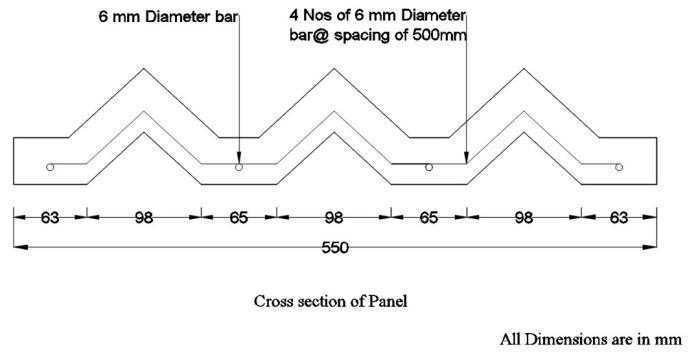
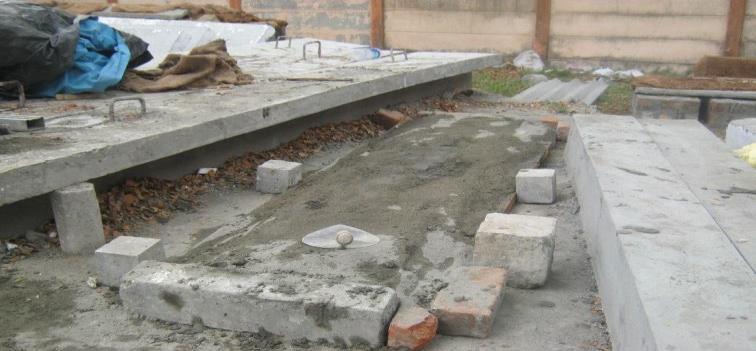
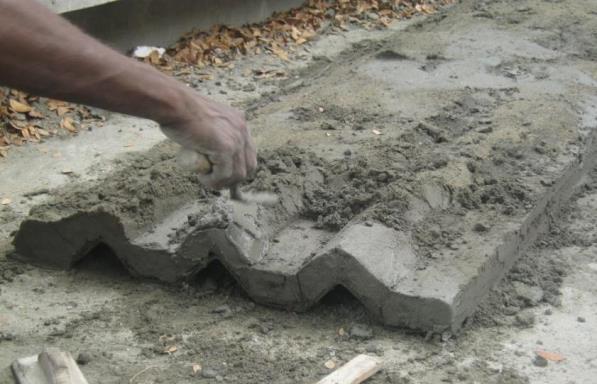
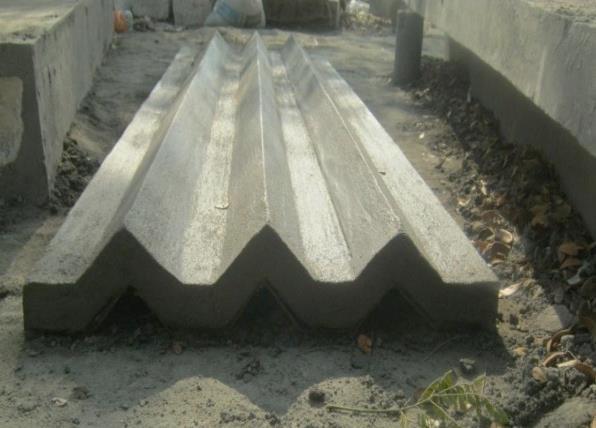
Thetypicalcross-sectionofthefoldedpanelwasdesigned considering practical feasibility such as mold preparation, castingprocesses,andlaboratorytestingfacilities.Thepanel spans2000mm,optimizedforflexuralfailuremode.Atotal offivepanelswerecastandsubjectedtotwo-pointloadingto inducepureflexuralbending.Allpanelsweretestedinaslab testingframeundersimulatedsimplysupportedconditions, withloadsappliedsymmetricallyviaconcentratedlineloads. A 50-ton capacity Hydraulic Jack was utilized for load application, and deflection at the panel's center was measuredusingaDialGaugewithaprecisionof0.01mmand a50mmrange.Tofacilitatecracktracing,panelswerecoated with white cement. Incremental load application was employed, and deflection was recorded continuously until failure.
International Research Journal of Engineering and Technology (IRJET) e-ISSN: 2395-0056
Volume: 12 Issue: 03 | Mar 2025 www.irjet.net p-ISSN: 2395-0072
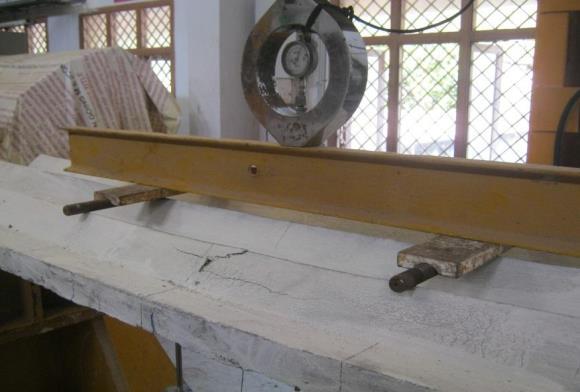
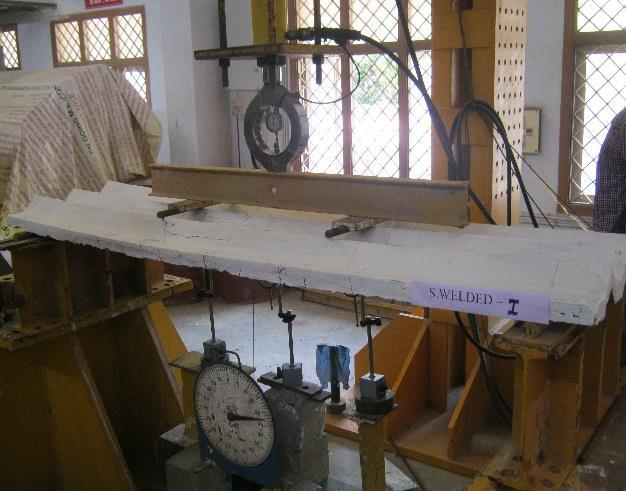
Fig -3. B
Fig -3. A – B- TestingSetupoftheFoldedFerrocement PanelunderTwo-pointlineloadstogetpureflexural bending
Table -3- TESTRESULTSOFSQUAREWOVEN-1
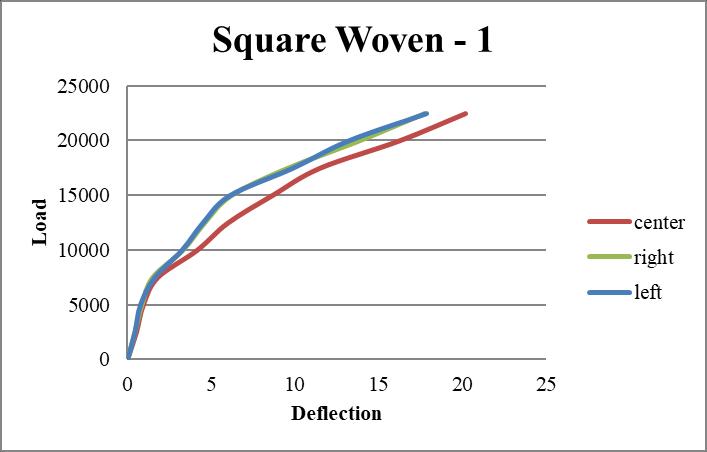
Chart -1:LoadVsDeflectionCurveofSquareWoven1.
Table -4- TESTRESULTSOFSQUAREWELDED1
2
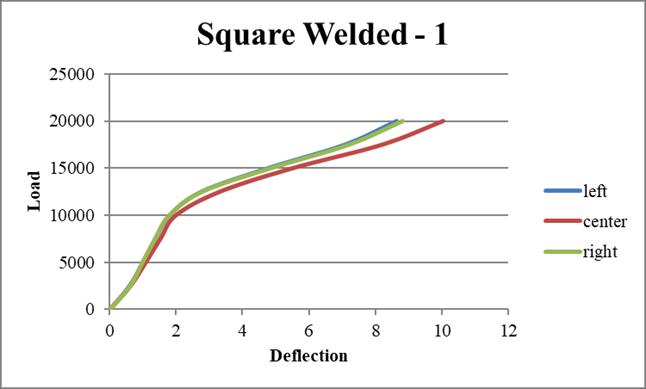
Chart -2:LoadVsDeflectionCurveofSquareWelded1.
International Research Journal of Engineering and Technology (IRJET) e-ISSN: 2395-0056
Volume: 12 Issue: 03 | Mar 2025 www.irjet.net p-ISSN: 2395-0072
Table -5- TESTRESULTSOFSQUAREWOVEN2 Sl
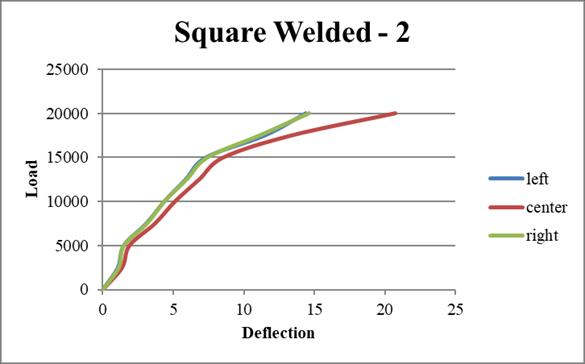
Chart -4:LoadVsDeflectionCurveofSquareWelded2
Table -7- TESTRESULTOFSQUAREWOVEN1+SQUARE WELDED1
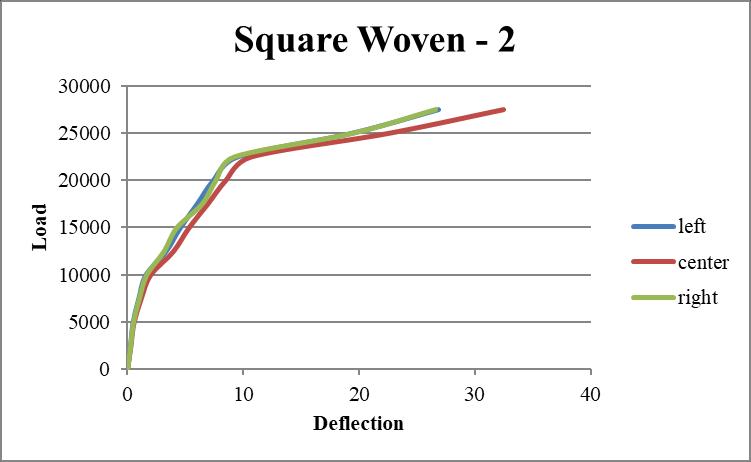
Chart -3:LoadVsDeflectionCurveofSquareWoven2.
Table -6- TESTRESULTSOFSQUAREWELDED2
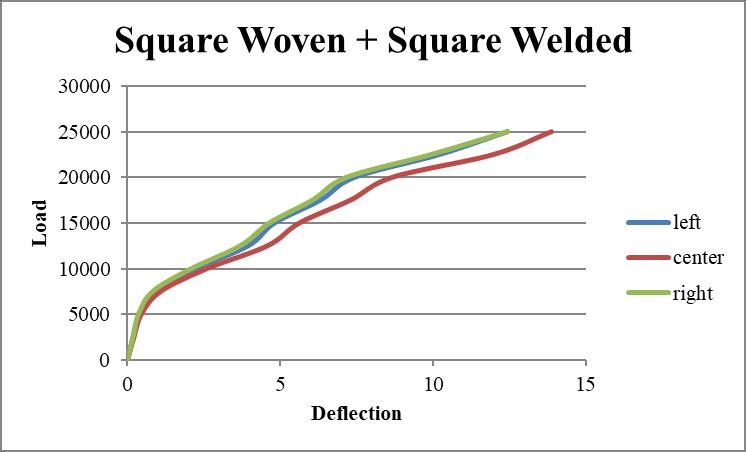
Chart -5:LoadVsDeflectionCurveofSquare Woven 1+ Square Welded 1.
International Research Journal of Engineering and Technology (IRJET) e-ISSN: 2395-0056
Volume: 12 Issue: 03 | Mar 2025 www.irjet.net p-ISSN: 2395-0072
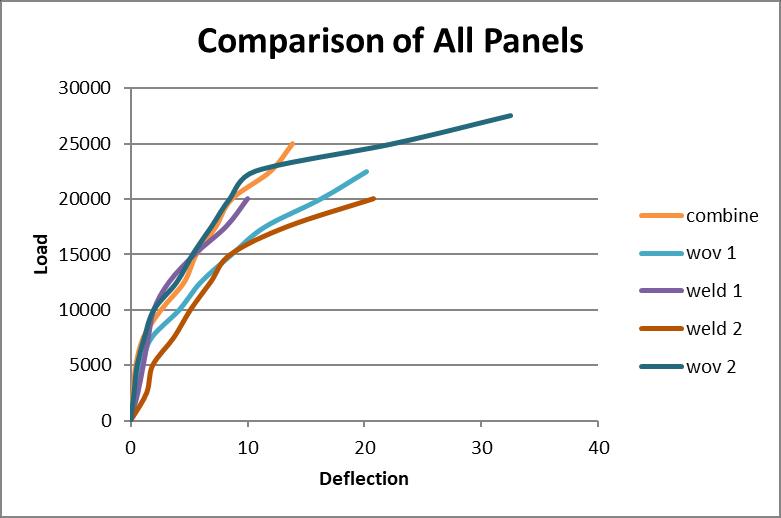
Chart -6 Load Vs Deflection Curve – Comparison of All Panels.
Table3to7,ShowstheexperimentalresultsofSquareWoven 1,SquareWelded1,SquareWoven2,SquareWelded2and Combination of Square Woven 1 and Square Welded 1 respectively. In which the data clearly shows that the deflectionatcentregraduallyincreases.Similardeflectionis observedwithnegligiblevariationatrightandleftdeflection readings
5. Conclusions and comments
5.1 Flexural Strength and Deflection:Panelswithmore wiremeshlayers,whethersquarewovenorsquare welded, exhibit higher flexural strength and lower deflection. For instance, panels with two layers of square woven mesh (Square Woven 2) and square weldedmesh(Square Welded2)showsignificantly higherload-bearingcapacityandreduceddeflection compared to panels with a single layer (Square Woven1andSquareWelded1).
5.2 Comparison of Mesh Types: Bothsquarewovenand square welded mesh types enhance the flexural strength of the panels. However, the specific performance variesslightly betweenthe twotypes. For example, at a load of 20000 Newtons, the deflection for Square Woven2is7.4mmattheleft dialgauge,whileforSquareWelded2,itis14.42mm, indicatingthatthewovenmeshmayprovidebetter resistancetodeflectionundersimilarloads.
5.3 Combined Mesh Layers: Panels reinforced with a combination of square woven and square welded mesh layers (Square Woven 1 + Square Welded 1) also show improved performance, with deflection valuesfallingbetweenthose oftheindividual mesh types. This suggests that combining different mesh types can be an effective strategy to optimize the flexuralbehaviorofferrocementpanels.
5.4 Load-Deflection Behavior: The load-deflection curvesindicatethatpanelswithmorelayersofwire mesh can sustain higher loads before significant
deflection occurs. This is evident from the progressive increase in deflection with increasing load, where panels with more mesh layers show a moregradualincreaseindeflection.
In summary, increasing the number of wire mesh layersinfoldedferrocementpanelssignificantlyenhances their flexural strength and reduces deflection, with both squarewovenandsquareweldedmeshtypescontributing positivelytotheoverallperformance. Combiningdifferent meshtypescanfurtheroptimizethestructuralbehaviorof thesepanels.
Square Woven Mesh:Offersbetterperformancein terms of lower deflection and higher stiffness, makingitmoresuitableforapplicationsrequiring higherflexuralstrengthandreducedbending.
Square Welded Mesh:Whilestilleffective,itshows higher deflection under similar loads, indicating slightlylowerstiffnesscomparedtowovenmesh.
Overall, square woven mesh panels exhibit superior performance in terms of flexural strength and deflection resistance compared to square welded mesh panels. Combining both types of meshcan optimize the structural behaviorofferrocementpanels
ACKNOWLEDGEMENT
I express my deepest gratitude to God for the guidance, strength, and blessings that allowed me to complete this project
REFERENCES
[1] ACI Committee 549, “State-of-the-art report on ferrocement”, ACI549-R97, in Manual of Concrete Practice,ACI,Detroit,1997,26pp.
[2] ACI Committee 549-1R-88 and 1R-93: Guide for the Design, Construction, and Repair of Ferrocement, ACI 5491R-88 and 1R-93, in Manual of Concrete Practice, AmericanConcreteInstitute,FarmingtonHills,Michigan, 1988and1993,27pages.
[3] ACI Committee 549-R97: State-of-the-Art Report on Ferrocement, ACI 549-R97, in Manual of Concrete Practice,AmericanConcreteInstitute,FarmingtonHills, Michigan,1997,26pages.
[4] Vincent Prabakar Rajaiah, S.Dharmar, Dr.S.Nagan, “Experimental Investigation on Flexural Behaviour of Folded Ferrocement Panels”, Inter-national Journal of Innovative Research in Science, Engineering and TechnologyVol.3,Issue7,July2014
[5] Mohana Rajendran, Nagan Soundarapandian “An ExperimentalInvestigationontheFlexuralBehaviorof
International Research Journal of Engineering and Technology (IRJET) e-ISSN: 2395-0056
Volume: 12 Issue: 03 | Mar 2025 www.irjet.net p-ISSN: 2395-0072
GeopolymerFerrocementSlabs.”JournalofEngineering andTechnology,Jul-Dec2013,Vol3,Issue2.
[6] Mohamad N. Mahmood, Sura A. Majeed, “Flexural Behavior of Flat and Folded Ferrocement Panels”, AlRafidainEngineeringVol.17No.4August2009
[7] R.Jayasree,G.Srinivasan,“ExperimentalInvestigationon Flexural Behavior of Folded Ferrocement Panels”
International Research Journal of Engineering and Technology(IRJET),Vol:05,Issue:07,July-2018.
BIOGRAPHIES

Dr.C.Sivanesan,M.E.,Ph.D., Professor,DepartmentofCivil Engineering,GovernmentCollege ofEngineeringSrirangam,Trichy12.


Mr.V.VijayKumar,M.E., AssistantProfessor,Departmentof Civil Engineering, Government CollegeofEngineeringSrirangam, Trichy-12.
Mrs.S.Sivabakyaselvi,M.E., AssistantProfessor,Department ofCivilEngineering,Government CollegeofEngineeringSrirangam, Trichy-12.
2025, IRJET | Impact Factor value: 8.315 | ISO 9001:2008