
International Research Journal of Engineering and Technology (IRJET) e-ISSN: 2395-0056
Volume: 13 Issue: 01 | Jan 2026 www.irjet.net p-ISSN: 2395-0072
International Research Journal of Engineering and Technology (IRJET) e-ISSN: 2395-0056
Volume: 13 Issue: 01 | Jan 2026 www.irjet.net p-ISSN: 2395-0072
Pradeep
Kumar Yadav1, Mr. Ushendra Kumar2
1Master of Technology, Civil Engineering, Lucknow Institute of Technology, Lucknow, U.P, India
2Head of Department, Department of Civil Engineering, Lucknow Institute of Technology, Lucknow, India ***
Abstract - The environmental impact associated with the production of ordinary Portland cement has encouraged the development of geo polymer concrete as a sustainable construction material. This study presents an experimental investigationon the effect of curing conditionsonthestrength development of geo polymer concrete. Fly ash–based and fly ash–GGBS blended geo polymer concretemixeswereprepared using sodium hydroxide and sodium silicate as alkaline activators. Two curing regimes, namely ambient curing and heat curing at elevated temperatures, were adopted to evaluate their influence on mechanical properties. Fresh properties were assessed in terms of workability, while hardened properties were evaluated through compressive, split tensile, and flexural strength tests at different curing ages. The results indicate that fly ash–based mixes exhibited higher workability, whereas the incorporation of GGBS reduced workability due to rapidreactionkinetics.Heat-cured geo polymer concrete achieved significantly higher early-age and28-day strength, while ambient-curedflyash–GGBSmixes attained strength comparable to conventional concrete. The study confirms that curing conditionsplayacriticalroleingeo polymerization and strength development.
Key Words: Geo polymer concrete; Curing conditions; Fly ash; Ground granulated blast furnace slag (GGBS); Ambient curing; Heat curing; Strength development; Sustainable construction materials
Theconstructionindustryisoneofthelargestconsumersof naturalresourcesandenergyworldwide.Concrete,beingthe mostwidelyusedconstructionmaterial,playsavitalrolein infrastructuredevelopment.However,theextensiveuseof ordinary Portland cement (OPC) as the primary binder in concretehasraisedseriousenvironmentalandsustainability concerns. This has led researchers to explore alternative binding materials that can reduce environmental impact while maintaining acceptable mechanical performance. In this context, geo polymer concrete has emerged as a promisingsustainablealternativetoconventionalOPC-based concrete.
TheproductionofordinaryPortlandcementisanenergyintensiveprocessthatinvolvesthecalcinationoflimestone
andthecombustionoffossilfuelsatveryhightemperatures, typicallyaround1450°C.Thisprocessreleasesasignificant amount of carbon dioxide into the atmosphere, both from fuelcombustionandfromthedecompositionoflimestone.It isestimatedthatcement manufacturingalonecontributes nearly 7–8% of global CO₂ emissions, making it a major contributortoclimatechange.Inadditiontogreenhousegas emissions,cementproductionconsumeslargequantitiesof natural resources and energy, further aggravating environmentaldegradation.
Growingenvironmentalawarenessandstricterregulations on carbon emissions have created an urgent need for sustainable alternatives to OPC-based concrete. The utilization of industrial by-products such as fly ash and ground granulated blast furnace slag (GGBS) not only reduces cement consumption but also addresses issues relatedtowastedisposal.Sustainableconcretetechnologies aim to minimize environmental impact while ensuring adequatestrength,durability,andservicelife.Geopolymer concreterepresentsonesuchalternativethatalignswiththe principlesofsustainabledevelopmentandcirculareconomy.
1.2.1
Geopolymerizationisachemicalprocessinwhichaluminosilicate materials react with alkaline activators to form a hardenedbinder.UnlikeOPCconcrete,whichgainsstrength throughhydrationreactions,geopolymerconcretedevelops strength through polymeric reactions involving silica and alumina species. Under alkaline conditions, these species dissolveandreorganizeintoathree-dimensionalaluminosilicate network, resulting in a strong and stable binding matrix. This process eliminates the need for cement and significantly reduces carbon emissions associated with concreteproduction.
1.2.2
Alumino-silicatesourcematerialssuchasflyashandGGBS playacriticalroleingeopolymerconcrete.Flyash,richin silica and alumina, contributes to long-term strength
International Research Journal of Engineering and Technology (IRJET) e-ISSN: 2395-0056
Volume: 13 Issue: 01 | Jan 2026 www.irjet.net p-ISSN: 2395-0072
development, while GGBS, containing higher calcium content,enhancesearly-agestrengthandenablesambient curing.Alkalineactivators,typicallysodiumhydroxideand sodiumsilicatesolutions,initiatethedissolutionofsilicaand alumina from the source materials and facilitate the geo polymerization process. The type, concentration, and proportion of these activators significantly influence reaction kinetics, strength development, and curing requirements.
1.3.1 Difference between OPC Hydration and Geo polymerization
Curingplaysafundamentallydifferentroleingeopolymer concretecomparedtoOPCconcrete.InOPCconcrete,curing primarily ensures continuous hydration by maintaining adequate moisture, leading to the formation of calcium silicate hydrate (C–S–H) gel. In contrast, geo polymer concrete does not rely on hydration; instead, curing promotes geo polymerization by providing favorable thermalandchemicalconditions.Asaresult,temperature rather than moisture becomes the dominant factor influencingstrengthdevelopmentingeopolymersystems.
Conventionalwatercuringmethods,whichareessentialfor OPC concrete, are not always suitable for geo polymer concrete. Water curing may lead to leaching of alkaline activators, thereby reducing the alkalinity required for effectivegeopolymerization.Thiscanresultinincomplete polymerization and lower strength development. Furthermore, excessive moisture does not significantly contribute to geo polymer reactions, highlighting the limitations of applying traditional curing practices to geo polymerconcrete.
Temperatureplaysacrucialroleincontrollingtherateand extentofgeopolymerization.Elevatedtemperaturecuring acceleratesthedissolutionofalumino-silicatematerialsand enhancesearly-agestrengthdevelopment,particularlyinfly ash-basedgeopolymerconcrete.Ambientcuringisfeasible whencalcium-richmaterialssuchasGGBSareincorporated. Thecuringenvironment,whethersealedoropen,alsoaffects the retention of alkaline solution and overall strength performance.Therefore,curingconditionsmustbecarefully optimizedforgeopolymerconcrete.
1.4.1
Althoughnumerousstudieshaveinvestigatedgeopolymer concrete, many focus on a single curing method or vary
multiple parameters simultaneously. There is a lack of systematicexperimentalstudiescomparingdifferentcuring regimes under identical mix proportions. This makes it difficulttoisolatethespecificinfluenceofcuringconditions on strength development and limits the reliability of reportedconclusions.
1.4.2
Most existing research emphasizes heat curing due to its effectivenessinachievinghighearly-agestrength.However, heatcuringisimpracticalformostcast-in-situconstruction. Limitedstudieshavefocusedonambientcuringstrategies thatarefeasibleforfieldapplications.Thisgaphighlightsthe needforexperimentalinvestigationsthatevaluateambient curing performance, particularly for blended geo polymer systems.
The primary objective of the present study is to experimentally evaluate the effect of curing conditions on the strength development of geo polymer concrete. The study aims to compare ambient curing and heat curing regimesusingflyashandflyash–GGBSbasedgeopolymer concrete mixes. By assessing early-age and later-age strengthcharacteristics,theresearchseekstoidentifycuring conditions that provide a balance between mechanical performanceandpracticalapplicability,therebysupporting thewideradoptionofgeopolymerconcreteinsustainable construction.
This section describes the materials used and the experimentalmethodologyadoptedtoinvestigatetheeffect of curing conditions on the strength development of geo polymerconcrete.Asystematicapproachwasfollowedfor materialselection;mixproportioning,specimenpreparation, curing, and testing in order to ensure reliability and reproducibility of results. The procedures adopted were based on established practices reported in previous geo polymerconcreteresearch.
2.1.1 Alumino-Silicate Source Materials
Fly ash and ground granulated blast furnace slag (GGBS) were used as the primary binder materials in the present study. Low-calcium Class F fly ash was selected due to its high silica and alumina content, which is suitable for geo polymerization.Flyashcontributestoimprovedworkability andlong-termstrengthdevelopment.GGBS,beingacalciumrich material, was incorporated to enhance early-age strength and enable effective ambient curing. The combinationofflyashandGGBSwasadoptedtostudythe influenceofcalciumcontentonstrengthdevelopmentunder differentcuringconditions.
International Research Journal of Engineering and Technology (IRJET) e-ISSN: 2395-0056
Volume: 13 Issue: 01 | Jan 2026 www.irjet.net p-ISSN: 2395-0072
Alkalineactivatorsconsistingofsodiumhydroxide(NaOH) andsodiumsilicate(Na₂SiO₃)solutionswereusedtoinitiate thegeopolymerizationprocess.Sodiumhydroxidesolution waspreparedatapredeterminedmolarityusinglaboratorygrade pellets and potable water, while commercially available sodium silicate solution was used. The activator solutionsplayacriticalroleindissolvingsilicaandalumina fromthesourcematerialsandfacilitatingpolymericchain formation.
2.1.3
Locallyavailablefineandcoarseaggregateswereusedinthe geopolymerconcretemixes.Naturalriversandconforming to standard grading requirements was used as fine aggregate,whilecrushedstoneaggregatesofnominalsize were used as coarse aggregate. Aggregates constitute the major volume of concrete and primarily contribute to strength through load transfer and interlocking. Their properties were maintained similar to those used in conventionalconcretetoensurecomparabilityofresults.
Table 1: Materials Used in the Study
Material Description Role in Geo polymer Concrete
Flyash(ClassF) Lowcalcium,richinSi andAl Primary geo polymerbinder
GGBS Calcium-rich industrialby-product Enhances early strength
Sodium hydroxide Alkalineactivator Dissolution of aluminosilicates
Sodiumsilicate Silica-richactivator Polymer network formation
2.2.1 Binder Composition
Geo polymer concrete mixes were prepared using fly ash aloneandflyash–GGBSblendedbindersystems.Thebinder composition was selected to evaluate the influence of calcium content on strength development under different curingconditions.Flyash-basedmixeswereprimarilyused to assess heat curing performance, while fly ash–GGBS blendswereusedtoevaluateambientcuringfeasibility.
2.2.2 Activator Molarity and Na₂SiO₃/NaOH Ratio
Themolarityofthesodiumhydroxidesolutionwasselected basedonpreviousresearchfindingstoensureadequategeo polymerization.Sodiumsilicatewascombinedwithsodium hydroxideinafixedratiotoenhancepolymerformation.The
Na₂SiO₃/NaOH ratio was maintained within an optimal rangetobalanceworkabilityandstrengthdevelopment.
2.2.3
Theactivator-to-binderratiowasmaintainedconstantforall mixes to isolate the effect of curing conditions. This ratio governs the availability of alkaline solution required for dissolution and polymerization. An optimum ratio was selectedtoensuresufficientgeopolymerreactionwithout causingexcessiveporosityorlossofworkability.
2.3.1
Geopolymerconcretewaspreparedbyfirstdrymixingthe binder materials and aggregates to ensure uniform distribution. The pre-prepared alkaline activator solution wasthenaddedgradually,andmixingwascontinueduntila homogeneous and workable mix was obtained. Proper mixingisessentialtopromoteuniformgeopolymerization throughouttheconcretematrix.
2.3.2
The fresh geo polymer concrete was placed into standard moulds in layers and compacted using appropriate compaction techniques to remove entrapped air. Proper compactionensureduniformdensityandminimizedvoids, whichdirectlyinfluencestrengthdevelopment.
2.3.3
Specimensweredemouldedaftertheinitialsettingperiod. Care was taken during de moulding to prevent surface damage. After de moulding, specimens were immediately transferredtotheirrespectivecuringenvironments.
International Research Journal of Engineering and Technology (IRJET) e-ISSN: 2395-0056
Volume: 13 Issue: 01 | Jan 2026 www.irjet.net p-ISSN: 2395-0072
2.4.1 Ambient Curing
Ambientcuringwascarriedoutbystoringthespecimensat roomtemperatureunderlaboratoryconditions.Thiscuring regimewasadoptedtoevaluatethepracticalapplicabilityof geo polymer concrete in field conditions, particularly for mixescontainingGGBS.
2.4.2 Heat Curing
Heat curing was performed by placing the specimens in a controlledcuringchamberorovenatelevatedtemperatures for a specified duration. Heat curing accelerates the geo polymerization process and enhances early-age strength, especiallyinflyash-basedgeopolymerconcrete.
2.5
2.5.1 Workability
Workability of fresh geo polymer concrete was assessed usingstandardtestmethodssuchasslumptest.Workability evaluation helped in understanding the effect of binder composition and activator content on fresh concrete behavior.
2.5.2 Compressive Strength Testing
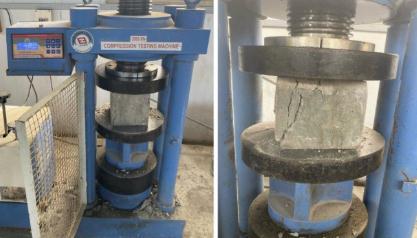
Compressive strength tests were conducted at specified curingagesusingacalibratedcompressiontestingmachine. Compressive strength was considered the primary parametertoassesstheinfluenceofcuringconditionsongeo polymerconcreteperformance.
2.5.3 Split Tensile and Flexural Strength Tests
Whereapplicable,splittensilestrengthandflexuralstrength testswereperformedtoevaluatethetensilebehaviorand crackingresistanceofgeopolymerconcreteunderdifferent curingregimes.
3.
Thissectionpresentsanddiscussestheexperimentalresults obtained from the investigation on geo polymer concrete under different curing conditions. The influence of curing regime and binder composition on compressive strength development is analyzed in detail. The results are interpretedtounderstandstrengthdevelopmentbehaviorat early and later ages and to assess the feasibility of geo polymer concrete as a sustainable alternative to conventionalconcrete.
3.1.1 Comparison between Ambient Curing and Heat Curing
The compressive strength results indicate a significant influence of curing conditions on the performance of geo polymer concrete. Heat-cured specimens consistently exhibited higher compressive strength compared to ambient-cured specimens at all testing ages. Elevated temperature curing accelerates the geo polymerization processbyenhancingthedissolutionofsilicaandalumina from the source materials, leading to rapid formation of a dense geo polymer matrix. In contrast, ambient curing resulted in comparatively lower strength due to slower reactionkinetics,particularlyinflyash-basedmixes.These observationsconfirmthatcuringtemperatureisadominant factor governing strength development in geo polymer concrete.
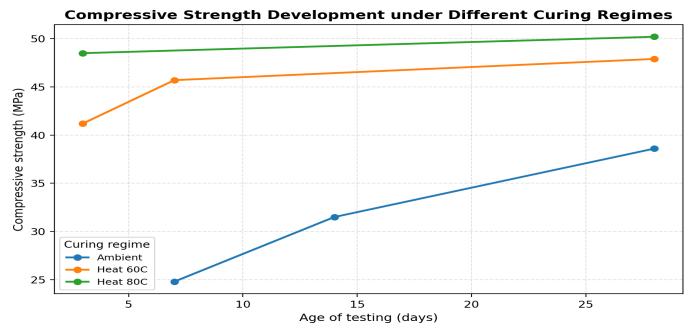
Figure-2: Compressive Strength of Geo polymer Concrete under Different Curing Conditions
3.1.2 Early-Age versus 28-Day Strength Behaviour
Atearlyages,heat-curedgeopolymerconcreteachieveda substantial portion of its 28-day compressive strength, indicatingrapidstrengthgain.Thisbehaviorisattributedto accelerated polymerization under elevated temperature conditions. Ambient-cured specimens showed relatively lowerearly-agestrength;however,continuousstrengthgain was observed with increasing age. By 28 days, ambientcured mixes, particularly those containing GGBS, attained compressive strength comparable to conventional OPC concrete.Thistrendhighlightsthepotentialofgeopolymer concretetodevelopadequatelong-termstrengthevenunder ambientcuring.
3.2.1 Fly Ash versus Fly Ash–GGBS Systems
The binder composition significantly influenced the compressivestrengthofgeopolymerconcrete.Flyash-based geo polymer concrete exhibited higher workability but showedslowerstrengthdevelopmentunderambientcuring
International Research Journal of Engineering and Technology (IRJET) e-ISSN: 2395-0056
Volume: 13 Issue: 01 | Jan 2026 www.irjet.net p-ISSN: 2395-0072
conditions. In contrast, fly ash–GGBS blended systems demonstratedenhancedstrengthdevelopmentatbothearly and later ages. The incorporation of GGBS improved the reactivity of the binder system, resulting in higher compressivestrengthunderambientcuring.Heat-curedfly ash-based mixes, however, performed exceptionally well, confirmingthesuitabilityofflyashsystemsunderelevated temperaturecuring.
The presence of calcium in GGBS played a crucial role in improvingtheambientcuringperformanceofgeopolymer concrete.Calciumcontributestotheformationofadditional bindingphasessuchascalcium-alumino-silicate-hydrate(CA-S-H) gel alongside geo polymer gel. This dual binding mechanism enhances early-age strength and reduces dependency on heat curing. As a result, fly ash–GGBS geo polymerconcreteexhibitedsuperiorstrengthdevelopment under ambient curing compared to fly ash-only systems, makingitmoresuitableforfieldapplications.
3.3.1 Rate of Strength Gain Under Different Curing Regimes
The rate of strength gain varied significantly with curing regime. Heat-cured specimens showed rapid strength developmentwithintheinitialcuringperiod,withmarginal strength gain at later ages. Ambient-cured specimens exhibitedgradualbutcontinuousstrengthdevelopmentover time. This behavior indicates that while heat curing is effectiveforachievinghigh earlystrength,ambientcuring allowssustainedgeopolymerizationandlong-termstrength gain,particularlyincalcium-richsystems.
3.3.2 Comparison with OPC Concrete Benchmarks
WhencomparedwithconventionalOPCconcrete,heat-cured geopolymerconcretedemonstratedcomparableorhigher compressivestrengthatearlyages.Ambient-curedflyash–GGBSgeopolymerconcreteachievedcompressivestrength values similar to OPC concrete at 28 days. These results suggestthatgeopolymerconcrete,whenproperlydesigned
andcured,canmeetstructuralstrengthrequirementswhile offering significant environmental benefits. The findings support the feasibility of geo polymer concrete as a sustainablealternativetoOPC-basedconcreteforpractical constructionapplications.
This experimental study evaluated the effect of curing conditions on the strength development of geo polymer concreteusingflyashandflyash–GGBSbindersystems.The results demonstrate that curing regime significantly influencesthegeopolymerizationprocessandmechanical performance. Heat-cured geo polymer concrete exhibited rapidstrengthdevelopmentandachievedhigherearly-age and 28-day compressive strength, particularly in fly ashbased mixes. Ambient curing resulted in comparatively lower early-age strength; however, fly ash–GGBS blended systems showed substantial improvement due to the presenceofcalcium,whichenhancedreactionkineticsand enabled effective strength gain at room temperature. The study confirmed that geo polymer concrete can achieve compressive strength comparable to conventional OPC concretewhenappropriatebindercompositionandcuring conditionsareadopted.Heatcuringiseffectiveforprecast applications,whileambient-curedflyash–GGBSgeopolymer concrete offers practical feasibility for cast-in-situ construction.Overall,thefindingssupportthepotentialof geopolymerconcreteasasustainableandenvironmentally friendlyalternativetoOPC-basedconcrete.
The present study has certain limitations that should be consideredwhileinterpretingtheresults.Theexperimental investigation focused primarily on strength-related properties, while long-term durability aspects such as resistancetochemicalattack,permeability,shrinkage,and creepwerenotevaluated.Microstructuralcharacterization using techniques such as SEM or XRD was not conducted, limiting detailed understanding of geo polymerization mechanisms.Thestudyconsideredalimitedrangeofcuring temperatures and durations, which may not represent all field conditions. Additionally, the mix proportions and activatorconcentrationswerekeptconstant,andtheeffect of varying molarity or activator ratios was not examined. Field-scale validation and performance under real environmentalexposurewerealsobeyondthescopeofthe presentinvestigation.
[1] J. Davidovits, “Geopolymers: Inorganic polymeric new materials,” Journal of Thermal Analysis, vol. 37, no. 8, pp. 1633–1656,1991.
[2] J. Davidovits, Geopolymer Chemistry and Applications, 3rded.Saint-Quentin,France:InstitutGéopolymère,2011.
International Research Journal of Engineering and Technology (IRJET) e-ISSN: 2395-0056
Volume: 13 Issue: 01 | Jan 2026 www.irjet.net p-ISSN: 2395-0072
[3] A. Palomo, M. W. Grutzeck, and M. T. Blanco, “Alkaliactivated fly ashes: A cement for the future,” Cement and ConcreteResearch,vol.29,no.8,pp.1323–1329,1999.
[4] T. Bakharev, “Thermal behaviour of geopolymers prepared using class F fly ash and elevated temperature curing,” Cement and Concrete Research, vol. 36, no. 6, pp. 1134–1147,2006.
[5] P. Nath and P. K. Sarker, “Effect of GGBFS on setting, workability and early strength properties of fly ash geopolymer concrete cured in ambient condition,” ConstructionandBuilding Materials,vol.66,pp.163–171, 2014.
[6] B. V. Rangan, “Fly ash-based geopolymer concrete,” Research Report GC-4, Curtin University of Technology, Perth,Australia,2008.
[7] J. Temuujin, R. Williams, and A. van Riessen, “Effect of mechanical activation of fly ash on the properties of geopolymer cured at ambient temperature,” Journal of Materials Processing Technology, vol. 209, no. 12–13, pp. 5276–5280,2009.
[8]M.Soutsos,A.P.Boyle,R.Vinai,A.Hadjierakleous,andS. J.Barnett,“Factorsinfluencingthecompressivestrengthof fly ash based geopolymers,” Construction and Building Materials,vol.110,pp.355–368,2016.
[9] S. A. Bernal, R. San Nicolas, R. J. Myers, R. Mejía de Gutiérrez,F.Puertas,andJ.L.Provis,“MgOcontentofslag controlsphaseevolutionandstructuralchangesinducedby acceleratedcarbonationinalkali-activatedbinders,”Cement andConcreteResearch,vol.57,pp.33–43,2014.
[10] J. L. Provis and J. S. J. van Deventer, Alkali Activated Materials:State-of-the-ArtReport,Dordrecht,Netherlands: Springer,2014.
[11]C.Shi,D.Roy,andP.Krivenko,Alkali-ActivatedCements andConcretes,London,U.K.:Taylor&Francis,2006.
[12] A. M. Neville, Properties of Concrete, 5th ed. London, U.K.:PearsonEducation,2011.
[13]IS516:2018,MethodsofTestsforStrengthofConcrete, BureauofIndianStandards,NewDelhi,India.
[14] IS 10262:2019, Concrete Mix Proportioning Guidelines,BureauofIndianStandards,NewDelhi,India.
[15] A. Allahverdi and F. Škvára, “Sulfuric acid attack on hardenedpasteofgeopolymercements Part1:Mechanism of corrosion at relatively high concentrations,” Ceramics–Silikáty,vol.49,no.4,pp.225–229,2005.
[16] S. Kumar, R. Kumar, and S. P. Mehrotra, “Influence of granulatedblastfurnaceslagonthereaction,structureand
propertiesofflyashbasedgeopolymer,”JournalofMaterials Science,vol.45,no.3,pp.607–615,2010.
[17] P. Duxson, A. Fernández-Jiménez, J. L. Provis, G. C. Lukey, A. Palomo, and J. S. J. van Deventer, “Geopolymer technology:Thecurrentstateoftheart,”JournalofMaterials Science,vol.42,no.9,pp.2917–2933,2007.
[18]A.M.NevilleandJ.J.Brooks,ConcreteTechnology,2nd ed.Harlow,U.K.:PearsonEducation,2010.
[19]R.Anuradha,V.Sreevidya,R.Venkatasubramani,andB. V.Rangan,“Modifiedguidelinesforgeopolymerconcretemix design using Indian standard,” Asian Journal of Civil Engineering,vol.13,no.3,pp.353–364,2012.
[20]H.Wang,H.Li,andF.Yan,“Synthesisandmechanical propertiesofmetakaolin-basedgeopolymer,”Colloidsand SurfacesA:PhysicochemicalandEngineeringAspects,vol. 268,no.1–3,pp.1–6,2005.
[21]R.A.Fletcher,K.J.D.MacKenzie,C.L.Nicholson,andS. Shimada, “The composition range of aluminosilicate geopolymers,”JournaloftheEuropeanCeramicSociety,vol. 25,no.9,pp.1471–1477,2005.
[22]P.NathandP.K.Sarker,“Flexuralstrengthandelastic modulus of ambient-cured blended low-calcium fly ash geopolymerconcrete,”ConstructionandBuildingMaterials, vol.130,pp.22–31,2017.
[23] M. Olivia and H. Nikraz, “Strength and water penetrabilityofflyashgeopolymerconcrete,”ARPNJournal ofEngineeringandAppliedSciences,vol.6,no.7,pp.70–78, 2011.
[24]K.A.LloydandJ.L.Provis,“Durabilityofgeopolymer binders:Areview,”AdvancesinAppliedCeramics,vol.109, no.6,pp.357–364,2010.
[25]S.WallahandB.V.Rangan,“Low-calciumflyashbased geopolymer concrete: Long-term properties,” Research Report GC-2, Curtin University of Technology, Perth, Australia,2006.
[26] A. Fernández-Jiménez and A. Palomo, “Mid-infrared spectroscopicstudiesofalkali-activatedflyashstructure,” MicroporousandMesoporousMaterials,vol.86,no.1–3,pp. 207–214,2005.
[27]IS383:2016,CoarseandFineAggregateforConcrete Specification,BureauofIndianStandards,NewDelhi,India.
[28]IS12269:2013,OrdinaryPortlandCement,53Grade Specification,BureauofIndianStandards,NewDelhi,India.
[29]ASTMC618-19,StandardSpecificationforCoalFlyAsh andRaworCalcinedNaturalPozzolanforUseinConcrete, ASTMInternational,WestConshohocken,PA,USA,2019.