

International Research Journal of Engineering and Technology (IRJET) e-ISSN: 2395-0056
Volume: 13 Issue: 04 | Apr 2026 www.irjet.net p-ISSN: 2395-0072
EXPERIMENTAL STUDY ON STRENGTH IMPROVEMENT OF CONCRETE
USING MARBLE DUST AS PARTIAL CEMENT REPLACEMENT WITH LIMESATURATED MIXING WATER
B. Prudhvi Rani
1 , B.
Sai Rama Lakshmi
2 , B.
Ajay
3 , K. Hareesh4 , N. Yamuna5
1Assistant professor, Dept. of civil Engineering, SANKETIKA VIDYA PARISHAD ENGINEERING COLLEGE, Andhra Pradesh, India
2345B.Tech student, Dept. of civil Engineering, SANKETIKA VIDYA PARISHAD ENGINEERING COLLEGE, Andhra Pradesh, India
Abstract – This paper explores the strength improvement of M25 concrete using marble dust as partial replacement of cement and lime-saturated mixing water (Prepared using hydrated lime). In this study five concrete mixes are considered, they are control mix, control mix using limesaturated mixing water and for other mixes, the cement is partially replaced with marble dust at various percentages such as 5%, !0%, 15% with Lime-saturated mixing water. Concrete cube specimens were cast and cured for 7, 14, 21 & 28 days. The compressive strength test is carried out for all curing periods using Compression Testing Machine (CTM). The results showed increase in compressive strength of concrete with marble dust to an optimum replacement level of 5% when compared to conventional concrete. The use of lime-saturated mixing water enhanced the hydration process, leading to better strength development. The study concludes that the combined use of marble dust and limesaturated mixing water can produce durable concrete
Key Words: Marble dust (MD), Lime-saturated mixing water(LSM),Controlmix(CM),Compressivestrengthtest, Waterabsorptiontest,Workability.
1.INTRODUCTION
Concrete is one of the most widely used construction materialsintheworld,anditspropertiescanbeimproved byincorporatingalternativematerials.Inrecentyears,the use of industrial waste materials such as marble dust has gained attention due to environmental and economic benefits. Marble dust, a by-product of marble processing, canbeusedasapartialreplacementofcementtoenhance concrete properties and reduce waste disposal issues. In addition, the use of lime-saturated mixing water can improve the hydration process and bonding within the concrete matrix. This study focuses on evaluating the strengthanddurabilitycharacteristicsofconcretebyusing marble dust along with lime-saturated mixing water, aiming to develop a more sustainable and efficient constructionmaterial.
1.1 MATERIALSUSED
•Cement
•Fineaggregate
•Coarseaggregate
•PotableWater
•MarbleDust
•HydratedLime
1.1.1CEMENT
Cementisa finelypowderedbindingmaterialthatplaysa vital role in the production of concrete. When mixed with water,cementundergoeshydrationandformscompounds that bind fine aggregate and coarse aggregate together, resulting in a hardened mass. In this study, Ordinary PortlandCement(OPC)53Gradewasusedduetoitshigh earlystrengthandsuitabilityforstructuralconcreteworks. The cement used was tested in accordance with relevant Indian Standard (IS) codes to ensure its quality and conformity.
1.1.2FINEAGGREGATE
Fine aggregate is an essential constituent of concrete that fills the voids between coarse aggregate particles and contributestothe strength and workability ofconcrete.It consists of natural sand or crushed stone sand passing through a 4.75 mm IS sieve. In this study, clean and wellgradednatural riversandconformingtoZone IIwasused asfineaggregate.Thefineaggregatewasfreefromorganic impurities, silt, and clay, and was tested as per relevant Indian Standard codes to ensure suitability for concrete production.
1.1.3COARSEAGGREGATE
Coarse aggregate is a major constituent of concrete that provides bulk, strength, and dimensional stability to the mix.Itconsistsofcrushedstoneorgravelretainedona4.75 mm IS sieve. Coarse aggregate contributes significantly to
International Research Journal of Engineering and Technology (IRJET) e-ISSN: 2395-0056
Volume: 13 Issue: 04 | Apr 2026 www.irjet.net p-ISSN: 2395-0072
thecompressivestrengthanddurabilityofconcrete.Inthe present study, well-graded crushed stone aggregates of suitablesizewereusedandtestedasperrelevantIScodes.
1.1.4PORTABLEWATER
Water is an essential component of concrete as it is required for the hydration of cement and to achieve adequateworkability.Duringhydration,waterreactswith cementcompoundstoformcalciumsilicatehydrate(C–S–H) gel, which provides strength and binding to concrete. The quantity of water used has a significant influence on concreteproperties;insufficientwaterleadstoincomplete hydration and reduced strength, while excess water increasesporosityanddecreasesdurability.Thequalityof waterisalsoimportant,anditshouldbefreefromharmful impurities such as oils, acids, alkalis, organic matter, chlorides, and sulphates, as these may adversely affect settingtime,strength,durability,andmaycausecorrosion of reinforcement. Generally, potable water is considered suitableformixingandcuringconcrete,andpropercuring ensurescontinuoushydration,minimizesshrinkagecracks, and improves the long-term performance of concrete. PropertiesofWater.
1.1.5
MARBLEDUST
Marble dust is a fine powder obtained as a by-product during the cutting, polishing, and processing of marble stones.Itmainlyconsistsofcalciumcarbonate(CaCO₃)and hasveryfineparticlesize,similartocement.Whenusedin concrete, marble dust acts as a filler material, improving particlepackingandreducingvoids. Partialreplacementof cement or fine aggregate with marble dust can enhance workability and surface finish of concrete. Utilization of marble dust helps in reducing environmental pollution. Properproportioningofmarbledustcanimprovestrength characteristicsanddurabilityofconcrete.
1.1.6
HYDRATEDLIME
Hydrated lime, chemically known as calcium hydroxide Ca(OH)2, is produced by adding a controlled amount of watertoquicklime(calciumoxide).Thisprocess,knownas slaking,convertsquicklimeintoafine,whitepowdercalled hydratedlime.Ithasbeenwidelyusedinconstruction for centuries in mortar, plaster, soil stabilization, and as a supplementary material in concrete due to its excellent workability,binding,anddurability-enhancingproperties.
2. LITERATURE REVIEW
Prof.P.A.Shirule(2012):Investigatedfeasibilityofmarble dust powder as partial replacement of cement. Concrete cubes were tested at 7 and 28 days. Results showed improvement in compressive strength up to an optimum replacementlevelduetofillereffectofmarbledust.
Ghazi Abdullah (2013): Studied hydrated lime as partial cementreplacementinrollercompactedconcrete.Results showed improvement in compressive strength and physical properties due to enhanced hydration and densificationofconcretematrix.
Mariam Farouk Ghazy (2013): Studied cement pastes, mortars and concrete mixed with saturated lime water. Resultsshowedimprovedconsistency,delayedsettingtime and enhanced compressive strength due to increased calcium hydroxide availability and improved pozzolanic activity.
N. Gurumoorthy (2014): The main objective of this research is to investigate the performance of concretes contained marble dust as a cement replacement, mix was preparedwithcementandsandblendedwithmarbledust with replacement from 10%, 20%, 25% and 30%.The investigation indicates that replacement of cement by marble waste powder at different ranges, in concrete production, results in higher compressive strength, split tensile strength and flexural strength as of concrete specimenswithoutmarbledust
Ranjan Kumar (2015): Studied marble dust powder as cementreplacementat0%,5%,10%.Observedincreasein compressive strength up to 10% replacement, while further replacement caused strength reduction due to dilutionofcementcontent.
Awodiji etal.(2018):studiedthe compressive strength of hydratedlimecementconcretewithpartialreplacementof cement. The results showed optimum compressive strengthof30.83N/mm²at28dayswith18.75%hydrated limereplacement.Strengthincreasedwithcuringage,and excessive replacement reduced strength. The study confirmedthefeasibilityofusinghydratedlimeinconcrete forsustainableconstruction.
M. E. Mohammed (2020): Investigated two approaches: cement replacement with hydrated lime and use of limesaturated mixing water (3 g/L). Lime-saturated water enhanced pozzolanic reaction and improved compressive andtensilestrengthupto120days.
Muhammad Jaffar (2021): Examined effect of marble powderonworkability,compressiveandflexuralstrength of M30 concrete. Found that 5–10% marble powder replacement improved strength and contributed to sustainableconcreteproduction.
Majeed et al. (2021): Partial replacement of cement with waste marble powder at 10% enhances concrete compressivestrengthduetoimprovedcompactnessofthe mix,although workabilitydecreasesslightlyduetohigher fineness of marble powder. Non-destructive tests further confirm the densification of concrete at optimal replacementlevels.
Shiren Osman Ahmed (2022):Studied the performance of concrete containing waste marble powder as partial replacement of cement. The study reported improved compressive, flexural, and tensile strength up to 10% replacement level. Workability decreased with increased marble waste content, while density increased and water
International Research Journal of Engineering and Technology (IRJET) e-ISSN: 2395-0056
Volume: 13 Issue: 04 | Apr 2026 www.irjet.net p-ISSN: 2395-0072
absorption reduced. The study concluded that marble waste can be effectively used in concrete for sustainable construction.
3. METHODOLOGY
The experimental methodology adopted in this study was plannedsystematicallytoevaluatetheeffectofmarbledust and hydrated lime on the properties of concrete. The methodologyincludesmaterial procurement,preparation, testing, concrete mixing, casting, curing, and strength evaluation
MaterialProcurement
PreparationofMarbleDustPowder
MaterialTesting
PreparationofLime-SaturatedWater
ConcreteMixing
Workability(SlumpTest) ConcreteCubePreparation
CompressiveStrengthTesting
ResultAnalysis
3.1 MATERIAL PROCUREMENT
Material procurement for this experimental study was carried out by carefully selecting and collecting all the
required materials from reliable and locally available sources.Propercarewastakentoensurethatthematerials used were of good quality and conformed to the relevant IndianStandardspecifications.
3.2 PREPARATION OF MARBLE DUST POWDER
3.2.1CollectionofMarbleWaste
Waste marble pieces generated during marble cutting operations werecollectedfroma localmarblecuttingand polishingshop.Thecollectedmarblepiecesweresmalland freefromvisibleimpurities.
3.2.2Transportation
Thecollectedmarblepiecesweretransportedtothe residenceforfurtherpreparationandprocessing.
3.2.3InitialCrushing
Themarblepiecesweremanuallycrushedintosmaller fragmentsusingatraditionalstonegrindingtoolavailable athome.Thisstephelpedinreducingthesizeofthe marblepiecesintosmallchips.
3.2.4SecondaryGrinding
Thecrushedmarblefragmentswerefurthergroundusinga mortarandpestletoobtainfinerparticles.
3.2.5FinalGrinding
Thepartiallygroundmarblematerialwasthenplacedina householdmixergrinderandgroundthoroughlytoobtain afinemarblepowder.
3.2.6Storage
Thepreparedfinemarblepowderwascollectedandstored ina clean,dry, and airtight container to prevent moisture absorption and contamination until it was used for concretemixing.
3.3
MATERIAL TESTING
Beforeusingthematerialsforconcretepreparation,allthe constituent materials were tested to determine their physicalpropertiesandtoensurecompliancewithrelevant Indian Standard (IS) specifications. The tests were conductedtoassessthesuitabilityandqualityofmaterials usedintheexperimentalinvestigation.
International Research Journal of Engineering and Technology (IRJET) e-ISSN: 2395-0056
Volume: 13 Issue: 04 | Apr 2026 www.irjet.net p-ISSN: 2395-0072
3.3.1TESTSONCEMENT
• Finenesstest
• Standardconsistencytest
• Initial&Finaltests
3.3.1.1FinenessTestofCement(ISCode:IS4031(Part1): 1996)
Thistestiscarriedouttofindthefineness(particlesize)of cement.
3.3.1.2 Standard Consistency Test of Cement (IS Code: IS 4031(Part4):1988)
This test is conducted to find water required to mix the cement.
3.3.1.3 Initial Setting Time of Cement (IS Code: IS 4031 (Part5):1988)
Fromthistestthetimetakentostartsettingisdetermined.
3.3.1.4FinalSettingTimeofCement(ISCode:IS4031(Part 5):1988)
Fromthistestthetimetakentofinishsettingisdetermined.
3.3.2TESTSONFINEAGGREGATE
• Sieveanalysis
• Specificgravitytest
• Moisturecontenttest
3.3.2.1 Sieve Analysis of Fine Aggregate (IS Code: IS 383:2016)
Todeterminetheparticlesizedistribution.
3.3.2.2SpecificGravityofFineAggregate(ISCode:IS2386 (Part3):1963)
Densityofsandwasdetermined.
3.3.2.3 Moisture Content of Fine Aggregate (IS Code: IS 2386(Part3):1963)
Todeterminethemoisturecontentpresentinsand.
3.3.3TESTSONCOARSEAGGREGATE
• Sieveanalysis
• Specificgravitytest
• Aggregateimpactvaluetest
3.3.3.1 Sieve Analysis of Coarse Aggregate (IS Code: IS 383:2016)
Sizedistributionwasdetermined.
3.3.3.2 Specific Gravity of Coarse Aggregate (IS Code: IS 2386(Part3):1963)
Thetestiscarriedouttofinddensity.
3.3.3.3AggregateImpactValueTest(ISCode:IS2386(Part 4):1963)
Thistestisconductedtoknowthetoughnessandresistance tosuddenloads.
3.4
PREPARATION OF LIME-SATURATED WATER
Potable water was taken in a clean container for the preparation of lime-saturated water. Hydrated lime was accurately measured at a dosage of 3 grams per liter of water.Themeasuredhydratedlimewasaddedgraduallyto the water. The mixture was stirred thoroughly to ensure uniform mixing of hydrated lime in water. The prepared lime-treated water was used directly for concrete mixing. Lime-saturatedwaterwaspreparedfreshbeforemixingto maintainuniformityandconsistency
3.5 CONCRETE MIXING
Inthisstudyhandmixingiscarriedoutforpreparationof M25Concrete Mixingconsistsoftwo,theyareasfollows:
• Drymixing
• Wetmixing
3.5.1DRYMIXING
Theprocessofmixingalldrycomponentslikecement,fine aggregate,coarseaggregateuntilauniformmixisobtained.
3.5.2WETMIXING
Afterdrymixing,thewaterisaddedandmixedthoroughly toobtainaworkableconcretemix.
3.6 WORKABILITY (SLUMP TEST) IS Code: IS 1199: 1959)
Workabilityofconcreteindicatestheeasewithwhichfresh concrete can be mixed, placed, and compacted. In this study,workabilitywasdeterminedusingtheslumptestas perIS1199.
The slump obtained represents the consistency of the concrete mix and was used to compare normal concrete withmarbledustandhydratedlimemixedconcrete.
International Research Journal of Engineering and Technology (IRJET) e-ISSN: 2395-0056
Volume: 13 Issue: 04 | Apr 2026 www.irjet.net p-ISSN: 2395-0072
3.6.14.7.1SlumpConeTest(IS7320:1974)
Thistestis usedtodeterminethe workabilityofconcrete, consistencyoffreshconcreteandalsomaintainpropermix proportion.
3.7
CONCRETE CUBE PREPARATION
3.7.1CASTING
Concretecubesofstandardsize 150 mm × 150 mm × 150 mm were cast using the prepared concrete mix The concrete was placed in moulds within 3 layers and compactedwithtamperingrod ateachlayer with35blows toremoveairvoids.Aftercasting,thespecimenswerekept undisturbedfor24hoursatroomtemperature.
3.7.2DEMOULDING
After24hoursofcasting,theconcretecubeswerecarefully removed from the moulds without causing any damage. The demoulded specimens were then marked and immediatelyplacedinwaterforcuring.
3.7.3CURING
After 24 hours of casting, the concrete cubes were demoulded and cured in clean water. Curing was carried outfor 7, 14, 21, and 28 days toensureproperhydration andstrengthdevelopmentofconcrete.
3.8
COMPRESSIVE STRENGTH TEST (IS 516: 1959)
Compressive strength of concrete cubes was determined using a Compression Testing Machine (CTM) as per IS 516. The load was applied gradually until failure, and the maximum load was recorded. The compressive strength was calculated by dividing the failure load by the crosssectionalareaofthecube.
3.9 WATER ABSORPTION TEST OF CONCRETE CUBES
Waterabsorptionofconcreteindicatestheamountofwater absorbed by hardened concrete and helps evaluate its porosityanddurability.Inthisstudy,concretecubeswere first oven-dried and their dry weight was recorded. The cubes were then immersed in water for 24 hours and weighed again. The percentage increase in weight represents the water absorption of the concrete. Lower water absorption indicates a denser concrete structure withbetterdurability
4.RESULTS & DISCUSSIONS
41MATERIALTESTING
1. TESTSONCEMENT
2. TESTSONFINEAGGREGATE
3. TESTSONCOARSEAGGREGATE
4.1.1TESTSONCEMENT
4.1.2TESTSONFINEAGGREGATE
4.1.3TESTSONCOARSEAGGREGATE
International Research Journal of
Volume: 13 Issue: 04 | Apr 2026 www.irjet.net p-ISSN: 2395-0072
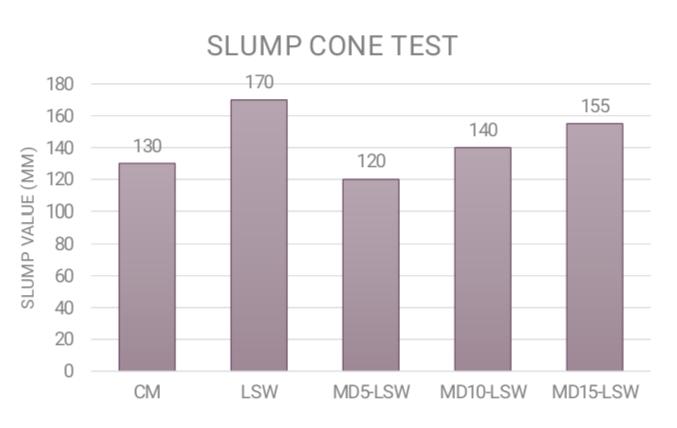
4.2SLUMPCONETEST
Workability of Concrete: The workability of concrete was evaluated using the slump cone test for different mix proportions. Overall, the results indicate that workability decreasesatoptimumreplacementlevelandincreaseswith highermarbledustcontent.
4.3COMPRESSIVESTRENGTHANALYSIS
4.3.17Days
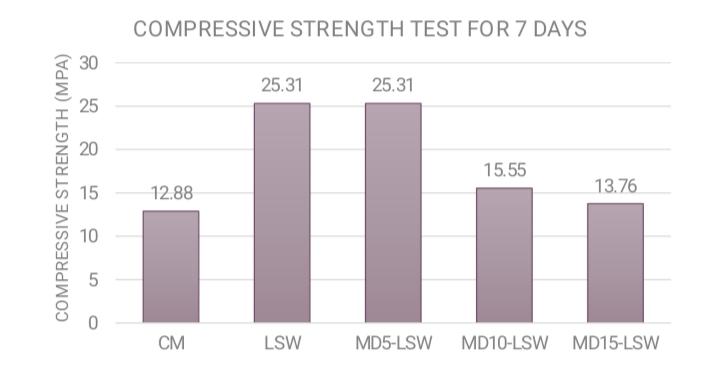
Thecompressivestrengthofconcreteat7daysshowsthat thecontrolmixattainedastrengthof12.88MPa.Theuseof lime-saturated mixing water significantly increased
strengthto25.31MPaduetoimprovedhydration.Themix containing 5% marble dust also exhibited a strength of 25.31 MPa, indicating better early strength development due to improved particle packing. However, further increase in marble dust content resulted in a decrease in strength,withvaluesof15.55MPaand13.76MPafor10% and15%replacementsduetoreductionincementcontent.
4.3.214Days
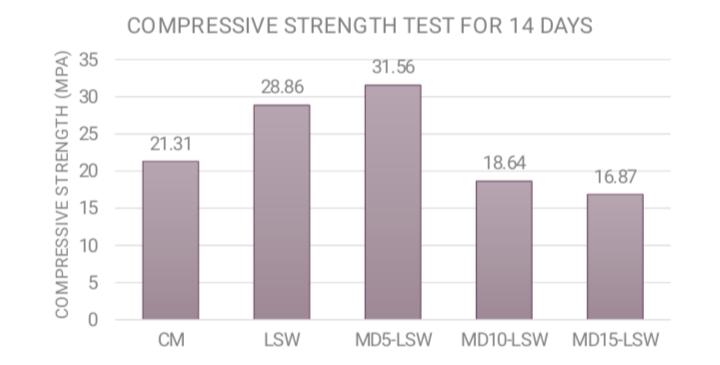
At14days,thecompressivestrengthincreasedforallmixes comparedto7days.Thecontrolmixachievedastrengthof 21.31MPa,whilethe limemixshowedimprovedstrength of 28.86 MPa. The 5% marble mix exhibited the highest strengthof31.56MPa,indicatingoptimumperformanceat this level. However, the strength decreased for higher replacements,withvaluesof18.64MPaand16.87MPafor 10%and15%respectively,duetodilutionofcementitious material. This trend confirms that partial replacement of cement with marble dust is beneficial up to an optimum levelof5%.
International Research Journal of Engineering and Technology (IRJET) e-ISSN: 2395-0056
Volume: 13 Issue: 04 | Apr 2026 www.irjet.net p-ISSN: 2395-0072
4.3.321Days
Days
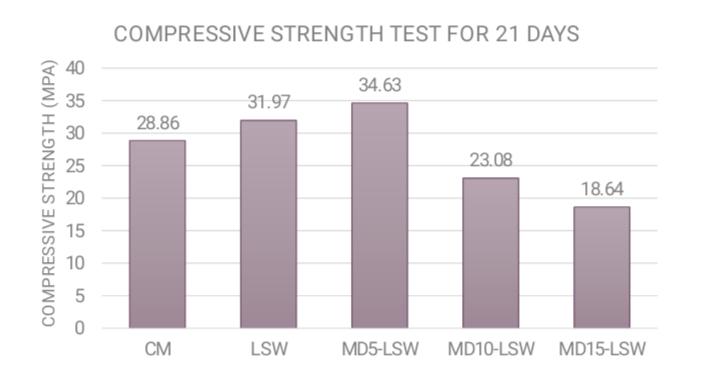
At21days,thecompressivestrengthofallconcretemixes showed a significant increase compared to earlier curing periods.Thecontrolmixachievedastrengthof28.86MPa, whilethelime-saturatedwatermiximprovedto31.97MPa duetoenhancedhydration.Themixcontaining5%marble dustexhibitedthehigheststrengthof34.63MPa,indicating optimumperformanceatthislevel.However,withfurther increaseinmarbledustcontent,thestrengthdecreasedto 23.08MPaand18.64MPafor10%and15%replacements. Thisreductionisduetothedilutionofcementandreduced bondingproperties.
4.3.4
28Days
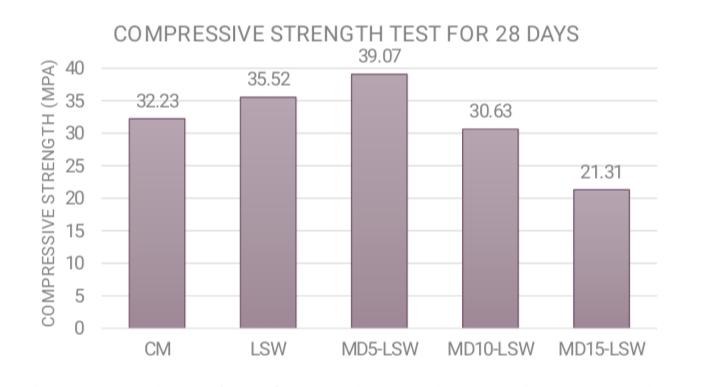
Thecontrolmixattainedastrengthof32.23MPa,whilethe limemixshowedanincreasedstrengthof35.52MPa.The 5%marbledustmixexhibitedthehigheststrengthof39.07 MPa, confirming it as the optimum replacement level. However, further increase in marble dust contentled toa reductioninstrength,withvaluesof30.63MPaand21.31 MPa for 10% and 15% respectively. This indicates that excessive replacement reduces the cementitious content, leadingtolowerstrength.Overall,theresultsconfirmthat
5% marble dust with lime-saturated water provides the bestcompressivestrength.
4.4
WATERABSORPTIONTESTOFCONCRETE CUBES
4.4.128Days
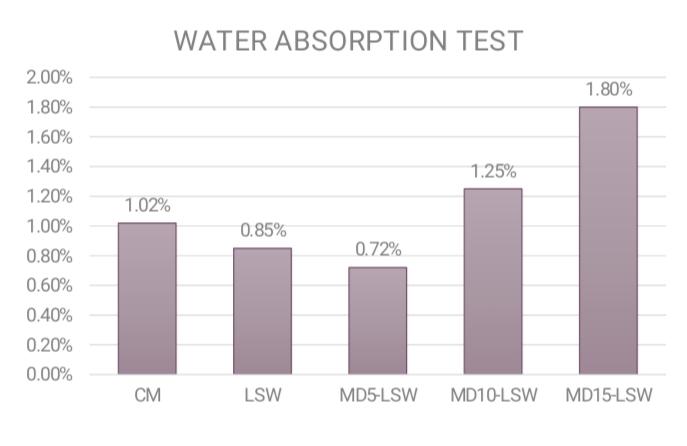
The water absorption test was conducted to evaluate the porosity and durability of different concrete mixes. The controlmixshowedawaterabsorptionof1.02%,whilethe useoflime-saturatedmixingwaterreduceditto0.85%.At 5%marbledustreplacement,thewaterabsorptionfurther decreasedto0.72%,indicatingadenserandmorecompact concrete structure. However, with an increase in marble dust content to 10% and 15%, the water absorption increased to 1.25% and 1.80% respectively due to the reduction in cement content and increase in voids. The results indicate that the optimum mix (5%) exhibits the lowestwaterabsorptionandhencebetterdurability.
International Research Journal of Engineering and Technology (IRJET) e-ISSN: 2395-0056
Volume: 13 Issue: 04 | Apr 2026 www.irjet.net p-ISSN: 2395-0072
5.CONCLUSION
Based on the experimental investigation carried out on concrete using marble dust and lime-saturated mixing water,thefollowingconclusionsweredrawn:
•Theexperimentalstudyshowsthattheadditionofmarble dust and lime-saturated water affects the properties of concrete.
• The workability of concrete, determined by the slump test,slightlychangedwiththeadditionofmarbledustdue tothefinerparticlespresentinthemix.
•Thecompressivestrengthofconcreteincreaseduptoan optimum percentage of marble dust replacement, after whichthestrengthgraduallydecreased.
• The use of lime-saturated mixing water helped in improving the bonding and hydration process in the concretemix.
•Theexperimentalresultsindicatethatmarbledustcanbe effectively used as a partial replacement material in concrete,whichhelpsinreducingcementconsumptionand utilizingindustrialwaste.
• Therefore, the use of marble dust and lime-saturated water in concrete can contribute to sustainable constructionpractices.
REFERENCES
[1] Shirule,P.A.(2012).Feasibilitystudyofusingmarble dust powder as partial replacement of cement in concrete. International Journal of Engineering ResearchandApplications.
[2] Ghazi Abdullah (2013). Effect of hydrated lime as partial cement replacement in roller compacted concrete.JournalofCivilEngineeringandConstruction Materials.
[3] Ghazy, M. F. (2013). Study on cement pastes, mortars and concrete mixed with limesaturated water. ConstructionMaterialsResearchJournal.
[4] Gurumoorthy, N. (2014). Performance of concrete containingmarbledustaspartialcementreplacement. International Journal of Engineering Science and Technology.
[5] Ranjan Kumar (2015). Experimental study on marble dust powder as partial replacement of cement in concrete. International Journal of Civil Engineering Research.
[6] Awodiji(2018).Anticipatingthecompressivestrength ofhydratedlimecementconcreteusingartificialneural network model. Civil Engineering Journal, Vol. 4, No. 12.
[7] Mohammed, M. E. (2020). Influence of hydrated lime and lime-saturated mixing water on strength of concrete. Journal of Sustainable Construction Materials.
[8] MuhammadJaffar(2021).Effectofmarblepowderon workability and strength characteristics of M30 concrete. International Journal of Structural Engineering.
[9] Majeed, A., et al. (2021). Utilization of waste marble powder as partial cement replacement in concrete. JournalofConstructionandBuildingMaterials.
[10] Ahmed,S.O.(2022).Evaluationoftheperformanceof concrete containing marble waste as cement replacement. International Journal of Engineering ResearchandTechnology(IJERT).