
International Research Journal of Engineering and Technology (IRJET) e-ISSN: 2395-0056
Volume: 13 Issue: 04 | Apr 2026 www.irjet.net p-ISSN: 2395-0072
International Research Journal of Engineering and Technology (IRJET) e-ISSN: 2395-0056
Volume: 13 Issue: 04 | Apr 2026 www.irjet.net p-ISSN: 2395-0072
Aravind A1, Gokulram H2 , Irfana Parveen3
1PG Student, Department of Civil Engineering, CSI College of Engineering, Ketti, The Nilgris
2Assistant Professor, Department of Civil Engineering, CSI College of Engineering, Ketti, The Nilgris
3Assistant Professor, Department of Civil Engineering, CSI College of Engineering, Ketti, The Nilgris
Abstract - The rapid increase in cement production has significantly contributed to global carbon dioxide (CO₂) emissions, necessitating the development of sustainable alternatives. This study investigates high-performance geopolymer concrete produced using fly ash, ground granulated blast furnace slag (GGBS), and locally available laterite. Four mix proportions were developed with varying laterite content (0–30%). Mechanical properties including compressive strength, split tensile strength, and flexural strengthwereevaluatedalongwithdurabilitycharacteristics such as water absorption. Results indicate that geopolymer concrete achieved a maximum compressive strength of 46.2 MPa at 28 days under ambient curing. Increasing laterite content resulted in a gradual reduction in strength; however, allmixessatisfiedstructuralrequirements.Thestudyconfirms that geopolymer concrete incorporating local materials is a sustainable and viable alternative to conventional concrete.
Key Words: Fly ash; Ground granulated blast furnace slag (GGBS); Laterite; Sustainable construction; Alkaline activation; Compressive strength; Durability; Industrial by-products; Ambient curing; Eco-friendly concrete; High-performance concrete.
Concrete is the most widely used construction material; however, Ordinary Portland Cement (OPC) production contributesnearly8%ofglobalCO₂emissions.Geopolymer concrete offers an alternative binder system utilizing industrialby-productssuchasflyashandGGBSactivatedby alkalinesolutions.
Kerala has abundant laterite resources, which can be incorporatedintogeopolymersystems.Thisstudyevaluates thecombineduseofflyash,GGBS,andlateritetoproduce sustainablehigh-performanceconcrete.
2. MATERIALS
The materials used in the preparation of geopolymer concretearedescribedbrieflyasfollows:
2.1 Fly Ash (Class F)
ClassFflyash,aby-productofthermalpowerplants,was usedasthemainbinder.Itisrichinsilicaandalumina,
makingitsuitablefordurablegeopolymerconcretedueto itslowcalciumcontent.
2.2 Ground Granulated Blast Furnace Slag (GGBS)
GGBS,obtainedfromtheironandsteelindustry,contains highcalciumoxide,whichimprovesearlystrengthand enhancesreactivityunderambientcuring.
2.3 Laterite Soil
Processedandsievedlateritesoilwasusedasapartial replacementmaterialtoimprovesustainability.Itslower reactivityslightlyaffectsstrength.
2.4 Fine Aggregate (M-Sand)
Manufacturedsandwasusedasfineaggregate,providing bettergradation,consistency,andimprovedworkability comparedtonaturalsand.
2.5 Coarse Aggregate
Crushedstoneaggregates(20mmmaximumsize)were usedtoprovidestrengthandbulk,meetingstandard gradingrequirements.
2.6 Sodium Hydroxide (NaOH)
A10Msodiumhydroxidesolutionwasusedasanalkaline activatortodissolvesilicaandalumina,initiating geopolymerization.
2.7 Sodium Silicate (Na₂SiO₃)
Sodiumsilicatesolutionwasusedalongwithsodium hydroxidetoenhancepolymerization,improvingstrength anddurability.
3.
The geopolymer concrete mix was designed with a total binder content of 400 kg/m³, consisting of fly ash, GGBS, andlaterite.Analkalineactivator-to-binderratioof 0.40 was adopted to ensure adequate workability and reaction kinetics. The ratio of sodium silicate to sodium hydroxide solution was maintained at 2.5 to enhance the geopolymerizationprocess.
Fourdifferentmixproportionsweredevelopedbyvarying thepercentageof laterite whilekeepingtheGGBScontent constant at 30%. Fly ash content was reduced correspondinglytomaintainthetotalbindercomposition.
International Research Journal of Engineering and Technology (IRJET) e-ISSN: 2395-0056
Volume: 13 Issue: 04 | Apr 2026 www.irjet.net p-ISSN: 2395-0072
Table 1 – DifferentMixProportion
This approach was adopted to evaluate the influence of lateriteasapartialreplacementmaterialonthemechanical anddurabilitypropertiesofgeopolymerconcrete.
4. METHODOLOGY
Themethodologyadoptedforthepreparationandtestingof geopolymerconcreteisdescribedindetailbelow.
4.1 Preparation of Alkaline Solution
Thealkalineactivatorsolutionwaspreparedbydissolving sodiumhydroxide(NaOH)pelletsindistilledwatertoobtain a10molarity(10M)solution.Thesolutionwaspreparedat least24hourspriortomixingtoensurecompletedissolution ofpelletsandstabilizationoftemperature.Sodiumsilicate (Na₂SiO₃) solution was then mixed with the sodium hydroxidesolutioninaratioof2.5bymass.Thecombined alkalinesolutionwasallowedtoequilibratebeforeuse.
All dry materials, including fly ash, GGBS, laterite, fine aggregate (M-sand), and coarse aggregate (20 mm size), werefirstweighedaccuratelyasperthemixdesign.Thedry materials were thoroughly mixed in a pan mixer for approximately3–5minutestoachieveuniformdistribution. Followingthis,thepreparedalkalinesolutionwasgradually added to the dry mix while continuous mixing was maintained. Mixing was continued for an additional 5–7 minutestoensurepropercoatingofaggregatesanduniform consistencyofthegeopolymerconcrete.Carewastakento avoidrapidsettingbycontrollingmixingtimeandambient conditions.
4.3
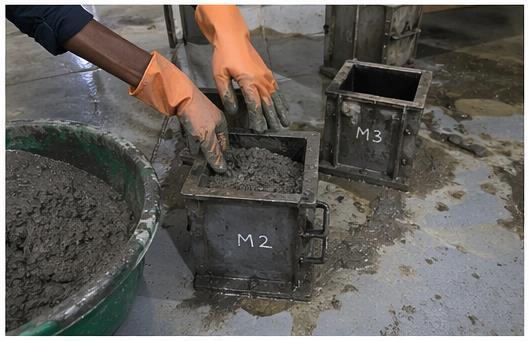
The fresh geopolymer concrete was placed into standard steelmouldsimmediatelyaftermixing.
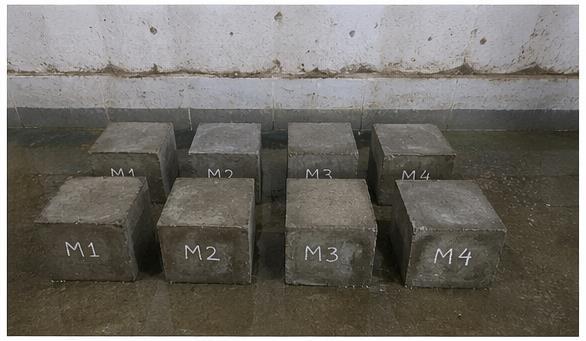
Cubes (150 mm × 150 mm × 150 mm) werecast forcompressivestrengthtestingasperIS516.
Cylindrical specimens were prepared for split tensilestrengthtestingasperIS5816.
Beam specimens were cast for flexural strength evaluationasperrelevantstandards.
Concretewasplacedinlayersandcompactedusingatable vibrator to eliminate entrapped air and ensure proper compaction.Thetopsurfacewasfinishedsmoothlyusinga troweltoobtainauniformsurface.
Aftercasting,thespecimenswereleftundisturbedatroom temperaturefor24hours.Subsequently,thespecimenswere demouldedcarefullytoavoiddamage. Unlikeconventionalconcrete,nowatercuringwasapplied. Instead, ambient curing conditions wereadopted,where specimenswerestoredatroomtemperature(approximately 25–30°C) in a laboratory environment. This method simulates practical field conditions and is one of the advantagesofgeopolymerconcrete,eliminatingtheneedfor externalcuring.
4.5
Thehardenedspecimensweretestedatdifferentcuringages (7,14,and28days).
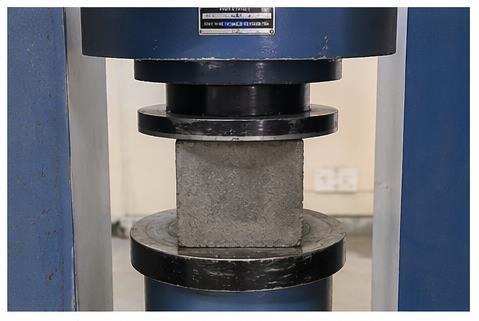
Compressive strength tests wereconductedusing aUniversalTestingMachine(UTM)asperIS516. Load was applied gradually until failure, and the maximumloadwasrecorded.
Split tensile strength tests were performed on cylindricalspecimensasperIS5816.
Flexural strength tests werecarriedoutonbeam specimensusingtwo-pointloadingmethods.
All test results were recorded and averaged from at least threespecimenstoensureaccuracyandreliability.
5.1 Compressive Strength (MPa)
Table 2 – CompressiveStrength(MPa)
Mix 7Days 14Days 28Days
International Research Journal of Engineering and Technology (IRJET) e-ISSN: 2395-0056
Volume: 13 Issue: 04 | Apr 2026 www.irjet.net p-ISSN: 2395-0072
5.2 Split Tensile Strength (28 Days)
Table 3 – SplitTensileStrength(MPa)
5.3 Flexural Strength (28 Days)
Table 4 – FlexuralStrength(MPa)
5.4 Water Absorption
Table 5 – WaterAbsorption(%)
6. RESULTS AND DISCUSSION
6.1 Graphical Analysis
6.2 Discussion of Results
Compressive strength decreases with increase in lateritecontent
Strength development is consistent across curing ages
Tensile strength is approximately 8–10% of compressivestrength
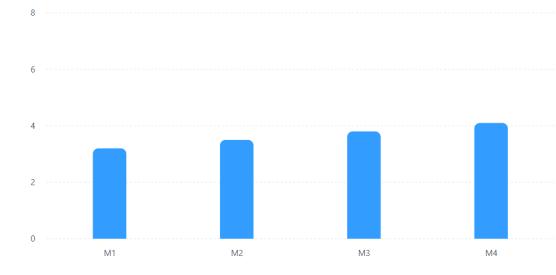
Waterabsorptionincreasesslightlyduetoporosity increase
Basedonexperimentaldataandshouldbeincludedinthe finalmanuscriptashigh-resolutionplots.
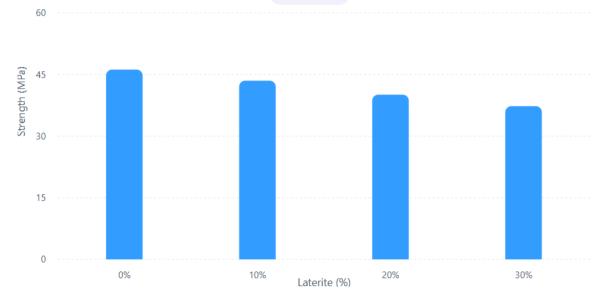
Figure 1: Compressive Strength vs Laterite Content (28 Days)
Showsacleardecreasingtrendfrom46.2MPa(0%) to37.3MPa(30%)
Indicates reduction in binder reactivity due to lateriteinclusion
International Research Journal of Engineering and Technology (IRJET) e-ISSN: 2395-0056
Volume: 13 Issue: 04 | Apr 2026 www.irjet.net p-ISSN: 2395-0072
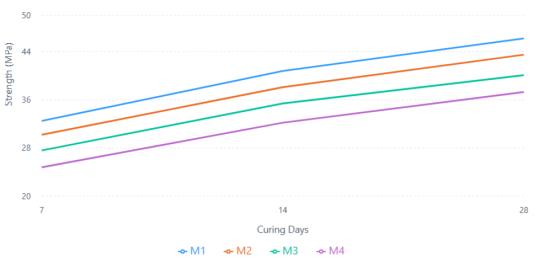
Figure 2: Compressive Strength Development (7, 14, 28 Days)
All mixes exhibit consistent strength gain with curingage
M1showshighestearlyandultimatestrengthdue toabsenceoflaterite
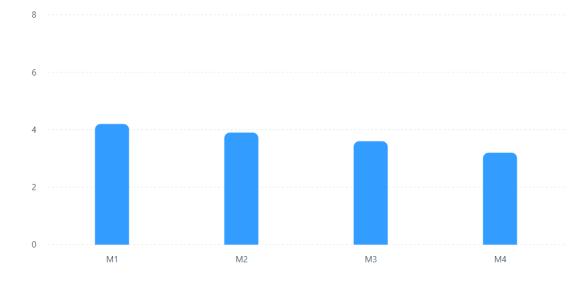
Figure 3: SplitTensileStrengthComparison
Valuesrangefrom4.2MPa(M1)to3.2MPa(M4)
Confirmstensilestrength≈8–10%ofcompressive strength
Figure 4: WaterAbsorptionvsMix
Increasingtrendfrom3.2%to4.1% Indicatesslightincreaseinporositywithlateritecontent
7. EXPERIMENTAL SETUP
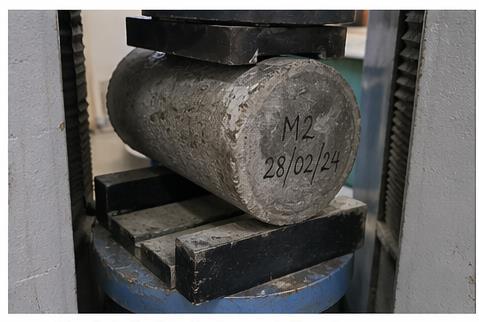
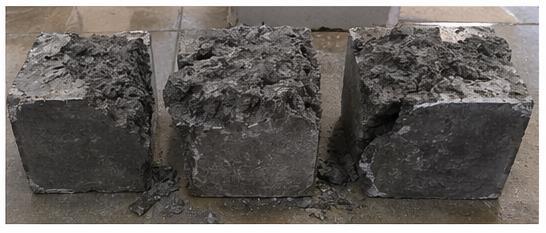
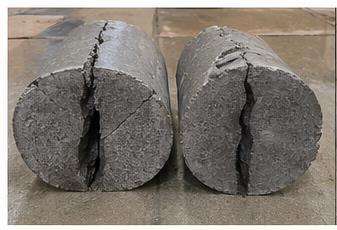
8. SUSTAINABILITY ANALYSIS
Geopolymerconcretedevelopedinthisstudydemonstrates significant sustainability advantages over conventional cement-based concrete. The complete replacement of OrdinaryPortlandCement(OPC)withindustrialby-products suchasflyashandGGBSresultedin 100% elimination of cement usage, thereby substantially reducing environmental impact. The reduction in CO₂ emissions is estimated to be approximately 70% lower compared to conventional concrete, primarily due to the avoidance of clinkerproduction.Additionally,theutilizationofindustrial wastematerialscontributestoeffectivewastemanagement and reduces the demand for natural resources. The incorporationoflocallyavailablelateritefurtherenhances sustainability by minimizing transportation requirements andpromotingtheuseofregionalmaterials.
Overall, the developed geopolymer concrete offers an environmentallyfriendlyandresource-efficientalternative forconstructionapplications.
International Research Journal of Engineering and Technology (IRJET) e-ISSN: 2395-0056
Volume: 13 Issue: 04 | Apr 2026 www.irjet.net p-ISSN: 2395-0072
Based on the experimental investigation, the following conclusionscanbedrawn:
The geopolymer concrete achieved a maximum compressivestrengthof 46.2 MPa underambient curingconditions,indicatingitssuitabilityforhighperformanceapplications.
TheinclusionofGGBSsignificantlyimprovedearly strengthdevelopmentandoverallreactivityofthe bindersystem.
Increasing laterite content resulted in a gradual reduction in mechanical strength due to its comparativelylowerreactivity.
Despitethereduction,allmixesexhibitedsufficient strengthforstructuralapplications.
Thedevelopedgeopolymerconcretedemonstrated improveddurabilitycharacteristicsandsignificant sustainability benefits compared to conventional concrete.
Theauthorswouldliketoexpresstheirsinceregratitudeto the Department of Civil Engineering of CSI College of Engineering,Kettiforprovidingthenecessaryfacilitiesto carry out this research work. The authors also thank the projectguideMr.GokulramH, forhisvaluableguidanceand supportthroughoutthestudy.
[1] J.Davidovits,GeopolymerChemistryandApplications, 2nd ed. Saint-Quentin, France: Institut Géopolymère, 2008.
[2] H.XuandJ.S.J.VanDeventer,“Thegeopolymerisation ofalumino-silicateminerals,”Int.J.Miner.Process.,vol. 59,no.3,pp.247–266,2000.
[3] S. Kumar, R. Kumar, and S. Mehrotra, “Influence of granulated blast furnace slag on geopolymer properties,”J.Mater.Sci.,vol.45,pp.607–615,2010.
[4] M. Olivia and H. Nikraz, “Properties of fly ash geopolymer concrete designed by Taguchi method,” Mater.Des.,vol.36,pp.191–198,2012.
[5] A. Palomo, M. W. Grutzeck, and M. T. Blanco, “Alkaliactivated fly ashes: A cement for the future,” Cem. Concr.Res.,vol.29,no.8,pp.1323–1329,1999.
[6] K. Komnitsas and D. Zaharaki, “Geopolymerisation: A reviewandprospects,”Miner.Eng.,vol.20,no.14,pp. 1261–1277,2007.
[7] P. Duxson et al., “The role of inorganic polymer technologyingreenconcrete,”Cem.Concr.Res.,vol.37, pp.1590–1597,2007.
[8] P. Chindaprasirt et al., “Workability and strength of geopolymerconcrete,”Cem.Concr.Compos.,vol.29,pp. 224–229,2007.
[9] M. Sofi et al., “Engineering properties of geopolymer concrete,”Cem.Concr.Res.,vol.37,pp.251–257,2007.
[10] P. Chindaprasirt et al., “Workability and strength of geopolymerconcrete,”Cem.Concr.Compos.,vol.29,pp. 224–229,2007.
[11] K.L.Scriveneretal.,“Eco-efficientcements:Potential and challenges,” Cem. Concr. Res., vol. 114, pp. 2–26, 2018.
[12]IS456:2000,PlainandReinforcedConcrete–Codeof Practice,BureauofIndianStandards,NewDelhi,India.
[13] IS 10262:2019, Concrete Mix Proportioning –Guidelines, Bureau of Indian Standards, New Delhi, India.
[14]IS383:2016,CoarseandFineAggregateforConcrete–Specification,BureauofIndianStandards,NewDelhi, India.
[15]IS5816:1999,SplittingTensileStrengthofConcrete–MethodofTest,BureauofIndianStandards,NewDelhi, India.