
International Research Journal of Engineering and Technology (IRJET) e-ISSN:2395-0056
Volume: 12 Issue: 03 | Mar 2025 www.irjet.net p-ISSN:2395-0072
International Research Journal of Engineering and Technology (IRJET) e-ISSN:2395-0056
Volume: 12 Issue: 03 | Mar 2025 www.irjet.net p-ISSN:2395-0072
Dr B V Mathew1 , Kripa K M2 , Amrithesh P3 , Nimmi R4 , Safna Nasrin I5, Sunil S6
1 Professor, HOD, Dept. of Civil Engineering, Ahalia School of Engineering and Technology, Kerala, INDIA
2 Assistant professor, Dept. of Civil Engineering, Ahalia School of Engineering and Technology, Kerala, India
3 UG Scholar, Dept of Civil Engineering, Ahalia School of Engineering and Technology, Kerala, INDIA
4UG Scholar, Dept of Civil Engineering, Ahalia School of Engineering and Technology, Kerala, INDIA
5 UG Scholar, Dept of Civil Engineering, Ahalia School of Engineering and Technology, Kerala, INDIA
6 UG Scholar, Dept of Civil Engineering, Ahalia School of Engineering and Technology, Kerala, INDIA
Abstract - In this study, we are experimenting with investigating the flexural strength of concrete beams bonded with Glass Fiber Reinforced Polymer (GFRP) sheets and subjected to sulphate environments. The concrete beams are cast and bonded with GFRP sheets before being immersed in a sulphate solution for a prolonged duration. The research included conducting flexural strength tests to evaluate how sulphate exposure affects the GFRP-concrete interface. The findings were compared with those from conventional concrete beams that are not reinforced with FRP and treated in both normal and sulphate environments. This analysis intends to assess how effectively FRP reinforcement can alleviate the negative impacts of sulphate exposure on concrete structures. The results offer important information regarding the durability and structural strength of FRP- FRP-reinforced concrete systems in harsh environments, supplying essential data for the design and upkeep of infrastructure exposed toconditionsrich insulphates.
Key Words:
Fiber-reinforcedpolymer(FRP)Epoxyresin
ConcreteDurability
Sulphateenvironment
1. INTRODUCTION
Reinforced concrete (RC) structures are widely used in theconstructionsectorbecauseoftheirnaturalstrength, longevity, and affordability. Nonetheless, when subjected to harsh environments, such as those containing sulphates, RC structures can face premature deterioration. The reaction between sulphates and the concrete matrix can initiate chemical processes that weaken the material's structure, leading to a notable decrease in service life and structural efficiency. To address this issue, Fiber-Reinforced Polymer (FRP) composites have surfaced as an effective option for strengthening and rehabilitating deteriorating RC structures. FRP-bonded concrete reinforcement systems have shown significant promise in improving the structural performance of these constructions, especially inlesseningtheimpactofenvironmentaldamage.
Despitetheirefficiency,thelong-termperformanceofFRPbonded concrete reinforcement systems, particularly in environments rich in sulphate, continues to be a major concern. The main aim of this experimental research is to thoroughly examine the impact of sulphate exposure on the bonding behavior and durability of FRP-bonded concrete reinforcement systems. In particular, the research will emphasize evaluating the effects of factors such assulphate concentration, duration of exposure, and the inherent material properties of FRP on the bond strength between FRP and concrete, along with the deteriorationoftheFRP-concreteinterfaceovertime.This researchseekstodeliver importantinsightsintothelongterm effectiveness of FRP reinforcement systems in environments exposed to sulphates through thorough experimentation and analysis. The outcomes of this investigation will play a crucial role in creating more efficient, long-lasting, and sustainable FRP-bonded concrete reinforcement systems. In the end, these improvements will increase the durability and lifespan of infrastructure facing harsh environmental conditions, promoting greater sustainability and minimizing the necessityforexpensiverepairsorreplacements.
Concrete structures in sulphate-bearing conditions are exposed to degradation concerns, such as cracking and reduction in strength. Conventional steel reinforcement rusts,
providing added decline. In this research, Glass Fiber Reinforced Polymer (GFRP) is investigated as a substitute reinforcing material because of its corrosion resistance, light weight, high tensile strength, and low thermal/electrical conductivity. GFRP possesses several advantages:
-Highcorrosionresistance,increasedlifespan -Lessheavythansteel,simplifiedhandling/installation -Hightensilestrength,cracking/tensileforce-resistant -Lowmaintenance,longservicelife -Flexibilityinapplication,includinginsulation
International Research Journal of Engineering and Technology (IRJET) e-ISSN:2395-0056
Volume: 12 Issue: 03 | Mar 2025 www.irjet.net p-ISSN:2395-0072
1.2
Theprimeaimsofthestudyareasfollows:
AssesstheSulphateexposureonFRPConcrete.
Toperformthetestofstrengthanddurability.
IdentifytheinfluenceofSulphateconcentration and exposuretimeonFRPconcrete.
ComparenormalconcretewithFRPconcrete
2.1
Bidirectional Glass Fiber Reinforced Polymer (GFRP) sheetsareusedinthisresearch.Thesheetsarecapableof playing two roles: reinforcing as well as strengthening structures. Here, specifically, the role is to improve structural resistance. The GFRP sheets used in this research are of 875 GSM grammage. The Ramdev Sales Corporation in Palghar, Thane, Maharashtra, India, is the source of the GFRP sheets. The epoxy resinusedwiththe GFRP sheets is Nitobond EP, which is a concrete bonding agent. The epoxy resin is composed of two parts: Part A (Base)andPartB (Hardener),andtheyarecombinedina ratio of 1:1.6 for bonding. Importantly, the firm supplying the epoxy resin has ISO 9001 and 14001 certifications Ordinary concrete is mixed with a grade of M30, following a mix design proportion of 1:1.86:2.16 for cement, fine aggregate, and coarse aggregate, respectively.
The nominal value of the slump for the concrete mix is 5mm.Theconcrete's28-dayflexuralstrengthand28-day compressive strength are important parameters in evaluatingitsperformance.
2.2
2.2.1
A thorough experiment was carried out to study the impact of sulphate solution on concrete beams and the effectiveness of Glass Fiber Reinforced Polymer (GFRP) wrapping in reducing these impacts. To accomplish this, 81 beams were produced and classified into three separate groups. The first group had 27 beams, which were cast and treated under normal water at ambient temperature. This was the control group, to enable researchers to establish the flexural strength of the beams under normal conditions. The second group also consistedof27beams,buttheywerecastandtreatedin asulphatesolution.
This group was meant to test the effect of sulphate exposureontheflexuralstrengthofthebeams. Thethird and last group consisted of 27 beams, which were cast, wrapped with GFRP, and treated in a sulphate solution.
This group was meant to test the effectiveness of GFRP wrappinginimprovingthedurabilityandflexuralstrength ofthebeamswhensubjectedtoasulphatesolution.
There was a single epoxy adhesive was used for bonding, whichwastheNITOBONDEPepoxyresinconcretebonding agent. The epoxy adhesive was combined in a proportion of 1:1.6, as indicated by the manufacturer. For effective bonding,the combined epoxy adhesive was left to dry for 24-48 hours. This helped create a firm and long-lasting bondbetweenthesurfaces.
Concrete beams of size 500mm x 100mm x 100mm were castaccordingtoIS516:1959withM30gradeconcreteand a mix ratio of 1:1.86:2.16 (cement: fine aggregate: coarse aggregate).Thebeamswerecast,curedatroomtemperature for 24 hours, demoulded, and kept under standard curing conditions for 7 days. Then, the beams were exposed to a sulphatesolutionfor7,21,and28days,and27specimens werecastforeverygrouptostudytheinfluenceofsulphate exposureontheconcretebeams.
Anartificialsulphatesolutionof0.1normalitywasprepared withsodiumsulphateanhydrous(Na2SO4)purchasedfrom NiceChemicalsPvt.Ltd.,Edappally,Kochi,Kerala.
For preparing the solution, 7.1 grams of sodium sulphate anhydrous was dissolved in distilled water to obtain the required normality of 0.1. The artificial sulphate solution was utilized to mimic the corrosive atmosphere and determinethestrengthoftheconcretebeams.Toprepare
0.1Nsodiumsulphate(Na₂SO₄)solution:
1.Equivalentweight=Molarmass/n-factor=142/2=71 grams.
2.The amount required for 0.1 N solution = 0.1 equivalents/L= 7.1grams/L
3. Take7.1gramsofNa₂SO₄,dissolveitindistilledwater, and diluteitto1liter.
Thisprovidesa0.1Nsodiumsulphatesolution.
International Research Journal of Engineering and Technology (IRJET) e-ISSN:2395-0056
Volume: 12 Issue: 03 | Mar 2025 www.irjet.net p-ISSN:2395-0072
3.1 Flexural strength test of GFRP composite
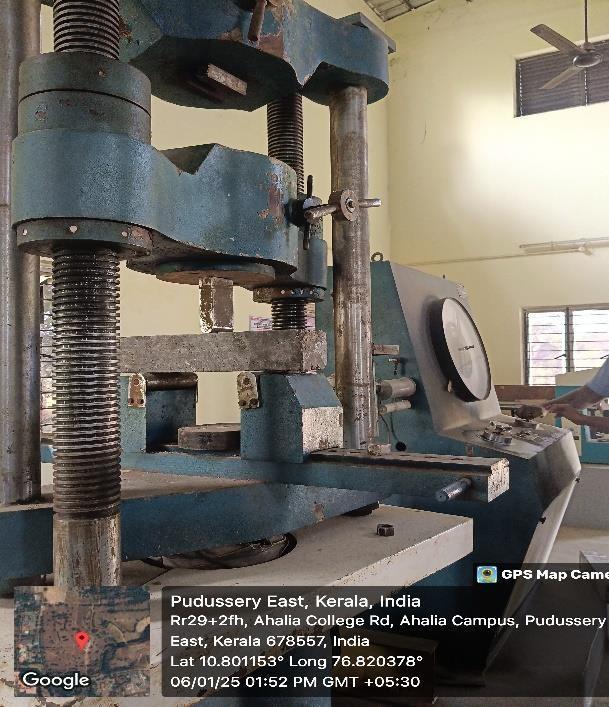
Fig -1:Flexuralstrengthtestofthenormalconcretebeam.
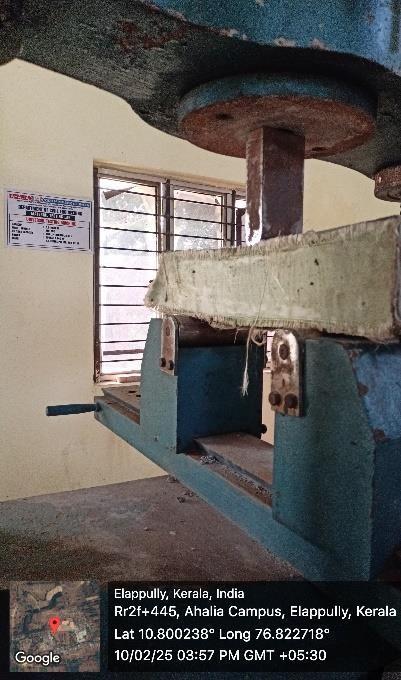
Fig -2:FlexuralstrengthtestofGFRPbondedconcretebeam.
FlexuralstrengthtestswereperformedonGlassFiberfiberreinforcedpolymer (GFRP)composite beamsto determine their tensile strength. The tests were conducted using a Universal Testing Machine (UTM), which is a versatile machine used to test the mechanical properties of various materials.TheUTMwassettoapplyaloadataratespecified bytheIndianStandard(IS)code.Thisensuredthatthetest wasconductedinastandardizedmanner.
The load was applied to the middle portion of the beam, which was supported at both ends.Thedistance between the supports,alsoknownasthespan,was300mm.Thissetup
allowed the beam to bend and deform under the applied load. The tensile strength of the beam was calculated using thefollowingFormula:
TensileStrength=(3/2)×(P×L)/(b×d^2)Where:
P=LoadinNewtons(themaximumloadappliedtothe beam)
L=Spaninmm(thedistancebetweenthesupports,which was300mm)
b=Breadthinmm(thewidthofthebeam)
d=Depthinmm(theheightorthicknessofthebeam)
This formula takes into account the load applied, the span, and the dimensions of the beam to calculate its tensile strength. The tensile strength is a measure of the beam's ability to withstand tensile forces or forces that stretch or pullitapart.
3.2Compressive strength test of GFRP Composite
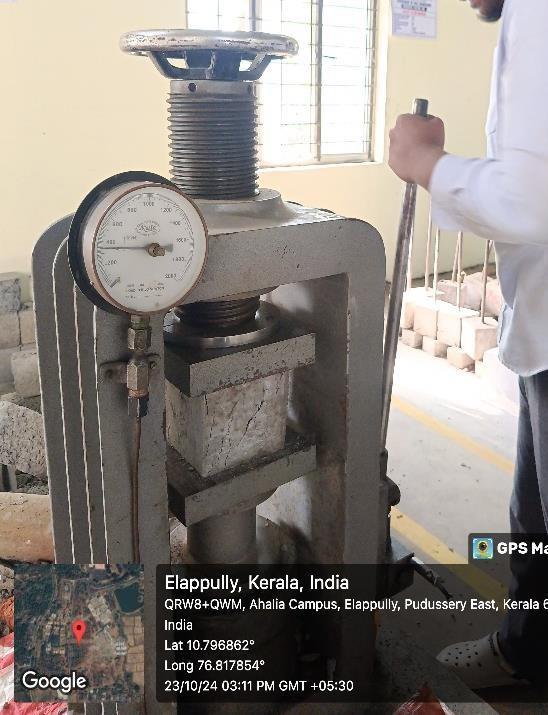
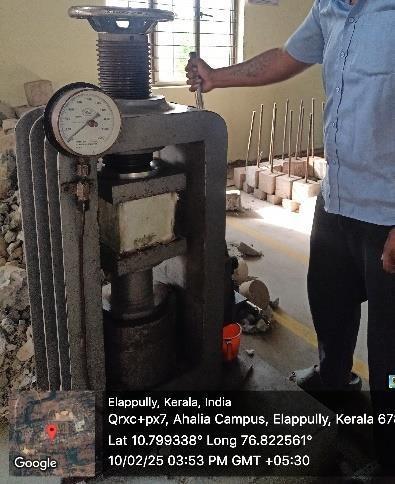
Fig -1:CompressivestrengthtestofthenormalcubeonCTM
International Research Journal of Engineering and Technology (IRJET) e-ISSN:2395-0056
Volume: 12 Issue: 03 | Mar 2025 www.irjet.net p-ISSN:2395-0072
Fig
Concrete specimens were compressed to determine their compressivestrength.Compressiontestsweredonewiththe helpofaCompressionTestingMachinewhichisinlinewith Indian Standard codes. Specimens included 150x150x150 mmconcretecubescuredinwater,concretecubescuredina sulphatesolution,andconcretecubesbondedtoGlassFiber Reinforced Polymer and cured in a sulphate solution. Compressive strength was calculated by the formula Compressivestrength=Load/Area.
Where;
The maximum load to which the sample is subjected is measuredinNewtons(N)andistermedtheload.
Area refers tothe cross-sectionalarea ofthe specimenin squaremillimeters(mm²)
ThecompressivestrengthisgiveninunitsofN/mm²,andit signifies the amount of force required to compress the specimen by unit area. By comparing the compressive strength of the different specimens differing effects of sulphate exposure and GFRP bonding on the concrete's compressive strength can be given. Such information is important in determining the durability and structural integrity of concrete structures that are exposed to rough conditions.
4.1 Durability of FRP composites
4.1.1
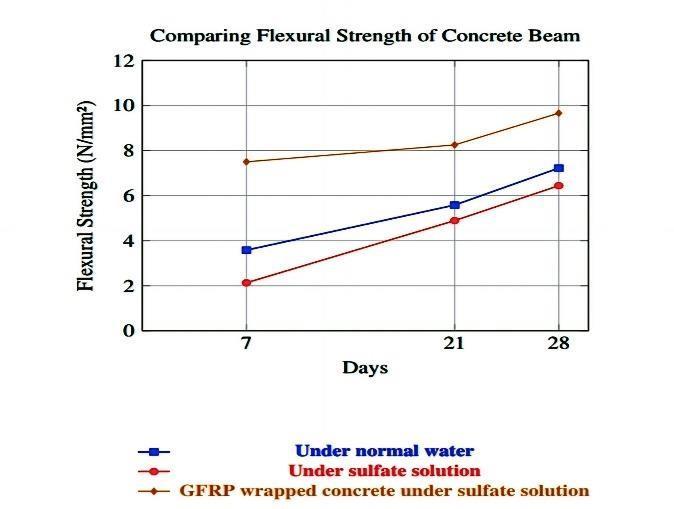
The illustration represents the strength of Reinforced Polymers(FRPs)afterbeingexposedtoasulphatesolutionfor severaldays.Theresultsarethencomparedtothoseofthe controlspecimens.Adistinctiveobservationfromthefigureis that the GFRP-wrapped concrete beams show the same il
strengthasthenormalconcretebeams,whichshowsthatthe GFRPwrapsinsomewayimprovetheilstrengthoftheFRP beams.Additionally,fromthe graph,itcanbeobservedthatthe tensilestrengthofGFRP-bondedconcretebeamsissignificantly higherthanthatofnormalconcreteafterexposuretoasulphate solution. More specifically, the tensile strength of GFRP-bonded concretebeamsincreasesnotablyafter7,21,and28daysof exposure. The increase in tensile strength is because GFRP bonds with concrete, which makes the beam more resistantto tensile forces. Therefore, the increase in strength is a clear indication that bound GFRP is beneficial for concrete beams, especiallyinareaswheretheywillbeexposedto asulphate solution.
Table -1: Comparisonofflexuralstrengthofconcretebeams.
Days Flexural strength of concrete beam under normal water (N/mm^2)
Flexuralstrength ofconcretebeam undersulphate solution(N/mm^2)
Flexuralstrength ofGFRP-wrapped concretebeam undersulphate solution(N/mm^2)
Graph-1: Comparisonofflexuralstrengthofconcrete beams.
4.1.2 Compressive strength of GFRP-bonded concrete cubes.
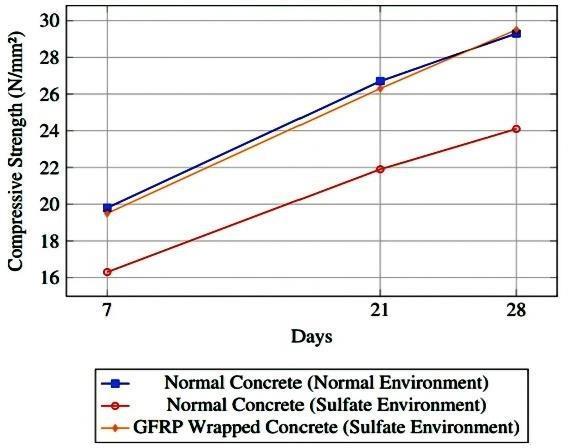
The table displays the compression strength results of ReinforcedPolymer(FRP)specimens aftertheywereimmersed inasulphatesolutionfordifferentperiods.Itiscomparedwith compressive strength results of unexposed control samples. In particular, the table shows that the compressive strength results of glass fiber-reinforced polymer (GFRP) -wrapped concretecubesareequaltothecompressivestrengthresultsof standard concrete cubes, which demonstrates the efficiency of GFRPwrapping.
International Research Journal of Engineering and Technology (IRJET) e-ISSN:2395-0056
Volume: 12 Issue: 03 | Mar 2025 www.irjet.net p-ISSN:2395-0072
Furthermore,thegraphillustratesthecompressivestrengthof sulfur-exposedplainconcretecubescomparedtoGFRP-bonded concrete cubes. There is a significant improvement in the compressive strength of GFRP-bonded concrete cubes compared to plain concrete cubes. Particularly, significant strengthincreasesinGFRP-bondedcubesareobservedafter7, 21and28days.
ThestrengthincreaseobservedisduetothebondofGFRPconcrete, which increases the resistance of the cube to compressivestresses.Thisincreaseinstrengthemphasizesthe benefitsofusingGFRPbondinginconcretecubes,especiallyin sulphate-richenvironments.
Table -2: Comparisonofcompressivestrengthofconcrete beams.
Days Compressive strengthof concrete beamunder normal water (N/mm^2)
7
Compressive strengthof concretebeam undersulphate solution(N/mm^2)
Compressive strengthofGFRPwrappedconcrete beamunder sulphate solution(N/mm^2)
Graph-2: Comparisonofcompressivestrengthof concrete beams.
5. CONCLUSIONS
In this context, the experimental study on concrete reinforcementsystemswiththeuseofFRPasbondedmaterials explained the effects of sulphate ions on concrete and the feasibilityofGFRPwrappingtoenhancedurabilityandstrength retention. The experiments showed that normal concrete exposed to a sulphate environment loses about 58% compressivestrengthand69%flexuralstrength because of sulphate deterioration. The sulphates, which react with cement hydration products, form expansive compounds such as ettringite and gypsum, micro-cracking, dimensional instability,andstructuraldecayofconcrete,resultingintheloss of10-15%compressivestrengthandupto40%lossofflexural
strength in early ages, and progressive reduction with time whencomparedtonormalconcretekeptinanon-aggressive environment.
FRP-bonded concrete, however, shows remarkable resistance tosulphateattack,retainingstrengthlevelsalmostasthoseof normalconcreteinanormalcuringenvironment. TheGFRP wrappingactsasabarriertopreventsulphatepenetration,thus limiting internal deterioration. Confinement of FRP also improves the load-carrying capacity of concrete, hence better flexural performance. On the other hand, the compressive strength of FRP-wrapped concrete is nearly unaffected by sulphate exposure, while its flexural strength shows significant improvement whencompared withnormal concrete, even ina non-aggressiveenvironment.
FRPbondingmaybeanefficientmeansofimprovingthelife economy of concrete structures against aggressiveness from sulphate. Because of reduced sulphate-induced damage, coupled with improved compressive and flexural strengths, FRPsystemsareanefficientandfeasiblemeansofenhancing the service life of concrete structures in aggressive conditions. This research yields a significant portion of knowledge concerning long-term behavior in FRP-bonded concrete, which couldactasaprecursorforadoptingmorerobust,sustainable, and cost-effective construction practices against sulphateaffectedregions
[1]Jianglinli,ZihuaMai,JianheXie,andZhongyuLu."Durabilityof components of FRP-concrete bonded reinforcement systems exposed to chloride environments"- Composite Structures, 2022–Elsevier
[2]ShrikantM.Harle."Durabilityandlong-termperformanceof fiberreinforcedpolymer(FRP)composites".-Structures,2024–Elsevier
[3] Jianglin Li, Jianhe Xie, Feng Liu, Zhongyu Lu."A critical review and assessment for FRP-concrete bond systems with epoxy resin exposed to chloride environments".-Composite structures,2019-Elsevier
[4] J.R. Cromwell a, K.A. Harries b, B.M. Shahrooz c"Environmental durability of externally bondedFRP materials intended for repair of concrete structures"-construction and buildingmaterial-[2011]-Elsevier
[5]Katarína GAJDOŠOVÁ1*, Róbert SONNENSCHEIN1, Stanislav BLAHO1, Simona KINČEKOVÁ1, Ján PECKA1"Durability of FRP reinforcementsandlong-termproperties"[2020].
[6] TatarJ,MilevS.Durabilityofexternallybondedfiberreinforced polymer composites in concrete structures: A criticalreview.[J].Polymers2021;13(5):765.
[7]AhmedA,ZillurRahmanM,OuY,LiuS,MobasherB,GuoS. A review on the tensile behavior of fiber-reinforced
International Research Journal of Engineering and Technology (IRJET) e-ISSN:2395-0056
Volume: 12 Issue: 03 | Mar 2025 www.irjet.net p-ISSN:2395-0072
polymer composites under varying strain rates and temperatures[J].ConstrBuildMater2021;294:123565.
[8]AliH,AkramiR,FotouhiS,BodaghiM,SaeedifarM,Yusuf M. Fiber-reinforced polymer composites in bridge industry[J].Structures2021;30:774–85.
[9]Oller E, Kotynia R, Marí A. Assessment of the existing models to evaluate the shear strength contribution of externally bonded FRP shear reinforcements[J]. Compos Struct2021;266:113641
[10]AnF,ZhangF,HouC.Influenceofmechanicalproperties of concrete on the failure behavior of FRP-to-concrete interface[J].ConstrBuildMater2020;264:120572.
[11]LiJ,XieJ,LiuF,LuZ.Acriticalreviewandassessment forFRP-concretebondsystemswithepoxyresinexposed to chloride environments[J]. Compos Struct 2019;229:111372.
[12] Cromwell J, Shahrooz B. Environmental durability of externally bonded FRP materials intended for repair of concretestructures[J].ConstrBuildMater2011;25:2528–39.
[13]AhmedA,Guo S, Zhang Z,Shi C,Zhu D.A reviewon the durability of fiber reinforced polymer (FRP) bars reinforced seawater sea sand concrete[J]. Constr Build Mater2020;256:119484.
[14] Lu Z, Xie J, Zhang H, Li J. Long-term durability of basalt fiber-reinforced polymer (BFRP) sheets and the epoxyresinmatrixundera wet–drycyclicconditionina chloride- containing environment[J]. Polymers 2017;9:652.
[15]Wu G, Wang X, Wu Z, Dong Z, Zhang G. Durability of basaltfibersandcompositesincorrosiveenvironments[J].J ComposMater2015;49:873–87.
[16] NguyenT,BaiY,ZhaoX,Al-MahaidiR.Durabilityof steel/CFRP double strap joints exposed to seawater, cyclic temperature and humidity[J]. Compos Struct 2012;94:1834–45.