
International Research Journal of Engineering and Technology (IRJET) e-ISSN: 2395-0056
Volume: 12 Issue: 04 | Apr 2025 www.irjet.net p-ISSN: 2395-0072
International Research Journal of Engineering and Technology (IRJET) e-ISSN: 2395-0056
Volume: 12 Issue: 04 | Apr 2025 www.irjet.net p-ISSN: 2395-0072
Ms. K. Sathya Prabha1, Lydia Mary Vincent Arockiaraj2, Srinithi.E3 , Manimozhi.T4 , Vijayaprabha.K5
1Assistant Professor, Department of Civil Engineering, Saranathan College of Engineering, Trichy, Tamil Nadu, India
2345IV year students of Department of Civil Engineering, Saranathan College of Engineering, Trichy, Tamil Nadu, India ***
Abstract - This experimental investigation explores the potentialofgrapheneasaperformance-enhancingadditivein paver block production, with a focus on optimizing strength and durability while reducing cement content. The study adopts a dual-layer paver block design. Graphene was incorporated into the mix in varying dosages, and the mix proportionwasstrategicallyalteredtoreduceoverallcement content without compromising performance. The primary parameters evaluated were compressive strength and water absorption, tested in according to IS 15658:2006. Results showed a significant improvement in compressive strength and a reduction in water absorption, particularly at an optimum graphene dosage. The dual-layer approach, combined with cement reduction, proved effective in enhancingthemechanicalpropertiesofthepaverblockswhile promotingsustainableandeconomicalconstructionpractices. This study concludes that graphene can serve as a promising additive for producing high-performance and eco-friendly paver blocks.
Key Words: Graphene, Nanomaterial, Paver Blocks, Strength Enhancement, Durability, Water Absorption, Sustainable
Paver blocks are widely used in urban infrastructure, pedestrian pathways, and road construction due to their easeofinstallationandmaintenance.However,conventional paver blocks often exhibit limitations such as low tensile strength,increasedwaterabsorption,andsusceptibilityto cracking under heavy loads. Recent advancements in nanomaterials have introduced graphene as a promising additiveincement-basedmaterials.Graphene’sexceptional mechanical and chemical properties make it an ideal candidateforreinforcingpaverblocks.
The introduction of graphene into concrete has shown potential in enhancing compressive strength and overall durability.Bymodifyingthecementmatrixatthenanoscale, graphene improves hydration efficiency, refines the pore structure,andenhancesparticlebonding.Thescopeofthis research includes an in-depth examination of these enhancements and their implications for real-world applications.
This paper investigates the potential of grapheneenhanced pavement blocks, focusing on their improved structural properties. The study evaluates the effect of different graphene dosages on the compressive strength, durability, and water resistance of paver blocks. By leveragingthesuperiorattributesofgraphene,thisresearch aimstodevelopamoreresilientandsustainablealternative toconventionalpavingmaterials
Thissectionprovidesareviewofexistingstudiesrelated to the enhancement of concrete properties through the addition of graphene and the role of lignosulfonate as a dispersingagent.
Syed Wasil et al. (2024) reported that graphene oxide associationwiththeconcreteduringhydrationofconcrete by acting as nucleation sites, resulting in a denser microstructureandimprovedstrength[1]
Tahreer Fayyad et al. (2022) explored the potential of graphene concrete as an eco-friendly and sustainable construction material. They found that small dosages of graphene can enhance the mechanical and durability performance of cement-based composites, opening up possibilitiesforitsuseintheprecastconcreteindustry[2].
ZhuPanetal.(2015)foundthatincorporatingaslittleas 0.05%GObyweightofcementimprovedthecompressive and flexural strength of mortar by over 30%. This was attributed to the bridging of microcracks and the enhancement of interfacial bonding between the cement matrixandaggregates[3]
MDSohelAhmedetal.(2023)showedthatworkabilityof concrete slightly decreased with increasing graphene contentduetohighersurfaceareaandwaterdemand[4].
In summary, the incorporation of graphene into cementitious materials offers a promising route to developing next-generation, high-strength, durable, and multifunctionalconcreteproducts,includingpaverblocks.
International Research Journal of Engineering and Technology (IRJET) e-ISSN: 2395-0056
Volume: 12 Issue: 04 | Apr 2025 www.irjet.net p-ISSN: 2395-0072
The effective dispersion of graphene within the cementitiousmatrixremainsamajorchallengeduetotheir high surface energy and tendency to agglomerate. In this context,theuseofdispersingagentsiscriticaltoachieving uniform distribution. Among various dispersants, Sodium Lignosulfonate (Na-LS) has gained attention for its dual functionalityasadispersingagentandplasticizer.Na-LSis an anionic surfactant that adsorbs onto the surface of graphenesheets,impartingelectrostaticrepulsionandsteric stabilization,therebyminimizingagglomeration.
Hongming Lou et al. (2015) reported that Na-LS significantly improved the dispersion of Graphene in aqueous solutions, resulting in enhanced bonding and hydration in cement matrices [5]. They investigated the influenceofSL'smolecularweightandsulfonicacidgroup content on dispersion efficiency, finding that lower molecularweightandhighersulfonicacidcontentenhanced graphenedispersion.
ResearcherslikeTahreerFayyadetal.(2022)highlighted the importance of proper dispersion techniques such as ultrasonication and the use of surfactants to avoid agglomeration, which can otherwise adversely affect the workabilityandmechanicalperformanceofthecomposite [1]. Yanlin Qin et al. (2016) investigated the dual functionalityofsodiumlignosulfonateasbothadispersing agent and a water-reducing admixture [6]. Their study concluded that sodium lignosulfonate enhances graphene dispersion, improves workability and compaction by reducing water in the mix. They found that incorporating sodiumlignosulfonatesignificantlyimprovedtheconcrete’s strength and durability, making it an essential additive in high-performance cementitious composites. Na-LS is considered an eco-friendly and cost-effective additive, aligning with the sustainable development goals of the constructionindustry.
Several researchers have explored the optimization of graphene dosage in concrete, focusing on achieving maximumstrengthanddurabilitywhileavoidingnegative effects like agglomeration. Syed Wasil Amin et al. (2024) investigated that 0.03% and 0.04% GO support in OPC composites have shown the rich arrangement of blossom type polyhedron precious stones which upgraded compressive strength in OPC concrete composites. Supporting 0.04% GO in OPC brought about expanding 46.34% compressive strength separately past 28 days of hydration[1]
JamesL.Suteretal.(2021)investigatedthatoverdoseof grapheneinconcretetendtoaggregateandthusreducing strength due to uneven distribution of graphene [7]. XiaojiangHongetal.(2023)concludedthattheidealrange
forgraphenedosagefrom0.02%to0.04%,whereconcrete exhibitsenhancedcompressivestrengthanddurability[8] ZhuPanetal.(2015)reportedthatgraphenesignificantly improves hydration kinetics, accelerating early strength development and refining the microstructure [3]. Many researchers result demonstrated that a small graphene content0.02%- 0.04%leadstoa 15%to30%increasein compressive strength, making it a cost-effective reinforcementoption.
3.1 Ordinary Portland Cement (OPC)
Ordinary Portland Cement (OPC) is the primary binding materialusedinthisstudy.Itactsasacrucialcomponentin the hydration process, reacting with water to form a hardenedmatrixthatbindstheaggregatestogether.OPC43 grade, has been selected due to its high compressive strength,durability,andfastersettingtime,makingitideal forpaverblockapplications.Thecementprovidesstructural integrity, enhances load-bearing capacity, and ensures resistancetoenvironmentalconditions.Itslowpermeability helpsinreducingwateringress,therebyimprovingthelongtermperformanceofthepaverblocks.
TableI:CementMaterialTestResults
TestParameter
BulkDensity(kg/m³) 1440
ManufacturedSand(M-Sand)isutilizedasthefineaggregate in this study, replacing natural river sand. M-Sand is producedbymechanicallycrushinghardstones,ensuringa uniform particle size distribution that enhances the workabilityandstrengthoftheconcretemix.Itpossessesa rough texture and angular shape, which improves the bondingbetweencementpasteandaggregates.Unlikeriver sand, M-Sand is free from organic impurities and silt, preventing strength reduction due to contamination. Its superiorcompactionpropertiescontributetotheincreased durabilityandload-bearingcapacityofthepaverblocks.
Coarseaggregatesformthestructuralframeworkofpaver blocks, providing strength and impact resistance. In this study, crushed granite coarse aggregates of 10mm and 20mmnominalsizeareusedduetotheirhighcompressive strength,hardness,anddurability.Theangularshapeofthe crushedaggregatesenhancestheoverallstabilityofthemix
International Research Journal of Engineering and Technology (IRJET) e-ISSN: 2395-0056
Volume: 12 Issue: 04 | Apr 2025 www.irjet.net p-ISSN: 2395-0072
byreducingvoids,leadingtoadenserandstrongerconcrete matrix. The use of high-quality coarse aggregates helps improve the mechanical properties of the paver blocks, makingthemsuitableforheavy-loadapplications.
Lignosulfonatesarewater-reducingagentsandplasticizers, commonly used in concrete to improve workability and reducewaterdemand.Theadditionofsodiumlignosulfonate prevents graphene agglomeration, allowing for better dispersion and uniform reinforcement. Furthermore, it enhances the overall flowability of the concrete mix, ensuring proper compaction and reducing internal voids. Studieshaveshownthatsodiumlignosulfonatecanimprove concrete durability, increase strength, and reduce permeability, making it a suitable additive for grapheneenhancedpaverblocks.
Aggregate
Waterisafundamentalcomponentinconcretemixing,asit initiates the hydration reaction of cement. Potable water, freefromharmfulimpuritiesisusedinthemixpreparation. Thequalityofwatersignificantlyinfluencesthestrengthand durability of the concrete. The water-cement ratio is carefully controlled to ensure proper workability while preventing excess porosity in the hardened paver blocks. Maintaining an optimal water-cement ratio is essential to achievinghighercompressivestrength,reducingshrinkage cracks,andensuringuniformhydrationofthecementitious materials.
Graphene,atwo-dimensionalnanomaterialcomposedofa singlelayerofcarbonatoms,isincorporatedintothemixto enhancethemechanicalanddurabilitypropertiesofpaver blocks. It is known for its extraordinary tensile strength, lightweightnature,andhighsurfacearea,whichfacilitates superiorbondingwithinthecementmatrix.Theadditionof grapheneimprovesthecompressivestrengthofconcreteby refiningthemicrostructure andreducingtheformation of micro-cracks. Furthermore, it enhances the resistance of paver blocks to water permeability, chemical attacks, and abrasion,therebyincreasingtheirlifespan.Differentdosages of graphene are introduced in this study to evaluate its impactontheoverallperformanceofthepaverblocks.
Sodium lignosulfonate was used as a dispersing agent to ensureproperdistributionofgrapheneinthecementmatrix.
The methodology for this study involves a systematic approach to designing and testing paver blocks incorporatinggrapheneandlignosulfonateasperformanceenhancing additives. The process includes mix proportioning,graphenedispersal,samplepreparation,and curing, followed by testing to evaluate mechanical properties.
Twodifferentconcretemixproportionsareutilizedinthis study. Batch A (Control Mix – Without Graphene), a conventionalmixwitha1:2:4ratio(cement:fineaggregate: coarseaggregate)andwater-cementratio0.45isusedasthe control sample, representing standard paver block composition without graphene. To optimize material efficiency while improving performance, a modified mix incorporating graphene and Sodium Lignosulfonate is developedusinga1:3:4ratiowithwater-cementratio0.35. In Batch B–E (Graphene-Modified Mixes), the cement contentisreducedwhilethefineaggregate(M-Sand)content isincreased,ensuringbetterworkabilityanddispersionof graphene particles. Reducing the cement content while increasing the fine aggregate content helps minimize shrinkage cracks, improve workability, and enhance graphene dispersion in the cementitious matrix. The adjustment in mix proportions aims to achieve costeffectivenesswithoutcompromisingstrength,asgraphene compensatesforthereductionincementitiousmaterial.
Oneofthecriticalaspectsofthisstudyisensuringuniform graphenedispersalwithintheconcretematrix.Graphenehas a strong tendency to agglomerate due to van der Waals forces, leading to uneven distribution in concrete. To counteractthis,sodiumlignosulfonate,awater-reducingand dispersing agent, was used to ensure proper graphene dispersion. Graphene and Sodium Lignosulfonate are measured by weight of cement. The dispersion process followedthesesteps:
Dry Mixing: Graphene powder was first dry-mixed with sodium lignosulfonate in powder form. Sodium
International Research Journal of Engineering and Technology (IRJET) e-ISSN: 2395-0056
Volume: 12 Issue: 04 | Apr 2025 www.irjet.net p-ISSN: 2395-0072
lignosulfonate acts as a surfactant, reducing graphene's tendencytoformclusters.
Pre-WettingProcess:Thegraphene-lignosulfonatemixture was gradually mixed with water using magnetic stirrer to create a uniform suspension. Studies suggest that using sodium lignosulfonate significantly enhances graphene dispersion and cement bonding, leading to improved mechanicalproperties.
FinalMixing:Thegraphene-lignosulfonatesolutionwasthen added to the concrete mix during the wet mixing stage, ensuringhomogeneousdistributionthroughoutthecement matrix.
Properdispersionofgrapheneiscrucialinachievingitsfull reinforcement potential, as studies have shown that welldispersedgraphenecanimprovecompressivestrengthbyup to30%.
Theconcretemix,preparedwiththerespectiveproportions, is subjected to a thorough dry mixing process to ensure uniform distribution of fine and coarse aggregates. Subsequently, water containing dispersed graphene and lignosulfonateisaddedgraduallywhilecontinuouslymixing toachievehomogeneity.Thefreshconcreteisthenpoured into Torus paver block moulds pre-coated with a release agenttopreventsticking.Thesamplepreparationfolloweda two-layer casting approach to optimize the load-bearing propertiesofthepaverblocks.
Layer1(TopLayer-10mm):Thislayerconsistedof10mm aggregates, providing a smooth and dense surface finish suitableforabrasionresistanceinpaverapplications
Layer 2 (Bottom Layer - 50mm): This layer incorporated 20mm aggregates, contributing to structural integrity and strengthbyenhancingtheload-bearingcapacityofthepaver blocks.
Eachlayerwascompactedseparatelyusingvibratingtableto ensureproperbondingbetweenthem,maintaininguniform density and reducing internal voids. The specimens are demouldedafter24hoursandtransferredforcuring.
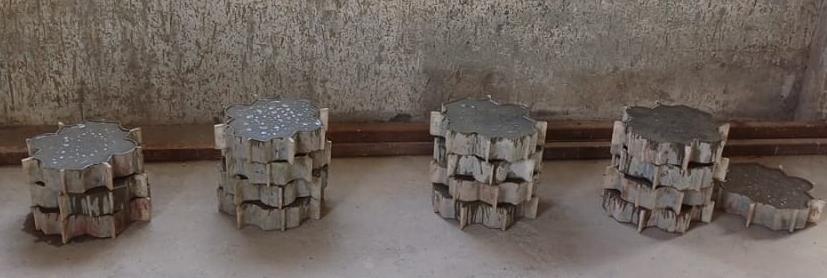
Thedemouldedpaverblocksaresubjectedtowatercuring for 28 days, ensuring adequate hydration and strength development.Afterthecuringperiod,theblocksaretested forcompressivestrengthandwaterabsorptionproperties, which are critical for determining their structural performanceanddurability.
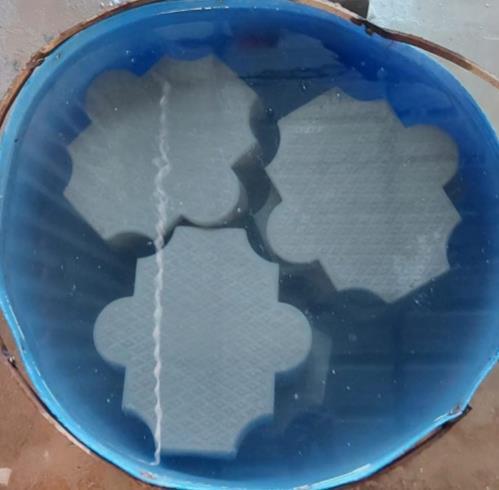
Fig-2:PaverBlocksinCuringTank
Thecompressivestrengthtestwasconductedinaccordance with IS 15658:2006 using a Universal Testing Machine (UTM).Thepaverblocksweresubjectedtoagradualaxial loaduntilfailure,andtheultimateload-bearingcapacitywas recorded.Theresultswereanalyzedtocomparethestrength enhancement due to graphene incorporation at different dosages(0.01%–0.04%).Theeffectofgrapheneinrefining themicrostructurewasalsoconsidered,asitcontributesto betterloaddistributionandcrackresistance.
The water absorption test was performed as per IS15658:2006,wherethepaverblockswereoven-driedat 105°Cfor24hours,weighed,andthenimmersedinwater foranother24hours.Aftertheimmersionperiod,theblocks wereweighedagain,andthewaterabsorptionpercentage wascalculatedbasedonthedifferencebetweenwetanddry weights. This test helped determine the permeability and durabilityofthepaverblocks,withlowerwaterabsorption indicating a denser and more durable matrix. The results wereanalyzedtoassesstheeffectofgrapheneandsodium lignosulfonate in reducing porosity and improving resistance.
Theexperimentalstudyevaluatedthecompressivestrength and water absorption of paver blocks with and without graphene and sodium lignosulfonate. The results indicate that incorporating graphene at varying dosages (0.01%–0.04%) significantly influenced the mechanical and durabilitypropertiesofthepaverblocks.Thecompressive
International Research Journal of Engineering and Technology (IRJET) e-ISSN: 2395-0056
Volume: 12 Issue: 04 | Apr 2025 www.irjet.net p-ISSN: 2395-0072
strength increased with the addition of graphene, while water absorption decreased as the graphene dosage increased.
5.1 Batch A – Control Mix (Without Graphene)
BatchA,thecontrolmix(1:2:4)withoutgraphene,exhibited anaveragecompressivestrengthof26.66MPa.Thisvalue represents the baseline strength for conventional paver blocks.Thewaterabsorptionwasmeasuredat5.8%,which isrelativelyhighduetotheporousnatureofthemix.
5.2 Batch B – Paver Blocks with 0.01% Graphene
Batch B, containing 0.01% graphene and 0.1% sodium lignosulfonate, demonstrated an improvement in compressive strength to 38.21 MPa, marking a 43.4% increaseoverthecontrolmix.Thewaterabsorptionreduced to 5.1%, indicating that graphene's influence on matrix densificationhadbegun.
5.3 Batch C – Paver Blocks with 0.02% Graphene
Batch C, containing 0.02% graphene and 0.15% sodium lignosulfonate, exhibited further strength enhancement, reaching44.12MPa,anincreaseof65.5%comparedtothe controlmix.Atthisdosage,graphene’snano-reinforcement effectbecamemoreprominent,improvingcrackresistance. The water absorption dropped to 4.6%, indicating better compactionandimprovedcementparticlebonding.
Batch D, with 0.03% graphene and 0.2% sodium lignosulfonate, recorded an even higher compressive strength of 48.67 MPa, demonstrating an 82.6% increase over the control mix. At this stage, graphene facilitated bettercrackbridgingandenhancedloaddistributionwithin thecementitiousmatrix.Thewaterabsorptionsignificantly reducedto3.9%,suggestingthatthemixhadreachedamore denselypackedandlessporousstructure.
Batch E, containing 0.04% graphene and 0.25% sodium lignosulfonate,achievedthehighestcompressivestrengthof 50.32 MPa, representing an 88.8% improvement over the controlmix.Thisimprovementisattributedtographene’s abilitytoenhancehydration,refinethemicrostructure,and prevent crack propagation. Furthermore, the water absorption decreased to 3.6%, confirming that the higher graphene content contributed to a denser, more waterresistantmatrix
Table-3:CompressiveStrengthResultson28th Day
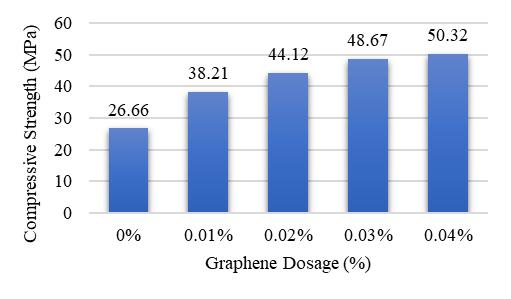
-1GraphIndicatingtheCompressiveStrengthTest Results
Table-4:WaterAbsorptionResultsofPaverBlockBatches
International Research Journal of Engineering and Technology (IRJET) e-ISSN: 2395-0056
Volume: 12 Issue: 04 | Apr 2025 www.irjet.net p-ISSN: 2395-0072
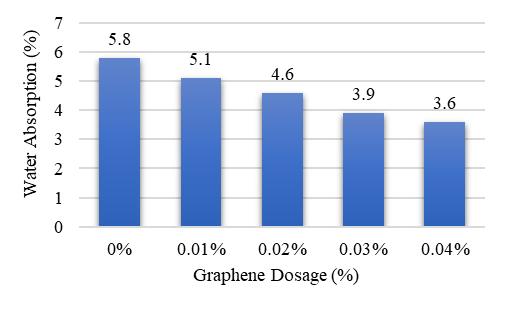
Chart -2 GraphIndicatingtheWaterAbsorptionTestResults
The results confirm that the inclusion of graphene significantly enhances the compressive strength of paver blocks.Theoptimumgraphenedosageisobservedaround 0.03%–0.04%,wherestrengthgainsaremaximizedwithout adversely affecting workability. The incorporation of lignosulfonate effectively facilitated graphene dispersion, ensuring uniform reinforcement throughout the concrete mix.Thesefindingsdemonstratethatgraphene,whenused in appropriate proportions, can substantially improve the mechanicalpropertiesofpaverblocks,makingthemmore durableandresistanttoenvironmentalstresses.
Graphene-enhancedpaverblocksoffersignificanteconomic and environmental advantages by improving material efficiencyandreducingresourceconsumption.Thefollowing benefitswereobserved:
CementProductionReduction:Grapheneimprovesconcrete performance, allowing less cement to be used while maintainingorevenenhancingstrengthanddurability.Since cementproductionaccountsforapproximately8%ofglobal CO₂emissions,reducingitsusagedirectlylowersthecarbon footprint.Byusinggrapheneinconcrete,Cementproduction canbereduced.
EnhancedHydrationEfficiency:Graphenepromotesamore complete reaction of cement particles, improving packing density, reducing porosity, and increasing durability. This resultsinastrongerconcretematrixwithreducedmaterial waste.
LowerWaterDemand:Theadditionofgrapheneimproves workability,enablingareductioninthewater-cementratio. Lower water consumption contributes to water resource conservation.
ConservingNaturalResources:theuseofmanufacturedsand (M-Sand)insteadofriversandhelpsinconservingnatural resources,addressingtheenvironmentalconcernsrelatedto excessivesandmining.
Longer Lifespan, Less Maintenance & Long-term Cost Savings: Graphene improves the durability and abrasion resistance of paver blocks, extending their lifespan. This reduces the frequency of replacements, ultimately decreasingoverallmaterialconsumptionandenvironmental impactresultinginlong-termcostsavings.
Stronger, Lighter Structures: The increased strength providedbygrapheneallowsforthinnerandlighterpaver blocks without compromising performance, reducing materialrequirementsinconstructionprojects.
Rainwater Infiltration & Groundwater Recharge: Interlocking gaps of paver blocks that facilitate rainwater infiltration, allowing water to pass through the spaces between pavers and seep into the ground. This reduces surfacerunoffandpromotesnaturalgroundwaterrecharge. Unlike conventional pavers that are often limited to pedestrianpathwaysandparkingareas,thesehigh-strength, durablepaverblockscanbeinstalledinmoreexposedareas, including heavy-load zones such as industrial yards, roadways, and public infrastructure, ensuring long-term performanceundervaryingenvironmentalconditions.
Graphene-enhanced paver blocks offer a wide range of applications due to their superior mechanical strength, durability,andresistancetoenvironmentaldegradation.The potentialapplicationsinclude:
UrbanRoadwaysandPedestrianWalkways:Theincreased strength and durability of graphene-enhanced pavement blocks make them ideal for high-traffic urban roads and pedestrianpathways.Theirabilitytowithstandheavyloads and resist wear ensures long-term performance with minimalmaintenance.
IndustrialFlooringandHeavy-DutyPavements:Thesepaver blocks can be used in industrial areas, warehouses, and loadingdockswhereheavymachineryandequipmentexert significantstressonthepavement.Theenhancedmechanical properties provide better load-bearing capacity and longevity.
Airport Pavements and Taxiways: Graphene-reinforced paver blocks can be deployed in airport taxiways and aprons,wherehighcompressivestrengthanddurabilityare crucial.Theirreducedwaterabsorptionalsominimizesthe riskoffreeze-thawdamageincolderclimates.
Coastal and Marine Infrastructure: The enhanced impermeability of graphene-infused concrete makes it suitableformarineenvironments,includingports,harbors, and seawalls. Its resistance to chloride-induced corrosion helps in prolonging the lifespan of structures exposed to seawater.
International Research Journal of Engineering and Technology (IRJET) e-ISSN: 2395-0056
Volume: 12 Issue: 04 | Apr 2025 www.irjet.net p-ISSN: 2395-0072
Public Parks and Recreational Spaces: These paver blocks areanexcellentchoiceforpublicparks,cyclingtracks,and joggingpaths.Theirdurabilityensuresthattheyremainin good condition despite exposure to varying weather conditionsandfoottraffic.
Smart Cities and Sustainable Infrastructure: Grapheneenhanced paver blocks contribute to sustainable urban development by reducing the carbon footprint of construction materials, increasing pavement lifespan, and enhancingpermeabilityforeffectiverainwatermanagement andgroundwaterrecharge.
Due to their high strength and durability, grapheneenhanced paver blocks can be utilized in a wide range of applications beyond traditional pedestrian pathways and parking areas. They are well-suited for heavy-load zones suchasindustrialyards,roadways,airportpavements,and publicinfrastructure.Theirenhancedmechanicalproperties ensure long-term performance even in high-traffic and exposedenvironments,makingthemaversatilesolutionfor variousconstructionandurbandevelopmentprojects.
This study demonstrates the incorporation of graphene significantly enhances the mechanical performance and microstructuralcharacteristicsofpaverblocks.Increasing graphenedosagefrom0.01%to0.04%ledtoasteadyrisein compressivestrength,withBatchE(0.04%)reaching50.32 MPa,an88.8%increaseoverthecontrolmix(26.66MPa). This improvement is attributed to graphene’s nano-filler effect, whichfillsmicro voids,restrictscrack propagation, andenablesefficientloadtransfer. Sodiumlignosulfonate, acting as a dispersing agent for uniform graphene distribution, improved cement hydration, and produced a denser,cohesivestructure.
In addition to strength enhancement, Water absorption decreasedfrom5.8%inthecontrolmixto3.6%inBatchE,a 38%reduction.Thisdeclineinpermeabilityreflectsadenser microstructure, enhancing resistance to moisture ingress, freeze-thaw cycles, and other environmental degradation. Reducedporosityextendedtheservicelifeofconcreteused inharshweatherconditions.
The optimized 1:3:4 mix design delivered superior mechanical properties and achieved a 12.6% reduction in cementcontent,supportingenvironmentalsustainability.As cement production significantly contributes to global CO₂ emissions,reducingitsusagelowersconstruction’scarbon footprint.Thesefindingspositiongraphene-enhancedpaver blocks as a high-performance, eco-friendly alternative for heavy-dutyapplicationslikeurbanroads,airportrunways, and marine structures. Future work should explore largescalefieldtrials,longtermdurability,cost-benefitanalysis, and advanced dispersion methods, along with potential
integration into smart or energy-harvesting pavement systems.
1. SyedWasilAminandAshishKumar(2024)‘AStudyon GraphenewithCementConcrete’-InternationalJournal ofInnovativeResearchinEngineeringandManagement (IJIREM),Vol.11,Issue2,pp.12-16.
2. Tahreer Fayyad, Ahmed Abdalqader and M. Sonebi (2022)‘AninsightintoGrapheneasanadditiveforthe use in concrete’ - Conference: CERI/ITRN 2022, Civil EngineeringResearchinIreland.
3. ZPan,LQiu,AHKorayem,GangLi,JWZhu,FCollins,D Li,WHDuan,MCWang(2015)‘Mechanicalproperties and microstructure of a graphene oxide cement composite’-CementandConcreteComposites,Vol.58, pp.140-147.
4. MD Sohel Ahmed and K. Prathap Reddy (2023) ‘An Investigation on Strength Characteristics of Concrete Enhanced with Graphene’ - International Journal of Innovative Research in Science, Engineering and Technology(IJIRSET),Vol.12,Issue11,pp.456-462.
5. Hongming Lou, Duming Zhu, Long Yuan, Xuliang Lin, Dongjie Yang, and Qiu Xueqing (2015) ‘Fabrication of High-Concentration Aqueous Graphene Suspensions DispersedbySodiumLignosulfonateandItsMechanism’ -TheJournalofPhysicalChemistryC,Vol.119,No.40, pp.23221–23230.
6. Yanlin Qin, Lixuan Yu, Ruchun Wu, Dongjie Yang, XueqingQiuand J.Y.Zhu(2016)‘Biorefinery Lignosulfonates from Sulfite-Pretreated Softwoods as DispersantsforGraphene’,ACSSustainableChemistry andEngineering,Vol.4,No.4,pp.2200–2205.
7. JamesL.SuterandPeterV.Coveney(2021)‘Principles governing control of aggregation and dispersion of aqueous graphene oxide’ Scientific Reports, Vol. 11, ArticleNo.22460.
8. XiaojiangHong,JinChaiLee,JingLinNg,ZeetyMdYusof, QianHeandQianshaLi(2023)‘EffectofGrapheneOxide on the Mechanical Properties and Durability of HighStrength Lightweight Concrete Containing Shale Ceramsite’-Materials2023,Vol.16,ArticleNo.2756.
9. T.D. Nguyen, Meini Su, Michael Watson, & Yong Wang (2023)‘Effectsofusingaqueousgrapheneonbehavior and mechanical performance of cement-based composites’-ConstructionandBuildingMaterials,Vol. 368,ArticleNo.130466.
International Research Journal of Engineering and Technology (IRJET) e-ISSN: 2395-0056
Volume: 12 Issue: 04 | Apr 2025 www.irjet.net p-ISSN: 2395-0072
10. HongjianDuandYouliLin(2020)‘Graphenereinforced cement composites’ - Construction and Building Materials,Vol.265,ArticleNo.120312.
11. ThusithaGinigaddara,ChathushikaEkanayake,Priyan Mendis,PasadiDevapura,AshenLiyanageand P. VazSerra (2022) ‘An Introduction to High Performance Graphene Concrete’ - Electronic Journal of Structural Engineering,Vol.22,No.3,pp.11-18.
12. Maria Achieng Akulu, Moffat Tembo and Erastus Misheng’uMwanaumo(2023)‘UtilizationofGraphene asa ConstructionMaterial forSustainableBuildings’International Journal of Innovations and InterdisciplinaryResearch(IJIIR),Vol.1,Issue1,pp.1631
13. Namrata Chavan and M.S. Karriappa (2021) ‘An Experimental Investigation on Strength Properties of ConcretewithGrapheneOxide’-InternationalResearch JournalofEngineeringandTechnology(IRJET),Vol.8, Issue1,pp.1981-1984.
14. SomnathBharechandRichaKumar(2015)‘AReviewon thePropertiesandApplicationsofgraphene’-Journalof MaterialScienceandMechanicalEngineering(JMSME), Vol.2,pp.70-73.
15. K. R. Mohammad Shareef, Shaik Abdul Rawoof and K.Sowjanya (2017)‘AFeasibilityStudyonMechanical Properties of Concrete with Graphene Oxide’International Research Journal of Engineering and Technology(IRJET),Vol.4,Issue12,pp.218-224.
16. A. Mashhadani and V. Pershin (2020) ‘Concrete Modification Using Graphene and Graphene Oxide’Advanced Materials & Technologies, No. 2(18), pp.46-56.
17. JamalA.Abdallaa,BlessenS.Thomasa,RamiA.Hawileha and K.I. Syed Ahmed Kabeer (2022) ‘Influence of nanomaterials on the workability and compressive strengthofcement-basedconcrete’-MaterialsToday: Proceedings,pp.2073-2076.
18. IS 15658:2006 – Precast Concrete Blocks for Paving CodeBook