
International Research Journal of Engineering and Technology (IRJET) e-ISSN: 2395-0056
Volume: 12 Issue: 06 | Jun 2025 www.irjet.net p-ISSN: 2395-0072
International Research Journal of Engineering and Technology (IRJET) e-ISSN: 2395-0056
Volume: 12 Issue: 06 | Jun 2025 www.irjet.net p-ISSN: 2395-0072
Shivamanjunathaswamy H G1, Ashish Aras K2 , Dr. Kiran T3
1 Ph. D Research Scholar, Dept. of Civil Engineering, Bangalore University, Bengaluru
2 Post Graduate Student, Dept. of Civil Engineering, University of Visvesvaraya College of Engineering (UVCE)
3Associate Professor, Dept. of Civil Engineering, University of Visvesvaraya College of Engineering (UVCE) Bengaluru ***
Abstract - The walls dividing floor spaces add considerable deadweighttothebuilding,increasingitsvulnerabilityduring an earthquake event. Thus, the mass of wall panels must be reduced to enhance structural resistance to dead loads and minimize earthquake risks. This paper presents an experimentalinvestigationtostudythestructuralbehaviorofa composite wall panel system under out-of-plane lateral loading. The system comprises of two outer skins of profiled thin-walled steel plates of thickness 1.0 mm bonded to a lightweight concrete core (with expanded polystyrene beads) using 8 mm diameter shear studs. Four panel variants are tested: 1. Lightweight concrete without sheet (LWC-1), 2. Basalt Fiber-reinforced lightweight concrete without sheet (BFRLWC-1),3. Lightweightconcretewithsheet(LWC–2)and 4. Basalt Fiber-reinforced lightweight concrete with sheet (BFRLWC-2). These panels are subjected to lateral tests to evaluate their flexural behavior. The key outcomes include failuremodesandload-deformationcurves,providinginsights into the system’s performance with different infill materials.
Key Words: Composite Wall Panel, Expanded Polystyrene Beads (EPS), Basalt Fiber, Lightweight Concrete (LWC), Basalt Fiber Reinforced Lightweight Concrete (BFRLWC), Out of Plane Lateral Load.
1.INTRODUCTION
Composite steel–lightweight concrete wall panels are innovative structural systems that combine two vertically aligned profiled steel sheets with a lightweight concrete core, often enhanced with materials such as expanded polystyrene(EPS)beadstoreducetheoverallweight.
Lightweight concrete is designed to meet specific requirementssuchasstructuralstrength,reduceddensity andhighthermalinsulation.Thereareseveralmethodsfor producinglightweightconcrete,withoneofthemostcosteffectivebeingtheuseoflightweightaggregatealternatives. Materialslikepumice,diatomite,perliteandvolcaniccinders arecommonlyusedforthispurpose.However,their highwaterabsorptionleadstoamoreporousconcretestructure. Toovercometheselimitations,ExpandedPolystyrene(EPS) beads are used, known for their closed-cell structure, hydrophobic nature and non-absorbent properties, EPS beads offer a viable solution for producing effective
lightweightconcretewithimproveddurabilityandreduced porosity.
Generallyconcreteisamaterialknownforitslowtensile strengthandlimitedstraincapacity.However,itsmechanical properties can be significantly improved by incorporating fibresintothemix.Fiber-reinforcedconcreteiscommonly usedduetoitsenhancedductility,corrosionresistanceand durability. Various types of fibres, including steel and syntheticoptions,canbeaddedtocement-basedcomposites. Among these, basalt fibre has emerged as a strong alternative to traditional fibres like glass and carbon, offering high strength, chemical resistance, flexibility and excellent electrical insulation. Basalt fibre-reinforced composites are increasingly used across sectors such as aerospace, construction, petrochemicals and automotive industries. Additionally, the production of basalt fibre is environmentallyfriendly,asitdoesnotreleasetoxicgasesor industrialwasteandavoidstheuseofharmfulsubstances like boron and alkali metal oxides during the melting process.
Therefore, the steel-lightweight concrete composite arrangementoffersaneffectivebalanceofstrength,ductility andthermalinsulation,makingitapromisingalternativeto traditionalwallconstructionmethods.Whilethesteelsheets contribute tensile resistance and serve as permanent formwork,theirthinprofilemakesthemvulnerabletolocal buckling.Thelightweightconcretecoreplaysacrucialrole inrestrainingthisbuckling,therebyenhancingtheoverall stabilityofthesystem.Thesepanelsarevaluedfortheirease ofinstallation,reduceddeadloadandefficientperformance under lateral. When used in combination with composite floorsystems,theyofferfurtherstructuraladvantagesand are increasingly adopted as core walls in steel-framed buildings.
Thestudyaimsthefollowingobjectives:
To analyse and evaluate the mechanical characteristicsoftheproposedconcretemix.
Tostudythestructuralresponseofcompositewall panels made with Cold-Formed Steel and Basalt
International Research Journal of Engineering and Technology (IRJET) e-ISSN: 2395-0056
Volume: 12 Issue: 06 | Jun 2025 www.irjet.net p-ISSN: 2395-0072
Fiber-Reinforced Lightweight Concrete when subjectedtolateralloads.
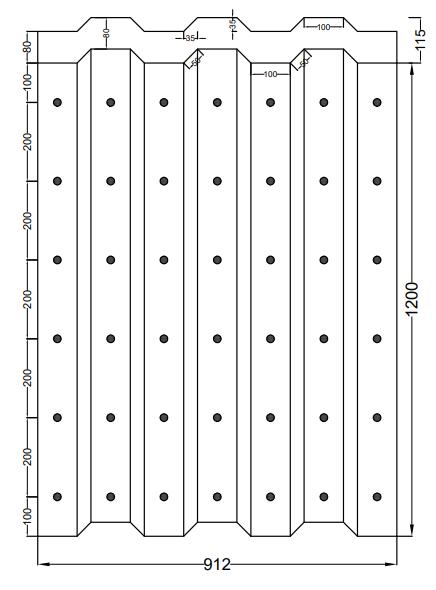
An experimental study was conducted to evaluate the structural behaviour of composite wall panels using coldformed steel sheet profiles. The profiles are designed in accordance with Eurocode IV, with each sheet measuring 1200mminlength,912mminwidthand1mminthickness. Tomaintainauniformwallthicknessof80mmacrossthe panel,theprofiledsteelsheetswereconnectedusingshear connectors comprising 8 mm diameter bolts and nuts. Washerswereplacedateachconnectionpointtoenhancethe gripbetweentheboltandnut,whilealsopreventingconcrete leakage during casting. This bolted connection ensured effective shear transfer between the steel sheets and the concrete core, thereby enabling composite action. The arrangementofshearconnectorsalsocontributedtouniform stress distribution under lateral loading. The detailed dimensions of the cold-formed steel profile are shown in Fig.1.Thesedesignconsiderationswerecriticaltoensuring the structural integrity and performance of the composite systemunderappliedloads.
4.1Cement - OrdinaryPortlandCement(53Grade)wasused asthebindingagent,exhibitinganinitialsettingtimeof75 minutesandafinalsettingtimeof315minutes
4.2 Fly Ash - Class F fly ash is utilized, conforming to the requirements outlined in ASTM C618. This category of fly ashismainlyobtainedfromthecombustionofanthraciteor bituminous coal, though it may also be sourced from subbituminouscoalandlignite.
4.3 Fine Aggregate - Msandisutilizedasthefineaggregate, possessing a specific gravity of 2.65 and falling within GradingZoneII.
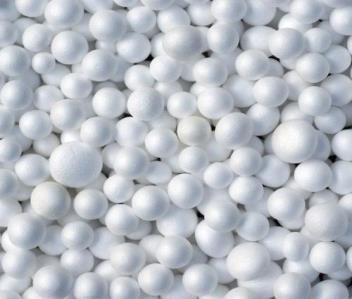
4.4 Expanded Polystyrene (EPS) - A lightweight and stable foam material composed primarily of air (approximately 98%)andasmallfractionofpolystyrene(about2%).Dueto its closed-cell structure, EPS does not absorb water and offers excellent resistance to impact. It is also a nonbiodegradable substance. As illustrated in Figure 2, EPS beads are available in a variety of sizes. In this study, uniformly sized spherical beads with a diameter of 4 mm wereutilized.

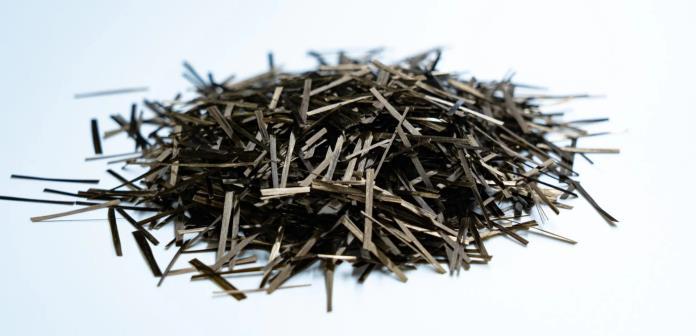
4.5 Basalt Fiber – The basalt fibres used in this study measured12mminlengthand20µmindiameter,withan aspect ratio of 600. They offer excellent thermal stability, strong resistance to alkaline environments (up to pH 14), and a specific gravity between 2.6 and 2.8, making them idealforenhancingconcreteperformance.
Volume: 12 Issue: 06 | Jun 2025 www.irjet.net
The mix proportions for thelightweight concrete were determinedthroughatrial-and-errorapproach,maintaining awater-to-cementratioof0.7.Themixproportionfor1m3 arepresentedinTable1.
Table -1: Mix Proportion of Cement Concrete
1
6. Construction and Lateral Load Test Details
6.1
Inthisexperimentalinvestigation,fourcompositewallpanel specimens were prepared. Two specimens were cast with LightweightConcrete(LWC)astheinfill onewithexternal steel sheeting and one without. Similarly, remaining two specimens utilized Basalt Fiber Reinforced Lightweight Concrete(BFRLWC)asinfillinthesameconfigurations.Each panelmeasured1200mminheight,912mminwidthand80 mminthickness,withprofiledsteelsheetshavingathickness of 1.0 mm. The infill concretes, LWC and BFRLWC, have densitiesrangingbetween1300-1400kg/m³.Thematerial propertiesofboththesteelsheetingandtheconcretemixes were determined through preliminary tests On the day of testing,thecompressivestrengthswereobservedtobe11.38 MPaforLWCand13.17MPaforBFRLWC.Table2represents typeofspecimenscasted.
The test set-up for lateral load shown in Fig. 4 and the procedureisasfollows.
The test setup was carefully aligned with the centrelineofthehydraulicjack,withsupportstands placed1000 mmapart.AnI-sectionbeam(1000 mm inlength,150 mmflangewidth,and300 mmheight) was positioned on the supports, and a steel roller wasplacedontheI-sectiontosupportthespecimen.
Thewallpanelspecimenwasplacedovertherollers, withtwoadditionalrollerspositionedattheloading points.Adistributionloadbeamwasplacedontop to ensure uniform load transfer across the panel width.
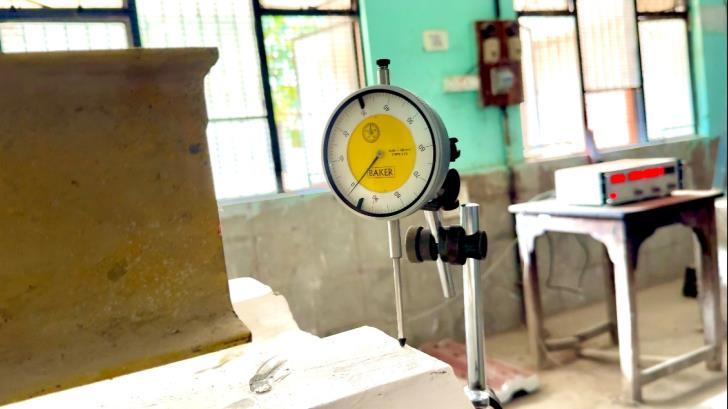
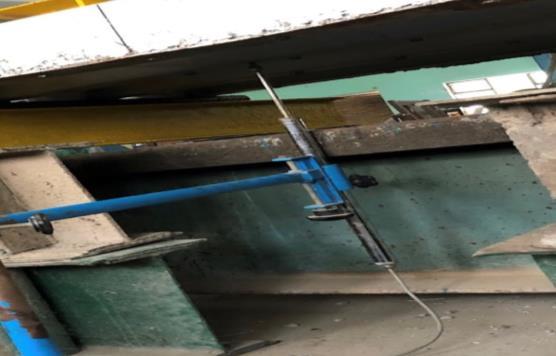
LinearVariableDifferentialTransformer(LVDT)is placedatmid-spantorecordthecentraldeflection, whiledialgaugesareplacedattheloadingpointand supportendtomeasurerotationanddisplacement respectively Fig.5andFig.6showsthedialgauge andLVDT.
Lateral (out-of-plane) loading was applied to the wallpanelspecimenstodeterminethefailuremodes andload-deformationcurves.
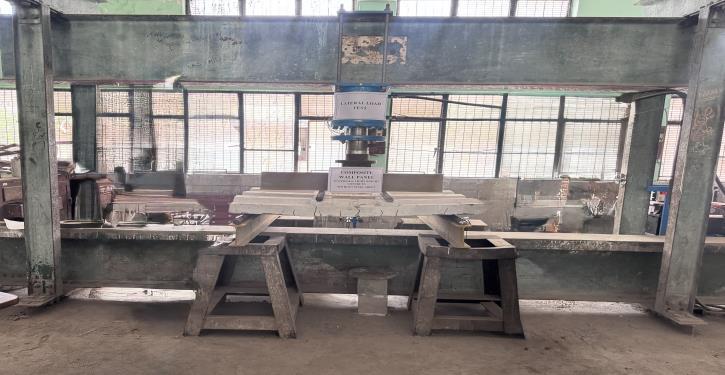
Table -2: Detailsof
International Research Journal of Engineering and Technology (IRJET) e-ISSN: 2395-0056
Volume: 12 Issue: 06 | Jun 2025 www.irjet.net p-ISSN: 2395-0072
ThemechanicalpropertiesofLightweightConcrete(LWC) andBasaltFiberReinforcedLightweightConcrete(BFRLWC) was evaluated through standardized testing in accordance withIS516:2021.Specimenswerecastandwater-curedfor7 and28daystoassesscompressive,flexuralandsplittensile strengths.TheexperimentalresultsshowninTable3indicate thattheincorporationofbasaltfibressignificantlyimproves the strength characteristics of lightweight concrete, demonstratingenhancedstructuralefficiencyandsuitability forload-bearingapplications.
No. of Days
Curing
Average compressive strength of cubes (N/mm2)
Average split tensile strength of cylinder (N/mm2)
Average flexural strength of prism (N/mm2)
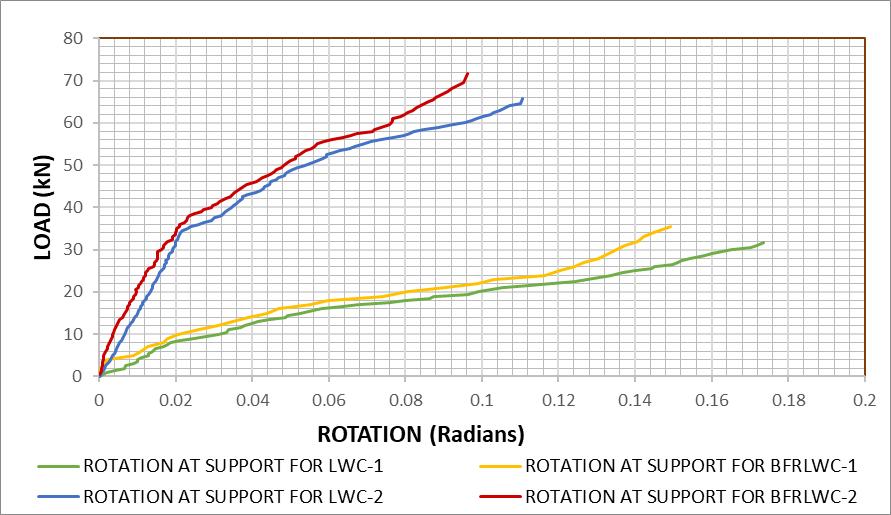
represents load deformation response of composite wall panelsatcentre,loadingpointandrotationatsupport.
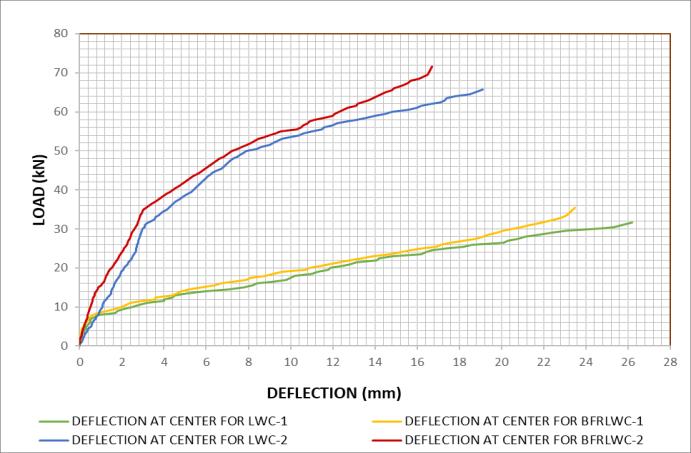
Graph - 1:Loadv/sDeflectionatCentre
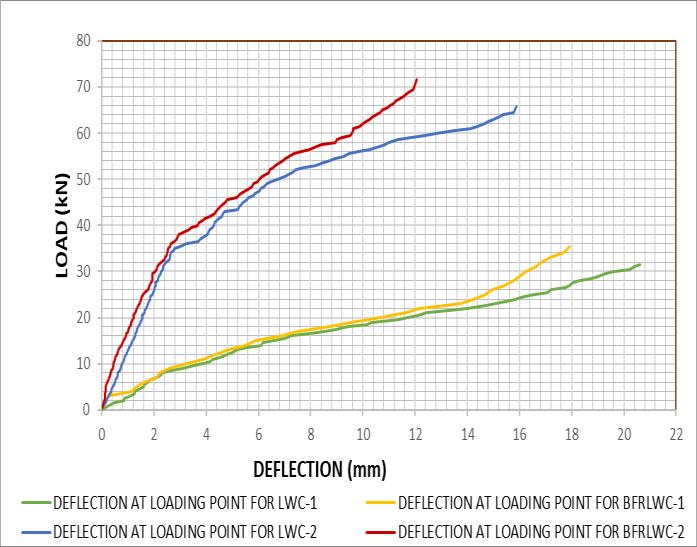
Table -2: MechanicalPropertiesofLWCandBFRLWC
Under lateral loading, composite wall panels with lightweightconcrete(LWC)infillexhibitedsuddenandbrittle failure.Withincreasingload,verticalsplittingcracksinitially formed between the loading points, followed by the developmentofadditionalcracksastheloadprogressed.Test observations revealed that the steel sheets and concrete initially behaved as a composite system under uniform loading. However, at higher load levels, the steel began to penetratethroughthetopsurfaceoftheconcrete,whilethe bottomsurfaceexperiencedtensilestretching.Loadtransfer fromconcretetosteelresultedinlocalizedbucklingnearthe loadingzonesduetostressconcentrations.Debondingofthe steel sheet was primarily observed beneath the cracked regions.ComparedtotheLWCpanels,theBFRLWC(Basalt FiberReinforcedLightweightConcrete)panelsdemonstrated improvedperformance,withfewercracks,attributedtothe crack-bridging effect of the basalt fibres. Graph 1, 2 and 3
Graph - 3:Loadv/sRotationatSupport
International Research Journal of Engineering and Technology (IRJET) e-ISSN: 2395-0056
Volume: 12 Issue: 06 | Jun 2025 www.irjet.net p-ISSN: 2395-0072
The test results of flexural deformations of the composite wallpanelsarerepresentedinTable3.
Table -3: ResultsforOutofPlaneLateralLoadTests
Incorporating 1% basalt fibre into the lightweight concrete mix led to notable enhancements in structural behavior, particularly in terms of increased load-bearing capacity and reduced deformation.Thebasaltfibre-reinforcedspecimens (BFRLWC-1andBFRLWC-2)consistentlysurpassed theperformanceofnon-reinforcedspecimens(LWC1andLWC-2).
Theinterfacebetweenthecold-formedsteelsheet and concrete, connected via shear connectors or studs, demonstrated sufficient bonding capacity withnoslippageobservedduringtesting,confirming effectivesheartransfer.
Specimensutilizingprofiledsteelsheeting(LWC-2 and BFRLWC-2) exhibited superior mechanical properties,includinggreaterstrengthandstiffness, compared to those without steel sheeting. This highlights the role of the steel sheet in enhancing composite interaction and resistance to lateral forces.
Among all tested panels, BFRLWC-2 achieved the best results, with the highest ultimate load and minimaldeflection,illustratingthecombinedbenefit ofbasaltfibrereinforcementandsteelsheeting.
Alltestspecimensfollowedaconsistentdeflection profile,peakingatmid-spanandminimizingatthe supports.Theincorporationofbasaltfibresandsteel sheetscontributedtoreducedmid-spandeflection and support rotation, indicating improved overall rigidityandload-sharingefficiency.
In conclusion, the integration of basalt fibres and profiled steel sheets significantly enhanced the structural efficiency of composite wall panels, suggesting their suitability for lightweight
construction scenarios demanding both high strengthandductility.
[1] S Kavia Padmashali, Mr. Pravek Sahu. (2024). “An Experimental Study of Light Weight Concrete with Expended Polystyrene Beads as Aggregates” International Research Journal of Engineering and Technology(IRJET),Volume:11Issue:07,e-ISSN:23950056,p-ISSN:2395-0072.
[2] Chethan Kumar S P, Shivamanjunathaswamy H G, Dr. Kiran T, 2023, “Experimental Studies on Flexural BehaviorofSteel-ConcreteCompositeSlabPanelUsing Basalt Fibre” International Journal of Engineering Research & Technology (IJERT) Volume 12, Issue 09 (September2023).
[3] Yao, B.; Fang, H.; Qian, Z.; Wang, Q.; Sun, J.; Wang, W. “Experimental and Numerical Study on Axial CompressionCold-FormedSteelCompositeWallunder ConcentratedLoads.”Buildings2023,13,1232.
[4] Yan Li, Jiupeng Zhang, Yinzhang He, Guojing Huang, JunboLi,ZhenxingNiu,BoGao,“Areviewondurability ofbasaltfiberreinforcedconcrete”CompositesScience andTechnology,Volume225,2022,109519,ISSN02663538.
[5] Yuxin Gao, Baojun Cheng, Pengfei Ma, Boyuan Shi, Shengrong Kang, and Yulin Tu. “Study on the HighperformanceCompositeWallPanelEnvelopofBuilding anditsRelevantJointConstruction”(2020),E3SWebof Conferences198,01003.
[6] Yamin Wang, Shaowei Hu, Xiping Sun, “Experimental investigation on the elastic modulus and fracture propertiesofbasaltfibre–reinforcedflyashgeopolymer concrete”ConstructionandBuildingMaterials,Volume 338,2022,127570,ISSN0950-0618.
[7] Zhou, H., Jia, B., Huang, H., & Mou, Y. (2020). “ExperimentalStudyonBasicMechanicalPropertiesof Basalt Fiber Reinforced Concrete.”Materials,13(6), 1362.
[8] Prof. Ashish S. Moon, Lokesh S. Selokar, Anuradha I. Patle, Dhanshree S. Bhoyar, Swati D. Kowale, SumaiyasarvatS.Quaz.“LightWeightConcretebyUsing EPS Beads” (2020), International Research Journal of EngineeringandTechnology(IRJET)Volume:07Issue: 07,e-ISSN:2395-0056,p-ISSN:2395-0072.
[9] S. Naga Priya, C. G. Sivakumar. “Experimental InvestigationofthePropertiesofLightWeightConcrete WallPanels”Vol.6No.3October-December,2021,ISSN: 0974-5823
International Research Journal of Engineering and Technology (IRJET) e-ISSN: 2395-0056
Volume: 12 Issue: 06 | Jun 2025 www.irjet.net p-ISSN: 2395-0072
[10] Jiang,Dongqi,CongzhenXiao,TaoChen,andYuyeZhang.
“Experimental Study of High-Strength Concrete-Steel Plate Composite Shear Walls” (2019), Applied Sciences9,no.14:2820.
© 2025, IRJET | Impact Factor value: 8.315 | ISO 9001:2008 Certified Journal | Page545