
International Research Journal of Engineering and Technology (IRJET) e-ISSN: 2395-0056
Volume: 13 Issue: 02 | Feb 2026 www.irjet.net p-ISSN: 2395-0072
EXPERIMENTAL STUDIES ON EFFECT OF ELEVATED TEMPERATURE ON FIBRE REINFORCED GEOPOLYMER CONCRETE
Rakshith D R1, Dr. Sadath Ali Khan Zai2 , Akash Babu L A3, Mohiyuddhin C S4
1,3,4 Department of Civil Engineering
2professor, Department of Civil Engineering
1,2,3,4UVCE, Bengaluru, Karnataka, India ***
Abstract - The present studies involves a comparative experimental investigation on the strength characteristics of M40 grade Conventional Concrete (CC) and Geopolymer Concrete (GPC) of having compressivestrength40N/mm2 with 10 Molarity to which incorporating glassfibreandsteelfibre.A total of eight concrete matrix were considered for detail experimental work, viz: M40 Conventional Concrete (control mix), M40 + GF, M40 + SF, M40+ GF + SF, Geopolymer Concrete GPC+10M, GPC+10M+GF, GPC +10M + SF, and GPC +10M + GF +SF. It is evident from the Experimental Study on Effect of Elevated Temperature on Mechanical Properties of Fibre ReinforcedGeopolymerConcreteresultsobtainedat28,56days and 90 days, the mix containing GPC +10M + GF +SF. has sustained maximum compressive strength, and flexural strength even at 100°C, 200°C and however, it is noticed that strength reduction at elevated temperature 300°C.
Key Words: GPC, Fly Ash GGBS, Steel fibre, Glass fibre, Alkaline activators and Elevated temperature,
1. INTRODUCTION
Concrete is one of the most widely used construction materials in the world and plays a vital role in the development of modern infrastructure. From residential buildings and bridges to highways, dams, and industrial structures,concreteformsthebackboneofcivilengineering projects.Itspopularityarisesfromacombinationoffactors suchashighcompressivestrength,durability,versatilityin form,andtheavailabilityofrawmaterialsatrelativelylow cost. Over the years, concrete technology has evolved significantly,respondingto thegrowingdemandforsafer, moredurable,andsustainablestructures.
Geopolymer concrete has gained significant attention as a sustainable alternative to conventional cement-based concrete due to increasing concerns over environmental pollution and climate change. The production of ordinary Portland cement is highly energy-intensive and is responsible for approximately 7–8% of global carbon dioxide (CO₂) emissions. This substantial environmental impact has encouraged the construction industry and researcherstoexploreeco-friendlymaterialsthatcanreduce carbon emissions without compromising structural performance. Hardened concrete structures are often exposed to elevated temperatures due to fire accidents, industrialprocesses,nuclearfacilities,orhigh-temperature
service environments. Understanding the behavior of hardenedconcreteunderelevatedtemperaturesisessential for evaluating structural safety, residual strength, and durability. Exposure to high temperatures significantly influences the physical, mechanical, and microstructural properties of concrete. In some cases, slight strength improvement may occur due to further hydration of unhydratedcementparticles.Whenconcreteisexposedto temperaturesbetween100°Cand200°Cand300°Cto600°C, significant degradation occurs, Calcium hydroxide decomposesaround450°C–550°C,causinglossofcohesion inthecementmatrix
2. EXPERIMENTAL INVESTIGATION
Experimentalinvestigationoftheelevatedtemperature mechanicalpropertiesofconcretefocusesonevaluatingits behavior under high thermal exposure, particularly in compression and flexure. This research is essential for assessing structural safety during fire incidents and hightemperature industrial applications. In a typical study, concretespecimenssuchascubes(forcompressiontests) and prisms or beams (for flexural tests) are cast using standardizedmixdesignsandcuredfor28,56and90days. After curing, specimens are exposed to elevated temperatures commonly 100°C, 200°C and 300° in an electricfurnace.Theheatingrateiscarefullycontrolledto preventthermalshock,andspecimensaremaintainedatthe target temperature for a specified duration to ensure uniform heat distribution. After exposure, samples are allowedtocooleithernaturally(aircooling)dependingon theexperimentalobjective.
Compressivestrengthisdeterminedusingacompression testing machine, where axial load is applied until failure. Resultstypicallyshowagradualreductionincompressive strengthwithincreasingtemperatureduetomoistureloss, microcracking, and decomposition of hydration products suchascalciumsilicatehydrate(C–S–H).Flexuralstrengthis evaluated using a three-point or four-point bending test. Flexural performance generally deteriorates more significantly than compressive strength because tensile zonesarehighlysensitivetothermalcracking.
International Research Journal of Engineering and Technology (IRJET) e-ISSN: 2395-0056
Volume: 13 Issue: 02 | Feb 2026 www.irjet.net p-ISSN: 2395-0072
3. MATERIALS AND MIXES
Geopolymer concrete (GPC) is produced by activating aluminosilicate-rich industrial by-products using alkaline solutions. The primary binders used are Fly ash (FA), especiallyClassF,andGroundGranulatedBlastFurnaceSlag (GGBS),bothknownfortheirhighsilica(SiO₂)andalumina (Al₂O₃)content.Thealkalineactivatortypicallyconsistsof sodium hydroxide (NaOH) and sodium silicate (Na₂SiO₃). Aggregates (fine and coarse) are used similarly to conventionalconcrete,oftenconstitutingabout75–80%of thetotalmix.Thewater-to-binderratioiskeptlow,while8M molarityofNaOHsolutionisusedwhilemixing,ithelpsto significantlyinfluencesstrength.
MIXES DETAILS
M40 M40Gradeofconcrete(controlmix)
M40+GF GlassfibercombinedwithM40Gradeof concrete
M40+SF SteelfibercombinedwithM40Gradeof concrete
M40+GF+SF GlassfiberandsteelfibercombinedwithM40 Gradeofconcrete
GPC+10M Geopolymerconcretewith10Mmolarity
GPC+10M+GF Geopolymerconcretewith10Mcombined withGlassfiber
GPC+10M+SF Geopolymerconcretewith10Mcombined withSteelfiber
GPC+10M+GF
+SF Geopolymerconcretewith10Mcombined withGlassfiberandSteelfiber
4.
INSTRUMENTATION
Thesampleexposedtoelevatedtemperaturetofindoutthe residualstrengthofconcrete.Theelevatedtemperaturetest wascarriedoutusingthermocontrolledovenusingelectric furnace installed by Max Heat Furnaces, Bengaluru at Structural Engineering Laboratory, Civil Engineering Department, UVCE, Bangalore University, Bengaluru-56. Concretetestingovenequipmentisanessentiallaboratory apparatus used to study the thermal behavior of concrete underelevatedtemperatureconditions.Inthisresearch,an electricallyoperatedlaboratoryovenisemployedtoexpose concrete specimens to controlled temperatures of 100°C, 200°C, and 300°C, simulating fire exposure and hightemperatureserviceenvironments.
5. RESULTS AND DISCUSSIONS
1) Residual Compressive Strength of Concrete on Elevated Temperature at 100°C, 200°C and 300°C For 28, 56 and 90 Days
Compressive strength tests were performed on standard cube specimens of size 150 × 150 × 150 mm for all mix variations.Thespecimensweretestedaftercuringperiodsof
28, 56, and 90 days to evaluate the strength development over time. The compressive strength values obtained for each mix at these intervals are summarized in the table below
Residual Compressive Strength at 28 days
Table 2:Compressivestrengthofallmixescuredfor28 daysatelevatedtemperature
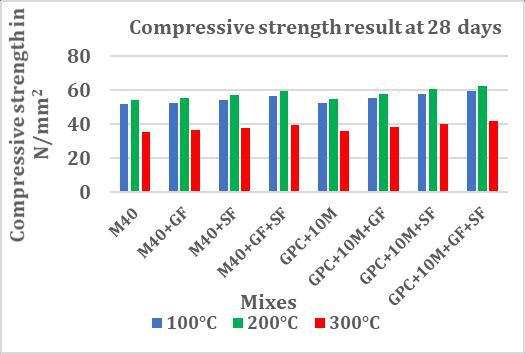
Figure 1: ComparisonofCompressiveStrengthof concrete ofallmixescuredfor28
at
International Research Journal of Engineering and Technology (IRJET) e-ISSN: 2395-0056
Volume: 13 Issue: 02 | Feb 2026 www.irjet.net p-ISSN: 2395-0072
Residual Compressive Strength at 56 days
Table 3: Compressivestrengthofallmixescuredfor56 daysatelevatedtemperature
Type of mixes
GPC+10M+GF+SF
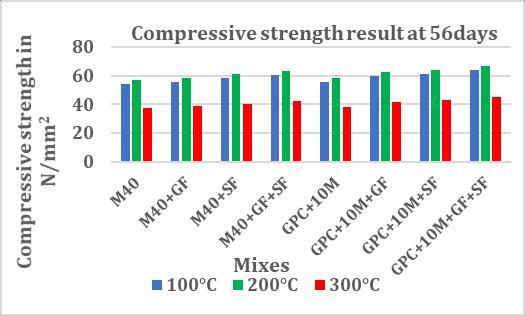
Figure 2:ComparisonofCompressiveStrengthof concreteofallmixescuredfor56daysatelevated temperature
Residual Compressive Strength at 90days
Table 4: Compressivestrengthofallmixescuredfor90 daysatelevatedtemperature
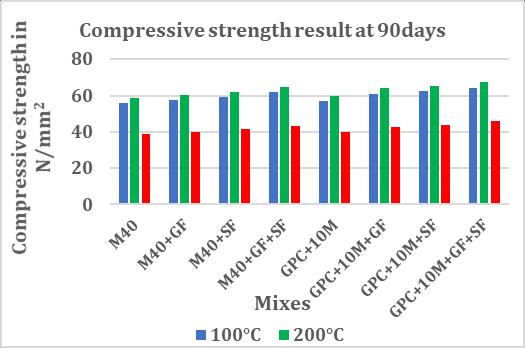
Figure 3: ComparisonofCompressiveStrengthof concreteofallmixescuredfor90daysatelevated temperature
2) Residual Flexural Strength of Concrete on Elevated Temperature At 100°C, 200°C and 300°C For 28, 56 and 90 Days
Flexural strength tests were conducted on beam specimenswithdimensionsof100×100×500mm.The specimens were tested after curing periods of 28, 56, and90daystoevaluatethestrengthdevelopmentover time Duringtesting,themaximumloadatfailurewas recordedforeachspecimen.Usingthisdata,theflexural strength was calculated in accordance with standard procedures.Theflexuralstrengthvaluesobtainedforall concretemixesaresummarizedinthebelowtable.
Residual Flexural Strength at 28 days
Table 5: Flexuralstrengthofallmixescuredfor28daysat elevatedtemperature
Type of mixes
Type of mixes
International Research Journal of Engineering and Technology (IRJET) e-ISSN: 2395-0056
Volume: 13 Issue: 02 | Feb 2026 www.irjet.net p-ISSN: 2395-0072
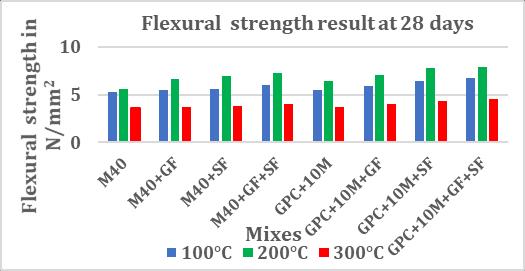
Figure 4:ComparisonofFlexuralStrengthofconcreteof allmixescuredfor28daysatelevatedtemperature
Residual Flexural Strength at 56 days
Table 6: Flexuralstrengthofallmixescuredfor56daysat elevatedtemperature
Type of mixes
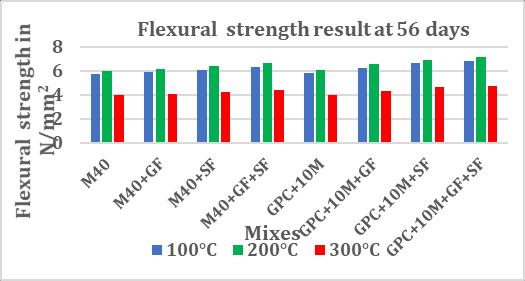
Figure 5: ComparisonofFlexuralStrengthofconcreteof allmixescuredfor56daysatelevatedtemperature
Residual Flexural Strength at 90 days
Table 7: Flexuralstrengthofallmixescuredfor90daysat elevatedtemperature
Type of mixes
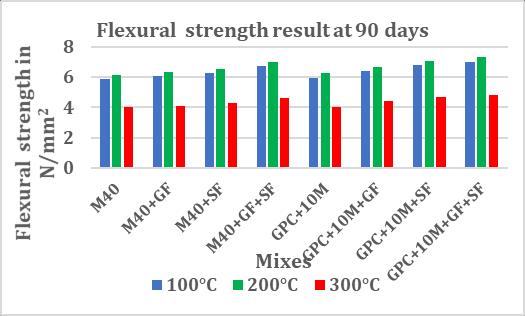
Figure 6: ComparisonofFlexuralStrengthofconcreteof allmixescuredfor90daysatelevatedtemperature
6. CONCLUSION
1. It is noticed that for the 28 days the increase in elevated Compressive strength of test specimen from 200°C is 15.03% for GPC+10M+GF+SF than M40respectively.Italsofoundthatlessreductionin Compressivestrengthat300°CisGPC+10M+GF+SF thanM40respectively.
2. It is noticed that for the 56 days the increase in elevated Compressive strength of test specimen from 200°C is 16.60% for GPC+10M+GF+SF than M40respectively.Italsofoundthatlessreductionin Compressivestrengthat300°CisGPC+10M+GF+SF thanM40respectively.
3. It is noticed that for the 90 days the increase in elevated Compressive strength of test specimen from 200°C is 14.92% for GPC+10M+GF+SF than M40respectively.Italsofoundthatlessreductionin
International Research Journal of Engineering and Technology (IRJET) e-ISSN: 2395-0056
Volume: 13 Issue: 02 | Feb 2026 www.irjet.net p-ISSN: 2395-0072
Compressivestrengthat300°CisGPC+10M+GF+SF thanM40respectively.
4. It is noticed that for the 28 days the increase in elevated Flexural strength of test specimen from 200°C is 16.98% for GPC+10M+GF+SF than M40 respectively. It also found that less reduction in Flexuralstrengthat300°CisGPC+10M+GF+SFthan M40respectively.
5. It is noticed that for the 56 days the increase in elevated Flexural strength of test specimen from 200°C is 19.07% for GPC+10M+GF+SF than M40 respectively. It also found that less reduction in Flexuralstrengthat300°CisGPC+10M+GF+SFthan M40respectively.
6. It is noticed that for the 90 days the increase in elevated Flexural strength of test specimen from 200°C is 18.77% for GPC+10M+GF+SF than M40 respectively. It also found that less reduction in Flexuralstrengthat300°CisGPC+10M+GF+SFthan M40respectively.
REFERENCES
1. C.S.Bezerra,P.S.Maciel,P.R.R.SoaresJunior,M.T. P. Aguilar, and P. R. Cetlin, “Effect of high temperatureonthemechanicalpropertiesofsteel fibre reinforced concrete,” Fibres, vol. 7, no. 12, 2019.
2. Gul,K.Khan,S.Akbar,andIrfanullah,“Effectofsteel fibredosageonmechanicalpropertiesofreinforced concrete,” in International Conference on Civil EngineeringandSustainableConstruction,vol.22, no.6,2022.
3. M. Shende, A. M. Pande, and M. Gulfam Pathan, “Experimental study on steel fibre reinforced concrete for M-40 grade,” International Refereed Journal ofEngineeringand Science(IRJES),vol.1, 2012.
4. Rihawi, M. M. Maras, E. Ekinci, and E. Kutlusoy, “Developmentofnovelfiberreinforcedeco-friendly concrete:Applicationingeopolymerconcretepipes infrastructure systems,” Clean Technologies and EnvironmentalPolicy,2025.
5. F. Shaikh and S. Haque, “Behaviour of carbon and basalt fibres reinforced fly ash geopolymer at elevated temperatures,” International Journal of ConcreteStructuresandMaterials,vol.12,art.no 35,May2018.
6. H. U. Ahmed, A. A. Mohammed, S. Rafiq, A. S. Mohammed,A.Mosavi,N.H.Sor,andS.M.A.Qaidi, “Compressivestrength of sustainable geopolymer concrete composites: A state of the art review,” Sustainability,vol.13,no.24,2021
7. J. Ahmad et al., “Glass fibers reinforced concrete: Overview on mechanical, durability and microstructureanalysis,”Materials,vol.15,no.15, 2022.
8. J. Asanammal Saral and A. M. Uzair, “A comprehensive review on fiber reinforced geopolymerconcrete:Mechanicalperformance,mix design,anddurability,”InternationalJournalofCivil EngineeringandTechnology(IJCIET),vol.10,no.2, 2019.