
International Research Journal of Engineering and Technology (IRJET) e-ISSN: 2395-0056
Volume: 12 Issue: 04 | Apr 2025 www.irjet.net p-ISSN: 2395-0072
International Research Journal of Engineering and Technology (IRJET) e-ISSN: 2395-0056
Volume: 12 Issue: 04 | Apr 2025 www.irjet.net p-ISSN: 2395-0072
Dastageer R. Jamadar 1, Naim N. Mulla2, Amol A. Patil3, Vaishnavi V. Varape4,Anuradha P. Magdum5
1,2,3,4 UG Student, D. Y. Patil Technical Campus , Faculty of Engineering and Management, Talsande, Kolhapur, Maharashtra, India
5, Assistant Professor, D.Y.Patil Technical Campus , Faculty of Engineering and Management, Talsande, Kolhapur, Maharashtra, India
Abstract - This study investigates the effects of key process parameters in Wire Electrical Discharge Machining (WEDM) onthe Material Removal Rate (MRR) duringthe machining of AISI D3 tool steel. Using a one-variable-at-a-time (OVAT) approach and Taguchi-based L9 orthogonal array for experimental design, the influence of pulse on time (TON), pulse off time (TOFF), peak current (IP), and wire feed rate (WF) was evaluated. Experimental trials were conducted on an ELECTRONICA SPRINTCUT machine using 0.18 mm zinccoated brass wire and deionized water as the dielectric medium. Analysis of Variance (ANOVA) identified pulse on time andwire feedrate as themost significant contributorsto MRR variation. A regression model was developed to predict MRR with high accuracy (R² = 94.17%). Results reveal that increasingTON andTOFFenhancesMRR,whilehigherWFand IP tend to reduce it. These findings provide a basis for optimizing WEDM parameters to improve machining efficiency of hard tool steels like AISI D3.
Key Words: WireEDM,MaterialRemovalRate,AISID3Tool Steel,PulseOnTime,TaguchiMethod,ANOVA
1.INTRODUCTION
WireElectricalDischargeMachining(WireEDM)isanontraditionalmachiningprocessthatutilizesaseriesofrapid, controlledelectricaldischarges(sparks)toerodeelectrically conductive materials. This process occurs between a thin, continuously moving wire electrode and the work piece, separated by a minute spark gap filled with an insulated dielectricfluid,typicallyde-ionizedwater.
During the machining operation, high-frequency pulses of alternatingordirectcurrentaredischargedfromthewireto the work piece. These discharges, occurring at rates exceeding one hundred thousand times per second and lasting less than a microsecond, generate intense heat, estimated between 15,000° to 21,000° Fahrenheit. This extremeheatcauseslocalizedmeltingandvaporizationofa tinyvolumeofmaterialfromboththeworkpieceandasmall portionofthewireelectrode.
Thewireelectrode,usuallymadeofbrass,copper,orabrasszinc alloy, ranges in thickness from 0.001 to 0.014 inches and is fed from a spool. As the wire moves along a programmed path, the sparks progressively erode the workpiece,creatingthedesiredshapeorcut.
The dielectric fluid plays a crucial role in the Wire EDM process. It acts as an insulator between the wire and the workpiece until sufficient voltage is applied to ionize it, allowing a controlled spark to occur. Furthermore, the pressurized flow of the dielectric fluid through top and bottom flushing nozzles effectively removes the eroded particles (chips) from the cutting zone, preventing short circuits and ensuring efficient machining. The continuous flowofthedielectricalsodissipatestheheatgeneratedby thesparks,preventingthermalexpansionoftheworkpiece, which could compromise dimensional and positional accuracy.Tomaintainconsistentmachiningconditionsand accuracy, the dielectric fluid is continuously filtered to remove suspended solids and passed through a chiller to maintainaconstanttemperature.
In essence, Wire EDM removes material through spark erosion, making it essential for the workpiece to be electricallyconductive.Theprocessallowsforthecreationof intricateandcomplexshapeswithhighprecisionandsurface finish,withthevolumeofmaterialremovedbeingdirectly relatedtothedesiredcuttingspeedandsurfacequality.
Thiscompilationsummarizesseveralstudiesexploring the influence of Wire Electrical Discharge Machining (WEDM) parameters on performance. Researchers have investigated how varying pulse-on time, pulse-off time, voltage, current, wire feed, wire tension, and flushing pressure affect Material Removal Rate (MRR), surface roughness,andkerfwidth.
MSivaKumaretal.[2]utilizedTaguchi'sL18array tostudyAISID3steel,findingthatincreasedpulse-ontime, current,andvoltageenhancedMRR,whilepulse-offtimehad
International Research Journal of Engineering and Technology (IRJET) e-ISSN: 2395-0056
Volume: 12 Issue: 04 | Apr 2025 www.irjet.net p-ISSN: 2395-0072
a minimal impact. Vaghela et al., also using AISI D3, employed Taguchi's L9 array, measuring MRR, surface roughness,andkerfwidth,andvaryingsimilarparameters.
Deepa Singh et al.[4 ]using a ZNC-250 machine and SK2MCr4steel,employedTaguchi'sL9tostudypulsetimes, current, and servo voltage, again measuring MRR, surface roughness,andkerfwidth.SinghandSharma[7],employing Taguchi'sL18,examinedH13toolsteel,demonstratingthat higher pulse-on time and current increased MRR, while servo voltage and pulse-off time decreased it. They also foundthatsurfaceroughnessincreasedwithwiretension, pulse-offtime,andservovoltage,butdecreasedwithwire feed,pulse-ontime,andcurrent.
[7]Sharmaetal.utilizedResponseSurfaceMethodology (RSM) and Central Composite Rotatable Design (CCRD)to modelWEDMofD2steel,showingthatincreasedpulse-on time and voltage increased surface roughness, while increasedpeakcurrentdecreasedit.SinghandPradhan[8], using Taguchi's L27, examined AISI D2 steel, finding that pulsetimessignificantlyimpactedMRRandcuttingrate,and pulse-ontimeandservovoltageaffectedsurfaceroughness.
Kanlayasiri and Boonmung [10] studied DC53 steel, finding that increased pulse-on time and peak current significantly increased surface roughness. Parashar et al.[11],usingTaguchi'sL32,investigatedsteelandfoundthat gap voltage, pulse times, wire feed, and flushing pressure influencedkerfwidth.
These studies consistently highlight the significant influence of pulse-on time and current on MRR. They also demonstrate the complex interactions between various parametersandtheireffectsonsurfaceroughnessandkerf width,emphasizingtheneedforcarefulparameterselection tooptimizeWEDMprocesses.
3.METHODOLOGY
This study was designed to experimentally analyze and optimize the influence of selected WEDM process parametersontheMaterialRemovalRate(MRR)duringthe machiningofAISID3toolsteel.Themethodologyfolloweda systematic approach encompassing material selection, parameter identification, experimental design, execution, anddataanalysis.
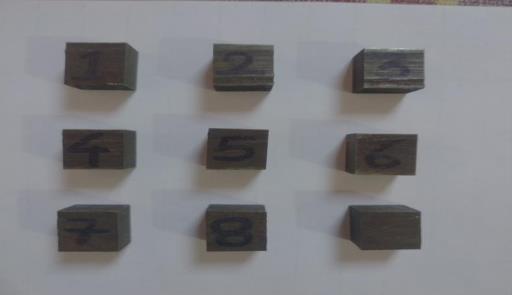
AISID3coldworktoolsteelwasselectedastheworkpiece material due to its high hardness and wear resistance, commonly used in dies and cutting tools. The work piece dimensionswere100mm×100mm×10mm.Theelectrode used for machining was a 0.25 mm diameter zinc-coated brasswire,chosenforitsgoodconductivityandmechanical strength. Deionized water served as the dielectric fluid to ensureproperflushingandsparkgeneration.
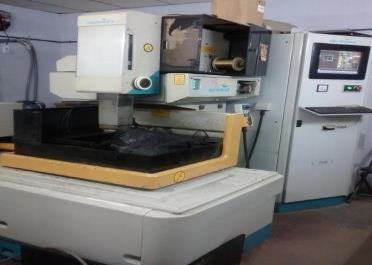
MachiningoperationswereconductedonanELECTRONICA SPRINTCUT Wire EDM machine. The setup provided consistent and controlled machining conditions. The dielectric system maintained a constant temperature and filtereddebristoensureaccuracyandsurfacequality.
C. Selection of Input Parameters
Four critical WEDM parameters were selected based on literatureandmachinecapability:
A.WireFeedRate(WF):2,3,4m/min
B.PulseOnTime(Ton):112,114,116µs
C.PulseOffTime(Toff):46,47,48µs
D.PeakCurrent(Ip):210,220,230A
Othermachiningconditionswerekeptconstant,including:
a)WireTension:8kg
b)ServoVoltage:20V
c)ServoFeed:2120mm/min
d)DielectricFlushingPressure:1kg/cm²
e)PeakVoltage:2V
A Taguchi-based L9 orthogonal array was employed for efficient experimental design, minimizing the number of trials while maximizing the information gained. This approach allowed the analysis of individual parameter effectsonMRRwithstatisticalreliability.
International
Volume: 12 Issue: 04 | Apr 2025 www.irjet.net
TheprimaryresponsevariablewasMaterialRemovalRate (MRR),calculatedfromthevolumeofmaterialremovedover time.Theformulausedwas:

Additionally,theSignal-to-Noise(S/N)ratiowascomputed for MRR using the "larger-is-better" criterion to assess processstabilityandoptimizeparameterlevels.
F. Statistical Analysis
AnalysisofVariance(ANOVA)wasconductedtodetermine the contribution and significance of each parameter. A multiplelinearregressionmodelwasdevelopedtopredict MRRbasedontheselectedinputvariables.Statisticaltools, including Minitab 17, were used for analysis and model development.
Theexperimentaltrialswereconductedinaccordancewith the L9 orthogonal array design derived from Taguchi methodology.TheaimwastoanalyzetheinfluenceofWire EDM parameters Wire Feed Rate (WF), Pulse On Time (Ton),PulseOffTime(Toff),andPeakCurrent(Ip) onthe MaterialRemovalRate(MRR)duringthemachiningofAISI D3toolsteel.
A. Experimental Observations
Atotalofnineexperimentswereperformed,varyingthefour selected process parameters at three levels each. The measuredvaluesofMRRandtheircorrespondingSignal-toNoise(S/N)ratiosarepresentedinTable1
ANOVAwasusedtoidentifythestatisticalsignificanceand contributionofeachparametertowardthevariationinMRR. TheresultsareshowninTable2.
TheresultsshowthatPulseonTimeisthemostinfluential parameter on MRR, followed by Wire Feed Rate, Peak Current,andPulseoffTime.
Table -1: L9OrthogonalArray–ExperimentalResults
Table -2: ANOVAforMRR
Amultiplelinearregressionmodelwasdevelopedtopredict MRRasafunctionoftheinputparameters:
This model yielded a coefficient of determination (R²) of 94.17%,indicatingahighdegreeoffitbetweenthepredicted andobservedvalues.TheadjustedR²was88.34%,andthe predicted R² was 66.99%, reflecting good model predictabilitywithinthetestedparameterrange.
The S/N ratio analysis for MRR was conducted using the "larger-is-better" criterion. The response table (Table 8) revealedthattheoptimallevelsformaximizingMRRwere:
a)WireFeedRate:Level1(2m/min)
b)PulseOnTime:Level3(116µs)
c)PulseOffTime:Level3(48µs)
d)PeakCurrent:Level2(220A)
Themaineffectsplotsconfirmedthesefindings,highlighting TonasthemostsensitiveparameterforenhancingMRR.
International Research Journal of Engineering and Technology (IRJET) e-ISSN: 2395-0056
Volume: 12 Issue: 04 | Apr 2025 www.irjet.net p-ISSN: 2395-0072
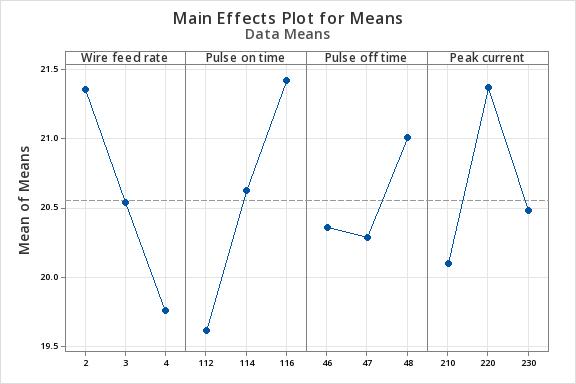
Chart -1:MainEffectsPlotForMeans
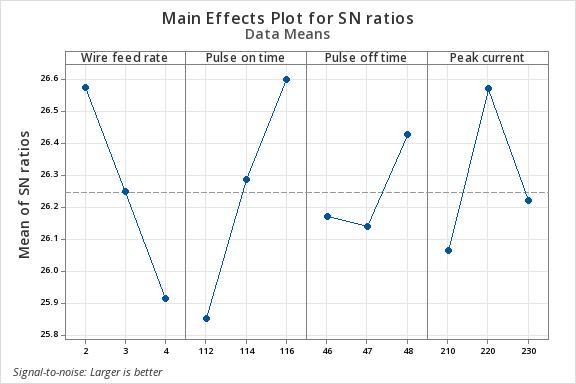
Chart -2:MainEffectsPlotForS/NRatios
[1] BrajeshKumarLodhi,SanjayAgarwal,“Optimizationof machiningparametersinWEDMofAISID3Steelusing TaguchiTechnique,”6thCIRPInternationalConference onHighPerformanceCutting,HPC2014.Availableonline atwww.sciencedirect.com
[2] MSivaKumar,KSivakumar,RShanmugaPrakashandS Vignesh, “Parameters Optimisation of Wire Electrical Discharge Machining on AISI D3 Steel with Different Thickness”,InternationalJournalofAppliedEngineering Research,ISSN0973-4562Vol.10No.62(2015
[3] Jignesh R. Vaghela, Janak B. Valaki, Jaysukh H. Pandit, “Parametric Optimization of Machining Parameters of AISI D3 Tool Steel Using Wire Cut Electric Discharge Machining – A Taguchi Based Approach,” https://www.researchgate.net/publication/300258053.
[4] Deepa Singh, S. Jindal, B.L. Salvi and M.S. Khidiya, “An ExperimentalInvestigationofMaterialRemovalRatein Electric Discharge Machining of Heat Treated Carbon ToolSteel(SK2MCr4),”InternationalResearchJournal of Engineering and Technology (IRJET) e-ISSN: 23950056Volume:05Issue:10|Oct2018www.irjet.netpISSN:2395-0072.
[5] JaganjeetSinghandSanjeevSharma,“EffectsofProcess Parameters on Material Removal Rate and Surface RoughnessinWEDM ofH13Tool Steel,”International Journal of Current Engineering and Technology ISSN 2277-4106©2013INPRESSCO.AllRightsReserved. Availableathttp://inpressco.com/category/ijcet.
[6] Taha A. El‐Taweel*1, Ahmed M. Hewidy,“ Parametric StudyandOptimizationofWEDM ParametersforCK45 Steel ,” InternationalJournalofEngineeringPractical Research (IJEPR) Volume 2 Issue 4, November 2013. www.seipub.org/ijepr
Table -3: ResponseTableforS/NRatios
5. CONCLUSIONS
ThisstudyoptimizedWEDMparameterstoimproveMRR while machining AISI D3 tool steel. Experimental results revealed that increasing pulse on time and pulse off time enhancesMRR,whilehigherwirefeedrateandpeakcurrent reduceit.Amongallparameters,pulseontimehadthemost significant impact. The developed regression model predictedMRRwithhighaccuracy.Thesefindingsprovide valuable insights for selecting optimal WEDM settings to improvemachiningefficiencyofhardtoolsteels.
[7] Neeraj Sharmaa\, Ajit Singha, Renu Sharmab, Deepak, “ModellingtheWEDMProcessParametersforCryogenic TreatedD2ToolSteelbyintegratedRSMandGA”,12th Global Congress On Manufacturing And Management, GCMM2014.Availableonlineatwww.sciencedirect.com
[8] VikramSingha,S.K.Pradhanb,“OptimizationofWEDM parameters using Taguchi technique and Response SurfaceMethodologyinmachiningofAISID2Steel”,2th Global Congress On Manufacturing And Management, GCMM2014.Availableonlineatwww.sciencedirect.com
[9] DAN SCOTT , SREEDHAR BOYINA & K. P. RAJURKAR, “Analysisandoptimizationofparametercombinations in wire electrical discharge machining”, International JournalofProductionResearch,29:11,2189-2207
International Research Journal of Engineering and Technology (IRJET) e-ISSN: 2395-0056
Volume: 12 Issue: 04 | Apr 2025 www.irjet.net p-ISSN: 2395-0072
[10] K.Kanlayasiri,S.Boonmung,“Aninvestigationoneffects of wire-EDM machining parameters on surface roughnessofnewlydevelopedDC53diesteel”,Journal ofMaterialsProcessingTechnology187–188(2007)26–29.
[11] Vishal Parashar, A. Rehman, J.L. Bhagoria, Y.M. Puri, “Kerfs width analysis for wire cut electro discharge machining of SS 304L using design of experiments”, Indian Journal of Science and Technology Vol. 3 No. 4 (Apr.2010)ISSN:0974-6846.
[12] R.Ramakrishnana,∗,L.Karunamoorthy,“Modelingand multi-response optimization of Inconel 718 on machiningofCNCWEDMprocess”,journalofmaterials processing technology 207 (2008) 343–349, journal homepage:www.elsevier.com/locate/jmatprotec.