
International Research Journal of Engineering and Technology (IRJET) e-ISSN: 2395-0056
Volume: 12 Issue: 03 | Mar 2025 www.irjet.net p-ISSN: 2395-0072
International Research Journal of Engineering and Technology (IRJET) e-ISSN: 2395-0056
Volume: 12 Issue: 03 | Mar 2025 www.irjet.net p-ISSN: 2395-0072
Sumayya Sherin T1, Sangeeth K2, Ardra Sivakumar3 , Aswin M4 , Priyanka Dilip P5
1234 Graduate students,5Assistant Professor Department of Civil engineering, AWH Engineering College Calicut, Kerala, India
Abstract: Theproposedstudyaimstoexplorethefeasibility of partially replacing coarse aggregate with steel slag in the production of concrete. The investigation is motivated by the need for sustainable construction materials that minimize environmental impact while maintaining or possibly enhancing the mechanical properties and durability of concrete. Steel slag is a byproduct of steel making process, formedwhenimpuritiesfrommoltenironareremovedknown for its strength and durability, replaces conventional coarse aggregateat20%,30%,40%byweight.Thesesubstitutionsare hypothesized to not only reduce the consumption of virgin materials and environmental footprint associated with concrete production but also potentially enhance the properties of the resulting concrete. The project will focus on assessing the compressive strength, flexural strength, split tensile strength, workability and durability of the modified concrete.Byconductingthis experiment,itisanticipatedthat the findings will contribute to the development of more sustainable concrete practices, promoting the use of waste materials in construction and potentially leading to innovations in building materials that are both environmentallyand economically beneficial.
Keywords: Steel slag, Sustainable Construction Materials, Replacement, Waste materials, resource utilization.
Concrete isa widely used construction material composed primarilyofcement,aggregates(fineandcoarse),andwater. Thepropertiesofconcretecanbetailoredbyusingadditives and reinforcements, which enhance its strength, durability, andworkability.Asoneofthemostcommonmaterialsused inconstructionworldwide,concreteisinhighdemanddueto the rapid growth in global infrastructure development. However,thiswidespreadusehasledtoanincreasingstrain on natural resources such as sand and coarse aggregates, whichare essential raw materialsfor concrete production. Thegrowingscarcityofthesematerials,coupledwithrising constructioncosts,necessitatestheexplorationofalternative, sustainablesolutionstoreducetheenvironmentalimpactand costofconcreteproduction.
In recent years, the utilization of industrial byproducts and alternative materials in concrete mixes has gained considerable attention to alleviate the pressure on naturalresources.Thisprojectinvestigatesthefeasibilityof
replacingcoarseaggregateswithsteelslag.Anindustrialbyproductthatholdpromiseforreducingwasteandenhancing thesustainabilityofconcrete.Steelslagisawastematerial fromsteelproduction,canbeutilizedtoreplaceconventional coarse aggregates. Additionally, the use of steel slag as a partial replacement for coarse aggregate may improve the mechanicalpropertiesofconcrete,suchasitsstrengthand durability,duetotheenhancedbondingbetweenthecement matrixandtheroughersurfacetextureoftheslagparticles. However, the use of these alternative materials also introduceschallengesrelatedtomixdesign,workability,and thelong-termdurabilityoftheconcrete.Itmayalsoaffectthe weight,workability,andoverallperformanceoftheconcrete mix.Thedensityofsteelslag,forexample,istypicallyhigher than that of natural aggregates, potentially influencing the weightoftheconcretestructure.Thisprojectaimstoexplore the potential of steel slag as sustainable alternatives in concrete production, offering a solution to the growing demand for natural resources and the need to reduce construction waste. By investigating the impact of these materialsontheconcretemix,thisstudyseekstocontribute valuable insights into the development of more sustainable andcost-effectiveconcreteformulationsthatcanhelpmeet the challenges posed by the construction industry’s increasingrelianceonnaturalaggregates.
2.1
Cement Portland Pozzolana cement of 53 grade conforming to IS 1489 (PART 1) was used throughout the experiment. The specific gravity of cement is 2.912, The fineness modulus of cement is 3%, The initial and Final settingtimeofcementare1hr45minand5hr25min,The Standardconsistencyofcementis32%.
LocallyavailableRiverSandpassingthrough4.75mmIS SievehavingSpecificgravityof2.6andfinenessmodulusof 2.814wasused.TheSandwasdriedinsunlightbeforeitis usedforstandarddesignmixconcrete.
20mm downsize natural crushed stone having specific gravityof2.89andwaterabsorptionof0.39%wasused.
International Research Journal of Engineering and Technology (IRJET) e-ISSN: 2395-0056
Volume: 12 Issue: 03 | Mar 2025 www.irjet.net p-ISSN: 2395-0072
Locallyavailablepotablewaterisused havingpHvalueof 6.5. Water is important ingredient for strength and durabilitycharacteristicsofconcrete.
Steel slag is the byproduct of the steel manufacturing process. Formedwhenimpuritiesareaddedtoironorein blastfurnacesorbasicoxygenfurnaces,resultinginamolten slagthatisseparatedfromtheliquidmetal.
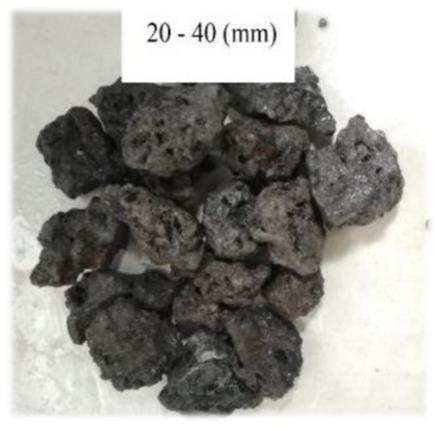
2.5 Steelslag
3.PROCEDURE
3.1 Mix Design proportion
Themixproportionchosenisasfollows:WeadoptedM25 grade of mix proportion i.e., 1:1.12:2.41 by partial replacement of Coarse aggregate with percentage of Steel slag(20%,30%,40%).
3.2 Mix Proportioning:
Table 1.Mixproportioning56
Table 2.Detailsofmixdesignationusingsteelslag
4.METHODOLOGY
Thisstudyinvestigatedthefeasibilityofusingsteelslagas sustainable alternatives in concrete production. The research involved selecting M25 grade concrete and PPC cement, collecting materials, and testing their properties. The study prepared conventional concrete and modified concretewithsteelslag(20%,30%,40%)replacingcoarse aggregate. Specimens were cured for 14 and 28 days and tested for strength. The optimal replacement values were determined,andconcretewithsteelslagwaspreparedand tested. The results were compared with conventional concrete.
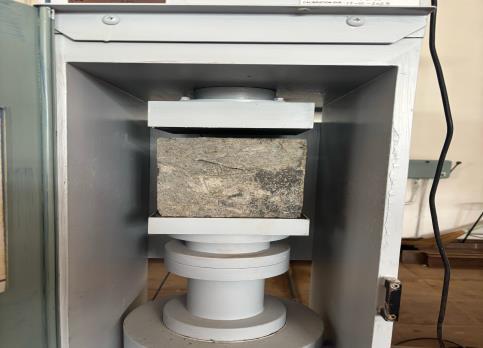
4.1Compressive strength test:
IS Code 516:1959 was used for method of tests for compressive strength of concrete. The size of specimens 150mm x 150mm x 150mm. At the time of testing, the maximumloadatwhichtheconcreteblockbreakwasnoted. From the noted values, the compressive strength was calculatedbyusingbelowformula.
CompressiveStrength=Load/Area
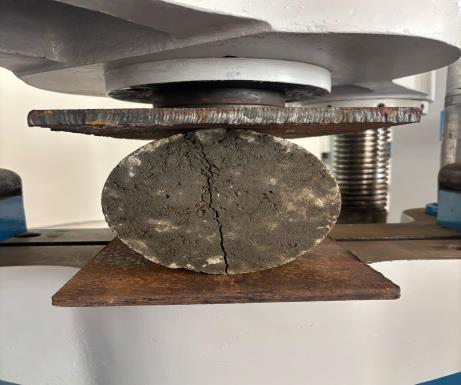
ISCode5816:1999wasusedformethodoftestsplittensile strength of concrete. The size of cylinder was 300 mm (length) x 150mm(diameter). The specimens were tested after28dayscuring.Thesplittensilestrengthcalculatedby using below formula. Splitting Tensile Strength = 2P/πld (Unit = N/mm2 or MPa) Where: P= Load, l= Length of Cylinder,d=DiameterofCylinder
International Research Journal of Engineering and Technology (IRJET) e-ISSN: 2395-0056
Volume: 12 Issue: 03 | Mar 2025 www.irjet.net p-ISSN: 2395-0072
4.3 Flexural strength test:
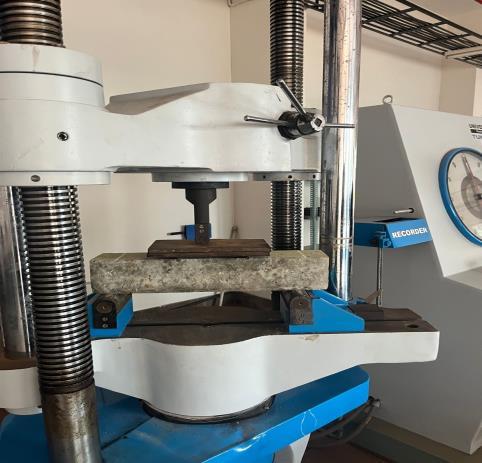
flexural strength test, often used to assess a material's resistance to bending, flexural strength was calculated by usingbelowformula.
F=(PL)/(bd2)
4.4 Compressive strength test result
Table 3. Compressivestrengthtestresults:
4.4:compressivestrength
4.5 Split tensile strength test results:
Table 4. Splittensilestrengthtestresults:
4.5:Splittensilestrength
International Research Journal of Engineering and Technology (IRJET) e-ISSN: 2395-0056
Volume: 12 Issue: 03 | Mar 2025 www.irjet.net p-ISSN: 2395-0072
Table 4. Flexuralstrengthtestresults:
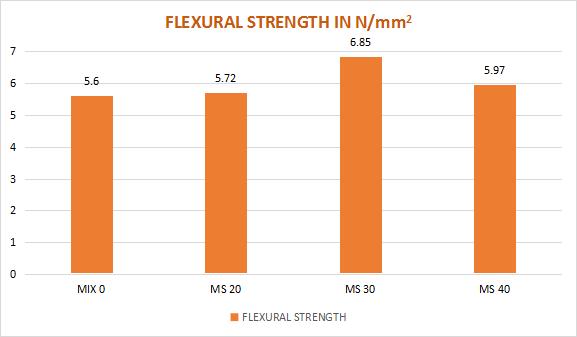
Fig 4.6:Flexuralstrength 5. CONCLUSIONS
Replacementofcoarseaggregatewithsteelslag:
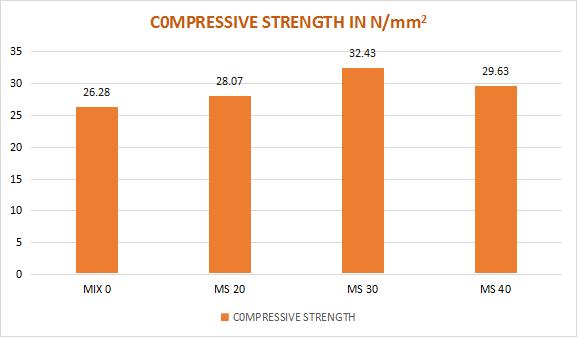
Theoptimumpercentageofcompressivestrength usingsteelslag30%,whichwasa23.4%increase overconventionalconcrete.
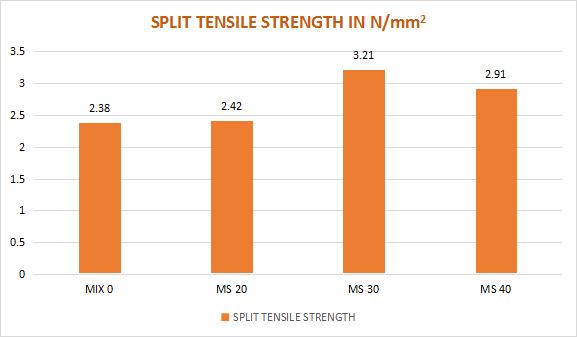
The optimum percentage of split tensile strength usingsteelslag30%,whichwasa34.47%increase overconventionalconcrete.
Theoptimumpercentageofflexuralstrengthusing steelslag30%,whichwasa23.32%increaseover conventionalconcrete.
Anincreaseinthesplittensilestrengthofconcrete offersseveraladvantages,particularlyinstructural performanceanddurability.
Highertensilestrengthhelpspreventtheformation and propagation of cracks, reducing the risk of structuralfailure.
Concretestructuressubjectedto bending,suchas beams, slabs, and pavements, benefit from increased split tensile strength, which enhances their load-bearing capacity. With better tensile properties, concrete can resist environmental stresses like temperature fluctuations, shrinkage, and freeze-thaw cycles, leading to longer service life.
Structuressuchasbridges,high-risebuildings,and industrialfloorscansustainheavierloadswithout crackingorfailure.
Inearthquake-proneareas,highertensilestrength improvesastructure’sabilitytowithstanddynamic forcesandreducestheriskofcatastrophicfailure.
Fewer cracks and structural issues mean lower repairandmaintenancecostsoverthelifespan of thestructure.
Concretewithhighersplittensilestrengthismore resistanttocyclicloading,makingitidealforroads, runways,andbridgessubjectedtorepeatedstress.
Higher tensile strength reduces microcracking, which minimizes water penetration and protects againstcorrosionofembeddedsteelreinforcement.
[1] Mohamed Elwi Mitwally, Amr Elnemr, Ahmed Shash, Ahmed Babiker (2024) “Utilization of steel slag as partial replacement forcoarseaggregateinconcrete”, InnovativeInfrastructureSolutions9:175.M.Young,The TechnicalWriter’sHandbook.MillValley,CA:University Science,1989.
[2] • Mani V, Dinesh Kumar S (2016) “Replacement of Coarse Aggregate using Steel Slag in Concrete”, International Journal of Engineering Research &Technology(IJERT)ISSN:2278-0181.K.Elissa.
[3] Ra.B. Depaa, Dr. T. Felix Kala (2017) “Experimental Study on Steel Slag as Coarse Aggregate in Concrete”, International Journal on Recent Research in Science, Engineering&TechnologyISSN:2347-6729Volume5, Issue4.
International Research Journal of Engineering and Technology (IRJET) e-ISSN: 2395-0056
Volume: 12 Issue: 03 | Mar 2025 www.irjet.net p-ISSN: 2395-0072
BIOGRAPHIES:





Ms. SUMAYYA SHERIN T FinalYear
B-tech student in Civil Engineering Department at AWH Engineering college,CalicutKeralaIndia.
Mr. SANGEETH K FinalYear BtechstudentinCivilEngineering Department at AWH Engineering college,CalicutKeralaIndia.
Ms. ARDRA SIVAKUMAR FinalYear
B-tech student in Civil Engineering Department at AWH Engineering college,CalicutKeralaIndia
Mr. ASWIN M Final Year B-tech student in Civil Engineering Department at AWH Engineering college,CalicutKeralaIndia.
Ms. Priyanka Dilip P is currently workingasanAssistantProfessorin CivilEngineeringDepartment,AWH EngineeringCollege,Calicut,Kerala, India She specialized in Structural Engineering. She has published 18 internationaljournalsandpresented one article in international conference She has more than 10 years ’ experience in teaching. Her interested areas are concrete and steelstructures .