
International Research Journal of Engineering and Technology (IRJET) e-ISSN: 2395-0056
Volume: 13 Issue: 02 | Feb 2026 www.irjet.net p-ISSN: 2395-0072
International Research Journal of Engineering and Technology (IRJET) e-ISSN: 2395-0056
Volume: 13 Issue: 02 | Feb 2026 www.irjet.net p-ISSN: 2395-0072
P. Senthilkumar
Lecturer,DepartmentofMechanicalEngineering,ValivalamDesikarPolytechnicCollege,Nagapattinam, Tamilnadu,India.
Abstract-The present research investigates the mechanical properties of Al6061 aluminium matrix composites reinforced with fly ash particles. The composites were fabricated using the stir casting technique with fly ash content varied from 0 wt. % to 12 wt. % in steps of 4%. The mechanical properties of the fabricated composites were evaluated. The experimental results reveal that the ultimate tensile strength and hardness increase with increasing fly ash content, whereas percentage elongation decreases as the fly ash content increases.
Keywords: aluminum, Al 6061, fly ash, mechanical properties, ultimate tensile strength, hardness, aluminum metal matrix composites.
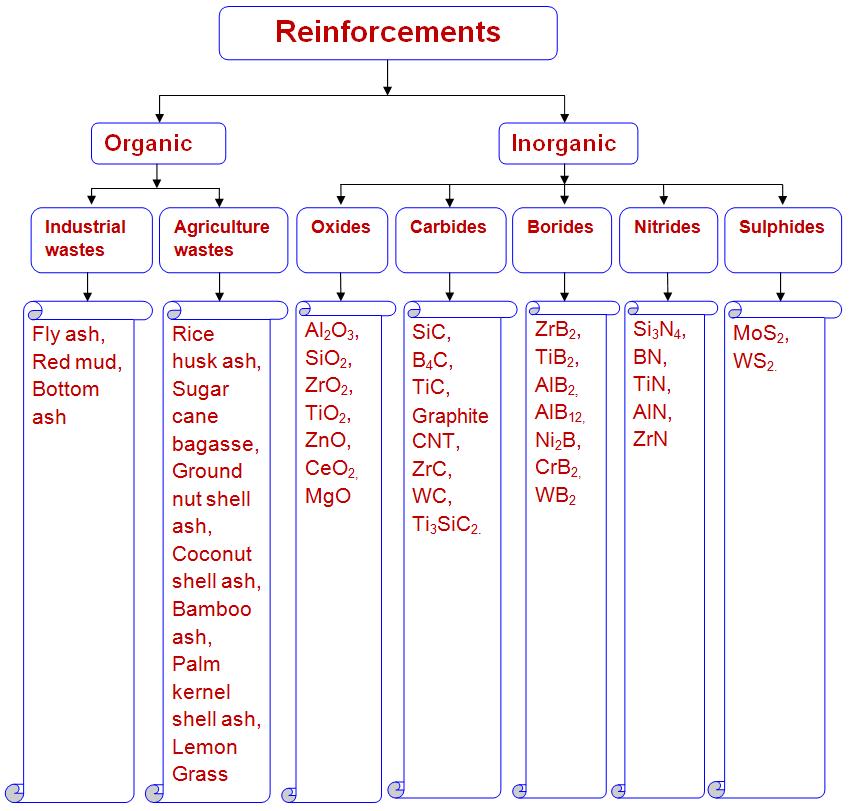
Thedemandforadvanced engineering materialsincritical sectorssuchasautomotive,aerospace, defense, and maritime industriesiscontinuouslyincreasing.Modernengineeringapplicationsrequirematerialswithlowweight,highstrength,high stiffness,andlowcost.Theserequirementscannotbefullysatisfiedbyconventionalmonolithicalloys,leadingtoagrowing interest in composite materials with enhanced properties. A composite material isa combination of two materials with differentphysicalandchemicalproperties.Acompositematerialismadeupofamatrixandareinforcementphase.Inrecent years, metal-matrix composites (MMCs) have attracted significant attention due to their superior mechanical properties comparedtoconventionalmonolithicalloys.AmongMMCs,aluminiummetal-matrixcomposites(AMMCs)areconsidered advancedmaterialsandarewidelyusedinapplicationssuchasaircraftstructures,racecarbodies,buildings,defensesystems, electronics,automotivecomponents,powerplants,andsatellitelaunchvehicles.Aluminummatrixcompositeshavesuperior propertiessuchashighmodulusofelasticity,highstrength,highfatigueresistance,highabrasionresistance,high rigidity, stabilityathightemperature,highstrengthtoweightratio,lowcoefficientofthermalexpansionandlowdensity.Various aluminiumalloyseries,including1xxx,2xxx,5xxx,6xxx,and7xxx,arecommonlyusedasmatrixmaterialsinAMMCfabrication. Amongthese,6xxxseriesaluminiumalloysarewidelypreferredduetotheirgoodmachinability,excellentmiscibility,and balanced mechanical properties. Aluminium matrix composites can be fabricated using several techniques, including stir casting, infiltration processes, squeeze casting, reactive in-situ methods, powder metallurgy, and friction stir processing. Among these methods, stir casting is one of the most economical and widely used techniques due to its simplicity, costeffectiveness,andsuitabilityforlarge-scaleproduction.Figure1showsdifferenttypesofreinforcementscommonlyusedfor thefabricationofMMCs.Flyash,awasteby-productgeneratedduringcoalcombustioninthermalpowerplants,isabundantly available in the Indian subcontinent and worldwide. Compared to conventional ceramic reinforcements such as carbon nanotubes(CNTs),boroncarbide(B₄C),siliconcarbide(SiC),aluminiumoxide(Al₂O₃),andtitaniumcarbide(TiC),flyashis significantlycheaper.
In2024–25,Indiagenerated340.11milliontonnesofflyash,ofwhich332.63milliontonnesweresuccessfullyutilized.During theyear2024-25,32%ofthetotalflyashgeneratedwasusedintheconstructionofroadsandflyovers,followedby27% utilizedwithinthecementindustry,and14%inthemanufacturingofbricksandtiles.TheutilizationofflyashinIndiaduring theyear2024–2025isdepictedinfigure2.
International Research Journal of Engineering and Technology (IRJET) e-ISSN: 2395-0056
Volume: 13 Issue: 02 | Feb 2026 www.irjet.net p-ISSN: 2395-0072
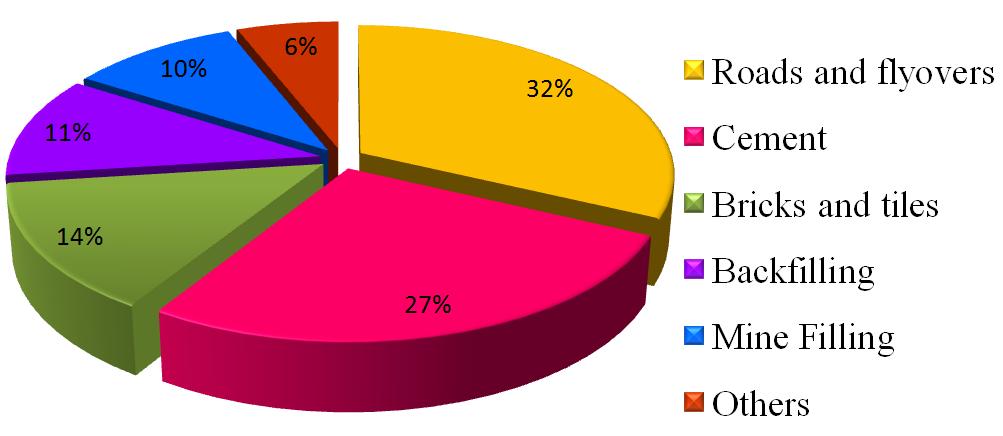
duringtheyear2024–2025.
International Research Journal of Engineering and Technology (IRJET) e-ISSN: 2395-0056
Volume: 13 Issue: 02 | Feb 2026 www.irjet.net p-ISSN: 2395-0072
Al6061 alloy
Al6061alloyisselectedasthematrixmaterialformetalmatrixcompositesbecauseofitsexcellentcombinationofproperties such as high strength-to-weight ratio and good corrosion resistance. The 6061 alloy mainly consists of aluminum with magnesiumandsiliconastheprincipalalloyingelements.Itiswidelyusedinautomotive,marine,aerospace,andstructural applications.Thecompositionofaluminiumalloy(Al6061)isshownintable-1.
Fly Ash (FA)
Flyashisaninexpensive,low-densitymaterialavailableasasolidwasteby-productofcoal-firedthermalpowerplants.The cementindustryisthelargestconsumerofflyashinthecountry.Flyashparticlesaregenerallysphericalinshapeandrangein sizefrom1µmto100µm.FAiscomposedofsiliconoxide(SiO2),aluminumoxide(Al2O3),andirontrioxide(Fe2O3)ofmore than 70%. It has been incorporated into metal matrix composites for the last few decades to reduce their weight and manufacturingcostandenhanceselectedproperties.Thecompositionofflyashisshownintable-2.
Table-1: ChemicalcompositionofAl6061
Table-2: ChemicalcompositionofFlyash
International Research Journal of Engineering and Technology (IRJET) e-ISSN: 2395-0056
Volume: 13 Issue: 02 | Feb 2026 www.irjet.net p-ISSN: 2395-0072
Stir casting
Stir casting is widely used to prepare MMCs of low melting point materials because it is economical, simple, flexible and suitableformassproduction.Inthismethod,thereinforcementphaseismixedwiththemoltenmatrixmetalbymechanical stirring. The molten composite slurry is then cast by conventional casting methods. The properties of the metal matrix composites produced using stir casting methods will depend on the processing parameters such as temperature of melt, stirring speed, stirring duration, geometry of the stirrer and size of crucible which will affect the distribution of the reinforcementsinthematrix.
Thealuminiumalloy(Al6061)isthebasematerial,andflyashisusedasthereinforcementparticles.Initially,purealuminium alloywascutintosmallpiecestominimizethemeltingtimeandmaximizetheeffectivemelting.The flyashparticleswere initiallypreheatedseparatelyatatemperatureof350-400°Cfor30minutestoremovemoistureandtohelpevendistribution withinthealuminiumalloy.Thealuminumalloywaschargedintothegraphitecrucibleandheatedto750°Ctilltheentiremetal in the crucible was melted. After the metal alloy is completely melted, degassing tablets are added to reduce porosity. Simultaneously, 1% by weight magnesium was added to the melt to enhance the wettability between the matrix and the reinforcements.Thepreheatedflyashparticleswereaddedtothemoltenmetalataconstantrateduringthestirring.Afterthe completion of particle feeding, stirring was maintained for a further 20 minutes to ensure uniform dispersion of the reinforcementparticles.After20minutesofstirring,thecompletemixtureofreinforcementmaterialswithaluminiumalloy metal matrixwasmade.Themixturewaspouredintothemold, whichwasalsopreheatedto500°C for20mintoobtain uniformsolidification.Aftersolidification,thecompositecanbecutintodifferentshapesandsizesasperrequirements.
Thepreparedaluminiummetalmatrixcompositesamplesareinvestigatedfortheirmechanicalpropertiesandarecompared withthepurealuminium.ThemechanicalpropertiesofthematrixalloyandthecompositespecimensarepresentedinTable3.
Table-3: Mechanicalpropertiesofthematrixalloyanditscomposites
International Research Journal of Engineering and Technology (IRJET) e-ISSN: 2395-0056
Volume: 13 Issue: 02 | Feb 2026 www.irjet.net p-ISSN: 2395-0072
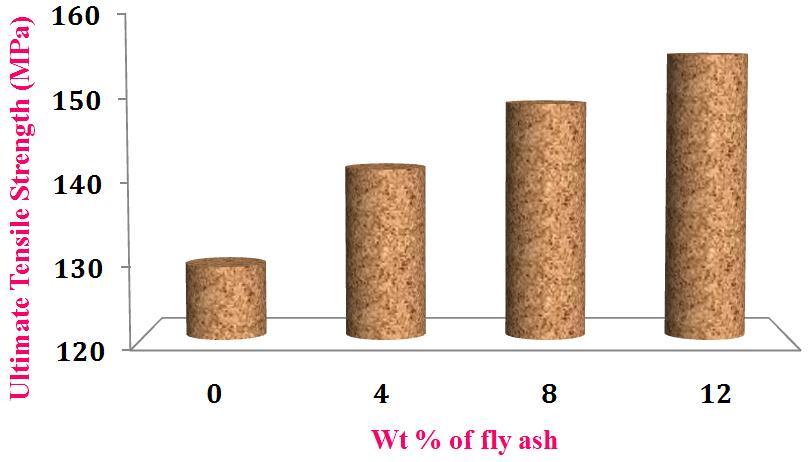
Thegraphplottedbetweenultimatetensilestrengthversusdifferentweightpercentagesofflyashparticulatesisshownin figure-3. From figure-3 it can be observed that, with the inclusion of fly ash particles, the ultimate tensile strength of compositesincreasedthanthematrixmaterial.Furthermore,incrementinthereinforcementweightpercentageincreasesthe ultimatetensilestrength.TheultimatetensilestrengthofAl6061-12%flyashcompositeis155N/mm2,whichis20.15%higher thanthatforAl6061alloy.TheincorporationofflyashasareinforcementinAl6061-basedmetalmatrixcompositesenhances theultimatetensilestrengthduetothepresenceofhardandrigidparticles,whichpromoteefficientloadtransferfromthe matrixtothereinforcementandrestrictdislocationmovementwithinthematrix.K.V.Mahendraetal[1]fabricatedaluminium - flyash compositeandinvestigated the effect of reinforcement on the mechanical properties ofaluminium metal matrix composite.ThereinforcingparticlesintheAl–4.5%Cualloywerevariedfrom0%to15%byweight.Resultsindicatedthatthe tensile strength of the composites is higher than the unreinforced matrix metal and tensile strength of the composites increased with increasing the amount of the fly ash in the matrix phase. S. Rajesh et al [2] fabricated and analysed the mechanicalpropertiesofflyashreinforcedaluminiumcomposites.Aluminiummetalmatrixcompositeswerefabricatedby consideringaluminiumalloy7075reinforcedwithvariousweightpercentage(0,5,and10)offlyashthroughstircasting technique.Theresearchersobservedthatthetensilestrengthofthecompositesishigherthantheunreinforcedmatrixmetal andthetensilestrengthofthecompositesincreaseswithincreasingtheweightfractionofflyash.
Percentage Elongation
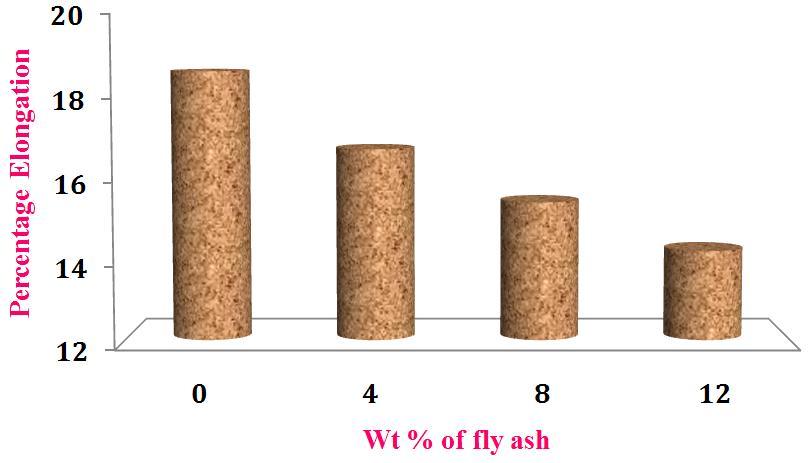
Figure-4showsthegraphbetweenthepercentageelongationsversustheflyashweightpercent.Fromthefigure,itisclearly evidentthatthepercentageelongationofthedevelopedaluminiummatrixcompositesislowerthanthatoftheunreinforced aluminiumalloy.Furthermore,thegraphindicatesadecreasingtrendinpercentageelongationwithincreasingflyashcontent inthecomposites. Amaximumdecreaseof23.65%inelongationwasobservedfortheAl6061–12wt.%flyashcomposite whencomparedtothebasealloy.Flyashcontainsceramicparticlessuchassilicaandalumina,whichareinherentlyhardand brittle,therebyreducingtheductilityofthecompositecomparedtounreinforcedAl6061.Mahendra Boopathi.Metal[3] createdaluminum-flyashcompositeandresearcheditsmechanicalproperties.Aluminumalloy(AA2024)isselectedasthe matrixmaterialandflyashasreinforcedparticles aremixedindifferentweightpercentages(0,5,and10wt%).Theauthors haverevealedthat theelongationofcompositesdecreasedwithanincreasein weightpercentageofflyashinthematrix material.Theelongationofcompositesislowerthanthatofun-reinforcedAl-alloy.PankajKr.Sharmaetal[4]fabricatedand investigatedtheeffectofreinforcementonthemechanicalpropertiesofaluminiummetalmatrixcomposite.Inthepresent case,theflyashcontentisvaryingincompositionof(0,6,8and10wt%) inaluminummatrix,fabricatedbystircasting technique.Theresultsindicatedthattheelongationofthecompositesdecreasedwithincreasingweightpercentageofflyashin thematrix
International Research Journal of Engineering and Technology (IRJET) e-ISSN: 2395-0056
Volume: 13 Issue: 02 | Feb 2026 www.irjet.net p-ISSN: 2395-0072
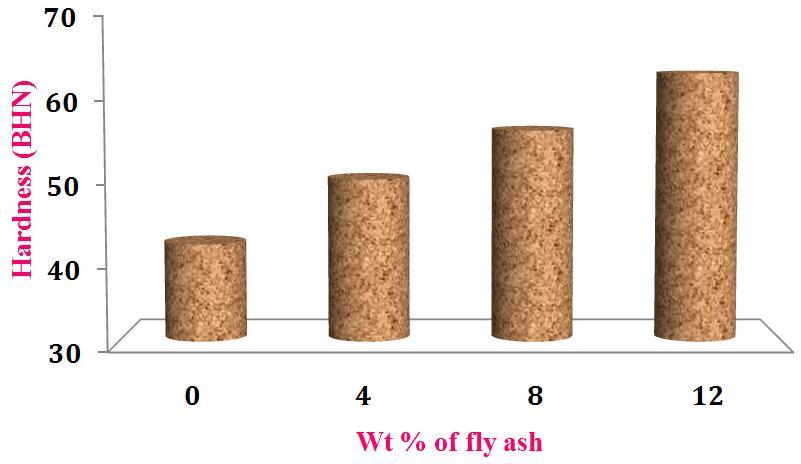
ThehardnessvaluesofAl6061anditscompositesarepresentedinfigure5.Itisevidentfromthefigurethatthedeveloped compositesexhibithigherhardnesscomparedtotheAl6061matrixalloy.Moreover,thehardnessincreasesprogressivelywith anincreaseintheweightpercentageofflyashreinforcement. Flyashmainlyconsistsofhardoxides(SiO₂,Al₂O₃,andFe₂O₃), anditsadditionasareinforcementincreasesthehardnessofthecompositematerial.G.N.Lokeshetal[5]createdaluminumflyashcompositeandresearcheditsmechanicalproperties.Aluminumalloy(Al-4.5wt%Cualloy)isselectedasthematrix materialandflyashasreinforcedparticles aremixedindifferentweightpercentages(0,3,6,9,and12wt%).Theresultsshow thatincreasingtheweightpercentageofflyashreinforcementincreasesthe hardnessofthecomposites.AlaaMohammed Razzaqetal[6]investigatedtheeffectofflyashparticlesonmechanicalpropertiesofaluminummetalmatrixcomposites.The fabricationofaluminumcompositeswithdifferentweightpercentageofflyashparticlesupto0-12%wasprocessedbystir castingprocess.Theresultshowsthatthehardnessofthecompositesishigherthantheunreinforcedmatrixmetalandthe hardnessofthecompositesincreaseswithincreasingtheweightpercentageofflyash.
Inthepresentresearchwork,Al6061–flyashmetalmatrixcompositesweresuccessfullyfabricatedbyvaryingtheweight percentageofflyashparticles.Fourdifferentcompositionswereprepared,andtheirmechanicalpropertiessuchasultimate tensile strength, percentage elongation, and hardness were evaluated. Based on the experimental results, the following conclusionsaredrawn:
Stircastingwasfoundtobeaneffectiveandeconomicaltechniqueforthefabricationofaluminiummatrixcomposites reinforcedwithflyashparticles.
TheAl6061–flyashcompositesexhibitedhigherultimatetensilestrengthcomparedtotheunreinforcedAl6061alloy. Furthermore,theultimatetensilestrengthincreasedwithanincreaseintheweightpercentageofflyashreinforcement.
Thepercentageelongationofthecompositesislowerthanthatoftheunreinforcedaluminiumalloy,anditdecreaseswith increasingflyashcontentinthematrixmaterial.
Thehardnessofthecompositesishigherthanthatoftheunreinforcedmatrixmetal,andthehardnessincreaseswithan increaseinflyashcontent.
1. K.V. Mahendra and K. Radhakrishna, “Fabrication of Al–4.5% Cu alloy with fly ash metal matrix composites and its characterization,”MaterialsScience-Poland,Vol.25,No.1,pp.57-68,2007.
2. S.Rajesh,R.SureshKumar,S.Madhankumar,M.Sheshan,M.VigneshandR.SanjayKumar, “Studyofthemechanical propertiesofAl7075alloy,siliconcarbideandflyashcompositesmanufacturedbystircastingtechnique,” Materials Today:Proceedings45(2021)6438–6443.
International Research Journal of Engineering and Technology (IRJET) e-ISSN: 2395-0056
Volume: 13 Issue: 02 | Feb 2026 www.irjet.net p-ISSN: 2395-0072
3. MahendraBoopathi,M.,K.P.ArulshriandN.Iyandurai,“EvaluationofmechanicalpropertiesofAluminiumalloy2024 reinforcedwithsiliconcarbideandflyashhybridmetalmatrixcomposites,”AmericanJournalofAppliedSciences,10(3): pp.219-229,2013.
4. PankajKr.Sharma,ShashiPrakashDwivedi,VijayGautamandAmitKr.Sharma,“EffectsofWeightFractionsonProperties ofAluminium-FlyAshMetalMatrixComposites,JournalofThinFilms,”CoatingScienceTechnologyandApplication,Vol: 03,Issue:3,pp.44-48,2016.
5. G.N.Lokesh,M.Ramachandra,K.V.MahendraandT.Sreenith,“CharacterizationofAl-Cualloyreinforcedflyashmetal matrixcompositesbysqueezecastingmethod,”InternationalJournalofEngineering,ScienceandTechnology,Vol.5,No. 4,pp.71-79,2013.
6. AlaaMohammedRazzaq,DayangLailaMajid,MohamadR.IshakandUdayM.Basheer,“EffectofFlyAshAdditiononthe PhysicalandMechanicalPropertiesofAA6063AlloyReinforcement,”Metals2017,7,477;doi:10.3390/met7110477.

P. Senthilkumar completedhis B.E. degree in Mechanical Engineering from E.G.S. Pillay Engineering College, Nagapattinam,in2004andhis M.E. degree in Manufacturing Engineering from Annamalai University, Chidambaram, in 2017.Hehasbeenworkingasa Lecturer in the Department of Mechanical Engineering at Valivalam Desikar Polytechnic College, Nagapattinam, since June2005.Hehaspublished24 research articles in leadingjournals. His research interest areasare composites, heat treatment, machining, weldingandbiodiesel.