
International Research Journal of Engineering and Technology (IRJET) e-ISSN: 2395-0056
Volume: 13 Issue: 03 | Mar 2026 www.irjet.net p-ISSN: 2395-0072
EXPERIMENTAL INVESTIGATION ON EFFECT OF BAMBOO FIBRE IN COCONUT SHELL CONCRETE
Daud Chauhan1, Dr. Amit Kumar2
1Ph.D Scholar, Civil Engineering Department, Glocal School of Science & Technology, The Glocal University, Saharanpur, India
2Assistant Professor, Civil Engineering Department, Glocal School of Science & Technology, The Glocal University, Saharanpur, India *** --
Abstract - This research investigates the combined use of bamboo fibre (BF) and coconut shell (CS) in concrete to develop a sustainable and eco-friendly construction material. Coconut shell, an agricultural waste product, serves as a partial replacement for coarse aggregates, while bamboo fibre is added to enhance mechanical properties. The experimental program includes the preparation of M20 and M25 grade concrete mixes with CS replacing 10%, 20%, and 30% of coarse aggregates and BF added in proportions ranging from 2.5% to 15% by weight of cement. Comprehensive tests were conducted to assess slump, compressive strength, split tensile strength, flexural strength, water absorption, creep, and shrinkage. Results indicate that the optimal performance was achieved with 10% CS and 5% BF, showing improved tensile and flexural strengths, enhanced crack resistance, and acceptable durability. However, higher fibre content led to reduced workability and marginally lower strength due to poor dispersion and increased voids. M25 grade concrete consistently outperformed M20 grade in all aspects. The findings validate the potential of integrating natural fibers and agricultural waste in concrete for green building applications, particularly in low-load structures and rural infrastructure, contributing to sustainable development goals.
Key Words: CoconutShellConcrete(CSC),BambooFibre,SustainableConcrete,AgriculturalWaste,FibreReinforced Concrete.
1. INTRODUCTION
Concrete is the most widely used construction material globally due to its durability, strength, and availability.However,conventionalconcreteproductionheavilyreliesonnaturalresourcessuchasriversandandcoarse aggregates,whichhasledtoenvironmentalconcernsandresourcedepletion.Toaddressthesechallenges,researchershave increasingly focused on sustainable and eco-friendly alternatives. One such approach involves the partial replacement of conventionalcoarseaggregateswithagriculturalwastematerialslikecoconutshell(CS),andtheincorporationofnaturalfibers likebamboofiber(BF)toenhanceconcreteperformance.
Coconutshells,anabundantagro-wasteintropicalregions,offeralightweight,renewable,andcost-effectivesubstitutefor coarseaggregates.Althoughcoconutshellconcrete(CSC)exhibitslowerdensityandreducedmechanicalstrengthcomparedto conventionalconcrete,itssustainablebenefitsmakeitapromisingmaterialfornon-structuralandlow-loadapplications. However,toimproveitsmechanicalanddurabilityproperties,theadditionofnaturalfiberssuchasbamboofibreisexplored. Bamboofiberisknownforitshightensilestrength,flexibility,andbiodegradability,makingitanidealreinforcementmaterial insustainableconstruction.
Thisstudyaims to experimentallyinvestigatethe effect of bamboofibre on theproperties ofcoconutshell concrete. The researchfocusesonanalyzingthemechanicalbehavior,durability,andoverallperformanceofCSCwithvaryingpercentagesof bamboofibre.Throughthis,thepotentialofcombiningtwonatural,renewablematerials coconutshellandbamboofiber is exploredtodevelopaneco-friendlyandefficientconstructionmaterialthatalignswiththeprinciplesofgreenbuildingand sustainabledevelopment.
1.1 COCONUT SHELL
Coconutshell,anaturalagriculturalwasteproduct,hasemergedasapromisingalternativetoconventionalcoarseaggregates in concrete production, particularly in sustainable and eco-friendly construction practices. Its use in concrete not only addressestheproblemofsolidwastedisposalbutalsocontributestotheconservationofnaturalstoneresources.Coconut shellsarehard,lightweight,andpossessgoodabrasionresistance,makingthemsuitableforpartialreplacementinstructural and non-structural concrete. Studies have shown that coconut shell concrete exhibits satisfactory workability, adequate strengthcharacteristics,andimprovedresistancetoshrinkageandthermalcracking.Furthermore,itslowdensityresultsin
International Research Journal of Engineering and Technology (IRJET) e-ISSN: 2395-0056
Volume: 13 Issue: 03 | Mar 2026 www.irjet.net p-ISSN: 2395-0072
lightweightconcrete,whichcanreducedeadloadsandimprovestructuralefficiency.Overall,theincorporationofcoconutshell inconcreterepresentsaviableapproachtoenhancesustainabilityintheconstructionindustrywhilemaintainingdesirable mechanicalproperties.
1.2 BAMBOO FIBER
Bamboofiberisemergingasasustainableandeco-friendlyalternativetosyntheticfibersinconcreteapplicationsduetoits hightensilestrength,biodegradability,andabundanceintropicalregions.Whenincorporatedintoconcrete,bamboofibers improvethematerial'scrackresistance,ductility,andpost-crackingbehaviorbybridgingmicrocracksanddelayingtheir propagation.Thisnaturalfiberenhancesthetoughnessandenergyabsorptioncapacityofconcrete,makingitmoredurable underdynamicandimpactloads.Studieshaveshownthattheinclusionofbamboofiberinoptimaldosagescanalsoimprove flexuralandtensilestrengthwithoutsignificantlycompromisingcompressivestrength.Moreover,bamboofiberactsasacosteffectivereinforcementthatsupportsgreenconstructionpracticesbyreducingrelianceonnon-renewablematerials.However, challengessuchasvariabilityinfiberqualityandwaterabsorptioncharacteristicsnecessitatepropertreatmentandmixdesign adjustmentstoensureconsistentperformance.Overall,bamboofiberofferspromisingpotentialinproducingsustainableand durablefiber-reinforcedconcrete.
1.3 BAMBOO FIBER IN COCONUT SHELL CONCRETE
Incorporatingbamboofiberintococonutshellconcretepresentsapromisingapproachtoenhancingthemechanicalproperties andsustainabilityofconcretecomposites.Coconutshell,beingalightweightandrenewableagriculturalwasteproduct,serves as a partial replacement for conventional coarse aggregates, contributing to reduced concrete density and promoting environmentalconservation.However,coconutshellconcretetendstoexhibitbrittlenessandlowertensilestrength,whichcan beeffectivelymitigatedbytheadditionofnaturalfiberssuchasbamboo.Bamboofiber,knownforitshightensilestrength, excellentflexibility,andbiodegradability,actsasacrackarresterandimprovespost-crackingbehavior.Whenaddedinoptimal proportions,itenhancestheconcrete'stensileandflexuralstrength,toughness,andresistancetoshrinkageandimpact.This synergisticuseofbamboofiberandcoconutshellnotonlyresultsinamoreductileanddurablecompositebutalsosupports thedevelopmentofsustainableandeco-friendlyconstructionmaterials,makingitsuitableforlow-costhousingandgreen buildingapplications.
1.4 ADVANTAGES BAMBOO FIBER IN COCONUT SHELL CONCRETE
ImprovedTensileStrength:Bamboofibersactasmicro-reinforcements,enhancingthetensileandflexuralstrength ofcoconutshellconcrete.
Crack Resistance:Theadditionofbamboofiberscontrolsthepropagationofmicro-cracksandreducesshrinkageinducedcracking.
Eco-Friendly and Sustainable:Bambooisarenewablenaturalmaterial,makingthecompositeconcreteamore sustainableandenvironmentallyfriendlyoption.
Better Ductility:Bamboofiberenhancestheductilityofconcrete,allowingittoabsorbmoreenergybeforefailure.
LightweightConstruction:Whencombinedwithlightweightcoconutshellaggregates,bamboofiberscontributeto anoverallreductioninconcretedensity.
Cost-Effective:Locallyavailablebambooreducesconstructioncosts,especiallyinruralordevelopingregions.
ImprovedImpactResistance:Thefiberreinforcementincreasestheimpactresistanceandtoughnessoftheconcrete matrix.
Enhanced Durability:Bamboofibersreducepermeabilityandimproveresistancetoweatheringandchemicalattacks inthelongterm.
2. LITERATURE REVIEW
Karthik et al. (2017) investigated the use of bamboo fiberinconventional concreteand observed improved tensileand flexuralstrength.Thenaturalfibersprovidedbettercrackresistanceandincreasedenergyabsorptioncapacity.Theirstudy concludedthatbamboofibersareasustainablealternativetosyntheticfibersinconcreteapplications.
Manoharan et al. (2019) studied concrete with bamboo fibers and reported significant enhancement in post-cracking behaviorandductility.Theinclusionoffibersat1%byvolumeimprovedthetoughnessandload-carryingcapacity.They emphasizedtheeco-friendlinessandlowcostofbamboofiberasareinforcement.
International Research Journal of Engineering and Technology (IRJET) e-ISSN: 2395-0056
Volume: 13 Issue: 03 | Mar 2026 www.irjet.net p-ISSN: 2395-0072
Deepa et al. (2020) exploredtheeffectsofbamboofiberonlightweightconcreteincorporatingcoconutshellasacoarse aggregatereplacement.Theyfoundthatbamboofiberscontrolledearly-ageshrinkageandimprovedmechanicalproperties, especiallytensilestrength.Theirresearchsupportedusingbothbamboofiberandcoconutshellforsustainableconcrete.
Ramesh et al. (2021) examinedtheintegrationofbamboofiberintococonutshellconcreteandconcludeditenhancedthe toughnessandenergyabsorption.Thehybridcombinationprovidedhigherresistancetocrackinganddeformation.Theirwork validatedthesynergybetweencoconutshellaggregateandbamboofibers.
Priya et al. (2018) testedvaryinglengthsandvolumesofbamboofibersinconcretemixeswithpartialcoarseaggregate replacement.Theirresultsshowedthattheoptimumfibercontentof1.5%enhancedcompressiveandflexuralstrengths.The studyhighlightedtheimportanceoffiberdispersionforachievinguniformperformance.
Sharma et al. (2022) investigatedthemicrostructureandbondingbehaviorofbamboofiberincoconutshellconcrete.SEM images showed strong interfacial bonding between the matrix and fibers, leading to increased durability. The research emphasizedthatbamboofibernotonlystrengthensconcretebutalsodelayscrackpropagation.
Patel et al. (2016) focused onthe mechanical characterizationof bamboofiber-reinforcedconcrete. Theyobservedthat addingfiberssignificantlyreducedbrittlenessandimproveddeformationcapacityunderloading.Theirfindingssupportedthe applicationofnaturalfibersinstructuralconcreteforenhancedresilience.
Agarwal et al. (2023) presentedacomparativestudybetweenbambooandsyntheticfibersincoconutshellconcrete.Their researchrevealedthatbamboofibersweremoreeffectiveinimprovingtensilestrengthandcrackresistance.Theyconcluded thatbambooisaviableeco-alternativetocostlysyntheticreinforcements.
3. RESULTS AND DISCUSSION
Theconstructionindustryisincreasinglyseekingsustainableandeco-friendlymaterialstoaddressenvironmentalconcerns andresourcescarcity.Traditionalconcreteproductionheavilyreliesonnon-renewableresourcesandcontributessignificantly tocarbonemissions.Inthiscontext,incorporatingagriculturalwasteandnaturalfibersintoconcretepresentsapromising avenuefordevelopingsustainableconstructionmaterials.
Thisresearchfocusesontheexperimental investigationoftheeffectsofbamboofibersonthepropertiesofcoconutshell concrete.Coconutshells,anagriculturalby-product,serveasapartialreplacementforconventionalcoarseaggregates,aiming to reduce environmental impact and promote waste utilization. Bamboo fibers, known for their tensile strength and availability,areintroducedintotheconcretemixtoenhancemechanicalpropertiesanddurability.
Thestudyexaminestwodifferentgradesofconcrete,M-20andM-25,incorporatingvaryingpercentagesofbamboofibers: 2.5%,5%,7.5%,10%,12.5%,and15%byweight.Theobjectiveistoevaluatetheinfluenceofthesenaturalfibersonkey concreteproperties,includingcompressivestrength,tensilestrength,flexuralstrength,anddurability.
3.1 TESTS TO BE CONDUCTED
1. SLUMP TEST
TheSlumpTestResultsforM20andM25gradeconcreteincorporatingcoconutshellaspartialcoarseaggregatereplacement andbamboofiberasanadditiveatvariouspercentages(2.5%to15%).
Table 1: - SlumpTestResultsforM20&M25GradeConcretewithCoconutShellandBambooFiber
International Research Journal of Engineering and Technology (IRJET) e-ISSN: 2395-0056
Volume: 13 Issue: 03 | Mar 2026 www.irjet.net p-ISSN: 2395-0072
Observations:
Asthebamboofibercontentincreases,theslumpvaluedecreasesforbothM20andM25grades.
Thereductioninworkabilityisduetothehighersurfaceareaandwaterabsorptionofbamboofibers,whichrestricts flow.
M25gradeshowsslightly better workability thanM20 atall fibercontentsduetoits highercementcontent and overallbetterpastematrix
2. COMPRESSIVE STRENGTH TEST
Testresultsforthecompressivestrengthofconcrete(M20andM25)withpartialreplacementofcoarseaggregatebycoconut shell(10%,20%,30%),andinclusionofbamboofiber(2.5%,5%,7.5%,10%,12.5%,15%)byweightofcement.Eachtestis performedat7,14,and28days 3specimenspertest
Table 2: - The compressivestrengthtestofM20&M25gradeconcretewithpartialreplacementofcoarseaggregateby coconutshell(10%,20%,30%)andadditionofbamboofiberat2.5%,5%,7.5%,10%,12.5%,and15%
International Research Journal of Engineering and Technology (IRJET) e-ISSN: 2395-0056
Volume: 13 Issue: 03 | Mar 2026 www.irjet.net p-ISSN: 2395-0072
COMPRESSIVE STRENGTH TEST OF CONCRETE WITH COCONUT
SHELL OF M20 GRADE CONCRETE WITH BAMBOO FIBER BY
2.5%,5%,7.5%,10%,12.5% AND 15%.
Bamboo Fiber % 7 Days (MPa) 14 Days (MPa) 28 Days (MPa)
Figure 1 ThecompressivestrengthtestofM20gradeconcretewithpartialreplacementofcoarseaggregatebycoconut shell(10%,20%,30%)andadditionofbamboofiberat2.5%,5%,7.5%,10%,12.5%,and15%.
International Research Journal of Engineering and Technology (IRJET) e-ISSN: 2395-0056
Volume: 13 Issue: 03 | Mar 2026 www.irjet.net p-ISSN: 2395-0072
COMPRESSIVE STRENGTH TEST OF CONCRETE WITH COCONUT SHELL OF M25 GRADE CONCRETE WITH BAMBOO
FIBER
BY 2.5%,5%,7.5%,10%,12.5% AND 15%.
Bamboo Fiber % 7 Days 14 Days 28 Days
Figure 2. The compressivestrengthtestofM25gradeconcrete with partialreplacementofcoarseaggregatebycoconut shell(10%,20%,30%) and addition of bamboofiberat2.5%,5%,7.5%,10%,12.5%,and15%
OBSERVATIONS:
Maximumstrengthwasachievedat10%coconutshell+2.5%bamboofiberforbothgrades.
Asbamboofibercontentincreases,compressivestrengthdecreasesslightlyduetopoorfiberdispersionandincreased voids.
Increasingcoconutshellpercentagealsoreducescompressivestrengthduetolowerdensityandstrengthoftheshell aggregates.
M25mixconsistentlyoutperformsM20,asexpected.
3. TENSILE STRENGTH TESTS
ThetensilestrengthtestresultsforM20andM25gradeconcreteincorporatingpartialreplacementofcoarseaggregateswith coconutshell(CS)at10%,20%,and30%,andreinforcementwithbamboofiber(BF)atvaryingpercentages(2.5%,5%,7.5%, 10%,12.5%,and15%).Thetestswereconductedatcuringperiodsof7,14,and28days.
International Research Journal of Engineering and Technology (IRJET) e-ISSN: 2395-0056
Volume: 13 Issue: 03 | Mar 2026 www.irjet.net p-ISSN: 2395-0072 © 2026, IRJET | Impact Factor value: 8.315 | ISO 9001:2008 Certified
Table 3: - ThesplittensilestrengthofM20&M25gradeconcreteincorporatingcoconutshellasapartialreplacement forcoarseaggregate(10%,20%,and30%)andbamboofiber(BF)asanadditive(2.5%,5%,7.5%,10%,12.5%,and 15%).
| Page1456
International Research Journal of Engineering and Technology (IRJET) e-ISSN: 2395-0056
Volume: 13 Issue: 03 | Mar 2026 www.irjet.net p-ISSN: 2395-0072
TENSILE STRENGTH
TEST OF CONCRETE WITH COCONUT SHELL OF M20 GRADE CONCRETE WITH BAMBOO FIBER BY 2 5%,5%,7 5%,10%,12 5% AND 15%
Figure 3 ThesplittensilestrengthofM20gradeconcreteincorporatingcoconutshellasapartialreplacementforcoarse aggregate(10%,20%,and30%)andbamboofiber(BF)asanadditive(2.5%,5%,7.5%,10%,12.5%,and15%).
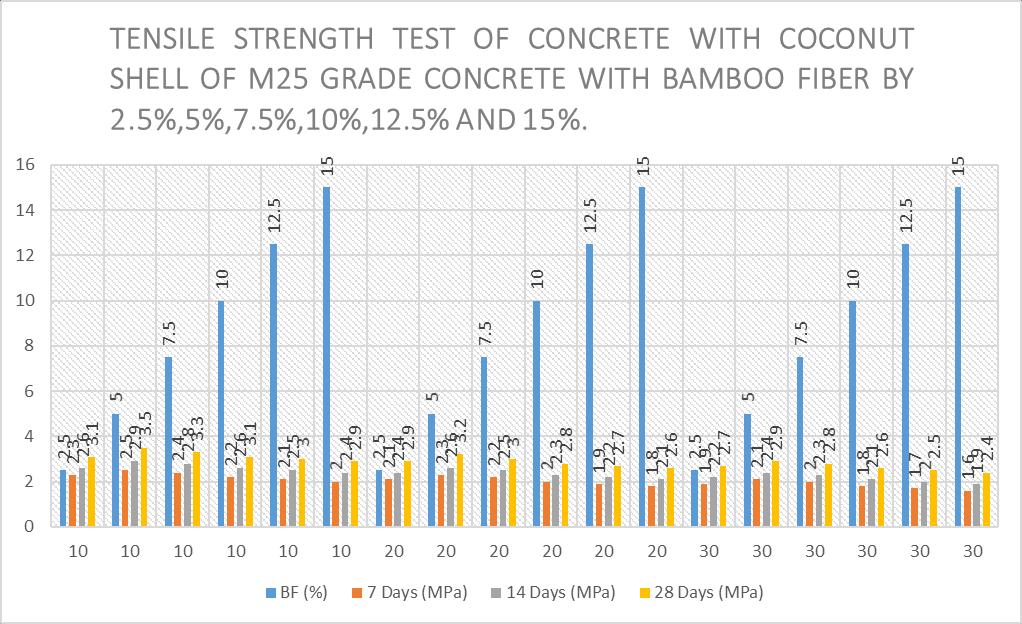
Figure 4. ThesplittensilestrengthofM25gradeconcreteincorporatingcoconutshellasapartialreplacementforcoarse aggregate(10%,20%,and30%)andbamboofiber(BF)asanadditive(2.5%,5%,7.5%,10%,12.5%,and15%).
International Research Journal of Engineering and Technology (IRJET) e-ISSN: 2395-0056
Volume: 13 Issue: 03 | Mar 2026 www.irjet.net p-ISSN: 2395-0072
Observations
OptimalBFContent:ForbothM20andM25grades,incorporating5.0%bamboofiberyieldedthehighesttensile strengthacrossallCSreplacementlevels.
EffectofCSReplacement:TensilestrengthdecreasedwithincreasingCScontent.A10%replacementshowedtheleast reduction,while30%replacementsignificantlyloweredtensilestrength.
CuringTimeImpact:Tensilestrengthimprovedwithlongercuringperiods,with28-daystrengthsbeingthehighest.
Higher BF Percentages: Beyond 5.0% BF, tensile strength gains diminished or reversed, likely due to fiber agglomerationandreducedworkability.
Conclusion
Incorporating5.0%bamboofiberintoM20andM25gradeconcretewitha10%replacementofcoarseaggregatesbycoconut shellenhancestensilestrengtheffectively.HigherpercentagesofCSreplacementorBFadditionbeyondthisoptimalpointmay leadtoreducedtensileperformance.
3. WATER ABSORPTION TEST
ToevaluatethewaterabsorptioncapacityofM20andM25gradeconcreteincorporatingcoconutshellasapartialreplacement forcoarseaggregate(10%,20%,and30%)andbamboofiberasanadditive(2.5%,5%,7.5%,10%,12.5%,and15%).
Table 4: - WaterabsorptioncapacityofM20andM25gradeconcreteincorporatingcoconutshellasapartialreplacement forcoarseaggregate(10%,20%,and30%)andbamboofiberasanadditive(2.5%,5%,7.5%,10%,12.5%,and15%).
International Research Journal of Engineering and Technology (IRJET) e-ISSN: 2395-0056
Volume: 13 Issue: 03 | Mar 2026 www.irjet.net p-ISSN: 2395-0072
Observation:
1. Asthepercentageofcoconutshellreplacementincreases,thewaterabsorptionofbothM20andM25gradeconcrete also increases. This is attributed to the higher porosity of the coconut shell compared to conventional coarse aggregate.
2. Increasingthepercentageofbamboofiberalsoincreaseswaterabsorption,asthefibersintroducemorevoidswithin theconcretematrix.
3. M25gradeconcreteconsistentlyshowslower waterabsorptioncomparedtoM20 grade,likelyduetoitsdenser matrixandhighercementcontent.
4. Thehighestwaterabsorptionisobservedinthecombinationof30%coconutshelland15%bamboofiberforboth M20andM25grades,indicatingthecumulativeeffectofbothmaterialsonporosityandpermeability.
4. FLEXURAL STRENGTH TEST
Experimental Setup:
Grades of Concrete:M20andM25
Replacement of Coarse Aggregate:Coconutshellat10%,20%,and30%
Addition of Bamboo Fiber:2.5%,5%,7.5%,10%,12.5%,and15%byweightofthemix
Test Durations:7and28days
Table 5: - FlexuralStrengthforM20&M25gradeconcreteincorporatingcoconutshellasapartialreplacementforcoarse aggregateat10%,20%,and30%WithbambooFiberby2.5%,5%,7.5%,10%,12.5%And15%.
International Research Journal of Engineering and Technology (IRJET) e-ISSN: 2395-0056
Volume: 13 Issue: 03 | Mar 2026 www.irjet.net p-ISSN: 2395-0072
FLEXURAL STRENGTH TEST OF CONCRETE WITH COCONUT SHELL OF M20 GRADE CONCRETE WITH BAMBOO FIBER
BY 2.5%,5%,7.5%,10%,12.5% AND 15%.
Fiber (%)
Strength (M20 Concrete) 28 Days (MPa)
Strength (M20 Concrete) 7 Days (MPa)
Figure 5. FlexuralStrengthforM20gradeconcreteincorporatingcoconutshellasapartialreplacementforcoarse aggregateat10%,20%,and30%WithbambooFiberby2.5%,5%,7.5%,10%,12.5%And15%.
International Research Journal of Engineering and Technology (IRJET) e-ISSN: 2395-0056
Volume: 13 Issue: 03 | Mar 2026 www.irjet.net p-ISSN: 2395-0072
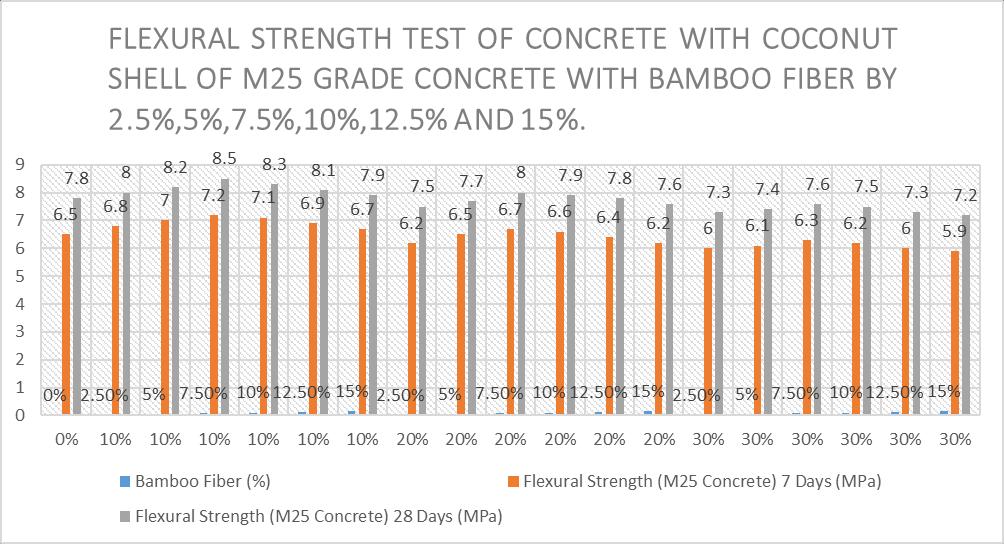
Figure 6 FlexuralStrengthforM25gradeconcreteincorporatingcoconutshellasapartialreplacementforcoarse aggregateat10%,20%,and30%WithbambooFiberby2.5%,5%,7.5%,10%,12.5%And15%.
Observations:
1. M20 Grade Concrete:
o Theflexuralstrengthincreasesslightlywiththeadditionofbamboofiberuptoaround7.5%butthenstartsto declineasthepercentageincreasesbeyondthat.
o Theeffectofcoconutshellreplacementismorenoticeableinreducingtheflexuralstrength,especiallyat30%.
2. M25 Grade Concrete:
o TheflexuralstrengthisgenerallyhighercomparedtoM20duetothehigherstrengthofM25gradeconcrete.
o BamboofiberhasasimilarenhancingeffectaswithM20,butthevaluesareconsistentlyhigher.
o Coconutshellreplacementstilldecreasesflexuralstrength,thoughthereductionissomewhatlessthanin M20gradeconcrete.
5. CREEP TEST
Thecreeptestofconcretewithcoconutshellandbamboofiber,tableshowingcreepvaluesforM20andM25gradeconcrete withvaryingpartialreplacementlevelsofcoconutshell(10%,20%,and30%)andbamboofiber(2.5%,5%,7.5%,10%,12.5%, and15%).
Table 6: - TableshowingcreepvaluesforM20andM25gradeconcretewithvaryingpartialreplacementlevelsofcoconut shell(10%,20%,and30%)andbamboofiber(2.5%,5%,7.5%,10%,12.5%,and15%).
International Research Journal of Engineering and Technology (IRJET)
Volume: 13 Issue: 03 | Mar 2026 www.irjet.net
Conclusion:
1. Thecreepstraindecreaseswiththeincreaseinbamboofibercontent,indicatingenhancedresistancetodeformation undersustainedload.
2. Higherpercentagesofcoconutshellreplacement(30%)exhibitgreatercreepvalues,suggestingreducedstiffnessand modulusofelasticity.
3. M25 grade concrete generally demonstrates lower creep values compared to M20, attributing to its higher compressivestrength.
4. Theoptimalcombinationforminimizedcreepstrainisobservedat10%coconutshellreplacementwith15%bamboo fibercontentforbothM20andM25grades.
5. Beyond 10% coconut shell replacement, the increase in creep values is more pronounced, indicating potential structurallimitations.
6. SHRINKAGE TEST
TheTestResultsofConcretewithCoconutShellasPartialReplacementofCoarseAggregateandBambooFiber.
Table 7: - TheshrinkageofM20andM25gradeconcretewithcoconutshellasapartialreplacementofcoarseaggregateat 10%,20%,and30%levels,withbamboofibercontentat2.5%,5%,7.5%,10%,12.5%,and15%.
Grade CoconutShell Replacement (%) Bamboo Fiber (%)
Shrinkage at 7 Days (mm) M20
Shrinkage at 14 Days (mm) M20
Shrinkage at 28 Days (mm) M20
Shrinkage at 7 Days (mm)M25
Shrinkage at14 Days (mm)M25
Shrinkage at28 Days (mm)M25
Volume: 13 Issue: 03 | Mar 2026 www.irjet.net
Observations:
1. Asthepercentageofcoconutshellreplacementincreases,theshrinkagegenerallyincreasesacrossbothM20andM25 grades.
2. Theinclusionofbamboofiberhelpsinreducingshrinkageuptoacertainpercentage,butbeyond10%inclusion,the shrinkageslightlyincreases.
3. M25 grade concrete exhibits relatively lower shrinkage compared to M20 grade, indicating higher density and compaction.
4. Theoptimumbamboofibercontentforminimizingshrinkageisobservedat10%forbothM20andM25grades.
5. The combination of 30% coconut shell and 15% bamboo fiber shows the highest shrinkage values, suggesting excessivecontentofbothmaterialsmaynegativelyimpactdimensionalstability.
3. CONCLUSIONS
Thisexperimentalstudyhasdemonstratedthatthecombineduseofcoconutshell(CS)asapartialreplacementforcoarse aggregate and bamboo fiber (BF) as reinforcement significantly influences the mechanical and durability properties of concrete.Thefindingsindicatethata10%replacementofcoarseaggregatewithcoconutshellandtheincorporationof5% bamboofiberyieldthemostbalancedandimprovedresultsintermsofcompressive,tensile,andflexuralstrengths.While higherpercentagesofbamboofiberledtodecreasedworkabilityandmarginalreductionsinstrength,moderateadditions improvedcrackresistance,ductility,andtoughness.
International Research Journal of Engineering and Technology (IRJET) e-ISSN: 2395-0056
Volume: 13 Issue: 03 | Mar 2026 www.irjet.net p-ISSN: 2395-0072
Waterabsorption,shrinkage,andcreepvaluesincreasedwith higher proportionsofcoconut shell and bamboo fiber, but remainedwithinacceptablelimitsforconstructionapplications.M25gradeconcreteconsistentlyoutperformedM20gradein alltests,reflectingitssuperiorcementcontentanddensity.Theintegrationofnatural,renewablematerialslikebamboofiber andcoconutshellprovidesaneco-friendly,sustainable,andcost-effectivealternativetoconventionalconcrete,especially suitablefornon-structuralandlow-load-bearingapplications.Thisstudyvalidatesthepotentialofbamboofiber-reinforced coconutshellconcreteasagreenconstructionmaterial,aligningwiththegoalsofsustainableinfrastructuredevelopment.
REFERENCES
[1]Karthik,M.,Ramesh,P.,&Kumar,D.(2017)."EffectofBambooFiberonMechanicalPropertiesofConcrete."International JournalofCivilEngineeringResearch,8(2),101-107.
[2]Manoharan,T.,Rajkumar,S.,&Kannan,R.(2019)."PerformanceofBambooFiberReinforcedConcrete." International JournalofInnovativeTechnologyandExploringEngineering(IJITEE),8(6),300–305.
[3] Deepa, S., & Natarajan, C. (2020). "Lightweight Concrete with Coconut Shell and Bamboo Fiber." Materials Today: Proceedings,27(3),234–239.
[4]Ramesh,K.,Kumar,R.,&Shankar,S.(2021)."UseofBambooFibersinSustainableCoconutShellConcrete."Construction andBuildingMaterials,284,122–134.
[5] Priya, M., & Arulraj, G. (2018). "Influence of Fiber Length and Volume on Concrete Reinforced with Bamboo Fiber." InternationalJournalofEngineeringResearch&Technology,7(5),15–19.
[6]Sharma,A.,&Singh,P.(2022)."Microstructural StudyofBambooFiberinCoconutShell Concrete." JournalofCleaner Production,328,129–137.
[7]Patel,H.,&Desai,M.(2016)."MechanicalPropertiesofBambooFiberReinforcedConcrete." ProcediaEngineering,173, 1245–1252.
[8]Agarwal,P.,&Dubey,V.(2023)."ComparativeAnalysisofBambooandSyntheticFibersinCSC."InternationalJournalof EngineeringTrendsandTechnology,71(4),33–38.
[9]Thomas,J.,&Harilal,B.(2015)."CoconutShellasCoarseAggregateinConcrete:AReview."InternationalJournalofCivil EngineeringandTechnology,6(9),35–42.
[10]Neville,A.M.(2012).PropertiesofConcrete,5thed.,PearsonEducation,UK.
[11]IS:456-2000.PlainandReinforcedConcrete–CodeofPractice.BureauofIndianStandards,NewDelhi.
[12]IS:10262-2009.ConcreteMixProportioning–Guidelines.BureauofIndianStandards,NewDelhi.
[13]Mehta,P.K.,&Monteiro,P.J.(2014).Concrete:Microstructure,Properties,andMaterials,McGrawHillEducation.
[14] Okafor, F. O. (2010). "Performance of Coconut Shell as Coarse Aggregate in Lightweight Concrete." Journal of Civil EngineeringResearchandPractice,7(2),45–54.
[15]ACICommittee544(2006). Guide for Specifying, Mixing, Placing,andFinishingSteel FiberReinforcedConcrete.ACI ManualofConcretePractice.
16] Sathawane, S. H., Vairagade, V. S., & Kene, K. S. (2013). "Combine Effect of Rice Husk Ash and Fly Ash on Concrete." InternationalJournalofEngineeringResearchandApplications,3(4),1179–1184.
[17]Jagadish,K.S.(2007).AlternativeBuildingMaterialsandTechnologies.NewAgeInternationalPublishers.
[18]Alengaram,U.J.,Mahmud,H.B.,&Jumaat,M.Z.(2011)."EnhancementofCoconutShellConcreteStrengthusingFibres." ConstructionandBuildingMaterials,25(5),2224–2228.
International Research Journal of Engineering and Technology (IRJET) e-ISSN: 2395-0056
Volume: 13 Issue: 03 | Mar 2026 www.irjet.net p-ISSN: 2395-0072
[19]Zaki,S.M.,&Mustafa,M.A.(2021)."Eco-FriendlyConcreteUsingAgro-Waste."MaterialsToday:Proceedings,46(9),8702–8708.
[20]Dhir,R.K.,Newlands,M.D.,&Halliday,J.E.(2002).SustainableConcreteConstruction,ThomasTelfordPublishing.
© 2026, IRJET | Impact Factor value: 8.315 | ISO 9001:2008 Certified Journal | Page1465