
International Research Journal of Engineering and Technology (IRJET) e-ISSN: 2395-0056
Volume: 12 Issue: 08 | Aug 2025 www.irjet.net p-ISSN: 2395-0072
International Research Journal of Engineering and Technology (IRJET) e-ISSN: 2395-0056
Volume: 12 Issue: 08 | Aug 2025 www.irjet.net p-ISSN: 2395-0072
Dr. Fayyaz Rehman1 , Robert Benham2
1Associate Professor, Department of Science and Engineering, Southampton Solent University, Southampton, UK 2Senior Lecturer, Department of Engineering, Computing and Mathematics, University of Chichester, Chichester, UK
Abstract – Additive Manufacturing (AM) is emerging as a cost-effective alternative to conventional manufacturing techniques for applications requiring components with complex geometries. Cost savings are achieved through reduced raw material usage, shorter manufacturing times, and the elimination of expensive tooling. AM serves as a valuable tool for designing and developing complex shapes in fluid flow research. Stepped spillways are widely recognized for their effectiveness in dissipating energy and are implemented globally. Their optimal design is critical for reducing downstream erosion and improving the economic efficiency of stilling basin configurations. Building on previous studies employing AM in open-channel flow applications, this paper presents a comparative analysis of two stepped spillway configurations incorporating preceding weir designs. The comparison evaluates fluid velocityprofiles, dischargerates,upstreamanddownstream water depths, associated hydraulic parameters, and experimental observations. To validate and extend the findings, this paper employs computational fluid dynamics (CFD) modelling, which demonstrates strong agreement with experimental results. Additional tests investigate sealed and unsealed models, the latter allowing significant side flow. This paper highlights how AM enables economical small-scale model fabrication, which can enhance largescaledesignprocessesandcontributetotheadvancementof experimentalfluidflowresearch.
Key Words: CFD Analysis, Additive Manufacturing, SteppedSpillway
1. INTRODUCTION
Additive manufacturing (AM) offers a contemporary and versatileapproachforadvancingexperimentaltechniques in traditional fluid mechanics research. Previous studies bytheauthors[1,2]havedemonstratedtheadvantagesof AM-fabricatedmodelsinarangeofhydraulicapplications, including weirs, drum gates, and flow-altering vanes. Building upon this foundation, the present study applies AM to the fabrication of small-scale stepped spillway modelsfordetailedhydraulicanalysis.
The principle of using stepped spillway structures to dissipatetheenergyofcascadingwaterisdeeplyrootedin
engineering history, with archaeological and textual recordsindicatingtheiruseinstructuresdatingbackmore than three thousand years [3]. These early designs, often constructed from stone masonry, reveal an enduring understanding oftheneedtocontrol hydraulicenergy for the protection of downstream channels. Contemporary stepped spillway research builds upon this ancient foundation, shifting the focus from empirical observation to systematic studies of flow regimes, aeration processes, and energy dissipation mechanisms. Advances in computational fluid dynamics (CFD) have further expanded this research, enabling detailed simulations of complex hydraulic interactions that were once described onlyqualitatively.
Despite these computational developments, physical modellingremainsessentialforvalidatingpredictionsand capturing phenomena such as air–water interactions, turbulence structures, and surface instabilities that can be challenging to model numerically. Large-scale models, however, pose practical and economic constraints, especially when multiple design variations are to be tested. In this context, AM provides a transformative advantage: small- and medium-scale AM models can be fabricated rapidly, at low cost, and with precise control over complex geometries. This flexibility enables systematic variation of parameters such as step height, slope, and preceding weir configuration, facilitating efficient design screening before committing to largerscaletesting.
While certain hydraulic behaviours, particularly those subjecttoscaleeffects,cannotbefullyreproducedinsmall models, CFD serves as a powerful complement, extending the experimental scope and identifying conditions under which flow regime transitions occur. The integration of AM-fabricatedmodelswithCFDanalysisthereforeoffersa cost-effective, flexible,and historicallyinformedapproach to spillway research, bridging ancient engineering principleswithmodernhydraulicscience.
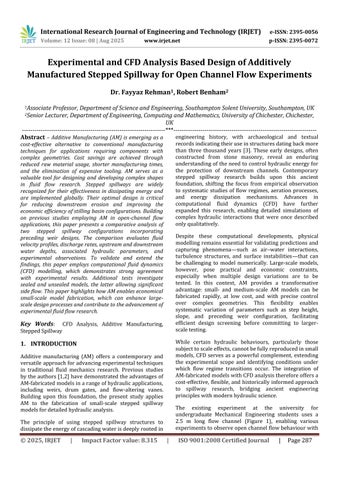
The existing experiment at the university for undergraduate Mechanical Engineering students uses a 2.5 m long flow channel (Figure 1), enabling various experimentstoobserveopenchannelflowbehaviourwith
International Research Journal of Engineering and Technology (IRJET) e-ISSN: 2395-0056
Volume: 12 Issue: 08 | Aug 2025 www.irjet.net p-ISSN: 2395-0072
different components. The experiments for flow channel currentlyinvolvesonlydrumgates,weirsandvanesbased components. However, there is no stepped spillway component available with the apparatus to fully understand the complexities of stepped spillway design use with different shapes for use in open channel flow experiments.
Thecasestudypresentedinthispaperextendspreviously published research [4] by the authors, providing detailed experimental and computational fluid dynamics (CFD) analysis of the effects of changing the stepped spillway shapes for various open channel experiments using additivemanufacturingtechnology.
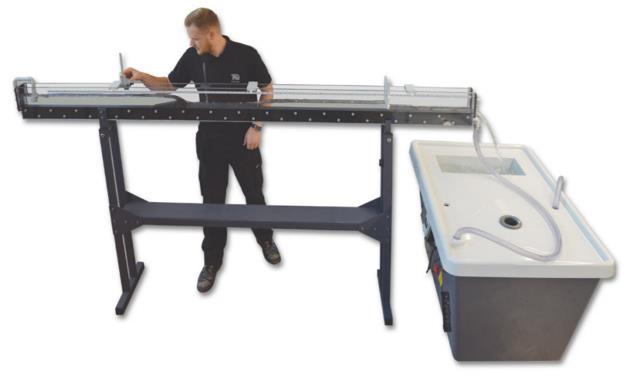
Experimentaltestingwasconductedina2.5mlaboratory flow channel. Based on prior facility constraints, the maximum spillway crest height was limited to approximately 85 mm, allowing for a practical range of discharges without causing uncontrolled overflow. Two stepped spillway configurations were examined: (i) a traditional horseshoe weir and (ii) a catenary-profile design previously developed by the authors [1]. These geometries,showninFig.2,wereselectedtoenabledirect comparison between a conventional and an experimentallyoptimisedprofile.
TheAMmodelsweredesignedsothatthesteppedsection spanned the full channel width, avoiding additional structural features along the sidewalls. This served two purposes: minimising material use and enabling controlled comparison between fully sealed models and those allowing side leakage. In sealed configurations, a continuous bead of sealant was applied along the sides, top,andbasetoeliminatebypassflow.
The step geometry incorporated an involute curve intended to promote the formation of small nappes and inter-step turbulence. While this curvature is expected to exert limited influence at the tested scale, it presents a
promising parameter for further study in larger models, potentiallywithalternativecurveprofiles.
Hydraulic testing involved four discrete flow rates, including the minimum discharge required to sustain the intendedflowregimesundersealedconditions.Additional trials were performed at the maximum volumetric flow rate to assess behaviour under potential overflow conditions. Water depths upstream of the crest were measured using a depth gauge at fixed spatial intervals, andsurfaceflowvelocitieswererecordedviatwopairsof infrared (IR) break-beam sensors connected to a Raspberry Pi Pico microcontroller. Flow patterns were documentedusinghigh-speedvideoandstillphotography forqualitativeanalysis.
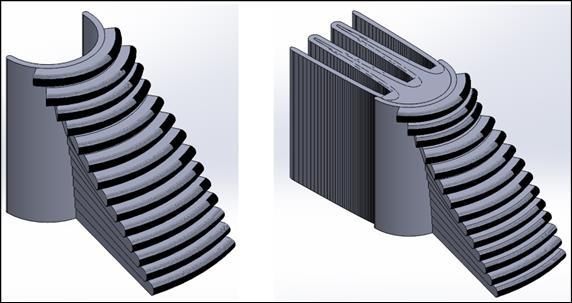
Figure2:CADfilesoftheAMsteppedspillways(left: horseshoe;right:catenary)
Complementary CFD simulations were performed to model velocity fields and flow regimes for both spillway configurations. Numerical results were compared with experimental data to assess predictive accuracy and to provide insight into hydraulic behaviour beyond the resolutionofphysicalmeasurements.
3.1 Flow Regime Observations and Comparative HydraulicAnalysis
Prior to commencing the experimental programme, a review of relevant literature indicated that small-scale physical models are inherently limited in their ability to replicate certain hydraulic behaviours, particularly flow aeration and the dynamic similarity between laboratory models and full-scale installations [6]. Stepped spillways are known to operate under three principal flow regimes nappe flow, transitional flow, and skimming flow depending on discharge conditions, step geometry, andchannelslope.Duetothereducedscaleofthepresent models, it was anticipated that only the skimming flow regimewouldbeachievableunderthetestedconditions.
Volume: 12 Issue: 08 | Aug 2025 www.irjet.net p-ISSN: 2395-0072
Experimental results confirmed this expectation: in most runs, the flow regime was classified as skimming, with water gliding over the step crests and limited free-fall between steps. On rare occasions, isolated small nappes were observed, particularly at lower flow rates or under specificvalvepositions.Theseinstanceswereinconsistent and cannot be categorised as sustained nappe flow. Nonetheless, their occurrence is noteworthy, as such features if replicated in larger-scale models could provide insight into transitional flow behaviours across a widerrangeofdischarges.
Given the relatively small size of the present spillway models compared to those in other stepped spillway studies,itwasinitiallyunclearwhetheranyobservableair entrainment would occur. As expected, at higher flow rates,visualevidenceofentrainedairwasnotapparent.At thehighestdischarges,partialnappesoccasionallyformed near the crest and uppermost steps (Fig. 3a), but this phenomenon was not repeatable when the flow control valve was adjusted gradually. At the lowest discharges, smallairbubbleswerevisiblealongthestepsurfaces(Fig. 3b), producing minor disturbances in the water surface. These were more clearly discernible when photographic negatives were processed and the images inverted, revealing subtle contrasts not visible to the naked eye. While such low-flow conditions fall outside the intended operational range, they approach worst-case scenarios involving excessive upstream ponding. Further investigation into potential aeration effects under these conditions particularly using higher-resolution digital imaging iswarranted.For comprehensiveanalysisofair entrainmentprocesses,high-speedvideographyshouldbe employed, especially in future studies involving largerscalephysicalmodels.
In addition to qualitative observations, the stepped spillways were evaluated against simple weir configurations using specific energy, Reynolds number, and Froude number comparisons. For example, the increase in specific energy between a 49 mm-high sharpcrested weir and an 83.5 mm-high horseshoe weir was found to be approximately 35%, while the corresponding maximum increase in Reynolds number across tested dischargeswasonly5%.Thecatenaryweirproducedeven closer Reynolds number values (within 2% of the sharpcrested weir) yet yielded a 37.5% increase in specific energy.Froudenumbervariationsweremorepronounced and inconsistent across discharges, except for the two lowest sealed-flow rates, where the horseshoe weir exhibited a 30% increase and the catenary weir a 38% increase compared to the reference sharp-crested weir. For the unsealed spillways,the large variability in Froude number is unsurprising, given the significant side leakage observed.
These findings highlight the scaling challenges associated with translating small-scale laboratory results to prototype conditions. Side leakage, geometric scaling effects,andreducedair–waterinteractionallcontributeto deviations from full-scale hydraulic behaviour. Future research should address these limitations through largerscale modelling and complementary numerical simulations, allowing a more robust evaluation of flow regimes, energy dissipation, and aeration processes in steppedspillwaydesigns.
Figures:3a(top)partialnappeformation;and3b(bottom) flowlinesobserved.
A critical feature in the hydraulic performance of stepped spillways is the inception point, defined as the location along the chute where significant air entrainment begins due to the intersection of the developing boundary layer withthefreesurface.Thisintersectioninitiateslarge-scale aeration, which plays a pivotal role in enhancing energy dissipation. Numerous studies have investigated the characteristicsandlocation oftheinceptionpoint,both in the context of retrofitting embankment dams [5] and in modelling specific dam structures [7]. The position of the inception point can be estimated using established empiricalrelationships,withcalculationsperformedbased ontheparametersillustratedinFig.4.
International Research Journal of Engineering and Technology (IRJET) e-ISSN: 2395-0056
Volume: 12 Issue: 08 | Aug 2025 www.irjet.net p-ISSN: 2395-0072

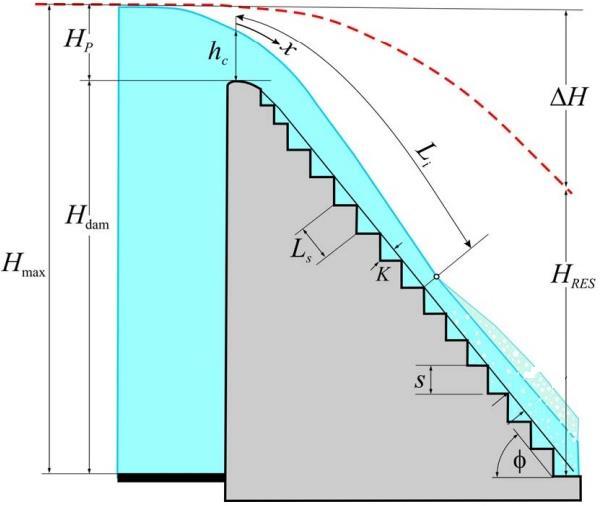
Figure4:Typicalspillwaysection,showingsomeofthe parametersusedinequation(1)tofindtheinception pointonasteppedspillway,basedonempiricalstudies [7].
Experimental measurements indicated that the estimated inceptionpoint, calculatedusingequation(1),occurred at approximately 59 mm from the crest over a total chute length of 110 mm. This location aligns broadly with the rangereportedinpreviousstudies;however,confirmation ofthisresultrequiresfurtherinvestigation.Duetocurrent instrumentation limitations, verification was not possible within this study, and additional high-resolution measurement apparatus will be necessary for more preciseassessment.
Upstream bulk velocities were also compared between sealed and unsealed configurations for both spillway types. For the horseshoe weir, sealing the model resulted in a reduction in upstream bulk velocity of 5.00–5.50 mm s⁻¹ at lower flow rates, increasing to 8.39 mm s⁻¹ at the highest tested discharge. The catenary spillway exhibited smaller reductions: 2.20–2.65 mm s⁻¹ at lower flow rates and 4.30 mm s⁻¹ at maximum discharge. Qualitative observations indicated that downstream discharge from unsealed configurationsappeared notably more turbulent compared with sealed conditions, suggesting that side leakage influences flow structure a finding warranting furthertargetedinvestigation.
Surface flow velocities were measured using infrared (IR) break-beam sensors, allowing comparison between bulk
and surface velocity reductions. For the horseshoe spillway,resultswereconsistentacrossallflowrates,with surface velocities measuring 19–25% lower than the corresponding bulk velocities. The catenary spillway showed greater variability: in the unsealed condition, reductions of approximately 36% were recorded at the two lowest flow rates, but this dropped to 13% at maximum discharge. In the sealed condition, the lowest flow rate produced a 34% reduction, while the remaining flowratesdemonstratedaconsistentrangeof12.5–14.5%.
It should be noted that measurement accuracy was constrained by several factors, including high turbulence in the downstream region, the fixed positioning of IR sensors, and the limited length of the laboratory flume, which restricted the available distance for velocity sampling downstream of the spillways. These limitations will need to be addressed in future work through improved sensor placement, increased measurement reach,andpotentiallylongertestchannels.
Finite Element Analysis (FEA)-based computational fluid dynamics (CFD) simulations were conducted to complement the experimental observations and enable direct comparison between physical and numerical results. Simulations were performed for both spillway configurations, in sealed and unsealed conditions, at two lower discharge rates (0.25 L s⁻¹ and 0.195 L s⁻¹). The analysis focused on the stepped section of each spillway, withrepresentativeresultspresentedinFig.5(a)–(d).
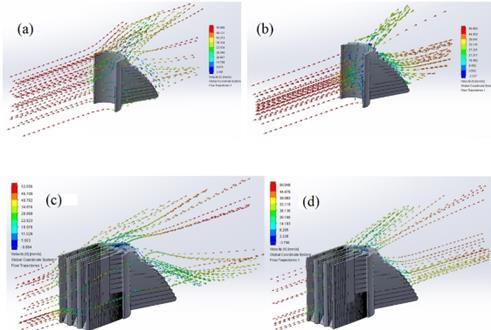
Figures.5(a)–(d):Top:horseshoespillways(left, unsealed;rightsealed).Bottom:catenaryspillways(left, unsealed;right,sealed).Flowrateis0.25litres/sec
The simulated flow fields revealed streamlines exhibiting an upward trajectory over portions of the spillway profile an observation not fully anticipated from the
International Research Journal of Engineering and Technology (IRJET) e-ISSN: 2395-0056
Volume: 12 Issue: 08 | Aug 2025 www.irjet.net p-ISSN: 2395-0072
experimentalrunsandwarrantingfurtherinvestigation.In general, greater downstream turbulence was observed in the unsealed configurations, consistent with side leakage effects, whereas sealed configurations exhibited more uniform and coherent flow structures in the downstream section.
The challenges associated with numerically modelling stepped spillways have been extensively discussed in the literature,withair–waterinteractions,andparticularlythe representation of entrained air, identified as key sources of inaccuracy [7]. These complexities remain a limitation of current modelling approaches and suggest that additionalrefinementofmultiphasesimulationmethodsis required for higher predictive fidelity. In the present study, certain potential influences such as variations in channel width, wall boundary effects, and fluctuations in pump output were not explicitly incorporated into the CFD model, which may account for some differences betweensimulatedandobservedflowbehaviour.
Despitetheselimitations,theCFDresultsprovidevaluable insight into the internal flow structure, including the interaction between flow lines and step geometry. In this work, the steps followed an involute curvature profile, chosen to promote nappe formation and inter-step turbulence; however, the numerical modelling framework established here could readily be extended to investigate alternative step geometries. Comparative simulations involving square, rectangular, and other curved profiles could yield further understanding of the influence of step shape on energy dissipation and flow regime development, especially since most prior studies have focusedonsquareorrectangularsteps.
Considering the advantages of additive manufacturing (AM) particularly its ability to reduce both manufacturinganddesigncosts thisstudydemonstrates thefeasibilityofinvestigatingsteppedspillwayhydraulics at very small scale while still enabling meaningful comparisons of flow parameters and characteristics between configurations. Although the physical models employed are below the scale typically required for comprehensive spillway testing, they provide a practical means of examining selected hydraulic parameters and generating substantial experimental datasets. Such smallscale models are also valuable in an educational context, particularly in laboratories without access to large-scale facilities.
Thepresentresearchservesasapreliminarysteptowards a broader investigation of stepped spillway performance. A logical progression would be to recreate the tested designs at scales comparable to those used in studies of operational spillways, thereby allowing more detailed
analysis of flow characteristics and reducing the uncertainty associated with small-scale testing. Further development of high-resolution photographic and videographic techniques would enhance the ability to capturedetailedflowregimefeatures.Larger-scalemodels wouldalsopermit morecomprehensiveassessmentof air entrainment, turbulence structures, and step-specific energydissipation.
From a practical perspective, sealing the small-scale AM models was straightforward but required considerable attentiontoensurecompleteelimination ofleakageinthe sealed configurations. In this study, only a single step profile the involute curve was investigated; however, AM technology readily enables the fabrication of a wide varietyofcomplexgeometries.Implementingsuchdesigns in full-scale spillways could present challenges, as commonly used construction materials such as rollercompacted concrete and masonry may be unsuitable for highly intricate geometries. Nevertheless, the application of advanced materials including ceramic coatings and composite systems could offer viable solutions for achieving desired step profiles, either directly or as surfacetreatmentsappliedtoastructuralsubstrate.
Overall, this work highlights the potential of AM as a powerful tool for conceptual design, prototyping, and preliminary hydraulic assessment in stepped spillway research. The findings provide a foundation for refining futureexperimentalprogrammesandidentifyingresearch priorities in a field that continues to attract significant interest in enhancing the performance and resilience of traditionalspillwaydesigns.
[1] F.Rehman,&R.Benham,R.(2022).Experimentaland computational fluid dynamics (CFD) analysis of additively manufactured weirs. IRJET, 9 (7), 1-7 (2022)
[2] R. Benham, F. Rehman, & A. Joshi. An Investigation intotheExploratoryUseofAdditiveManufacturingin DrumGateDesignforOpenChannelFlow.Advancesin Manufacturing Technology XXXVI (pp. 53-58). IOS Press.(2023)
[3] H. Chanson, C. A. Gonzalez. Stepped spillways for embankment dams: Review, progress, and development in overflow hydraulics. Proc. Intl Conf. on Hydraulics of Dams and River Structures, Tehran, Iran, Balkema Publ., The Netherlands (pp. 287-294). (2004)
[4] Benham, R., Rehman, F. [2024], MATEC Web of Conferences 401, 02010 (2024) Proceedings of the 21st International Conference on Manufacturing
International Research Journal of Engineering and Technology (IRJET) e-ISSN: 2395-0056
Research,Incorporatingthe38thNationalConference on Manufacturing Research, 28-30th August 2024, UniversityofStrathclyde,UK.
[5] S. L. Hunt, K. C. Kadavy. Inception point for embankment dam stepped spillways. Journal of HydraulicEngineering,139(1),60-64.(2013)
[6] P. Guenther, S. Felder, H. Chanson, H. Flat and pooled stepped spillways for overflow weirs and embankments: cavity flow processes, flow aeration and energy dissipation. International Workshop on HydraulicDesignofLow-HeadStructures(pp.77-86). (2013)
[7] B.Zindović,L.Savić,R.Kapor,N.Mladenović.Stepped spillway flow: Comparison of numerical and scale models.FMETransactions,42(3),218-223.(2014)
BIOGRAPHIES
time.Hehasstrongresearchinterestsin manufacturing and materials. As a result, he brings a wide range of experience of educational settings with adiversescopeoflearners.”

Volume: 12 Issue: 08 | Aug 2025 www.irjet.net p-ISSN: 2395-0072 © 2025, IRJET | Impact Factor value: 8.315 | ISO 9001:2008

“Dr. Fayyaz Rehman is an Associate Professor at Department of Science and Engineering, Southampton Solent University, UK. He is a Fellow of Higher Education Academy, a Chartered Engineer from the Engineering Council and a Fellow of the Institution of Engineering Designers, UK. He is also vicechairandcommitteememberofthe Consortium of UK Manufacturing Engineering Heads (COMEH), a UKbased body responsible for promoting manufacturing engineering education and research, as well as organizing the International Conference on Manufacturing Research (ICMR) conferenceseriesannually.Hisresearch interests are CAD/CAM/CAE, Material Testing and Additive Manufacturing Technologies.”

“Rob Benham is a Senior Lecturer at Department of Engineering, Computing and Mathematics at University of Chichester,UK.andcurrentlyaprogram coordinator of engineering courses. He has been teaching engineering courses at this institution and at previous institution for over 15 years. In 2003 Rob completed his PGCE (postcompulsory education) at Oxford Brookes University. He then taught in further education for one additional year He continued some FE teaching andsupplyteachingwhenworkingpart-