
International Research Journal of Engineering and Technology (IRJET) e-ISSN: 2395-0056
Volume: 13 Issue: 01 | Jan 2026 www.irjet.net p-ISSN: 2395-0072
International Research Journal of Engineering and Technology (IRJET) e-ISSN: 2395-0056
Volume: 13 Issue: 01 | Jan 2026 www.irjet.net p-ISSN: 2395-0072
Persi Angel P1 , Dr T Kiran2 ,
1 Student of Master in Technology, Department of Civil Engineering, Major: Structural Engineering, University of Visvesvaraya College of Engineering, Bengaluru, Karnataka, India. Email: persiangel7@gmail.com
2 Associate Professor, Department of Civil Engineering, University of Visvesvaraya College of Engineering, Bengaluru, Karnataka, India. Email: drkirantuvce@gmail.com
Abstract - Reinforced concrete columns are primary loadcarrying members in structural systems, and their axial compression behaviour plays a crucial role in ensuring structuralsafetyandperformance.Conventionally,reinforced concrete columns are provided with high-yield strength deformed (HYSD) steel bars as longitudinal reinforcement. However,durabilityissuesassociatedwithsteelcorrosionhave led to increased interest in alternative reinforcement materials such as glass fibre reinforced polymer (GFRP) bars. In the present study, an experimental and theoretical investigation is carried out to compare the axial compression behaviour of HYSD and GFRP reinforced concrete columns. A total of four reinforced concrete column specimens were cast with identical geometric dimensions and concrete grade, differing only in the type of longitudinal reinforcement. Axial compression tests were conducted to evaluate the ultimate load-carrying capacity, axial deformation behaviour, and failure characteristics of the specimens. The experimental results were further compared with theoretical axial load capacitiescalculatedusingestablisheddesignprovisions. The results indicate that HYSD reinforced columns exhibit higher axialloadcapacityandimprovedductility duetothe effective contribution of steel reinforcement. In contrast, GFRP reinforcedcolumnsshowedrelativelyloweraxialstrengthand a brittle failure response, primarily governed by concrete crushing. The study highlights the influence of reinforcement type on axial performance and provides useful experimental data supporting the potential application of GFRP bars in compression members where durability and corrosion resistance are critical considerations.
Keywords: Axial compression behavior; Reinforced concrete columns; High-yield strength deformed (HYSD) steel reinforcement; Glass fiber-reinforced polymer (GFRP) reinforcement Experimental investigation; Theoretical analysis; Failure behavior.
Reinforced concrete (RC) columns are fundamental structuralelementsresponsiblefortransferringloadssafely fromthesuperstructuretothefoundation.Theperformance ofcolumnsunderaxialcompressionplaysacrucialrolein ensuring the overall stability and safety of reinforced concrete structures. Traditionally, high-yield strength
deformed (HYSD) steel bars have been widely used as longitudinalreinforcementinRCcolumnsduetotheirhigh strength,ductility,andwell-establisheddesignprovisions. However, the long-term durability of steel-reinforced concrete structures has become a growing concern, particularly in aggressive environments where corrosion significantlyreducesstructuralcapacityandservicelife.
Corrosionofsteelreinforcementleadstocracking,spalling of concrete, reduction in cross-sectional area of reinforcement,andlossofbondbetweensteelandconcrete. Thesedeteriorationmechanismscanseverelyaffecttheaxial load-carryingcapacityofreinforcedconcretecolumnsand mayresultinprematurestructuralfailure.Asaresult,there has been increasing interest in exploring alternative reinforcementmaterialsthatcanmitigatecorrosion-related issueswhilemaintainingadequatestructuralperformance. Among the various alternatives, fibre reinforced polymer (FRP)barshavegainedconsiderableattentionduetotheir highstrength-to-weightratio,corrosionresistance,andnonmagneticproperties.
Glassfibre reinforcedpolymer (GFRP)barsareoneof the most commonly used FRP reinforcements in concrete structuresbecauseoftheirrelativelylowcostcomparedto otherFRPtypessuchascarbonoraramidfibres.GFRPbars exhibit high tensile strength and excellent resistance to chemical attack; however, their behaviour under compression is significantly different from that of conventionalsteelreinforcement.Unlikesteel,GFRPbarsare linearelasticuntilfailureandlackyieldingcharacteristics, thisfundamentaldifferenceinmaterialbehaviorresultsina comparativelybrittleresponse,raisingimportantconcerns regardingthesuitabilityofGFRPbarsforuseincompression memberssuchasreinforcedconcretecolumns.
Several researchers have investigated the performance of FRP-reinforcedconcretecolumnsunderaxialcompression. ExperimentalstudieshaveshownthatwhileFRPbarscan provide confinement and improve durability, their direct contributiontoaxialloadcapacityislimitedduetotheirlow compressivestrengthandsusceptibilitytomicro-buckling. Consequently,mostdesignguidelinesconservativelyneglect the compressive contribution of FRP reinforcement and considertheaxialcapacityofFRP-reinforcedcolumnstobe primarilygovernedbyconcretestrength.Thisconservative
International Research Journal of Engineering and Technology (IRJET) e-ISSN: 2395-0056
Volume: 13 Issue: 01 | Jan 2026 www.irjet.net p-ISSN: 2395-0072
approachoftenresultsinlowerpredictedaxialcapacitiesfor GFRP-reinforcedcolumnscomparedtoconventionalsteelreinforced columns of identical geometry and concrete grade.
Despite these limitations, GFRP-reinforced columns offer significant advantages in terms of durability, especially in structures exposed to marine environments, chemical industries,andregionswithhighhumidity.Therefore,aclear understanding of the axial compression behaviour, failure characteristics, and load–deformation response of GFRPreinforcedconcretecolumnsisessentialforevaluatingtheir feasibility as alternatives to conventional steel reinforcement in specific structural applications. A direct experimental comparison between HYSD- and GFRPreinforced columns under identical conditions offers valuableinsight into their relative performanceas well as theirpracticallimitations.
In this study, the axial compression behaviour of short reinforcedconcretecolumns(200×150mmcross-section, M30concretegrade) reinforced with HYSDsteel barsand GFRP bars is investigated experimentally. A total of four column specimens were cast, comprising two HYSDreinforced columns and two GFRP-reinforced columns, all havingidenticalcross-sectionaldimensions,concretegrade, and reinforcement detailing. The specimens were tested underconcentricaxialcompressiontoexaminetheirloadcarrying capacity, axial deformation response, crack development,andfailuremodes.Theexperimentalresults werefurthercomparedwiththeoreticalaxialloadcapacities obtained using established design approaches to evaluate theaccuracyandconservatismofanalyticalpredictions.
The primary objective of this study is to present a clear comparisonoftheaxialcompressionbehaviourofHYSD-and GFRP-reinforcedconcretecolumns,withparticularemphasis ondifferencesinstrength,deformationcharacteristics,and failure mechanisms. The findings aim to provide experimentalevidencetosupportinformeddecision-making regarding the use of GFRP bars in compression members, especially in applications where durability considerations areprioritisedoverductilityrequirements.
Theexperimentalprogrammedwasdesignedtoexamine andcomparetheaxialcompression behaviorofreinforced concrete columns reinforced with high-yield strength deformed (HYSD) steel bars and glass fiber reinforced polymer (GFRP) bars. A total of four short reinforced concrete column specimens were cast and tested under concentricaxialcompression.Ofthese,twospecimenswere reinforced with HYSD steel bars, while the remaining two werereinforcedwithGFRPbars.Allcolumnsweredesigned with identical geometric dimensions, concrete grade, and reinforcement layout to ensure that the effect of
reinforcementtypeonaxialbehaviourcouldbeisolatedand evaluatedaccurately.
Allcolumnspecimenshadarectangularcross-sectionof 200 mm × 150 mm and a total height of 1300 mm. The columnsweredesignedasshortcolumns,andslenderness effectswereneglected.Theclearcovertoreinforcementwas maintainedat 25 mm forallspecimens.Thespecimenswere designatedbasedonthetypeoflongitudinalreinforcement used.
HYSD-1, HYSD-2: Columns reinforced with HYSD steelbars
GFRP-1, GFRP-2: Columns reinforced with GFRP bars
Theconcretegradeusedforallspecimenswas M30,and identical reinforcement detailing was adopted to maintain consistencyacrossspecimens.
1.2.1
Concrete of grade M30 was used for casting all column specimens. Ordinary Portland cement, fine aggregates, coarse aggregates, and potable water were used in accordance with standard practice. The concrete mix was designedtoachievethetargetcompressive strengthat28 days.Standardcubespecimenswerecastandtestedtoverify the compressive strength of concrete before testing the columns.
1.2.2
HYSD steel bars of 12 mm diameter wereusedas longitudinal reinforcement in steel-reinforced columns.
GFRP bars of 12 mm diameter were used as longitudinal reinforcement in GFRP-reinforced columns.
Eachcolumnwasreinforcedwith four longitudinal bars, placedsymmetricallyatthecornersofthecross-section.The totalareaoflongitudinalreinforcementwaskeptthesame forbothHYSDandGFRPreinforcedcolumnstoallowdirect comparison.
Lateralreinforcementwasprovidedintheformof 8 mm diameter ties, spaced uniformly along the length of the column to ensure confinement and prevent premature bucklingoflongitudinalbars.
Thereinforcementcageswerefabricatedasperthedesign detailingandplacedinsidethemouldswithadequatecover spacers.Concretewaspouredinlayersandcompactedusing
International Research Journal of Engineering and Technology (IRJET) e-ISSN: 2395-0056
Volume: 13 Issue: 01 | Jan 2026 www.irjet.net p-ISSN: 2395-0072
mechanicalvibrationtoeliminateairvoids.Aftercasting,the specimensweredemoldedafter24hoursandsubsequently curedinwaterfor28daystoensureadequatehydrationand properstrengthdevelopment.
Allcolumnspecimensweretestedunderconcentricaxial compression using a compression testing machine of sufficientcapacity.Theloadwasappliedaxiallythroughsteel bearingplatesplacedatthetopandbottomofeachspecimen toensureuniformloadtransferandminimiseeccentricity.
Axial deformation was measured using displacementmeasuringdevicespositionedalongtheheightofthecolumn. The load was applied gradually in incremental stages, allowing the corresponding deformation response to be recordedaccuratelyateachloadlevel.Visualobservations werecarriedoutthroughoutthetestingprocesstomonitor crack initiation, crack propagation, and the overall failure behaviorofthespecimens.
1.2.5
Theloadwasappliedmonotonicallyunderdisplacementcontrolledconditionsuntilfailure.Ateachloadincrement, axial deformation was recorded, and the specimen was carefully inspected for crack development. Loading was continueduntilasignificantdropinload-carryingcapacity wasobserved,indicatingfailureofthecolumn.
Thefailuremodesofthespecimensweredocumentedin detail.IntheHYSD-reinforcedcolumns,failurewasgenerally characterizedbygradualconcretecrushingaccompaniedby visiblecrackingandyieldingofthesteelreinforcement.In contrast, GFRP reinforced columns exhibited relatively suddenfailuregovernedbyconcretecrushing,withlimited warning prior to collapse. Crack patterns and failure characteristics were recorded for all specimens for comparisonanddiscussion.
Thetheoreticalanalysisofcolumnstrengthwascarriedout basedonthefollowingassumptions:
1. Thecolumnissubjectedto pure concentric axial compression
2. Thecolumnbehavesasashortcolumn;slenderness effectsareneglected.
3. Plane sections remain plane before and after loading.
4. Perfect bond exists between concrete and reinforcement.
5. Concretecrushinggovernstheultimatefailureofthe column.
TheanalysisforHYSDreinforcedcolumnswascarriedout usingprovisionsof ACI 318,whileGFRPreinforcedcolumns were analysed based on recommendations of ACI 440.1R. Indian Standard provisions (IS 456) were referred toas a supportingframework.
2.1 Axial Capacity of HYSD Reinforced ConcreteColumns
Foraxiallyloaded tied reinforced concrete columns,ACI 318providesthefollowingexpressionfornominalaxialload capacity:
Where:
=nominalaxialloadcapacity(N)
=characteristiccompressivestrengthofconcrete (MPa)
=grosscross-sectionalareaofcolumn(mm²)


=areaoflongitudinalsteelreinforcement(mm²)
=yieldstrengthofsteelreinforcement(MPa) Fortiedcolumns,the strength reduction factor is:

Hence,the design axial load capacity is:

In HYSD reinforced columns, both concrete and steel contribute significantly to the axial load resistance. The yieldingcapabilityofsteelreinforcementprovidesadditional strengthandductility,resultingingradualfailurebehaviour underaxialcompression.
Unlikesteelreinforcement,GFRPbarsexhibit linear elastic behaviour until failure anddonotyieldundercompression. Experimental and analytical studies have shown that the compressive contribution of GFRP bars is limited due to micro-bucklingandlowcompressivestrength.Therefore,ACI 440recommendsneglectingthecompressivecontribution of GFRP bars whileestimatingaxialloadcapacity. Accordingly, the nominal axial load capacity of GFRP reinforcedconcretecolumnsisexpressedas:

Where:

=areaoflongitudinalGFRPreinforcement(mm²)
The strength reduction factor recommended for FRPreinforcedcompressionmembersis:

Thus,thedesignaxialloadcapacityisgivenby:
International Research Journal of Engineering and Technology (IRJET) e-ISSN: 2395-0056
Volume: 13 Issue: 01 | Jan 2026 www.irjet.net p-ISSN: 2395-0072
SincethecontributionofGFRPreinforcementincompression isneglected,theaxialstrengthofGFRPreinforcedcolumnsis
Primarily governed by concrete strength
2.3 Comparison Basis
Toensureafaircomparison,thefollowingparameterswere keptidenticalforbothHYSDandGFRPreinforcedcolumns:
Columncross-section:200mm×150mm
Concretegrade:M30
Longitudinalreinforcementarea
Typeandspacingoflateralties
Loadingcondition:concentricaxialcompression
The theoretical axial capacities obtained using the above expressions was compared with experimentally observed ultimateloadstoevaluatetheeffectivenessandconservatism oftheanalyticalmodels.
2.4 Significance of Theoretical Evaluation
The theoretical analysis provides a baseline for understandingtheexpectedaxialperformanceofreinforced concrete columns with different reinforcement types. Comparison between theoretical and experimental results helpsin:
Assessing the suitability of existing design provisions
Understandingtheinfluenceofreinforcementtype onaxialcapacity
Evaluation of the adequacy and conservatism of safetymarginsprescribedbydesigncodes.
3. THEORETICAL ANALYSIS Results
3.1 General
Thissectionpresentstheexperimentalresultsobtainedfrom axial compression tests on HYSD- and GFRP-reinforced concrete columns and discusses their behavior in comparisonwiththeoreticalpredictions.Theperformanceof thecolumnsisevaluatedintermsofultimateload-carrying capacity, axial deformation response, crack development, and failure modes. The experimental findings are further comparedwiththeoreticalvaluescalculatedusingrelevant designprovisionstoassesstheaccuracyandconservatismof theanalyticalapproaches
3.2 Ultimate Axial Load Capacity
The experimental ultimate axial load for each column specimenwasrecordedatthepointoffailure,identifiedbya pronounced reduction in load-carrying capacity accompanied by visible concrete crushing. These
experimentalultimateloadsweresubsequently compared with the theoretical axial capacities calculated using establishedanalyticalexpressions.
Table 1. ComparisonofExperimentalandTheoreticalAxial CompressionCapacitiesLoad
Specimen Reinforcement
TheresultsindicatethatHYSD-reinforcedcolumnsexhibited ahigheraxialloadcapacitythanGFRP-reinforcedcolumns withidenticalgeometryandconcretegrade.Thisbehaviour canbeattributedtothecombinedcontributionofconcrete andtheyieldingofsteelreinforcementinHYSDcolumns.In contrast,theaxialcapacityofGFRP-reinforcedcolumnswas governed primarily by the strength of concrete, as the compressivecontributionofGFRPbarsisrelativelylimited. Thetheoreticalpredictionsshowedreasonableagreement withtheexperimentalresultsforbothreinforcementtypes. In the case of GFRP-reinforced columns, the theoretical values closely reflected the dominant role of concrete in resisting axial compression, indicating a generally conservativeestimationoftheirload-carryingcapacity. The predictions were generally conservative, which is consistent with the design assumption that neglects the compressivecontributionofGFRPbars.
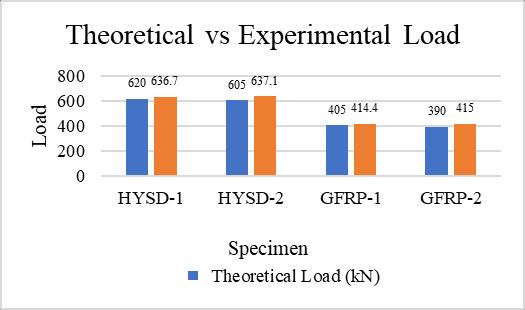
-1:TheoreticalvsExperimentalLoad
3.3 Load–Deformation Behaviour
The axial load–deformation response of the column specimenswasobtainedbyrecordingaxialdisplacementat successiveloadincrements.Theresultingload–deformation curves provide valuable insight into the stiffness
International Research Journal of Engineering and Technology (IRJET) e-ISSN: 2395-0056
Volume: 13 Issue: 01 | Jan 2026 www.irjet.net p-ISSN: 2395-0072
characteristics,deformationcapacity,andfailurebehaviour ofthecolumns.
HYSD-reinforced columns exhibited a gradual increase in axial deformation with increasing load, followed by a relativelyductilepost-peakresponse.Thepresenceofsteel reinforcementfacilitatedstressredistributionafterconcrete cracking, leading to a more controlled and progressive failuremechanism.
Incontrast,GFRP-reinforcedcolumnsdemonstratedalower deformation capacity and a steeper load–deformation response up to failure. Once the peak load was reached, failureoccurredabruptlywithminimalwarning,indicatinga brittleresponse.Thisbehaviourisconsistentwiththelinear elastic nature of GFRP bars and the absence of yielding undercompressiveloading.
3.4 Crack Pattern and Failure Modes
Crack initiation in all specimens was first observed at relatively higher load levels, indicating that the concrete carriedthemajorityoftheaxialloadduringtheinitialstages of loading. With further increase in load, vertical and inclinedcracksdevelopedprogressivelyalongtheheightof thecolumns
3.4.1 HYSD Reinforced Columns
HYSD-reinforced columns exhibited multiple fine cracks distributedalongthesurfaceofthespecimens.Failurewas characterized by progressive concrete crushing, typically occurring near the mid-height or ends of the columns, accompanied by yielding and minor buckling of the longitudinalsteelbars.Thefailureprocesswasgradualand providedclearvisualwarningpriortocollapse
3.4.2 GFRP Reinforced Columns
GFRP-reinforcedcolumnsexhibitedfewerbutwidercracks. Failure occurred primarily due to sudden crushing of the concrete,withlittlepriordeformation,reflectingthebrittle nature of the response of concrete, with minimal contributionfromtheGFRPbars.Theabsenceofyieldingin theGFRPreinforcementledtoabruptfailurewithminimal post-peakdeformation.
3.5 Comparison between HYSD and GFRP Reinforced Columns
AdirectcomparisonbetweenHYSD- andGFRP-reinforced columns clearly highlights the influence of reinforcement typeonaxialcompressionbehaviour:
•HYSD-reinforcedcolumnsdemonstratedhigheraxialload capacityalongwithimprovedductility.
•GFRP-reinforcedcolumnsexhibitedlowerstrengthanda predominantly brittle failure mode governed by concrete crushing.
•Theoreticalpredictionsweregenerallymoreconservative for GFRP-reinforced columns due to the neglect of the compressivecontributionofFRPbars.
• Despite the reduced axial capacity, GFRP reinforcement offerssignificantadvantagesintermsofcorrosionresistance and long-term durability, making it suitable for selected applications where durability requirements outweigh strengthandductilitydemands.
Theresultsofthisstudyindicatethat,althoughGFRPbars are effective in enhancing durability, their application in compressionmembersshouldbeapproachedwithcaution due to the associated reduction in axial strength and ductility. HYSD reinforcement remains more suitable for columns where high axial load capacity and ductile behaviour are critical performance requirements. Nevertheless, GFRP-reinforced columns may offer advantagesinenvironmentswherecorrosionresistanceisa primary concern and the imposed load demands are moderate.
The experimental findings also confirm the conservative natureofcurrenttheoreticaldesignapproachesforGFRPreinforced columns, highlighting the need for further experimentalinvestigationstorefineandimproveexisting designprovisions.
Based on the experimental investigation and theoretical analysis of short reinforced concrete columns reinforced with HYSD steel bars and GFRP bars under axial compression,thefollowingconclusionsaredrawn:
1. The axial compression behaviour of reinforced concretecolumnsisstronglyinfluencedbythetype of longitudinal reinforcement employed. HYSDreinforced columns demonstrated a higher axial load-carrying capacity than GFRP-reinforced columns with identical geometry and concrete grade.
2. The experimental results indicate that HYSDreinforced columns exhibited more ductile behaviour, characterised by gradual concrete crushing and clear warning prior to failure. The yielding capacity of the steel reinforcement contributedsignificantlytoenhanceddeformation capacityandanimprovedpost-peakresponse.
3. GFRP-reinforcedcolumnsexhibitedcomparatively loweraxialstrengthandabrittlefailureresponse. Failurewasprimarilygovernedbysuddenconcrete
International Research Journal of Engineering and Technology (IRJET) e-ISSN: 2395-0056
Volume: 13 Issue: 01 | Jan 2026 www.irjet.net p-ISSN: 2395-0072
crushing,withminimalcontributionfromtheGFRP barsinresistingcompressiveforces.
4. The theoretical axial capacities calculated using established design provisions showed good agreement with the experimental resultsfor both reinforcement types. The variation between experimental and theoretical values remained within acceptable limits, demonstrating the reliabilityoftheanalyticalmodels.
5. The conservative nature of the theoretical predictions for GFRP-reinforced columns can be attributed to design assumptions that neglect the compressivecontributionofGFRPbars.Whilethis approachensuresanadequatemarginofsafety,it mayleadtoanunderestimationoftheactualaxial capacity.
6. AlthoughGFRP-reinforcedcolumnsexhibitedlower axial capacity than HYSD-reinforced columns, the useofGFRPbarsoffersnotableadvantagesinterms of corrosion resistance and long-term durability. Consequently, GFRP reinforcement may be considered for compression members in environments where durability requirements govern design and the applied load demands are moderate.
[1] ACI Committee 318, Building Code Requirements for Structural Concrete (ACI 318-19), American Concrete Institute,FarmingtonHills,MI,USA,2019.
[2] ACI Committee 440, Guide for the Design and ConstructionofStructuralConcreteReinforcedwithFRP Bars (ACI 440.1R-15), American Concrete Institute, FarmingtonHills,MI,USA,2015.
[3] Bureau of Indian Standards, Plain and Reinforced Concrete – Code of Practice (IS 456:2000), BIS, New Delhi,India,2000.
[4] M.ToutanjiandT.Saafi,“DurabilityStudiesonConcrete Columns Reinforced with FRP Bars,” Cement and Concrete Composites, vol. 22, no. 2, 2000, pp. 77–83, doi:10.1016/S0958-9465(99)00045-8.
[5] J.Teng,J.Chen,S.Smith,andL.Lam,FRP-Strengthened RCStructures,JohnWiley&Sons,Chichester,UK,2002.
[6] A. Afifi, H. Mohamed, and B. Benmokrane, “Axial BehaviourofCircularConcreteColumnsReinforcedwith GFRP Bars and Spirals,” Journal of Composites for Construction, vol. 18, no. 2, Apr. 2014, pp. 1–11, doi:10.1061/(ASCE)CC.1943-5614.0000428.
[7] P.NealeandJ.Labossière,“DesignofConcreteColumns Reinforced with FRP Bars,” Canadian Journal of Civil Engineering, vol. 34, no. 5, May 2007, pp. 563–574, doi:10.1139/L06-148.
[8] S. Alsayed, “Strength of Concrete Columns Reinforced withFRPBars,”CompositesPartB:Engineering,vol.29, no. 4, 1998, pp. 459–465, doi:10.1016/S13598368(97)00061-0.