
International Research Journal of Engineering and Technology (IRJET) e-ISSN: 2395-0056
Volume: 13 Issue: 04 | Apr 2026 www.irjet.net p-ISSN: 2395-0072

International Research Journal of Engineering and Technology (IRJET) e-ISSN: 2395-0056
Volume: 13 Issue: 04 | Apr 2026 www.irjet.net p-ISSN: 2395-0072
Shital Subhash Dandge1 , Dr. A. P. Wadekar2 , Dr. D. N. Kakade3
1PG Student, Masters of Technology in Structural Engineering – P.E.S College of Engineering, Chhatrapati Sambhajinagar, M.S.
2Principal & Professor - P.E.S College of Engineering, Chhatrapati Sambhajinagar, M.S.
3Associate Professor and Head of Civil Engineering Department - P.E.S College of Engineering, Chhatrapati Sambhajinagar,M.S.
Abstract - The most often used building material is concrete, which needs enough curing to get desired strength and lifetime. Though efficient, traditional water-curing techniqueshaverestrictionsinremotelocations,tallbuildings, and areas with limited water supply. Under such circumstances, incorrect curing may cause decreased durabilityandperformance. Thisworkinvestigatesthe use of self-curing concrete, in which internal curing agents supply moisture during hydration, so lowering the demand for external curing. Performance of two self-curing agents Polyethylene Glycol 400 (PEG 400) and Superabsorbent Polymers (SAP) in M30-grade concrete was assessed. While SAPs gradually absorb and release water, PEG 400 aids to retain water for internal hydration. Six concrete mixes conventional water-cured (M1), non-cured (M2), PEG-based (M3, M4), SAP-based (M5), and PEG with water curing (M6) were made. Following ISand ASTMcriteria,these mixes were evaluated for workability, compressive strength, tensile strength,flexuralstrength,andwaterabsorptionat7,14,and 28 days. The results revealed that PEG 1.5% (M4) attained better workability and strengths equivalent to conventional curing. SAP (0.2%) greatly increased water retention and lowered shrinkage, so strengthening durability. Mix M6 showed advantages from combined internal and external curing and recorded the best strength. The uncured mix (M2) shown the lowest performance. This work validates that, particularlyinwater-limitedenvironments,self-curingagents are efficient substitutes for conventional approaches. Their applicationguaranteesconcreteperformanceandquality, so supporting sustainable building.
Keywords : Self-curing concrete, PEG 400, Superabsorbent polymers, Internal curing, Compressive strength, Durability, Sustainable construction
1. INTRODUCTION
Becauseofitsgreatstrength,durability,andmoldabilityinto many forms, concrete still forms the backbone of contemporaryinfrastructure.Itscompressivestrengthand adaptability make it extensively used in many structural applicationsincludingbuildings,bridges,pavements,dams, and precast elements. But a crucial phase controlling its performanceisthecuringprocess,whichguaranteesenough
hydrationofcementitiousmaterials,sopromotingstrength increaseandlifetimeovertime.
Conventional curing in traditional building techniques is keeping external moisture under control using ponding, sprinklingorcoveringwithwetmaterials.Althoughefficient, these techniques have major drawbacks including great water demand, labour intensity, inefficiencies in remote, underground, or high-rise buildings. Actually, poor or insufficient curing results in surface cracking, reduced strength,higherpermeability,andanotabledecreaseinthe lifetimeofconcretebuildings [1]
Researchers have looked at other methods to overcome these difficulties; self-curing concrete has shown great promise. By including internal curing agents such PolyethyleneGlycol (PEG)andSuperAbsorbent Polymers (SAP), which retain water inside the concrete mix and release it gradually over time, so enabling continuous hydration and eliminating the need for outside water application[2][3]. These agents create internal moisture reservoirs that guarantees continuous curing even in challengingsiteenvironments.
Because PEG 400, a water-soluble polymer, can hold and releasemoisturegradually,ithasbeenincreasinglyapplied in concrete as a self-curing agent. Research show PEG promotes strength development and helps to lower autogenous shrinkage[4]. Similarly, SAPs are hydrophilic polymersthatcanabsorbandretainwatermanytimestheir weight,soactingasinternalreservoirsofcuringwater[5] .
Inhigh-performanceconcrete,BentzandSnyder[2] showed thatlightweightaggregatespre-soakedwithwaterbehave effectively in internal curing by reducing shrinkage and improvinglong-termstrength.Ininternallycuredconcrete samples,CussonandHoogeveen[3]verifiedbetterhydration and less cracking. Especially in low water-cement ratio concretes, Jensen and Hansen[4] showed even more how SAPsenhancemicrostructureandpreventself-desiccation. MehtaandMonteiro[7] underlinedhowappropriatecuring helps to improve the resistance of concrete against environmentaldamage.
International Research Journal of Engineering and Technology (IRJET) e-ISSN: 2395-0056
Volume: 13 Issue: 04 | Apr 2026 www.irjet.net p-ISSN: 2395-0072
Furthermore, Lura et al.[6] demonstrated that in highperformanceconcrete(HPC)wherelowwater-cementratios causequickself-desiccation,internalcuringisquitehelpful. Aïtcin[8] underlined that modern concrete techniques dependonself-curingmethods,particularlyincaseswhere sustainabilityandwatereconomytakefrontstage.
Thus,bymeansofcomparativeanalysisofmechanicaland durability criteria, this study explores the efficacy of selfcuring agents (PEG 400 and SAP) in M30–grade concrete. The objective is to find whether in terms of performance, resourceeconomy,andpracticalapplicabilitytheseagents can be dependable replacements for conventional curing techniques.
Thematerialsusedinthisworkwerechosenwithparticular attentionontheircompatibilitywithself-curingtechniques andtheircapacitytoguaranteeoptimalhydration,strength development, and durability of concrete in the absence of conventional external curing methods.
2.1 Materials
2.1.1 Cement
All concrete mixes used ordinary Portland cement (OPC) Grade53conformingtoIS12269:2013.Highearlystrength developmentofgrade53cementmakesitespeciallyfitfor experimentalstudiesassessingtheeffectsofinternalcuring onearly-agemechanicalproperties.
2.1.2 Fine and Coarse Aggregates
PerfectAggregate:Thefineaggregatecamefromclean,river sand that fit IS 383:2016. It was sieved and cleaned to remove harmful elements and preserve appropriate gradation (Zone II). Thecoarseaggregateconsistedincrushedgraniteof20mm nominalsize.
Twoself-curingagentswereusedtofindhowwelltheykept internalmoisture:
Low molecular weight hydrophilic polymer PEG 400 can absorb and then progressively release water over time. It was added at cement weight-based dosages of 1.0% and 1.5%.
ii) SAPs, or superabsorbent polymers
Cross-linkedpolymers,SAPscanabsorbwateruptoseveral hundred times their own weight. Based on research
directionandtrialdata,theywereusedata0.2%byweight ofcementdosage.
2.1.4 Water
MixingtookcleanpotablewatercompliantwithIS456:2000. Maintaining a constant water-to cement (w/c) ratio of 0.40, all mixes guaranteed consistency and enabled comparativeanalysis.
Bymeansofsuitableratiosofcement,water,fineaggregate, coarseaggregate,andself-curingchemicals,themixdesign technique aims to produce concrete of the necessary strength and workability. Structural application and environmentalconditionsofexposuredefinetargetstrength. Thiswork makesuse of M30gradeconcrete, a commonly used grade in real-lifestructural projects requiring either modesttohighstrength.
According to IS 10262: 2019 and IS 456: 2000, the target meanstrength iscalculatedusingtheformula:
Where:
= Characteristic compressive strength at 28 days=30MPa(forM30)
S = Standard deviation = 5 MPa (as per IS 10262:2019forM30gradeconcrete)
So,theTargetMeanStrength=38.25MPa
Targetinggoodworkabilityandstrength,experimentaltrial mixes and IS 10262:2019 helped derive the final mix proportionsforM30gradeconcretewithaw/cratioof0.40. The mix was developed for conventional water-cured concreteaswellasself-curedconcrete(withPEG400and SAPs).
Table 2.2.2.1 : NominalMixRatio(byweight)for1m³of concrete(Conventional) Material Quantity (kg/m³)
Cement(OPC53)
Water
400
160
International Research Journal of Engineering and Technology (IRJET) e-ISSN: 2395-0056
Volume: 13 Issue: 04 | Apr 2026 www.irjet.net p-ISSN: 2395-0072
FineAggregate 650
CoarseAggregate 1200
Water-CementRatio 0.40
To evaluate the performance of self-curing concrete, two additives were introduced in different mixes, replacing a smallpercentageofwaterorcementbyweight:
Table 2.2.3.1 : MixwithPEG400(1.0%and1.5%by weightofcement)
Material PEG 1.0% PEG 1.5%
Cement(OPC53) 400kg/m³ 400kg/m³
Water 160kg/m³ 160kg/m³
PEG400 4.0kg/m³ 6.0kg/m³
FineAggregate 650kg/m³ 650kg/m³
CoarseAggregate 1200kg/m³ 1200kg/m³
Water-CementRatio 0.40 0.40
PEG400wasaddedasaliquidself-curingagentandmixed withwaterbeforeblendingwith drymaterials.
Table 2.2.3.2 : MixwithSuperabsorbentPolymers(SAP) –0.2%byweightofcement
Material SAP 0.2% Mix
Cement(OPC53) 400kg/m³
Water 160kg/m³
SAP(powder) 0.8kg/m³
FineAggregate 650kg/m³
CoarseAggregate 1200kg/m³
Water-CementRatio 0.40
SAPpowderwasdry-mixedwiththeaggregatesandcement beforetheadditionofwatertoensureuniformdispersion.
2.2.4 Why These Mix Proportions and Dosages Were Selected
Broadly used in both domestic and commercial building,M30GradeSelectionstrikesacompromise
between workability and strength. It provides a reasonablebasisforassessingtheeffectsofdrugs meantforself-curing.
ResearchandliteraturepointtoPEG 400at1.0% and1.5%dosagesaseffectiveindeliveringinternal moisture and reducing shrinkage without compromisingstrength.
SAP absorbs water many times more than their weightat0.2%.Theythusprovideexcellentinternal cureevenatlowpercentages.Higherpercentages can result in micro voids able to compromise strength.
This was selected to guarantee strength development while minimising water content, so optimisingtheneedandefficacyofinternalcuring, witha0.40w/cratio.
Aggregate Ratios: The choice of coarse to fine aggregateratiowasdirectedbyamaximumpacking density, desired workability, and particle size distribution.
2.3.1
Cement:OPC53GradeconfirmingtoIS12269
Fine Aggregate:Cleanriversand(ZoneII)asperIS 383
Coarse Aggregate:Crushedgranitestones(10mm and20mm,mixed)
Water:Potablewater
Self-Curing Agents:
o Polyethylene Glycol (PEG 400) at 1.0% and 1.5% byweightofcement
o Superabsorbent Polymer (SAP) at 0.2% byweightofcement
Table 2.3.1.1 :MixesConsidered(6Total)
Mix No. Description
M1 ConventionalConcrete–WaterCuring
M2 ConventionalConcrete–NoCuring
M3 PEG400–1.0%(Self-Curing)
M4 PEG400–1.5%(Self-Curing)
M5 SAP–0.2%(Self-Curing)
M6 PEG400–1.0%(WaterCuring)
International Research Journal of Engineering and Technology (IRJET) e-ISSN: 2395-0056
Volume: 13 Issue: 04 | Apr 2026 www.irjet.net p-ISSN: 2395-0072
Table 2.3.1.2 : SpecimenCastingandQuantities
Specime n Type Dimension s
(6 Mixes )
Cubes 150×150× 150mm Compressiv eStrength 9(3each @7,14,28 days) 54
Cylinder s 150mmØ× 300mm height SplitTensile Strength 3(1each @7,14,28 days) 18
Beams 100×100× 500mm Flexural Strength 2(1each @7,28 days) 12
Allconcretewasmixedinalaboratoryconcretemixer.Selfcuringagents(PEG400orSAP)wereaddedafterdrymixing cementandaggregates,andbeforeaddingwater.
1.ConventionalWaterCuring(M1,M6)
Specimenswerecured in watertanksat27±2°C for7,14,and28days.
2. No Curing (M2)
Specimensstoredinshadedlabconditionswithout anycuring.
Helpsassesstheimpactofzeromoistureexposure.
3. Self-Curing (M3, M4, M5)
Noexternalwaterapplied.
Internalcuringvia:
o PEG400at1.0%and1.5%(M3,M4)
o SAPat0.2%(M5)
Theseagentsretaininternalmoisturetoaidhydrationover time.
TheconcretepropertiesweretestedasperIndianandASTM standards.
Table 2.3.3.1 : ConcretetestsaccordingtoIndianand ASTMstandards.
Sr. No. Test
1 Slump (Workability)
2 Compressive Strength
3 Split Tensile
IS 1199:1959
7,14,28 IS516:1959
Cylinder 7,14,28 IS 5816:1999
3. RESULTS AND DISCUSSION 3.1 Slump Test (Workability)
Table 3.1.1 : Slumptestresults
M1 Conventional –WaterCuring
M2 Conventional – No Curing
Mediumworkability
Slight increase, due to fastmoistureloss
M3 PEG 400 – 1.0% (Self-Curing) 100 Higher slump due to PEGlubricatingeffect
M4 PEG 400 – 1.5% (Self-Curing) 110 Highest workability amongallmixes
M5 SAP – 0.2% (SelfCuring) 90 Slightlyreduceddueto SAPswelling
M6 PEG 400 – 1.0% (WaterCuring) 95 Good workability, similartoM3
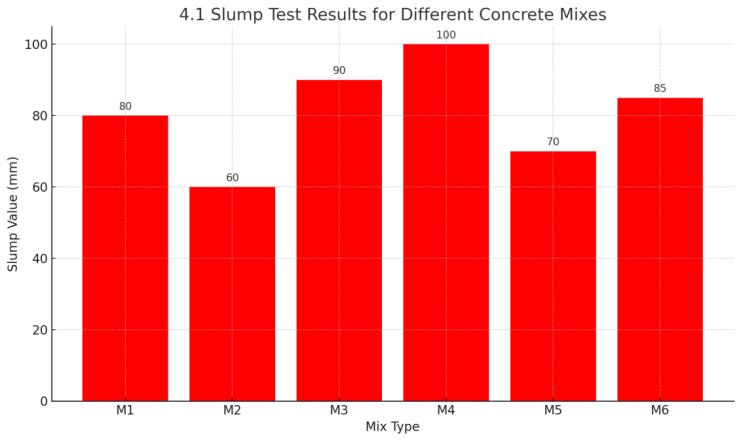
Fig 3.1.1 : Slumpconetestresults
With100mmand95mmslump,respectivelyM3 (PEG1.0%)andM6(PEG1.0%+WaterCuring)also showedgoodworkability;M4(PEG1.5%)hadthe maximumworkabilityat110mmandshowedgreat flow and simplicity of installation resulting from PEG'slubricatingaction.
M5 mix had a small slump (90 mm), since SAP absorbswaterandswells,somewhatthickeningthe mix.
Typical formedium workabilityconcrete,M1and M2 conventional mixes showed lower slump values(80–82mm).
Volume: 13 Issue: 04 | Apr 2026 www.irjet.net p-ISSN:
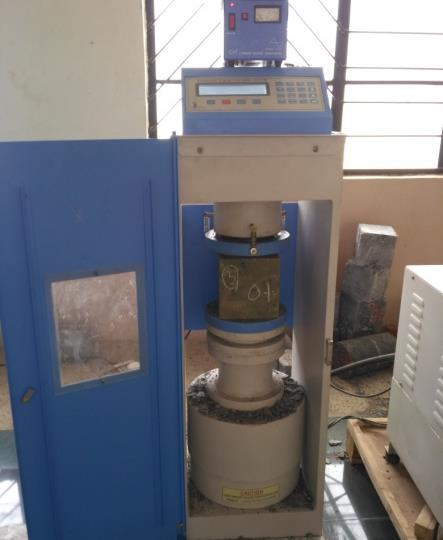
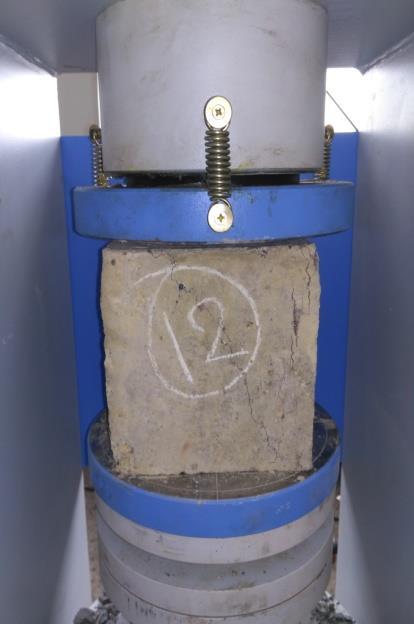
Fig 3.2.1 : Compressivestrengthtesting
Table 3.2.1 : Compressivestrengthtestresults
M1
M3
As per expectations for M30–M40
Lowerstrengthduetono curing
Slightly lower than M1, butacceptable M4
Closely matches conventionalstrength
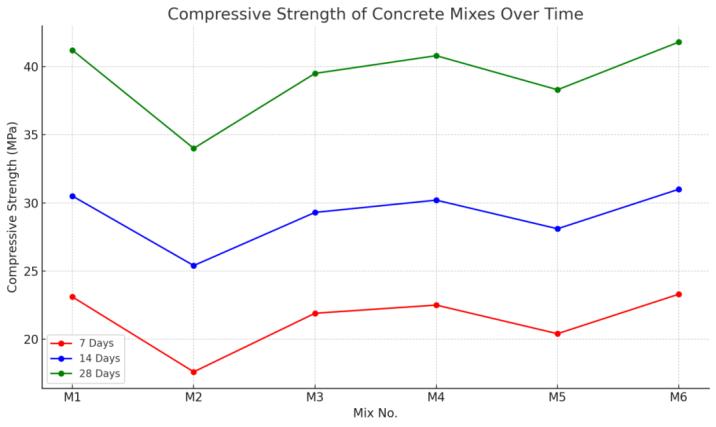
Fig 3.2.2 : Compressivestrengthtestresults
M5
M6
M1 (Conventional + Water Curing) and M6 (PEG 1.0% + Water Curing) respectively showed top marks with respective 28-day compressive strengthsof41.2MPaand41.8MPa.
closelyfollowedwith40.8MPaM4(PEG1.5%)and said that increasing PEG dosage helped to effectivelyretainhydration.
M3(PEG1.0%)andM5(SAP0.2%)showedrather lowerstrength(about39.5MPaand38.3MPa),still withinreasonablebounds.
Frominsufficienthydrationeitherinsideoroutside cured,M2(NoCuring)showedtheloweststrength of34.0MPa.
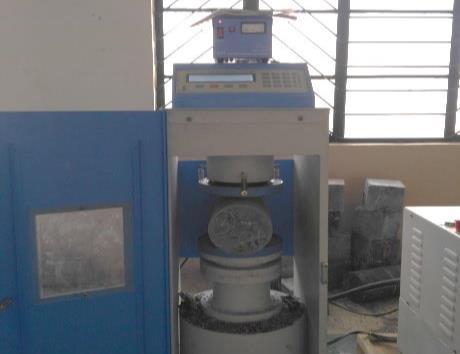
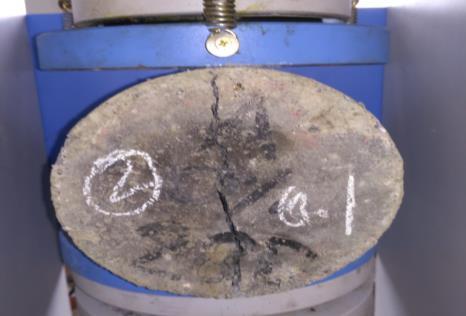
Fig 3.3.1 : Splittensilestrengthtesting
International Research Journal of Engineering and Technology (IRJET) e-ISSN: 2395-0056
Volume: 13 Issue: 04 | Apr 2026 www.irjet.net p-ISSN: 2395-0072
Table 3.3.1 :SplitTensileStrengthtestresults
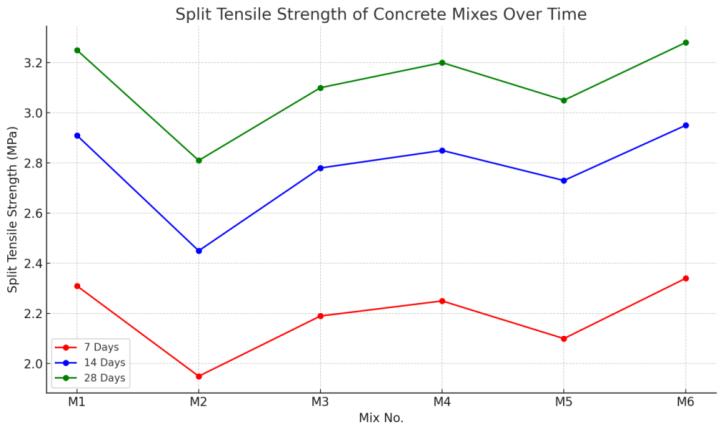
Fig 3.3.1 : SplitTensileStrength test results
M6(PEG+WaterCuring)andM1(Conventional+ Water Curing) once more had the highest tensile strengths around 3.28 MPa and 3.25 MPa respectivelyat28days.
Slightlybetter(3.20MPa)thanSAP(M5)PEG1.5% (M4)PEG1.0%(M3)
Withatensilestrengthof2.81MPa,M2(NoCuring) underlinedhowmuchabsenceofcuringinfluences crackresistance.
3.4 Flexural Strength Test
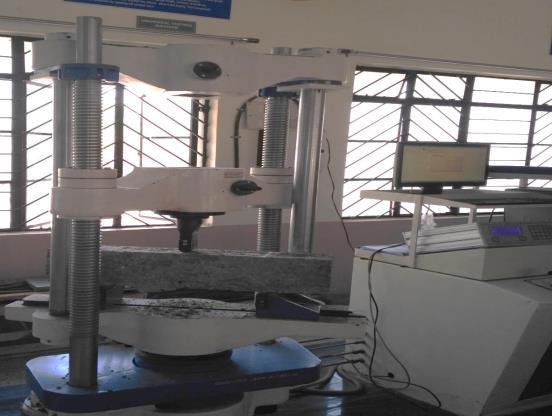
3.4.1
Table 3.4.1 : Flexuralstrengthtestresults
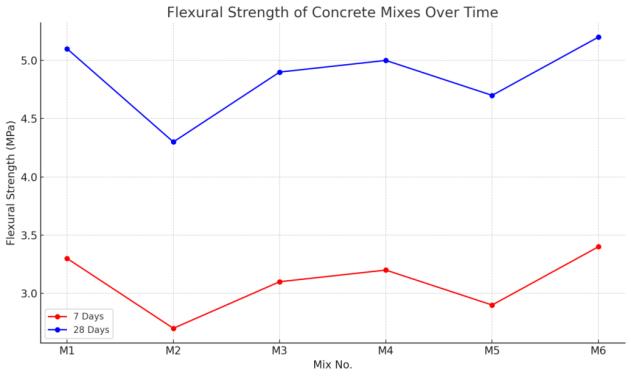
Fig 3.4.1 : FlexuralStrengthtestresults
Flexural strength developed in line with compressivestrength.
M6 and M1 showed respectively the best values withcorresponding28-dayreadingsof5.2MPaand 5.1MPa.
ResultswithPEG-basedmixes(M3andM4)ranged somewhatlowerbutstillrathergood(4.9–5.0MPa).
SAP mix (M5) performed rather well at 4.7 MPa, indicating sufficient hydration but less tensile resiliencethanPEG.
Once more lagging behind at 4.3 MPa is M2 (no curing).
Table 3.5.1 : Waterabsorptiontestresults
Mix No. Water Absorption (%)
M1 4.5
M2 5.8
Remarks
Normalabsorption
Highduetopoorhydration
M3 4.2 PEGreducesearlydrying
M4 4.0
M5 3.9
Improvedinternalcuring
SAP stores and slowly releases water
M6 4.3 Water + PEG gives optimal absorption
International Research Journal of Engineering and Technology (IRJET) e-ISSN: 2395-0056
Volume: 13 Issue: 04 | Apr 2026 www.irjet.net p-ISSN: 2395-0072
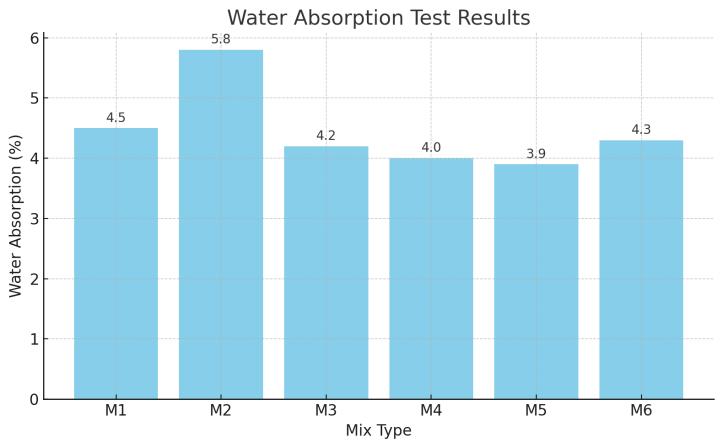
Fig 3.5.1 : Waterabsorptiontestresults
SAPmix(M5)showedgreatmoistureretentionbut thelowestabsorption rate(3.9%),whenpolymer swelling.
PEG-based mixes also shown reduced water absorption: M4 at 4.0%, M3 at 4.2%, and M6 at 4.3%,soindicatingtheirinternalcuringefficiency.
M1 (water cure) absorbed rather moderately at 4.5%.
M2 (No Curing) suggested larger voids and poor matrixdensityresultingfromlackofhydrationwith amaximumabsorptionof5.8%.
EspeciallyPEG400andSAP,self-curingcompounds helptosignificantlyimproveconcrete'sworkability, strength,anddurability.
The SAP-based mix (0.2%) showed remarkable water retention qualities, so lowering water absorptionandincreasingdurabilitybyraisingthe concrete's resistance to environmental elements; PEG 400 at 1.0% and 1.5% by weight of cement shownnotablegainsincompressivestrength,split tensile strength, and flexural strength when comparedtoordinaryconcrete.
Water curing and self-curing (PEG 400) showed almost exact performance in strength tests, so demonstratingthatthesesustainableandefficient alternatives for traditional water curing are feasible.
Thelowestperformancecamefromnocuring(M2), thus stressing the need of enough curing in the concrete hydration process; PEG 400 improves workability, according the slump test; SAP somewhatreducesitbecauseofwaterabsorption.
Self-curingmethodscansignificantlyreducewater usage in areas with limited resources and on big concretebuildingprojects.
Thestudyconfirmsthat,ifonewantsgreatstrength anddurabilitywithminimalenvironmentalimpact, self-curing concrete can be a wise option for modernbuilding.
The results confirm the necessity of curing in obtaining long-term durability and best concrete performance.
This extensive research reveals the possibilities of selfcuring chemicals in delivering premium concrete, so substitutingfortraditionalcuringmethodsandsupporting moreenvironmentallyfriendlybuildingapproaches.
1. Mather,M.,&Warner,R.(2017).Thecriticalfunction of curing in concrete: A review of traditional techniques and alternatives. Cement and Concrete Research,93,53-65.
2. Bentz,D.P.,&Snyder,K.A.(2015).Internalcuringof high-performance concrete using lightweight aggregates: Mechanisms and performance. Cement andConcreteComposites,63,118-127.
3. Cusson, D., & Hoogeveen, T. (2016). The effect of internal curing on high-performance concrete: A comparativestudy withtraditional curing methods. MaterialsandStructures,49(8),3379-3387.
4. Jensen,O.M.,&Hansen,P.F.(2001).Superabsorbent polymers as internal curing agents in concrete. CementandConcreteResearch,31(6),967-972.
5. Raoufi,M.,&Weiss,J.(2015).Moisturetransferand hydrationininternallycuredconcreteusingsaturated lightweightaggregates.JournalofMaterialsScience, 50(12),4620-4632.
6. Lura, P., Jensen, O. M., & Weiss, J. (2006). Internal curing of high-performance concrete: A method to reduceautogenousshrinkage.CementandConcrete Research,36(7),1148-1153.
7. Mehta,P.K.,&Monteiro,P. J.M.(2017).Theroleof curing in concrete durability. Concrete Technology, 12(4),156-162.
8. Aïtcin, P. C. (2000). Curing and hydration of highperformanceconcrete:Advancesincuringmethods. CementandConcreteResearch,30(6),1043-1052.
9. Bentz,D.P.,Garboczi,E.J.,&Sant,G.(2014).Internal curingandthedevelopmentofearly-agecrackingin concrete. Journal of Materials in Civil Engineering, 26(7),0919-0927.
10. Kovler,K.,&Jensen,O.M.(2014).Self-curingsystems for concrete: A review of materials and methods. MaterialsandStructures,47(5),1045-1056.
11. Snoeck, D., & Schlangen, E. (2016). Self-curing characteristics of concrete with superabsorbent polymers.ConstructionandBuildingMaterials,102, 204-213.
12. Castel, A., & Foster, S. J. (2014). Internally cured concrete with lightweight aggregates: Effects on hydration and shrinkage. Cement and Concrete Research,56,1-11.
13. Hasholt, M., Jensen, O. M., & Kovler, K. (2017). Evaluation of superabsorbent polymers and pre-
International Research Journal of Engineering and Technology (IRJET) e-ISSN: 2395-0056
Volume: 13 Issue: 04 | Apr 2026 www.irjet.net p-ISSN: 2395-0072
wettedlightweightaggregatesasself-curingagentsin concrete.MaterialsandStructures,50(4),1231-1241.
14. Kopf, W. J.,&Spragg,R.(2018).The roleofinternal curinginimprovingtheperformanceofbridgedecks in extreme weather conditions. Journal of InfrastructureSystems,24(2),04018015.
15. Lura, P., & Weiss, J. (2015). Early-age cracking in constrained concrete elements with self-curing conditions.CementandConcreteComposites,56,110118.
16. Geiker,M.R.,&Bentz,D.P.(2013).Influenceofselfcuringonself-desiccationandhydrationinflyashand silica fume-based concretes. Cement and Concrete Research,52,65-75.
17. Zhutovsky, Y., & Kovler, K. (2014). Self-curing concrete in hot weather conditions: Lightweight aggregates and curing chemicals. Construction and BuildingMaterials,55,380-388.
18. Snoeck, D., Steuperaert, S., & Van Tittelboom, K. (2016). Self-healing concrete with superabsorbent polymers and fibers: A study on crack closure and long-termdurability.MaterialsandStructures,49(1), 111-124.
19. Raoufi,M.,Bentz,D.P.,&Weiss,J.(2017).Influenceof internal curing on drying shrinkage and hydration heatinthickconcretesections.CementandConcrete Research,92,118-128.
20. Kim,Y.,&Lee,H.(2015).Theapplicationofself-curing chemicals in fast-drying concrete: Effectiveness of SAPs and saturated lightweight aggregates. ConstructionandBuildingMaterials,75,157-165.